“How loud is 60 decibels?”
“My hearing test says 40 dB. Is that a lot?”
A decibel (dB) is a unit that measures how loud a sound is. The bigger the number, the louder the sound. A whisper is about 30 dB, normal conversation is about 60 dB, and a gas-powered lawn mower is around 80 to 85 dB.
But decibels show up in two different places, and that is where many people get mixed up. On a sound level meter, dB tells you how loud a sound is in the world around you. On a hearing test, dB tells you how loud a sound has to be before you can hear it. The same “60 dB” means something different in each case.
This guide explains both in plain language, with no math. If you are new to hearing loss, or you just got a hearing test and want to understand the numbers, you are in the right place.
In this article
- What a decibel is, and why 0 dB is not silence
- How loud everyday sounds are (a simple chart)
- What a 10 dB step really means
- How loud is too loud, and for how long
- What dB means on a hearing test, and how to read an audiogram
- What mild, moderate, and severe hearing loss mean in decibels
- Short notes for readers in Japan
- What Is a Decibel (dB)?
- Everyday Sounds in Decibels
- How Decibels Add Up (10 dB Is a Big Step)
- How Loud Is Too Loud? Level and Time Both Matter
- Decibels on a Hearing Test: What dB HL Means
- What Do Hearing Test Numbers Mean? Degrees of Hearing Loss
- Decibels and Hertz: What Is the Difference?
- TV and Phone Volume Numbers Are Not Decibels
- Frequently Asked Questions
- Summary
- References
What Is a Decibel (dB)?
Length is measured in meters and weight in kilograms. Loudness is measured in decibels.
Sound travels as tiny vibrations in the air. The range between the faintest sound we can hear and a painfully loud one is enormous. A siren at 120 dB carries about a trillion times more sound energy than the faintest sound. Writing numbers that big would be awkward, so the decibel scale squeezes them into a small, easy range, usually between 0 and about 140.
Is 0 dB silence?
No. 0 dB is roughly the faintest sound that a healthy young ear can just barely detect. Even a quiet room is full of sounds above 0 dB. At the other end, sounds around 120 dB are painful to the ear at close range.
Everyday Sounds in Decibels
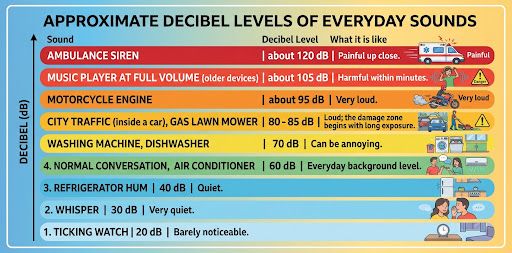
| Sound | About how loud | What it is like |
|---|---|---|
| Ticking watch | 20 dB | Barely noticeable |
| Whisper | 30 dB | Very quiet |
| Refrigerator hum | 40 dB | Quiet |
| Normal conversation, air conditioner | 60 dB | Everyday background level |
| Washing machine, dishwasher | 70 dB | Can be annoying |
| City traffic (inside a car), gas lawn mower | 80–85 dB | Loud; the damage zone begins with long exposure |
| Motorcycle engine | about 95 dB | Very loud |
| Music player at full volume (older devices) | about 105 dB | Harmful within minutes |
| Ambulance siren | about 120 dB | Painful up close |
These are typical examples. Real levels change with distance and setting, and different sources round the numbers a little differently.
A handy way to think about it: use normal conversation (60 dB) as your anchor. Anything quieter is easy on the ears. Anything much louder than a conversation is a sound to be careful with.
How Decibels Add Up (10 dB Is a Big Step)
Here is the part that surprises most people. Decibels do not add up like ordinary numbers. The scale climbs in multiplying steps.
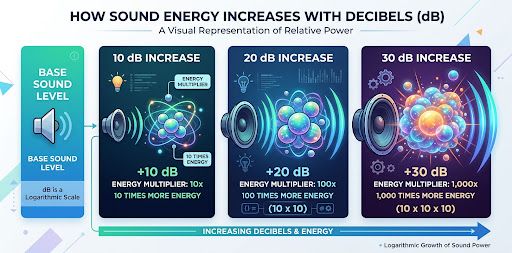
- Every 10 dB increase means about 10 times more sound energy. To your ears, it sounds roughly twice as loud.
- Every 20 dB increase means 100 times more sound energy, and every 30 dB means 1,000 times more.
- A normal conversation (60 dB) carries about 1,000 times the sound energy of a whisper (30 dB). The numbers are only “twice” as far apart.
What happens when two sounds are combined?
Two identical sounds do not double the dB number. They add only about 3 dB. Two 60 dB sounds together make about 63 dB. It takes ten identical sounds to add 10 dB.
How Loud Is Too Loud? Level and Time Both Matter
Whether a sound can harm your hearing depends on two things: how loud it is and how long you hear it. The louder the sound, the less time your ears can handle it.
- Below about 70 dB is generally considered safe, even over long periods.
- At 85 dB or higher, repeated or long exposure can damage the tiny hair cells in the inner ear, which do not grow back. (More in our guide to noise-induced hearing loss.)
- In the workplace, the U.S. National Institute for Occupational Safety and Health (NIOSH) recommends keeping exposure to 85 dBA over an eight-hour shift. For every 3 dB above that, the safe time is cut in half: about 4 hours at 88 dBA, about 2 hours at 91 dBA.
- For headphones, the World Health Organization (WHO) and the International Telecommunication Union (ITU) use 80 dB for up to 40 hours a week for adults, and 75 dB for children. Because each 10 dB cuts the safe time to about one tenth, listening at 90 dB would use up that weekly allowance in around four hours. See headphones and earbuds for practical volume tips.
You do not need to be afraid of every loud moment. Small habits go a long way: turn the volume down, move away from the noise source, take listening breaks, and wear earplugs at concerts or when using power tools. If you notice ringing or muffled hearing after a loud event, give your ears a rest and see tinnitus for what to expect. If it does not fade, or hearing seems different, ask a doctor or audiologist.
Curious how loud your surroundings are? The free NIOSH Sound Level Meter app for iPhone gives a rough reading. A phone is not a calibrated instrument, but it is good enough to spot a very noisy place.
Decibels on a Hearing Test: What dB HL Means
Now for the second use of dB, the one you meet in an audiologist’s office.
In a hearing test, you listen to beeps of different pitches and press a button when you hear them. The test finds the quietest sound you can hear at each pitch. That level is written in dB HL, short for “decibels hearing level.”
- 0 dB HL is the average faintest sound that healthy young adults can hear at each pitch.
- The higher the number, the louder the sound has to be before you hear it. So a higher number means more hearing loss.
For example, if your result is 40 dB HL at one pitch, that sound had to be turned up 40 dB above the “average healthy ear” level before you could hear it.
Why “60 dB” on a hearing test is not “60 dB” in a conversation
Our ears are not equally sensitive to every pitch. We hear mid-range sounds best and need low or very high sounds to be louder just to notice them. So the hearing test does not use one fixed loudness as zero. It sets “0 dB HL” separately for each pitch, at the level an average healthy ear can just hear.
A sound level meter, by contrast, measures the physical strength of the sound itself. That is why the two numbers sit on different scales, and you cannot simply compare them.
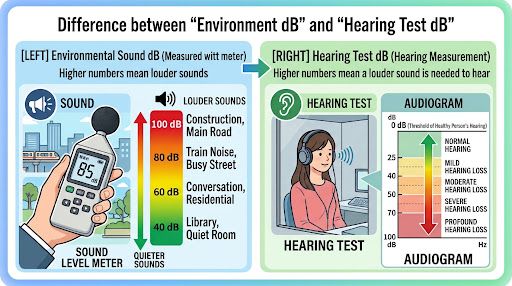
A hearing loss of 60 dB HL does not mean “you cannot hear anything below 60 dB.” It means that, at those pitches, sounds need to be about 60 dB above the average healthy threshold before you notice them. In daily life, that usually means missing parts of normal conversation, especially in noise, unless speech is louder or amplified.
Three kinds of dB you may see
| Term | What it measures | Where you see it |
|---|---|---|
| dB SPL | The physical strength (sound pressure) of a sound | Scientific and technical measurements |
| dBA | Sound level adjusted to how the human ear responds | Sound level meters, workplace and noise guidelines |
| dB HL | How loud a sound must be for you to hear it, compared with average healthy hearing | Hearing tests and audiograms |
If you are reading a noise guideline, you will usually see dBA. If you are reading your hearing test result, you will see dB HL.
How to read an audiogram
Your hearing test results are drawn on a chart called an audiogram.
- Horizontal axis: pitch, from low sounds on the left to high sounds on the right.
- Vertical axis: hearing level in dB HL. 0 dB is at the top, and numbers get larger as you go down. Lower on the chart means quieter sounds were not heard, so hearing is worse.
- Symbols: the right ear is usually marked with an O and the left ear with an X.
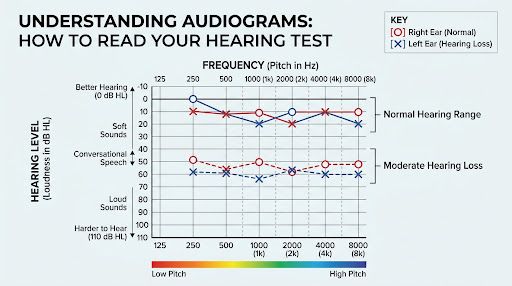
If your marks sit near the top of the chart, your hearing is in the typical range. The lower they drop, the greater the loss at that pitch. A line that slopes downward to the right is common: it means high-pitched sounds are harder to hear.
What Do Hearing Test Numbers Mean? Degrees of Hearing Loss
Audiologists describe the average of your results as a degree of hearing loss. One commonly used scale comes from ASHA, the American Speech-Language-Hearing Association.
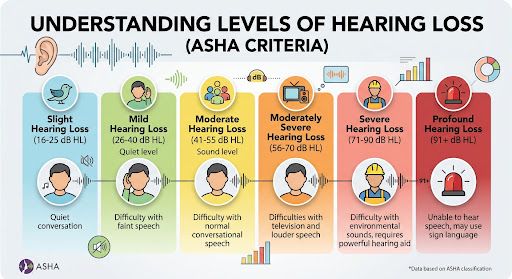
| Degree | Hearing level | What it can feel like |
|---|---|---|
| Typical hearing | −10 to 15 dB HL | No difficulty |
| Slight | 16–25 dB HL | Soft or distant speech can be missed |
| Mild | 26–40 dB HL | Quiet speech and noisy conversations are harder to follow |
| Moderate | 41–55 dB HL | Normal conversation is hard to follow; hearing aids are often considered |
| Moderately severe | 56–70 dB HL | Speech is missed unless it is loud or very close |
| Severe | 71–90 dB HL | Loud speech is hard to understand |
| Profound | 91 dB HL or more | Even loud sounds may not be heard |
A few things worth knowing:
- Different organizations draw the lines a little differently. The WHO’s 2021 report, for example, counts hearing better than 20 dB HL as typical and describes mild loss as 20 to under 35 dB, moderate as 35 to under 50 dB, and so on, using the average of four pitches in the better ear. The overall picture is the same.
- The number does not tell the whole story. Two people with the same dB HL can have very different daily struggles. With sensorineural hearing loss, for example, the problem is often clarity, not just volume. See sensorineural hearing loss.
- My wife is a good example. She has a sensorineural hearing loss of about 60 dB HL and uses hearing aids. On the ASHA scale above, that falls in “moderately severe”; on Japan’s scale (see the box below), the same hearing is called “moderate.” The labels differ, but what matters is the question “In which situations do I struggle?”
If you are wondering whether your numbers mean you need hearing aids, our guide on who needs hearing aids and when to get checked walks through it, and What Is a Hearing Aid? covers the basics.
Decibels and Hertz: What Is the Difference?
You will also see Hz (hertz) on your audiogram. Hertz measures pitch, not loudness. A bigger Hz number means a higher-pitched sound. People can typically hear from about 20 Hz to 20,000 Hz, and hearing tests usually check pitches from about 250 to 8,000 Hz, the range that matters most for speech. So a test result such as “40 dB HL at 4,000 Hz” means: at a high pitch, the quietest sound you heard was 40 dB above average.
TV and Phone Volume Numbers Are Not Decibels
“Dad keeps the TV on volume 30.” You may hear this a lot, but the number on a TV, phone, or music player is not in decibels. It is simply the manufacturer’s own scale. Volume 30 on one device can be quieter than volume 20 on another, and room size and speaker position change what you hear. If the TV volume is a daily struggle in your home, see speakers designed to make dialogue clearer.
→ Learn more about dB in headphone specs, equalizers, and volume meters
Living in Japan?
- Classification: Japan uses the Japan Audiological Society classification (2014), based on the average hearing level: mild 25 to under 40 dB, moderate 40 to under 70 dB, severe 70 to under 90 dB, and profound 90 dB or more.
- Workplace noise: Japan’s Ministry of Health, Labour and Welfare asks employers to take noise-reduction measures and provide hearing protection in places at or above 85 dB.
- Disability certificate and support: certain levels of hearing loss qualify for a Physical Disability Certificate and for hearing aid support. See the certificate guide and hearing aid subsidies in Japan.
- Rules change, so please confirm with your city office. (Information as of November 2026.)
Frequently Asked Questions
What decibel level is harmful to hearing?
It depends on both loudness and time. Sounds at or above 85 dB can harm hearing with long or repeated exposure, and the louder the sound, the less time it takes. Below about 70 dB is generally considered safe.
Is 0 dB silence?
No. 0 dB is roughly the faintest sound a healthy young ear can just hear. It is not the absence of sound.
Is a 60 dB hearing loss the same as a 60 dB conversation?
No. They are on different scales. A 60 dB HL loss means that sounds at certain pitches must be about 60 dB louder than the average healthy threshold to be heard. A 60 dB conversation is a measurement of how strong the sound is.
What is a normal hearing level in dB?
On an ASHA-style scale, typical hearing is up to 15 dB HL. The WHO’s 2021 scale uses a limit of under 20 dB HL. Either way, your audiologist will tell you how your own results compare.
Does 20 dB sound twice as loud as 10 dB?
No. Every 10 dB increase is about 10 times more sound energy and sounds roughly twice as loud to the ear. A 20 dB sound is far more than twice the energy of a 10 dB sound.
What is the difference between decibels and hertz?
Decibels (dB) measure loudness. Hertz (Hz) measure pitch. A hearing test checks how loud each pitch has to be before you hear it.
Summary
- A decibel (dB) measures loudness. A whisper is about 30 dB, normal conversation about 60 dB, and a siren about 120 dB.
- 0 dB is not silence. It is about the faintest sound a healthy young ear can detect.
- Every 10 dB is about 10 times more sound energy, and it sounds roughly twice as loud. Two identical sounds add only about 3 dB.
- Both loudness and time matter. Long exposure to 85 dB or more can harm hearing, and 80 dB for up to 40 hours a week is the WHO-ITU guide for headphones.
- On a hearing test, dB HL shows how loud a sound must be for you to hear it. The higher the number, the more hearing loss. It is a different scale from the dB of everyday sounds.
- If you are unsure about your hearing, a hearing test with a doctor or audiologist is the best first step.
Numbers can look intimidating, but they are just a way of describing what you hear. Take your results one step at a time, and ask your audiologist to walk you through them.

コメント