This article reflects the system in Japan as of November 2026. Criteria and procedures can change, so please confirm the details with the disability welfare office of your local municipal government before you apply.
“I hear well with one ear, but almost nothing with the other. Can I get a disability certificate in Japan?”
If you or someone close to you has hearing loss in one ear, you may be wondering the same thing.
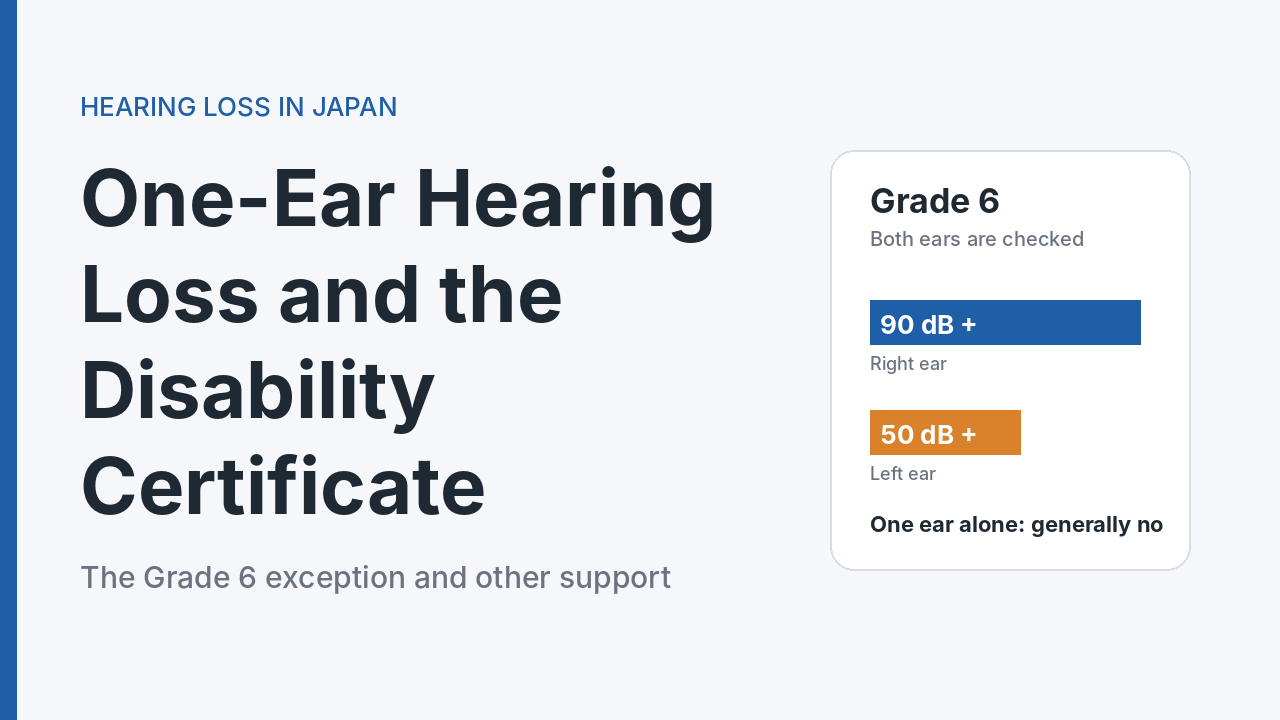
The short answer: hearing loss in only one ear generally does not qualify for the Physical Disability Certificate (身体障害者手帳, shintai shōgaisha techō) for hearing impairment in Japan. There is one exception. If you have 90 dB or more in one ear and 50 dB or more in the other, you meet the Grade 6 criteria. In that case, though, both ears are affected.
This article explains why, shows the exception with examples, and then covers the help you can use without a certificate. This article is about Japan’s system. Other countries use different rules. For the full grade table and how to apply, see our Physical Disability Certificate guide.
In this article
- Why one-ear hearing loss generally does not qualify
- The Grade 6 exception, with six examples
- How the hearing level is measured
- What to do if you suddenly lose hearing in one ear
- How other countries treat one-ear hearing loss
- Support you can use without a certificate
- When it is worth asking about an application
- FAQ
- Can You Get a Disability Certificate for Hearing Loss in One Ear in Japan?
- The Exception: 90 dB in One Ear and 50 dB in the Other
- If You Suddenly Lose Hearing in One Ear
- How Do Other Countries Treat One-Ear Hearing Loss?
- Support You Can Use Without a Certificate
- When to Ask About an Application
- FAQ: One-Ear Hearing Loss and the Disability Certificate in Japan
- Summary: One-Ear Hearing Loss Alone Is Generally Not Covered, but Help Exists
- References
Can You Get a Disability Certificate for Hearing Loss in One Ear in Japan?
Generally, no. The criteria for the certificate are set by the national government and are the same across Japan. They are based on the hearing level of both ears.
If only one ear is affected and the other ear hears normally, the criteria are not met. This is true even when the affected ear can hardly hear at all.
That does not mean one-ear hearing loss is easy to live with. Many people with it struggle to tell where a sound is coming from, to follow a conversation in a noisy place, or to notice someone speaking on their weaker side. The condition is also invisible, so others often do not realize. Hearing loss in one ear is often less recognized in public systems than hearing loss in both ears, and many people feel the system does not fit them well.
The good news is that a certificate is not the only route to support. Later in this article we cover what you can use without one.
The Exception: 90 dB in One Ear and 50 dB in the Other
Grade 6 is the lowest of the four grades for hearing impairment in Japan. It has two criteria:
- 70 dB or more in both ears, or
- 90 dB or more in one ear and 50 dB or more in the other
The second criterion is the one that matters for people with a very weak ear. But it still requires hearing loss in the other ear. Having one ear at 90 dB or more is not enough on its own.
For reference, 50 dB falls in the “moderate” range in Japan’s classification (Japan Audiological Society, 2014: 40 dB or more, less than 70 dB). If your better ear is only “a little hard to hear” and below 50 dB, the exception does not apply.
Six Examples
The numbers below are for illustration only. They are the average hearing level of each ear (explained in the next section).
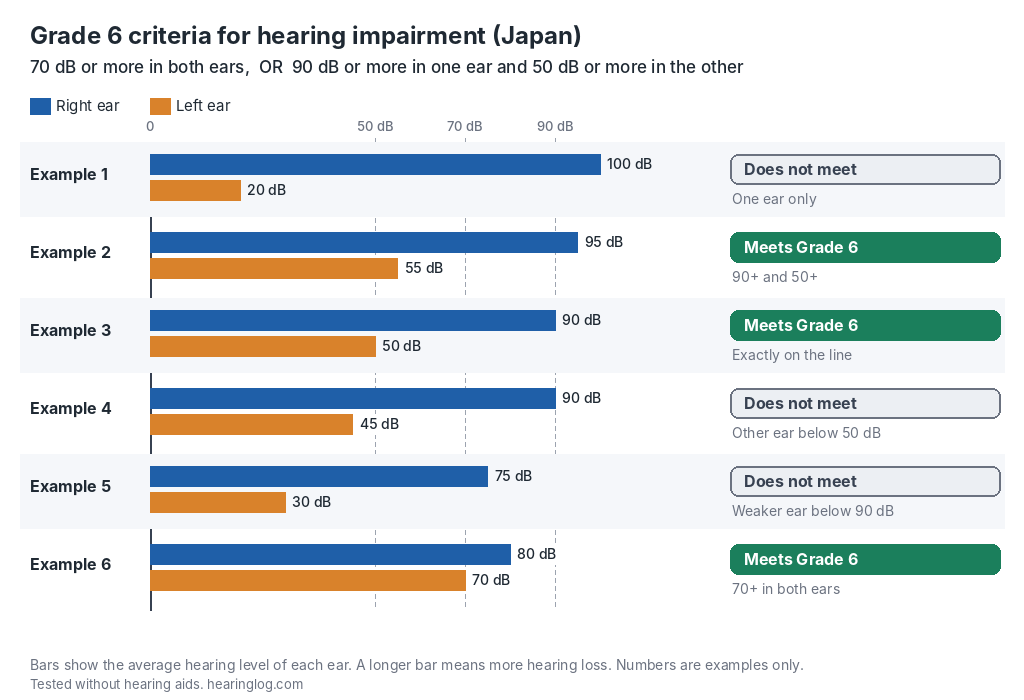
- Example 1: right ear 100 dB, left ear 20 dB. Does not meet the criteria. This is hearing loss in one ear only.
- Example 2: right ear 95 dB, left ear 55 dB. Meets Grade 6 (90 dB or more in one ear, 50 dB or more in the other).
- Example 3: right ear 90 dB, left ear 50 dB. Meets Grade 6. This is exactly on the line.
- Example 4: right ear 90 dB, left ear 45 dB. Does not meet the criteria. The other ear is below 50 dB.
- Example 5: right ear 75 dB, left ear 30 dB. Does not meet the criteria. The weaker ear is below 90 dB, and the other ear is mild.
- Example 6: right ear 80 dB, left ear 70 dB. Meets Grade 6, because both ears are 70 dB or more. Grade 4 would need 80 dB or more in both ears, so this does not reach it.
How the Hearing Level Is Measured
The “dB” in the criteria is not a single number read off your hearing test. It is an average of three test frequencies: 500 Hz, 1,000 Hz and 2,000 Hz, calculated for each ear. The 1,000 Hz value is counted twice.
Average hearing level = (500 Hz value + 1,000 Hz value × 2 + 2,000 Hz value) ÷ 4
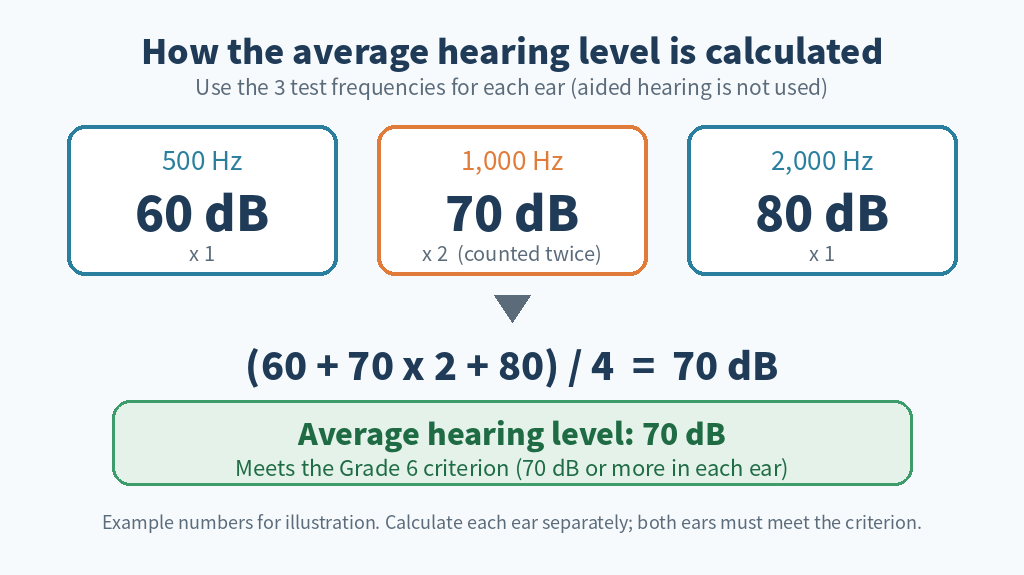
The test is done without hearing aids, generally in a soundproof room. If you hear well with hearing aids, you are still judged on your hearing without them. Using hearing aids does not stop you from qualifying.
This is a rough guide only. The grade is decided by a designated physician and the local government’s review.
If You Suddenly Lose Hearing in One Ear
If you wake up and one ear suddenly cannot hear, see an ear, nose and throat (ENT) doctor as soon as possible. Think about the certificate later. With sudden hearing loss, starting treatment early can matter for recovery.
The certificate is for a disability that is expected to be permanent. While your hearing may still change, treatment comes first. Once your hearing has settled, you can ask a designated physician about your situation.
How Do Other Countries Treat One-Ear Hearing Loss?
Japan is not alone in judging hearing loss by both ears or by the better ear. Systems abroad differ a lot, and many have no single “certificate” like Japan’s. These are examples, not a complete list:
- United States, Social Security disability benefits: the hearing listing looks at the better ear. A person with good hearing in one ear, or only mild loss, is not expected to meet it, even if the other ear is deaf. These benefits are for people who cannot work.
- United States, veterans’ disability ratings: if hearing loss is service-connected in only one ear, the other ear is generally treated as having normal hearing when the rating is calculated. The exception is when the service-connected ear is rated at 10 percent or more and the other ear has its own hearing loss that meets VA’s standard. Then both ears can be considered.
- United States, anti-discrimination law (ADA): the EEOC guidance on hearing conditions does not set a dB cutoff or single out one-ear loss. The test is whether a condition substantially limits a major life activity, and the benefit of hearing aids is not counted. This gives you a right to reasonable accommodation at work, not a benefit.
The pattern is similar. Benefit systems tend to look at the better ear, or to treat the other ear as normal, so hearing loss in one ear alone usually receives a low rating or none. The details depend on the country and the program, so check with the authority where you live. If you live in Japan, the criteria above apply.
Support You Can Use Without a Certificate
Not qualifying does not mean there is no help. These are the main options.
Local Hearing Aid Subsidies
Some municipalities help pay for hearing aids for children with mild or moderate hearing loss who do not qualify for the certificate.
- Most programs focus on children, and many have an upper age limit (often under 18).
- Conditions differ by municipality. Some require hearing loss in both ears above a set level. Some also accept hearing loss in one ear only.
- You often need to apply before you buy.
- Subsidies for adults without a certificate are limited to a small number of municipalities.
Ask the disability welfare office or health center in your municipality whether a subsidy exists and whether one-ear hearing loss is covered. For people who do hold a certificate, a national system covers part of the cost of a hearing aid. We explain it in our hearing aid subsidy guide.
Reasonable Accommodation at Work and School
Since April 2024, businesses in Japan have been required by law to provide “reasonable accommodation” for people with disabilities, when asked and when the burden is not excessive. You can ask for accommodation without holding a certificate.
For one-ear hearing loss, requests like these often help:
- A seat where your better ear faces the speaker
- Important information in writing as well as out loud
- Getting your attention first (from your better-hearing side, or a light tap on the shoulder) before speaking
- Talking in a quiet place when the conversation is important
For a child, telling the teacher which ear hears better and sitting near the teacher can make a large difference. Some children also use a remote microphone system that sends the teacher’s voice directly to them.
Everyday Tools and Strategies
- Seating and quiet places: choose where you sit, and pick a quieter table. See our guide to unilateral hearing loss for more everyday tips.
- Hearing aids and CROS: if the weaker ear still has some usable hearing, a hearing aid may help. A CROS system sends sound from the weaker side to the better ear. See our guide to hearing aids.
- Captions and speech-to-text: useful in meetings and online calls. For other ways to get text in real time, see our guide to live captioning.
- Cochlear implants: in 2024 the Japanese Otological Society published criteria for cochlear implants in severe hearing loss in one ear. In February 2026, a cochlear implant for this use was approved in Japan. Eligibility is limited, and conditions and costs should be confirmed with an ENT specialist. See our guide to cochlear implants.
When to Ask About an Application
If the other ear also has hearing loss, you may meet the criteria. Consider asking your municipal office or an ENT doctor if:
- both ears have hearing loss and each is 70 dB or more, or
- one ear is 90 dB or more and the other is 50 dB or more, or
- the hearing in your better ear has been getting worse
The usual steps are:
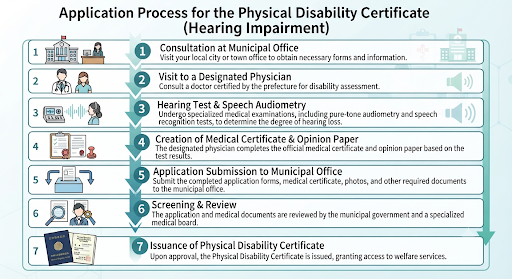
- Consult the disability welfare office of your municipality
- See a designated physician for testing
- Have the medical certificate and opinion form prepared
- Submit the application
- After the review, the certificate is issued
From application to certificate usually takes about one to two months, and it varies by municipality. For documents and details, see the full guide linked at the top of this article.
FAQ: One-Ear Hearing Loss and the Disability Certificate in Japan
I Am Completely Deaf in One Ear. Can I Get a Certificate?
If the other ear hears normally, generally no. If the other ear also has hearing loss of 50 dB or more, you meet the Grade 6 criteria.
One Ear Is 70 dB and the Other Hears Normally. Do I Qualify?
No. Grade 6 needs either 70 dB or more in both ears, or 90 dB or more in one ear and 50 dB or more in the other.
What if I Use a Hearing Aid?
The test is done without hearing aids. Using one does not affect the criteria.
What if My One-Ear Hearing Loss Started Suddenly?
See an ENT doctor first. Once your hearing has settled, ask a designated physician.
Is There Help for Adults Without a Certificate?
Local subsidies for adults are limited to a small number of municipalities. Ask yours. Reasonable accommodation at work does not require a certificate.
Will One-Ear Hearing Loss Qualify in the Future?
We have not seen any announced change. Rules can change, so check with your municipal office before you apply.
Summary: One-Ear Hearing Loss Alone Is Generally Not Covered, but Help Exists
- In Japan, the certificate for hearing impairment is based on both ears. Hearing loss in one ear alone generally does not qualify.
- The exception is 90 dB or more in one ear and 50 dB or more in the other (Grade 6). 70 dB or more in both ears also qualifies for Grade 6.
- The test is done without hearing aids, using the average of 500, 1,000 and 2,000 Hz.
- If hearing suddenly drops in one ear, see an ENT doctor before thinking about a certificate.
- Without a certificate, you can still use local hearing aid subsidies (mostly for children), reasonable accommodation, and everyday tools such as hearing aids, CROS and captions.
If you are not sure where you stand, start by asking an ENT doctor or the disability welfare office of your municipality.
References
- Ministry of Health, Labour and Welfare, “Physical Disability Certification Standards” (hearing and balance disabilities) / Act on Welfare of Physically Disabled Persons, Enforcement Regulations, Appended Table No. 5
- Japan Audiological Society, classification of the degree of hearing loss (2014)
- Japanese Otological Society, cochlear implant criteria for severe unilateral hearing loss (2024)
- Cochlear Japan, notice of approval of cochlear implants for unilateral and asymmetric hearing loss (2026)
- Municipal subsidies for children with mild to moderate hearing loss: Shimane Prefecture, Uruma City (one-ear hearing loss included from April 2024)
- ASHA, Degree of Hearing Loss
- U.S. Social Security Administration, Listing of Impairments 2.10, Hearing Loss Not Treated With Cochlear Implantation
- Code of Federal Regulations, 38 CFR 4.85 and 38 CFR 3.383 (VA rating of hearing loss in one ear)
- U.S. Equal Employment Opportunity Commission, Hearing Disabilities in the Workplace and the Americans with Disabilities Act


コメント