
What you’ll learn
- How to tell whether hearing aids might help you
- Everyday signs that it is time to get your hearing checked
- How hearing levels relate to hearing aids
- Who can wait, and what to do in the meantime
- Who to see first, and what to expect with cost
- How to talk to a family member who may be struggling to hear
“I keep asking people to repeat themselves lately.”
“Should I get hearing aids, or is it too early?”
Hearing aids are not something everyone with a little trouble hearing needs. At the same time, many people put up with real difficulty because they tell themselves it is just part of getting older, or not bad enough to worry about yet.
This article walks through a few simple ways to think about it. Whether you are wondering about yourself or someone you love, I hope it helps you decide on a next step.

- The Short Answer: Look at Daily Life, Not Just Numbers
- Signs You Might Need Hearing Aids
- Hearing Levels and Hearing Aids
- Who Can Wait
- Benefits, and Getting Used to Them
- Who to See First
- Cost and Help With Paying
- If You Are Not Sure: Other Ways to Help
- If You Think a Family Member Is Struggling to Hear
- Living in Japan? A Few Things That Work Differently
- Key Takeaways
The Short Answer: Look at Daily Life, Not Just Numbers
Whether you need hearing aids is not decided by a hearing test number alone. What matters most is whether hearing is getting in the way of everyday life.
- Struggling with conversations, phone calls, or meetings? It may be a good time to look into hearing aids.
- Not having trouble right now? There is no need to start using them. It still helps to check your hearing from time to time.
Either way, a hearing test can give you a clear picture of where you stand. That is a useful thing to know, even if the answer is no hearing aids for now.
Signs You Might Need Hearing Aids
If several of these sound familiar, it may be time to get your hearing checked.
- You often ask people to repeat themselves
- Group conversations or noisy places such as restaurants are hard to follow
- Voices on the phone are hard to understand
- You lose the thread in meetings
- Family members say the TV is too loud
- You do not notice when someone calls you from behind
- Talking with people has started to feel tiring, so you do it less
Hearing usually changes slowly, so the person themselves is often the last to notice. If a family member mentions that the TV is loud, it may be your first clue.
One important exception: if your hearing drops suddenly, or you suddenly cannot hear in one ear, do not wait. See a doctor as soon as you can, ideally the same day or the next. Sudden hearing loss is treated as an urgent matter, and early care gives the best chance of recovery. You can read more in Sudden Hearing Loss.
Hearing Levels and Hearing Aids
A hearing test measures the quietest sounds you can hear, in decibels (dB HL), and the results are grouped into degrees of hearing loss. One commonly used scale looks like this.
- Mild (26–40 dB): Soft speech is easy to miss, especially in noisy places. Hearing aids can help in situations that give you trouble, such as meetings.
- Moderate (41–55 dB): Normal conversation is harder to follow. Hearing aids are often a good match.
- Moderately severe (56–70 dB): Speech is often missed, and group conversation takes effort. Hearing aids are usually recommended.
- Severe (71–90 dB): Normal speech is hard to hear without help. Hearing aids are standard care, and a cochlear implant may be discussed if they do not help enough.
- Profound (91 dB and above): Hearing aids may give limited benefit, and cochlear implants are often considered.
※ dB (decibel) is a unit of sound level. The higher the number, the louder a sound must be before you can hear it.
※ These ranges are a rough guide. Different organizations draw the lines slightly differently, and what you actually need depends on your hearing test, your type of hearing loss, and the situations you struggle with.
Even a mild loss can matter if you are missing things that are important to you, such as meetings at work. And two people with the same numbers can find daily life very different.
Who Can Wait
Most of the time, you do not need to start hearing aids right away if:
- You rarely have trouble hearing
- You ask people to repeat themselves now and then, but it does not get in the way of your life or work
- A hearing test shows hearing that is normal for your age, and you are not bothered by it
If you do not feel any trouble, a hearing aid can feel like something is stuck in your ear for no reason. There is no need to push through that discomfort.
That said, hearing changes slowly. A quick hearing check every year or so, perhaps around the time of a routine health visit, makes changes easier to spot.
Benefits, and Getting Used to Them
The biggest benefit of hearing aids is easier conversation. When you are not straining to catch every word, talking with people can feel less tiring, and some people say they have more energy at the end of the day.
Hearing aids do not give you your old hearing back overnight, though. They pick up sound with a tiny microphone and make it louder, so everyday noises get louder too, not just voices. It usually takes a few weeks to a few months to get used to them.
During this time, it helps to go back to your hearing professional for adjustments and to wear them a little longer each day. Many people want to give up at the stage where everything sounds too loud, but adjustments often make a big difference. For the basics, see Hearing Aids: An Overview.
Hearing aids are also used by far fewer people than could benefit from them. The World Health Organization estimates that only about 17% of people who could benefit from a hearing aid actually use one. So if you are wondering whether you are the only one, you are not.
Who to See First
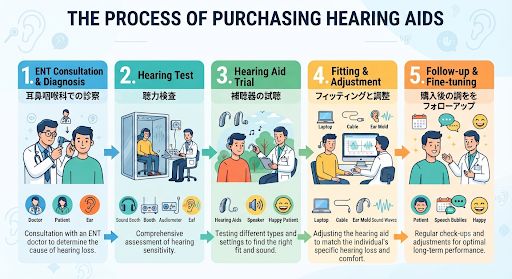
If this is your first time, this order tends to feel easiest.
- Get your hearing checked. Trouble hearing can have many causes, and some, such as earwax, are simple to treat. A doctor or audiologist can check your ears and test your hearing before you buy anything.
- Try hearing aids with a hearing professional. Look for someone who will let you try devices and who is happy to adjust them several times. See How to Choose a Hearing Aid for what to look for.
- Keep adjusting as you go. Plan on follow-up visits after you start.
Hearing aids are not a buy-it-and-forget-it product. They are a tool you fine-tune to your own ears, so it is worth choosing a place where you can keep going back after you buy. Devices bought online or from a TV ad can be harder to adjust to your needs, which is one reason they are less often recommended for a first pair.
Cost and Help With Paying
Rules and prices vary a lot from country to country. In some places the public health system or insurance helps with the cost, and in others you pay most of it yourself. It is worth asking your doctor, insurer, or local health office what is available before you buy.
In the United States, there is also a lower-cost route for some people. Over-the-counter (OTC) hearing aids are FDA-regulated devices that adults can buy without a prescription if they have what the FDA calls perceived mild to moderate hearing loss. They are not meant for children or for more severe hearing loss, so if you are unsure, a hearing check first is still a good idea.
If You Are Not Sure: Other Ways to Help
You may be thinking that hearing aids feel like a lot right now. That is perfectly fine.
A word of caution: personal sound amplifiers, sometimes called PSAPs, are consumer electronics. They are different from hearing aids, are not medical devices, and are not fitted to your hearing. If hearing is a concern, it is better to get a hearing check first.
Meanwhile, a few habits can make listening easier.
- Sit where you can see the speaker’s face
- Talk in a quiet place, and turn off the TV before you start
- For important meetings or conversations, take notes or record them (with permission)
If You Think a Family Member Is Struggling to Hear
Parents and partners often say they are fine, even when they are missing things.
My grandfather was like that. He was from an older generation, and he never wanted to admit his hearing was fading. He said he did not need hearing aids. But he often had trouble joining in at family gatherings, and I remember him looking a little lonely.
Someone who says they are fine may still feel left out when the conversation moves too fast.
For why people push back on hearing aids and how to approach it, see Why Older Adults Refuse Hearing Aids (and How Families Can Help).
Rather than saying you should get hearing aids, try starting with the situations that bother them.
- Ask, “Is the TV hard to follow lately?”
- Offer to go along to a hearing check together
- Do not push. Wait for the right moment
Living in Japan? A Few Things That Work Differently
If you or your parent live in Japan, some details are different.
- Hearing aids are mostly paid out of pocket. Standard public health insurance generally does not cover them.
- A tax deduction may be possible. If an ear, nose and throat doctor registered as a “hearing aid consultation doctor” writes a designated information form, the purchase may qualify for the medical expense deduction. Keep the form (or a copy) and the receipt, and check details with your tax office.
- Some national support exists. Depending on your hearing, you may qualify for support under the Comprehensive Support Act. See Hearing Aid Subsidy in Japan.
- Many cities and wards offer their own subsidies, including for mild and moderate hearing loss that the national system does not cover. Rules differ, so ask your local government office first.
- Look for specialist shops. Japan has a certification for hearing aid specialists and for specialty stores. Seeing an ear doctor first and then a certified shop is a common route.

Key Takeaways
- Whether you need hearing aids depends on whether hearing is causing trouble in your daily life, more than on the numbers.
- If you are asking people to repeat themselves more, or phone calls and meetings are harder, get your hearing checked.
- If you are not having trouble, there is no need to start hearing aids. A hearing check about once a year is a good habit.
- A good order is: hearing check, then a professional who will fit and adjust, then follow-up visits. Expect a few weeks to a few months to get used to them.
- Help with cost varies by country and by situation, so check what is available before you buy.
Hearing aids are not for everyone, but if you notice hearing getting in the way of daily life, it is worth looking into early. Go at your own pace, one step at a time.
References
- American Speech-Language-Hearing Association, Degree of Hearing Loss
- World Health Organization, Deafness (facts in pictures, 2024)
- NIDCD, Sudden Deafness
- NIDCD, Over-the-Counter Hearing Aids
- FDA, OTC Hearing Aids: What You Should Know
- Harvard Health, Tips for getting used to over-the-counter hearing aids
- National Council on Aging, How to adjust to hearing aids
- Japan National Tax Agency, notice on the deduction for hearing aid purchases (2018, Japanese)


コメント