
In this article
- Why hearing can change in both ears at a young age
- Common causes, including sudden hearing loss, loud noise, medicines, and genes
- What genetic hearing loss that starts young can look like
- When to see a doctor, and what tests to expect
- Ways to hear better and cope at work
Hearing loss is often seen as an older person’s problem. But it can start in your 20s or 30s, and it can affect both ears.
The short answer is that there is no single cause. Sudden hearing loss, loud noise, certain medicines, and genes can all play a part, and sometimes no cause is found. One group is genetic hearing loss that begins in childhood or early adulthood and slowly gets worse. Doctors can’t tell which cause is behind your hearing loss from symptoms alone, so the most useful step is a hearing test.
The good news: whatever the cause, there are ways to hear better and make daily life easier. And if your hearing dropped suddenly, don’t wait. See a doctor right away.
- Yes, Hearing Loss Can Happen in Your 20s and 30s
- Common Causes of Hearing Loss in Both Ears at a Young Age
- Genetic Hearing Loss That Starts at a Young Age
- When to See a Doctor, and What to Expect
- Ways to Hear Better
- Work and Daily Life
- What About Your Family and Future Children?
- Living in Japan?
- Frequently Asked Questions
- Summary
- References
Yes, Hearing Loss Can Happen in Your 20s and 30s
Age-related hearing loss usually appears after middle age. So when hearing drops in both ears much earlier, doctors look for other causes.
You might notice:
- You can’t follow conversations in meetings, restaurants, or group chats
- You ask people to repeat themselves, especially on the phone
- Other people say the TV is too loud
- You hear voices but the words sound unclear
- You have ringing in your ears (tinnitus)
If you notice one or more of these in both ears, book a hearing test. It is quick and painless. If you want a broader overview first, our guide to sensorineural hearing loss explains the most common type.
Common Causes of Hearing Loss in Both Ears at a Young Age
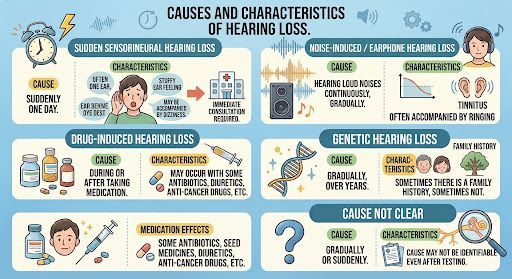
The cause often shows in how the hearing loss started. Here are the main possibilities.
- Sudden hearing loss: It comes on overnight or over a few days. It usually affects one ear, but it can affect both, and it needs urgent care.
- Loud noise: It builds up gradually after repeated exposure and often comes with ringing in the ears. Protecting your ears matters.
- Medicines: It can appear during or after treatment. Some antibiotics, cancer drugs, and strong water pills can affect hearing.
- Genes: It changes slowly, over years, and may or may not run in the family.
- Other health conditions: For example, inner ear disorders such as Ménière’s disease.
- Unknown cause: Even after testing, sometimes no cause is found.
You can read more about sudden hearing loss and noise-induced hearing loss in their own guides.
A few notes on medicines. Drugs known to affect hearing include some antibiotics (aminoglycosides), the cancer drug cisplatin, and loop diuretics. The risk depends on the dose, how long you take them, and your health. If you take any of these, don’t stop on your own. Ask your prescriber about your concerns first. We explain this in drug-induced hearing loss.
You can’t tell the cause from the outside. If your hearing dropped suddenly, don’t wait and see.
Genetic Hearing Loss That Starts at a Young Age
Some people have changes in genes that are involved in hearing. More than 125 genes have been linked to hearing loss that isn’t part of a wider syndrome. When hearing loss begins after a child has learned to speak, the most common pattern is “autosomal dominant.” That means a change in just one copy of a gene can be enough to cause it.
Doctors describe this kind of hearing loss as usually:
- In both ears
- Starting in childhood or early adulthood
- Affecting high-pitched sounds first
- Slowly getting worse, at a pace and to a degree that varies a lot from person to person
The details depend on the gene. For example, one well-studied form, called DFNA2, usually starts in childhood or the teen years. It affects high pitches first, then more pitches over time, at roughly 1 decibel per year in many families. Other forms start later or move faster.
Many people with this pattern have a parent with hearing loss, but not everyone does. Genetic testing can sometimes find the gene behind it, and sometimes it can’t. A test that finds nothing doesn’t mean your hearing loss isn’t real. For testing basics, see our guide to genetic testing for hearing loss.
Reading this may feel heavy. Please remember that the pace and final degree of hearing loss vary widely. Having a genetic cause doesn’t mean your hearing will go quickly, and hearing aids and other support help many people. Knowing early gives you more choices.
What it can sound like
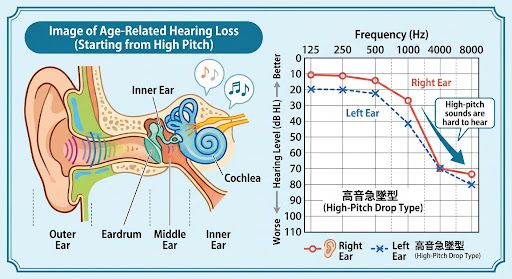
When high-pitched sounds fade first, people often say, “I can hear you, but I can’t make out the words.” Many consonants, such as s, f, th, t, and k, are higher pitched than vowels. So speech can sound muffled, especially with background noise or several people talking. Some people also notice ringing in the ears or, less often, dizziness.
When to See a Doctor, and What to Expect
If hearing drops suddenly, treat it as an emergency. The U.S. National Institute on Deafness and Other Communication Disorders (NIDCD) says to see a doctor immediately for sudden hearing loss. It often affects only one ear, but it can affect both, so don’t assume it will pass. Prompt treatment can improve your chances of getting hearing back.
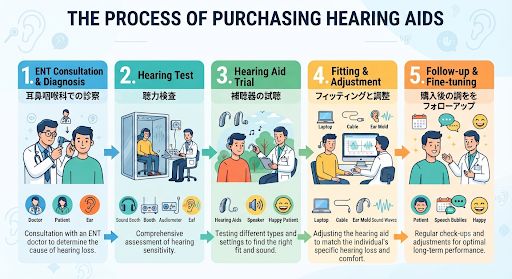
If it is gradual, book an appointment with an audiologist or an ear, nose, and throat (ENT) doctor.
What you may have done:
- Pure-tone hearing test (audiogram): finds which pitches you hear and how softly. It also shows whether hearing changes over time.
- Speech test: checks how well you understand words.
- Other tests, if needed: scans or blood tests to look for other causes, and genetic testing with a specialist if a genetic cause is suspected.
It helps to bring:
- Any past hearing test results (school, work, or newborn screening)
- A list of your medicines
- What you know about family members with hearing loss, such as when it started
Ways to Hear Better
There is no cure for most genetic hearing loss yet
Right now, support focuses on helping you hear. Researchers are working on treatments such as gene therapy. The first clinical successes have been in children with changes in one specific gene (OTOF), and most causes of progressive hearing loss in adults don’t have an approved gene treatment yet. Read more in our article on gene therapy for hearing loss.
Hearing aids
Hearing aids can help at any age. A good fit matters, especially for high-pitched loss, so work with a hearing professional who can adjust them as your hearing changes. If you’re not sure you need them yet, our guide on who needs hearing aids can help you decide, and the hearing aid overview explains how they work.
Cochlear implants
If hearing aids no longer give enough clarity, a hearing professional may talk with you about a cochlear implant. Some systems combine a hearing aid and an implant in the same ear. They use the hearing you still have for lower pitches and the implant for higher ones.
Work and Daily Life

Small changes can make a big difference.
Meetings
- Ask for the agenda or slides ahead of time
- Sit where you can see people’s faces. Lip movements help.
- Use live captions or transcription on your phone or computer, and turn on captions in video calls
For important meetings, you can also ask for a trained captioner. Our guide to live captioning for hearing loss explains the options and how to request them.
Phone calls
- Ask people to use email or chat for key details
- Captioned phone services show the other person’s words as text. In the U.S., for example, a free service called IP CTS is available for people with hearing loss. Availability varies by country.
Telling your employer or school
Sharing your hearing loss takes courage, but it helps others support you. Many countries protect this right. In the U.S., for example, employers with 15 or more employees generally must provide reasonable accommodations under the Americans with Disabilities Act, and the Job Accommodation Network (AskJAN.org) offers free guidance. You could say:
- “It helps me when you face me and speak at a normal pace.”
- “Could you also send important points by email or chat?”
If you worry it may get worse: talk with your audiologist early about options, and plan ahead for your work and hearing devices.
What About Your Family and Future Children?
It’s natural to wonder whether your hearing loss can be passed on. It depends on the gene and how it is inherited, and it doesn’t always pass to children. A genetic counselor can explain what it means for you. Our guide on how hearing loss is inherited explains the basics.
Living in Japan?
Japan lists “juvenile-onset bilateral sensorineural hearing loss” as a designated intractable disease (No. 304), run by the Ministry of Health, Labour and Welfare. In Japanese it is called 若年発症型両側性感音難聴. The diagnosis is rare and has three conditions:
- Hearing loss began before age 40
- It affects both ears
- A gene known to cause late-onset hearing loss is found, and known outside causes such as noise, injury, medicines, or viral infection are ruled out
Medical expense subsidy: based on the ministry’s criteria (checked in November 2026), the subsidy generally applies when the better ear’s average hearing level at 500, 1000, and 2000 Hz is 70 dB or worse. People who don’t meet that level may still qualify if they need ongoing high-cost medical care. You apply at your prefecture or designated city office with a diagnosis from a designated physician.
Other support in Japan: a physical disability certificate and hearing aid subsidies (rules differ by city). Since April 2024, private businesses in Japan are required to provide reasonable accommodations. Japanese specialists who study this condition have pointed to the value of starting hearing aids early, even for milder loss. Ask an ENT clinic (耳鼻咽喉科).
Frequently Asked Questions
Is it normal to have hearing loss in your 20s or 30s?
It is not typical, because age-related hearing loss usually comes later. But it does happen, and there are many possible causes. A hearing test is the best first step.
Can hearing loss in both ears be cured?
It depends on the cause. If hearing dropped suddenly, fast treatment can improve the chances of recovery. For genetic, slowly progressive hearing loss, there is currently no approved cure, but hearing aids and implants help, and research continues.
Is genetic hearing loss always in the family?
No. Many people with this pattern have a relative with hearing loss, but not everyone does. A genetic counselor or doctor can help you sort this out.
Should I get hearing aids if my hearing loss is mild?
Ask your audiologist. The question is less “How low is my score?” and more “Is it getting in the way of my daily life?” Many people find that starting early helps them keep up in conversations.
Can I keep working?
Many people do, with a few adjustments such as captions, written follow-ups, and a quieter seat. If you’re worried, talk with your doctor and your employer early.
Summary
- Hearing loss in both ears can start in your 20s or 30s, and the causes include sudden hearing loss, loud noise, medicines, and genes.
- Genetic hearing loss that starts young usually affects both ears, high pitches first, and slowly changes over years. The pace varies a lot.
- A hearing test is the first step. If hearing drops suddenly, see a doctor right away.
- There is no cure for most genetic forms yet, but hearing aids, implants, captions, and workplace changes help.
- Knowing early gives you more choices.
If something sounds off, you’re not overreacting. Getting your hearing checked is a smart move.
References
- NIDCD. Sudden Deafness. https://www.nidcd.nih.gov/health/sudden-deafness
- Shearer AE, et al. Genetic Hearing Loss Overview. GeneReviews (updated 2023). https://www.ncbi.nlm.nih.gov/books/NBK1434/
- Smith RJH, Hildebrand M. DFNA2 Nonsyndromic Hearing Loss. GeneReviews. https://www.ncbi.nlm.nih.gov/books/NBK1209/
- Aldè M, et al. Autosomal Dominant Non-Syndromic Hearing Loss (DFNA): A Comprehensive Narrative Review (2023). https://pmc.ncbi.nlm.nih.gov/articles/PMC10296186
- Drug-induced hearing loss (review). PubMed 25629145. https://pubmed.ncbi.nlm.nih.gov/25629145/
- American Academy of Audiology. Ototoxicity (medicines and hearing). https://www.audiology.org/?p=5251
- Hearing Loss Association of America. Sudden Deafness. https://www.hearingloss.org/?p=10772
- Massachusetts Eye and Ear / MGH Advances. Gene therapy for genetic deafness. https://advances.massgeneral.org/otolaryngology/article.aspx?id=1616
- Job Accommodation Network. Employees with Hearing Loss. https://www.govinfo.gov/content/pkg/GOVPUB-L41-PURL-gpo9226/pdf/GOVPUB-L41-PURL-gpo9226.pdf
- FCC. Internet Protocol (IP) Captioned Telephone Service. https://www.fcc.gov/node/23839
- Japan Ministry of Health, Labour and Welfare. 304 Juvenile-onset bilateral sensorineural hearing loss (in Japanese). https://www.mhlw.go.jp/content/10905000/001175082.pdf
- NIBIOHN. 304. Juvenile-onset bilateral sensorineural hearing loss. https://ddrare.nibiohn.go.jp/cgi-bin/disease_info_e.cgi?id=304


コメント