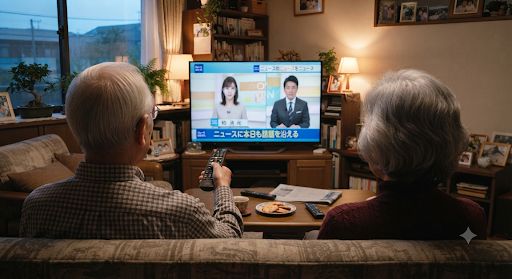
Does your TV volume keep creeping up? Does a family member say it is too loud, while you still struggle to follow the words?
Many people feel this way, and many of them are not ready for hearing aids yet. The Mirai Speaker is a TV speaker designed to make speech easier to pick up without turning the volume up. This article explains why it can help, who it suits, how it differs from a hearing aid, and how to choose among the current models.
In this article
- Why the Mirai Speaker is easier to understand
- Whether it can replace a hearing aid
- Who is likely to notice a difference, and who is not
- Where to place it and how to set it up
- How the Mini, Stereo, Carry and Ear differ
What Is the Mirai Speaker?
The Mirai Speaker is made by Sound Fun, a Japanese company. It is built to make spoken words easier to hear.
A normal speaker makes sound by moving a flat or cone-shaped diaphragm. The Mirai Speaker uses a curved vibrating plate instead. The idea came from the shape of an old gramophone horn. The result is that speech carries farther into the room and stays clearer.
Setup is simple. Put it near the TV and connect it with the supplied cable. No complicated settings are needed.
Who Is It For?
It may be a good fit if:
- You cannot agree on a TV volume with the rest of your family
- You need subtitles to follow what people say on TV
- You are not ready to try hearing aids
- You want a gift for older parents
- Your hearing difficulty is mild to moderate
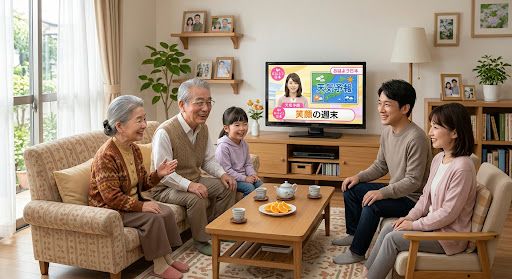
Many older people do not want hearing aids, yet still watch a lot of TV. A TV speaker is an easy first step for them.
Watching TV together is also a simple way to keep an older parent part of family conversation. Staying connected through good hearing is one reason hearing is often talked about together with brain health. You can read more in our article on hearing loss and dementia.
If your main problem is the TV, a speaker can be a gentle place to start. Our guide on talking with someone who is hard of hearing has more ideas for everyday life at home.
Can It Replace a Hearing Aid?
No. The Mirai Speaker is not a replacement for a hearing aid.
A hearing aid is a medical device. It is fitted and adjusted for one person’s hearing, and it works for mild to severe hearing loss. You wear it all day, so it helps in conversation and when you are out.
The Mirai Speaker helps mostly when you are sitting in front of a speaker, such as when watching TV. It works best for mild to moderate difficulty.
If you struggle in everyday conversation, a hearing aid or a hearing check is a better first step. If TV sound is the main problem, the Mirai Speaker is an easy thing to try.
If you have noticed new trouble hearing, it is a good idea to have your hearing checked by a doctor or audiologist first. Some causes can be treated. For more on hearing aids, see our hearing aid overview.
Why Is It Easier to Understand?
With age, high-pitched sounds are often the first to become harder to hear. Many people say, “I can hear the sound, but I can’t make out the words.” Turning up the TV makes everything louder, but the words do not get clearer.
The curved vibrating plate helps the sounds that matter for understanding speech reach farther. So you can keep the volume lower and still follow the words.
One surprising point is that people with typical hearing often do not find it too loud. In a demonstration study I took part in, around seven to eight out of ten people with some hearing difficulty said it was easier to hear. I have also sat with a family member who had the volume set to the level they needed, and I did not find it loud.
How is it different from a personal speaker?
A personal TV speaker sits near your ear so you can listen up close. It is great for someone who sits away from the TV or listens alone.
The Mirai Speaker stays near the TV, so everyone in the room hears the same sound. If you want to watch TV together as a family, the Mirai Speaker is the better fit. If you want to listen at your own seat, a personal speaker may suit you.
Who Notices a Difference, and Who Does Not?
Results vary from person to person.
More likely to notice a difference
- People with mild to moderate hearing difficulty (in a quiet room, they can follow when someone faces them and speaks a little louder)
- People whose hearing has become harder with age
- People who mainly want clearer TV speech
Less likely to notice a difference
- People with severe hearing loss
- People who struggle in situations beyond TV, such as everyday conversation or when out
- People who want rich sound for music and films (the Mirai Speaker puts speech first, so a stereo speaker is a better fit for music)
It can also be used together with hearing aids or cochlear implants. My wife already uses hearing aids, and adding a Mirai Speaker let us lower the TV volume further.
Placement and Setup Tips
Setup is easy. Plug in the power, then connect the supplied audio cable to your TV’s headphone jack (3.5 mm). The stereo model can also connect through an optical digital port. Check which outputs your TV has before you buy.
If you do not notice an effect at first, try moving it:
- Point it straight at the listener
- Place it about two to three meters from where they sit
- Turn down the TV’s built-in speaker volume
Many people find it works better a little farther away than very close.
It can also work with other devices
Anything with a 3.5 mm headphone output can be connected. If you connect a smartphone, phone calls and video calls can become easier to hear, so you can talk face to face on screen.
What Users Say
Here is what I noticed when I used it:
- Simple. It is ready to use quickly
- Speech is clearer than on other TV speakers I have tried
- Results vary from person to person
- You need to match the speaker position and where you sit
Common points in other people’s reviews:
Good points
- The TV volume went down
- Older parents were happy with it
- Connecting it was easy
Things to keep in mind
- General sound quality is ordinary, since the focus is speech
- The effect differs from person to person
- It is not designed for music
Overall, satisfaction seems high. Still, it will not help everyone, so it is wise to know that before you buy. Check the seller’s return policy (see the Where to Buy section below).
Current Models and How to Choose
As of November 2026, these four are the main models. Prices below are the Japanese list prices (including tax) at the time of release. They may differ by country and shop.
| Model | Type | Good for | Price in Japan |
|---|---|---|---|
| Mirai Speaker Mini | Compact speaker beside the TV | First-time buyers, families watching together | ¥19,800 |
| Mirai Speaker Stereo | Long stereo speaker under the TV | Those who also enjoy films and drama | ¥39,600 |
| Carry by Mirai Speaker | Wireless speaker for your own seat | Those who want to listen near their seat | ¥24,750 |
| Mirai Speaker Ear | Ear-cuff style sound amplifier | Those who want help beyond TV | ¥39,600 (Lite: ¥29,700) |
Mirai Speaker Mini
This is the most standard model. It is the successor to the Mirai Speaker Home, which is no longer sold. It keeps most of the features at a lower price. A white version was added in June 2026.
Older Mirai Speakers were large and stood out next to a TV. The Mini is a plain black rectangle from the front, so it does not get in the way. If you want to try one, I think the Mini is the place to start.
Mirai Speaker Stereo
This is a stereo model with two curved vibrating plates. It keeps the clear speech and also lets you enjoy background music and sound effects in films. It sits under the TV, comes with a remote, and connects by headphone jack or optical digital. It is good for people who like films and drama, not only news and variety shows. It costs more than the Mini.
Carry by Mirai Speaker (personal speaker)
Released in March 2026, this is the personal-speaker model. A base unit connected to the TV sends sound wirelessly to a portable speaker, so you can listen near your own seat. It connects to the TV with HDMI (ARC), optical digital or a headphone jack. It has a function to make speech clearer with two strength levels, and it also works as a Bluetooth speaker.
Note that Carry does not use the curved plate. It uses an ordinary speaker. If you want the whole family to hear the same sound, choose the Mini or Stereo. If you want to listen at your own seat, choose Carry.
Mirai Speaker Ear (sound amplifier)
Released in August 2026, this is an ear-cuff style sound amplifier. You wear it on your ear instead of using a speaker. It does not block the ear canal, so it feels less tight, and at 5.6 g per side it is light enough to wear with glasses.
There are two versions:
- Ear: Use a smartphone app for a five-minute hearing check, and it adjusts the sound to how you hear. If you place the charging case near the TV, the case picks up the sound and sends it to your ears, so you can hear from away from the TV.
- Ear Lite: A simpler model, without the app hearing check and the function that sends sound from the case. You can change the volume with buttons on the charging case, so it suits people who are not comfortable with smartphones.
The Ear is a sound amplifier, not a hearing aid (medical device). If you are worried about your hearing, talk to a doctor or audiologist first, and then think of it as something to try in daily life.
Models no longer sold
You may see older models secondhand, so here is a quick guide. If you are buying now, current models are the better choice.
- Mirai Speaker Home (discontinued): A home TV model released in 2020. It was a compact version of the earlier large Mirai Speaker. Its successor is the Mini.
- Mirai Speaker Moby (discontinued): A larger portable model with two wireless microphones. It was used at outdoor events and to speak to many people in large venues.
Earlier models such as BOXY and CARVY also existed. I own an old CARVY.
Living in Japan?
The Mini, Stereo, Carry and Ear are sold in Japan. Sound Fun’s official online store and call center are in Japanese. Large electronics shops and online marketplaces such as Amazon.co.jp and Rakuten may also sell them. Prices differ by shop, so check before you buy.
Where to Buy
The maker sells the Mirai Speaker on its official site. Some models are also sold on large online marketplaces, but which models are available differs by country. Check the maker’s site for your country.
Before you buy, check:
- Which model is available where you live
- The price including shipping and tax
- The return policy of the shop
- Whether your TV has the connection you need (headphone jack or optical)
Return rules differ from shop to shop, and the maker’s guarantee may only apply when you buy from the official store. If you are not sure it will help, buy from a place with a clear return policy and try it at home.
Summary
The Mirai Speaker makes TV speech easier to follow without turning the volume up. It does not replace a hearing aid, but for mild to moderate difficulty and mainly TV sound, it is an easy thing to try.
- To try one first: Mini
- To enjoy films and music too: Stereo
- To listen at your own seat: Carry
- To help beyond TV: Ear (a sound amplifier)
I hope TV time at home becomes a little easier for everyone.
References
- Mirai Speaker official site (Japan, in Japanese)
- Soundfun official site (US)
- Notebookcheck: Sound Fun launches lower-priced Mirai Speaker Mini to help TV viewers hear dialogue better
- TechRadar: This new cheap TV speaker has a curved design to make speech clearer
- TechRadar: Soundfun Mirai soundbar review
- AV Watch: Carry by Mirai Speaker launch news (in Japanese)
- Phile-web: Mirai Speaker Ear and Ear Lite announcement (in Japanese)


コメント