In this article
- What headphone hearing loss is, in words kids can follow
- Safe volume and listening time (numbers from the WHO and the US NIDCD)
- Warning signs, and when to see a doctor
- Four “ear promises” your family can start today
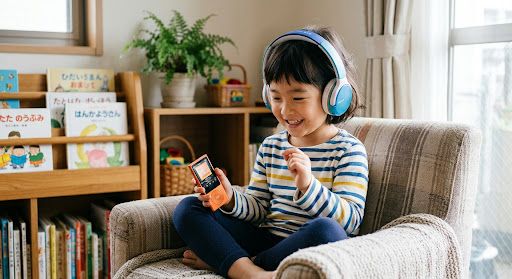
Kids today listen to music, watch videos, and play games on phones and tablets. Headphones and earbuds (some people say “earphones”) are also part of school and online learning.
They are handy. But loud sound played for a long time can wear on the ears. This is often called headphone hearing loss. There is no need to panic. A few small changes to volume and listening time go a long way toward preventing it, and this guide explains them in plain language you can share with your child.
Something you can say to your child
“Headphones aren’t the bad guy. Let’s make a few rules together so your ears don’t get tired.”
What is headphone hearing loss?
Headphone hearing loss is hearing loss caused by listening to loud sound through headphones or earbuds for too long. Both over-ear headphones and in-ear earbuds can cause it. Earbuds sit closer to the eardrum, but what matters most is how loud the sound is and how long you listen. Doctors call this kind of damage noise-induced hearing loss.
▶ Want the bigger picture on hearing loss from loud sound? Read Noise-Induced Hearing Loss: How Loud Sound Damages Your Ears, and How Families Can Prevent It (2026 Guide)
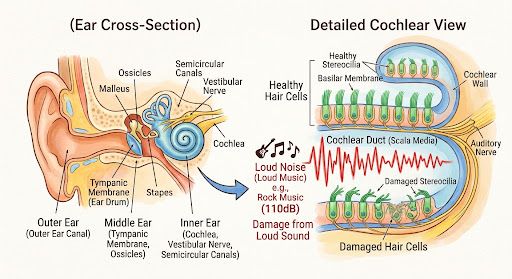
Deep in the ear, there are tiny “hairs” that sense sound
Inside your inner ear are tiny sensors called hair cells. They look a bit like hairs. When they sway, sound signals travel to the brain.
Listening to loud sound for a long time tires these sensors and can damage them. Think of walking over the same patch of grass again and again until the blades can’t stand back up. Once hair cells are damaged, they do not grow back, and there is no medicine today that repairs them. Hearing loss caused by damage to the inner ear is called sensorineural hearing loss.
It happens slowly, so it is easy to miss
Headphone hearing loss creeps in. You may not feel anything at the time, but a little strain builds up each day. That is why everyday habits matter, even when everything sounds fine right now.
How loud and how long is safe?
Two things matter: how loud and how long. The louder the sound, the less time your ears can stay safe.
The WHO guideline
The WHO and the International Telecommunication Union (ITU) set a global standard for personal audio devices such as phones and music players. It is built around a weekly “sound allowance” of 40 hours:
| Who | Volume guide | Time guide |
|---|---|---|
| Adults | 80 dB or lower | Up to 40 hours per week |
| Children | 75 dB or lower | Up to 40 hours per week |
The US National Institute on Deafness and Other Communication Disorders (NIDCD) adds a useful picture of how fast things change. Sounds at or below 70 dBA are generally considered safe. Sounds at 85 dBA can harm hearing after a few hours, 100 dBA after about 14 minutes, and 110 dBA after about 2 minutes.
These are general guides, not a promise that anything below them is safe for everyone. Some people’s ears are more sensitive than others.
What does “dB” mean?
A decibel (dB) is a unit for how loud a sound is. The bigger the number, the louder it is. (You may also see “dBA”, which is decibels adjusted to how human ears actually hear. For this article, you can treat them the same.)
| Sound | Roughly how loud |
|---|---|
| Normal conversation | 60–70 dB |
| Lawn mower | 80–100 dB |
| Sports event | 94–110 dB |
| Headphones at maximum volume | 94–110 dB |
| Fireworks | 140–160 dB |
On a bus, a train, or in a busy street, it is tempting to turn the volume up to beat the noise. That pushes the sound in your ears higher than you may realize.
Two quick checks you can do at home
- The arm’s-length test. If your child can’t hear you when you speak from an arm’s length away, the volume is probably too high.
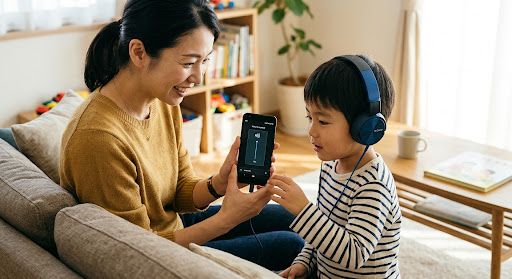
- The phone’s own meter. Many phones now show how loud your headphones are (see the next section).
What has changed in recent years
Many young people are at risk worldwide
A 2022 review in BMJ Global Health, led by researchers working with the WHO, looked at studies of people aged 12 to 34. It estimated that about 24% were exposed to unsafe listening through personal devices such as phones, and that 0.67 to 1.35 billion young people worldwide could be at risk of hearing loss from unsafe listening, including loud venues. The study did not measure hearing loss directly, so “at risk” is the key phrase. It is a reason to build good habits early, not a reason to be afraid.
Younger children are using headphones too
In a 2024 US poll from the University of Michigan’s C.S. Mott Children’s Hospital, two in three parents said their child aged 5 to 12 regularly uses headphones or earbuds. Headphone hearing loss is no longer only a teenager’s issue.
Phones and games are starting to help
- Phones. On iPhone, for example, Headphone Notifications warn you when your listening has been loud enough for long enough (for example, over 80 dB for a total of 40 hours in the past 7 days). You can find them in Settings, under Sounds and Haptics, then Headphone Safety. Many Android phones have a similar volume-limit setting, though the name differs by brand.
- Video games. In 2025, the WHO and ITU published the first global standard for safe listening in video games and esports. It asks game devices to track sound exposure, show warnings, and lower the volume when you switch from speakers to headphones.
- Check the label. Stanford Children’s Health notes that some headphones sold as “kid safe” can still reach 85 to 90 dB, which is higher than the level generally advised for children. A volume limit is only useful if the limit is low enough.
When to see a doctor
Please talk to a doctor if you notice any of these in your child (or yourself):
- Ringing or buzzing in the ears that lasts for hours, or keeps coming back
- Sounds that seem muffled for days after loud listening
- Asking “what?” more often, or turning the TV up
- Hearing that seems worse on one side
A brief ring right after loud sound is a sign that the volume was too high, so turn it down. If it keeps happening or doesn’t go away, book a check-up. A pediatrician, an audiologist, or an ear, nose and throat (ENT) doctor can help.
If hearing suddenly gets worse, don’t assume it is the headphones. Hearing loss has many causes, and some need treatment quickly. See Sudden Hearing Loss: Symptoms, Causes, Treatment, and When to See a Doctor and get checked as soon as you can.
If you’d like to understand hearing loss more broadly, What Is Hearing Loss? Causes, Symptoms, Types, Diagnosis, and Treatment is a good starting point.
Four “ear promises” to make as a family
Rules stick better when you make them together than when you hand them down. Writing them on a card and sticking it on the fridge works well.
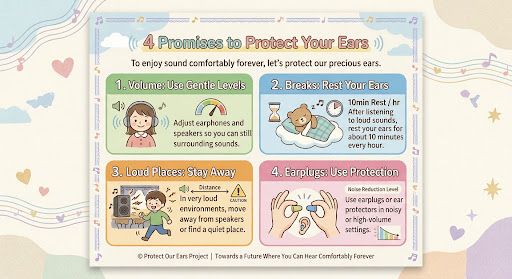
Promise 1: Keep the volume around 60% or lower
Aim for about 60% of the maximum volume, and use the arm’s-length test to check. If your phone shows a headphone volume warning, follow it. Volume percentages differ from device to device, so treat 60% as a rough starting point and check the phone’s level meter when you can.
When you lower the volume, go one notch at a time. After a month, try one more notch. Ears get used to quieter sound little by little.
Promise 2: Take a short break every hour
After an hour of listening, take the headphones off and rest your ears for around 10 minutes. Tie the break to something natural, like the end of homework or a game level. Skip headphones at bedtime too, since wearing them all night is not recommended.
Promise 3: In noisy places, don’t turn it up
On trains, buses, and planes, turning the volume up is the usual reflex. A better move is to cut the noise around you. Noise-cancelling headphones, or earbuds that fit snugly, let you hear clearly at a lower volume. Noise cancelling doesn’t make loud volume safe, so keep Promises 1 and 2 as well.
Promise 4: Use earplugs at loud events
At concerts, festivals, and fireworks shows, earplugs can protect your child’s ears. Cheap foam earplugs from a drugstore work well for older kids and teens, and well-fitting earmuffs suit younger children. Many “music” earplugs keep the sound clear and just turn the loudness down.
What parents can do
- Listen together. Ask your child to let you hear what they are listening to.
- Use the volume-limit and parental-control settings on their devices.
- On long days (travel, online classes), plan the breaks in advance.
- Follow the rules yourself. Adult ears are worth protecting too, and kids copy what they see.
Living in Japan?
Japan’s Ministry of Health, Labour and Welfare published a guide to headphone hearing loss in August 2024, recommended by the Japan Otorhinolaryngology Society. Its tips include keeping the volume at 60% or lower, taking a break of around 10 minutes after an hour of listening, and using noise-cancelling headphones in noisy places. The guide is in Japanese.
Frequently asked questions
Q. How old should a child be to use headphones?
The sources used here don’t set a minimum age. The WHO does set a lower volume guide for children (75 dB, versus 80 dB for adults). If your child uses headphones, set a volume limit and start with short sessions.
Q. Are noise-cancelling headphones safe?
They help because they let you hear clearly at a lower volume, and the Stanford Children’s team suggests them for kids. But a loud volume is still loud, even with noise cancelling. Keep the volume and time rules too.
Q. Can over-ear headphones cause hearing loss too?
Yes. Larger over-ear headphones can still harm hearing if the volume is high and the listening is long. The same guide applies: keep the volume down and take breaks.
Q. Does hearing come back once it is damaged?
Gradual, noise-related hearing loss is considered very hard to reverse once it has set in. That is exactly why prevention matters. If hearing or ringing changes suddenly, see a doctor as soon as you can.
Summary
- Headphone hearing loss happens when loud sound played for a long time damages the tiny hair cells deep in the ear.
- A good starting guide is the “60% volume, a short break each hour” habit. The WHO guide for children is 75 dB or lower and up to 40 hours a week.
- If ringing or muffled hearing keeps going, see a doctor.
- Rules made together stick better than rules handed down.
References
- WHO: Safe listening devices and systems: a WHO-ITU standard
- WHO: Global standard for safe listening, video gameplay and esports
- NIDCD (US): How Loud Is Too Loud?
- Chadha S, Dillard LK, et al. (2022). Prevalence and global estimates of unsafe listening practices in adolescents and young adults. BMJ Global Health.
- University of Michigan C.S. Mott Children’s Hospital National Poll on Children’s Health (2024), as reported by HealthDay
- Apple Support: Headphone notifications on your iPhone, iPad, or Apple Watch
- Stanford Children’s Health: Preventing Hearing Loss in Kids
- Japan MHLW: Headphone (earphone) hearing loss (in Japanese)


コメント