
You’re sitting in a quiet room, and you hear a high, thin sound. Nobody else hears it. Nothing in the room is making it.
That is tinnitus (say TIN-uh-tus or tin-EYE-tus; both are fine). It means hearing a sound that has no outside source. It is not a disease. It is a symptom, and a very common one. Researchers estimate that about 14 in 100 adults around the world have it at some point, and about 2 in 100 have a severe form.
My wife also has hearing loss, and she sometimes tells me that she is hearing it again. She describes a high, thin tone and a low hum, both at once. I can’t hear any of it, so it is not easy for me to picture what that is like.
This guide puts the big picture in one place: the types, the causes, the signs that mean you should see someone soon, and what actually helps. Read the parts that matter to you.

In this guide
- What tinnitus is, and the types
- What can cause it
- Signs that mean you should get checked soon
- Who to see, and what happens at the visit
- What helps, and what the evidence says
- Everyday habits, and quick answers to common questions
What Is Tinnitus?
Tinnitus is the sense of sound when no sound is coming from outside your body. People describe ringing, buzzing, hissing, whistling, clicking, or a sound like a motor. Most of the time, only the person who has it can hear it.
Almost everyone has a short spell of ringing now and then, for example after a loud concert. That usually passes within hours or days.
For some people the sound sticks around. When it does, the sound itself is often not the hardest part. The harder part is what it does to sleep, focus, and mood. That is why most treatment aims to make tinnitus less bothersome, not only to make the sound quieter.
Types of Tinnitus
Tinnitus can be sorted in a few useful ways.
What it sounds like. Some people hear high sounds like ringing or hissing. Others hear lower sounds like humming or roaring. Many people hear more than one sound, like my wife.
Pulsatile or not. Most tinnitus is steady or changing but has no rhythm. Some people hear a beat that matches their pulse. That is called pulsatile tinnitus. It is less common, and it is one of the reasons to get checked (see below).
How long it lasts. It can last seconds, come and go, or be there every day. Doctors often call tinnitus persistent when it lasts six months or more.
One ear or both. Tinnitus in one ear only, or much louder on one side, is another reason to get checked.
What Causes Tinnitus?
There is often more than one cause, and sometimes no clear cause is found. About one in three people with tinnitus has no problem that can be found in the ears or hearing.
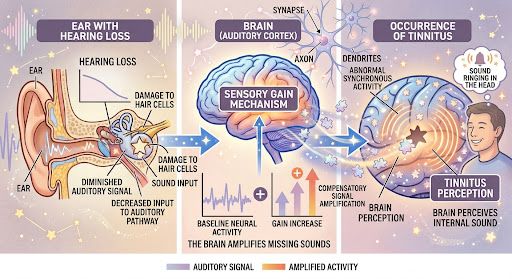
Hearing loss. Hearing loss is the most common identifiable cause. One idea is that when the ear sends less sound to the brain, the brain turns up its own sensitivity to fill the gap, and the extra activity is heard as a sound. This is still a theory, but it fits why so many people with tinnitus also have hearing loss.
Ear problems. Earwax blocking the ear canal, ear infections (see our guide to ear infections in children), Ménière’s disease, and otosclerosis can all cause tinnitus. Treating the ear problem sometimes helps.
Loud noise. Loud sound can damage the ear and lead to tinnitus, either briefly or for the long term. Our guides on noise-induced hearing loss and on headphones and earbuds explain safe volume and how to protect your ears.
Medicines. Some medicines can cause tinnitus as a side effect, including certain antibiotics, some chemotherapy drugs, and high doses of aspirin or anti-inflammatory painkillers. Some can also affect hearing; see drug-induced hearing loss. If you notice tinnitus after starting a medicine, talk to the doctor or pharmacist who gave it to you. Do not stop it on your own.
Stress, tiredness, and poor sleep. These do not usually start tinnitus, but they can make it feel louder and harder to ignore. Then the worry makes it feel worse, which becomes a loop.
Head or neck injury, and blood vessel or nerve problems. These are less common causes, but they are the reason some signs on the next list matter.
When to See a Doctor
Most tinnitus is not a sign of something serious. Even so, it is worth getting checked if:
- you have it often, or all the time
- it is getting worse
- it bothers you, for example it affects your sleep or focus
- you hear it in one ear only
- you hear a beat that matches your pulse
Get urgent medical care if tinnitus comes with:
- sudden hearing loss
- weakness in the muscles of your face
- a spinning feeling (vertigo)
- or if it starts after a head injury
If your hearing suddenly drops, do not wait to see if it passes. Sudden hearing loss is best treated quickly. Our guide on sudden hearing loss explains the signs and the timing.
Who to See, and What Happens at the Visit
In many countries, you start with a general doctor (a GP or primary care doctor). They look in your ears for things they can treat, such as earwax or an infection, and check for hearing loss. They may refer you to an audiologist (a hearing specialist) or an ear, nose, and throat (ENT) doctor.
Because hearing loss is so often behind tinnitus, a hearing test is a key step. Current guidance says everyone with tinnitus should have a proper hearing evaluation. Scans such as MRI are not needed for most people; they are kept for cases with warning features, such as tinnitus in one ear, a pulse-like sound, or other nerve symptoms.
Living in Japan? You can usually go straight to an ENT clinic (耳鼻咽喉科, jibi-inkōka) without a referral. Bring a note of when it started, what it sounds like, and which ear.
What Helps? Treatment and Management
There is no treatment that reliably makes tinnitus disappear for everyone. But there are good ways to make it much less bothersome, and many people find it fades into the background with time.
The American Academy of Otolaryngology–Head and Neck Surgery Foundation (AAO-HNSF) updated its tinnitus guideline in 2026. It points to a personalized approach built on these steps.
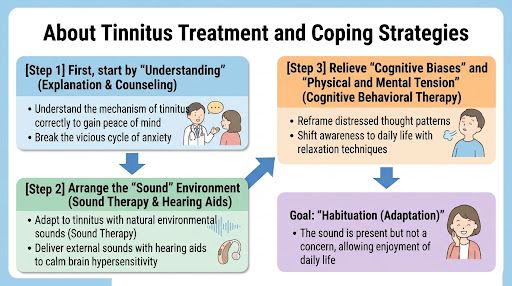
1. Education and counseling
Learning what tinnitus is, and that it is rarely dangerous, takes a lot of fear out of it. Less fear often means the sound bothers you less.
2. A hearing check, and hearing aids if you have hearing loss
If hearing loss is part of the picture, hearing aids can help. They bring back outside sounds, and tinnitus becomes less noticeable. Start with our guides on what hearing aids are and how to tell whether you need them.
3. Cognitive behavioral therapy (CBT)
CBT does not remove the sound. It helps you change how you react to it, so it stops dominating your day. The 2026 guideline names CBT as the one treatment aimed directly at tinnitus that it specifically recommends.
4. Sound enrichment
Soft background sound, such as a fan, quiet music, nature sounds, or a sound app, can make tinnitus less noticeable, especially at night. Total silence tends to make it stand out.
Some clinics also offer tinnitus retraining therapy (TRT), which combines counseling with sound over a longer period. Availability and the evidence for it vary.
What the evidence does not support
The guideline advises against routinely using medicines such as antidepressants and anti-anxiety drugs, supplements, or magnetic brain stimulation to treat tinnitus itself. Doctors do treat related problems, like trouble sleeping or low mood, and underlying ear conditions. Acupuncture has been studied, but the research is too limited to say that it works. Be careful with products and ads that promise a cure.
Living in Japan? The Japan Audiological Society’s tinnitus guideline (2019) also puts counseling, hearing aids or sound generators, and psychological therapy such as CBT first. Kampo (herbal) medicines may be prescribed, but the guideline gives only a weak recommendation for them.
Everyday Habits That May Help
- Protect your sleep. Poor sleep makes tinnitus harder to ignore. A quiet background sound can help you fall asleep.
- Avoid total silence. Soft music or ambient sound in the background makes it less noticeable.
- Do not let worry build. Fear of the sound can make it louder in your mind. If the worry is heavy, talk to your doctor, and ask about CBT.
- Protect your ears from loud sound. Loud concerts and loud earbuds can make tinnitus worse. Use earplugs or lower the volume.
- Get hearing problems checked. If you are straining to hear, a hearing test is a good first step.
If tinnitus is making you feel hopeless, or you have thoughts of harming yourself, please contact a doctor or your local emergency or crisis line right away. You do not have to manage this alone.
Tinnitus and Hyperacusis
Some people with tinnitus also find ordinary sounds too loud or uncomfortable. That is a separate problem called hyperacusis, and the two can happen together. See our guide to hyperacusis.
Frequently Asked Questions
Will my tinnitus go away?
It depends on the cause. Short spells usually fade by themselves. If a cause like earwax, an ear infection, or a medicine is found and treated, tinnitus may improve. When the sound stays, treatment and sound-based habits help many people stop noticing it.
Is it dangerous?
Usually not. Most tinnitus is not a sign of a serious illness. But some signs, listed above, call for a prompt check.
Is it all right to ignore it?
If it is brief and nothing else is going on, waiting is usually fine. If it keeps coming back, or if you notice hearing changes, it is worth a hearing test.
Do supplements or herbal remedies work?
The evidence does not support them as a treatment for tinnitus itself. If you want to try one, talk to your doctor first, especially if you take other medicines.
What if I can’t sleep because of it?
Try a quiet background sound. If sleep problems last more than a few days, talk to your doctor. CBT can help with both tinnitus and sleep.
Summary
Tinnitus is hearing a sound with no outside source. It is common, and it has many possible causes, including hearing loss, ear problems, loud noise, and some medicines.
Get checked soon if it is in one ear, matches your pulse, started suddenly, or comes with hearing loss, weak face muscles, spinning, or a head injury. Otherwise, if it lasts or bothers you, a hearing check is a good first step.
Treatment aims to make tinnitus less bothersome: education and counseling, hearing aids if you have hearing loss, CBT, and sound. These help many people.
If you are worried about your hearing in general, our guide on hearing loss is a good place to go next.
References
- Tunkel DE, et al. Clinical Practice Guideline: Tinnitus. Otolaryngol Head Neck Surg 2014. (AAO-HNSF) AAO-HNSF fact sheet
- Adams ME, et al. Clinical Practice Guideline: Tinnitus Update. Otolaryngol Head Neck Surg 2026. (AAO-HNSF) AAO-HNSF news release
- RNID. What to do if you have tinnitus. https://rnid.org.uk/information-and-support/tinnitus/what-to-do-if-you-have-tinnitus
- NI Direct. Tinnitus. https://nidirect.gov.uk/node/10351
- NHS. Tinnitus. https://www.nhs.uk/conditions/tinnitus/
- Jarach CM, et al. Global prevalence and incidence of tinnitus: a systematic review and meta-analysis. JAMA Neurology 2022.
- NIDCD. Tinnitus. https://www.nidcd.nih.gov/health/tinnitus
- 日本聴覚医学会「耳鳴診療ガイドライン 2019年版」(金原出版) Minds


コメント