Your earbuds say “105 dB/mW.” Your equalizer slider says “+3 dB.” Your music app’s volume meter says “−6 dBFS.” That is the same unit three times, and yet each number means something different.
Here is the short version: every dB number compares one level to a reference point. The only thing that changes is the reference. Once you know what each number is compared with, the labels stop being confusing.
This guide walks through the dB numbers you meet in music and audio, in plain language and without heavy math. If you want the basics first, start with our guide to what a decibel is. Then come back here to see how decibels work in headphone specs, equalizers, and volume meters.
In this article
- The four kinds of dB you will see in audio, in one table
- How to read any dB number: 3 dB, 6 dB, and 10 dB in everyday terms
- What headphone sensitivity (dB/mW) tells you, and what it does not
- What +3 dB on an equalizer really changes
- Why digital volume meters show negative numbers (dBFS)
- Simple habits for enjoying music while protecting your hearing
- The Quick Answer: Four dB Numbers, Four Different References
- How to Read Any dB Number: 3 dB, 6 dB, and 10 dB
- Headphone Sensitivity (dB/mW): How Easily Your Headphones Get Loud
- EQ Gain (+3 dB, −3 dB): How Much Is That, Really?
- Digital Volume (dBFS): Why the Numbers Are Negative
- Enjoying Music While Protecting Your Hearing
- Frequently Asked Questions
- Summary
- References
The Quick Answer: Four dB Numbers, Four Different References
| Where you see it | Example | What it is compared with | Think of it as |
|---|---|---|---|
| Headphone or earphone specs | 105 dB/mW | The sound level produced by 1 milliwatt of power | How easily the headphones get loud |
| Equalizer or tone controls | +3 dB | No change (0 dB) | How much a pitch range is boosted or cut |
| Digital volume meters and audio software | −6 dBFS | The maximum level a digital file can hold (0 dBFS) | How much headroom is left |
| Phone safety settings and sound level meters | 85 dB | The sound pressure at your ear, adjusted to how the ear hears (dBA) | The real listening level |
The first three describe equipment and files. Only the last one is about the sound that actually reaches your ears.
How to Read Any dB Number: 3 dB, 6 dB, and 10 dB
Decibels do not add up like ordinary numbers, so it helps to learn three landmarks.
| Change | Power | Voltage or sound pressure | How it sounds |
|---|---|---|---|
| 3 dB | 2 times | about 1.4 times | A modest change; most people notice it if they compare directly |
| 6 dB | 4 times | 2 times | Clearly louder or quieter |
| 10 dB | 10 times | about 3.2 times | Roughly twice as loud |
A change of 1 dB is hard to notice for most people. These are rules of thumb, and real hearing depends on the sound and the listener.
You will see the “power” column in headphone specs, because sensitivity is rated per milliwatt. You will see the “voltage” column in digital audio, because a digital file stores wave heights. That is why −6 dBFS means “half the wave height,” while 6 dB more power means four times as much.
Headphone Sensitivity (dB/mW): How Easily Your Headphones Get Loud
What the number means
Sensitivity tells you how loud a pair of headphones or earphones plays when it receives a fixed amount of signal. Most makers measure it with 1 milliwatt (mW) of power, which is a tiny amount, and write the result as dB SPL/mW or simply dB/mW.
Typical values are roughly 80 to 125 dB/mW for earphones and about 90 to 105 dB/mW for larger headphones, though there are exceptions.
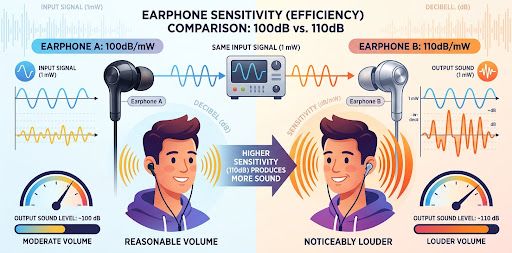
So if one earphone is rated 100 dB/mW and another 110 dB/mW, the second one plays about 10 dB louder with the same power. To your ears, that is roughly twice as loud.
Three things worth remembering
1. A sensitivity difference shows up on your volume slider. If you switch to more sensitive earphones, your usual volume setting may suddenly be too loud. Start low and turn it up slowly.
2. High sensitivity does not mean better sound. Sensitivity only describes how easily a headphone gets loud. It says nothing about clarity, balance, or comfort.
3. dB/mW and dB/V are not directly comparable. Some brands rate sensitivity per volt (dB/V) instead of per milliwatt. The two use different references, and converting between them needs the headphone’s impedance (its resistance, measured in ohms). For example, a 32-ohm headphone rated 100 dB/mW is about 115 dB/V. When you compare models, compare numbers written in the same unit.
Impedance in one sentence
Impedance affects how much power your phone or player can deliver to the headphones. In general, headphones with high sensitivity and low impedance get loud easily, even from a phone, while low-sensitivity, high-impedance models may need an amplifier to reach a comfortable level.
Sensitivity and your ears
Sensitivity is not a danger in itself. But because 1 mW is so small, an efficient pair of earphones can reach loud levels with very little power. A 105 dB/mW earphone fed one tenth of that power (10 dB less) would still produce roughly 95 dB in a lab measurement. Real levels in your ear vary with fit and music, so treat this as an illustration, not a prediction.
The practical lesson: when you buy more sensitive earphones, lower the volume before you press play.
EQ Gain (+3 dB, −3 dB): How Much Is That, Really?
An equalizer (EQ) lets you raise or lower certain pitch ranges, such as bass or treble. The dB value is the change you make. The reference is 0 dB, which means “no change.”
- +3 dB: boost that range
- −3 dB: cut that range
- 0 dB: leave it alone
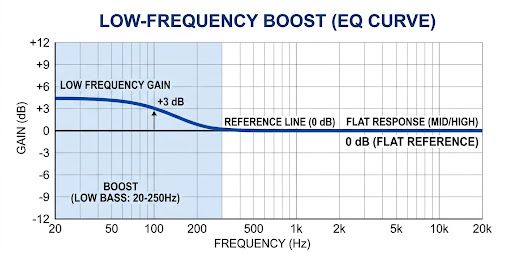
From the table above, +3 dB means that range gets twice the power. In your ears, it is a modest change: you might think “a little more bass.” A +6 dB boost is clearly noticeable, and a +10 dB boost is a big change. For everyday listening, small moves of 1 to 3 dB are often enough to shape the sound.
Three EQ tips
Cut rather than boost when you can. Boosting a range makes the whole signal louder and can cause distortion. If something sounds too heavy, try lowering that range a little instead.
Lower the preamp when you boost. Many EQ apps have a slider called preamp or pre-gain. A common rule is to lower it by the same amount as your biggest boost. If you add +5 dB of bass, set the preamp to about −5 dB. This leaves room so the loudest peaks do not get cut off.
Re-check your volume. Louder music often sounds better at first, so compare your EQ settings at the same volume. After you boost, you may also find your usual volume setting is now too high.
Digital Volume (dBFS): Why the Numbers Are Negative
Audio software, some music players, and USB audio devices show levels such as “−6 dBFS.” The letters FS stand for full scale: the maximum level a digital audio file can hold. That maximum is 0 dBFS, and every quieter level is a negative number.
| Level | Roughly how big the wave is |
|---|---|
| 0 dBFS | The maximum. Anything louder gets cut off (clipping) and sounds distorted |
| −6 dBFS | About half the maximum wave height |
| −12 dBFS | About one quarter |
| −20 dBFS | About one tenth |
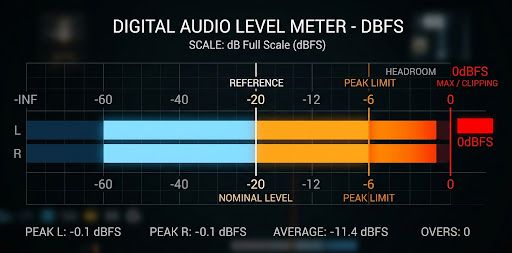
So dBFS does not tell you how loud something is. It tells you how much room is left before the digital ceiling. The closer to 0, the closer to the maximum.
dBFS is not the sound level at your ear
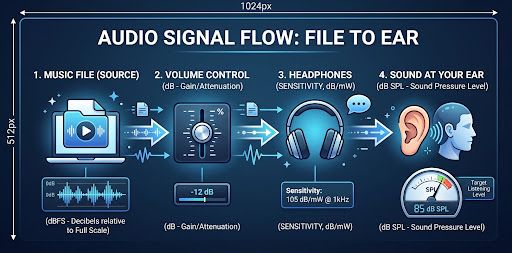
A file at −6 dBFS can be quiet or very loud in your ears, depending on your volume setting and your headphones’ sensitivity. That is why the signal path matters: file level, then volume control, then the headphones, then your ear.
What about loudness (LUFS)?
Two songs can both peak at −1 dBFS yet feel very different in loudness. Streaming services use a separate measure called LUFS to even out the difference. For example, Spotify adjusts tracks toward −14 LUFS by default, and Premium listeners can choose Loud (−11 LUFS) or Quiet (−19 LUFS). You do not need to calculate any of this. Just know that LUFS describes how loud music feels over time, while dBFS describes the peak ceiling of the file.
Enjoying Music While Protecting Your Hearing
Now we can connect the numbers to your ears. The two things that matter most for hearing safety are the level and the time you listen. For adults, the WHO and ITU safe listening standard uses 80 dB for up to 40 hours a week, and 75 dB for children. You can read the details in our guide to headphones and earbuds.
A few simple habits:
- Start low after a change. New earphones with higher sensitivity, a new EQ boost, or a different app can all make the same volume setting louder.
- Use your phone’s limit. On iPhone, go to Settings > Sound & Haptics > Headphone Safety and turn on Reduce Loud Audio (called Reduce Loud Sounds in earlier versions of iOS). You can choose a maximum between 75 and 100 dB in steps of 5. For long listening, a limit around 75 to 80 dB is a sensible place to start. Many Android phones have similar tools, but the names differ by brand.
- Take listening breaks. A few quiet minutes every hour gives your ears a rest.
- Protect your ears at concerts and clubs. Live music is often much louder than headphone listening. See our guide to noise-induced hearing loss for more.
- Do not ignore warning signs. If you notice ringing or muffled hearing after loud music, give your ears a rest and see tinnitus for what to expect. If you find yourself turning the volume up more and more, a hearing test is a good idea. You can learn more in our guide to hearing loss.
Frequently Asked Questions
What is a good headphone sensitivity?
There is no single “good” number. Higher sensitivity means the headphones get loud with less power, which is convenient for phones. Lower sensitivity is not worse, but it may need more power from an amplifier. Sensitivity does not measure sound quality.
Are high-sensitivity earphones bad for my ears?
No. The sensitivity itself does not harm your hearing. The risk comes from listening too loudly for too long. With sensitive earphones, the same volume setting plays louder, so turn the volume down when you switch.
How much is +3 dB on an equalizer?
It doubles the power in that pitch range. To your ears, it is a modest, noticeable change, not a dramatic one. Compare at the same volume to judge it fairly.
What does −6 dB mean?
It means the level is 6 dB lower than the reference. In a digital volume setting or in dBFS, that is about half the wave height. It sounds clearly quieter, but not half as loud, because a 10 dB drop is what sounds roughly half as loud.
Why is dBFS always negative?
Because the reference, 0 dBFS, is the loudest level a digital file can hold. Every quieter level sits below it, so it has a minus sign.
Is dBFS the same as dB SPL?
No. dBFS describes a level inside a digital file, compared with its maximum. dB SPL describes the actual sound pressure in the air. The same file can produce very different dB SPL values depending on your volume and your headphones.
Summary
- Every dB number compares a level with a reference. Always ask, “compared with what?”
- Headphone sensitivity (dB/mW) shows how easily headphones get loud. A 10 dB difference is roughly twice as loud, and dB/mW cannot be compared directly with dB/V.
- An EQ’s +3 dB means the pitch range gets twice the power. It is a modest change, and lowering the preamp by the largest boost helps prevent distortion.
- dBFS measures headroom below the digital maximum (0 dBFS). It is not the sound level at your ear.
- After you switch to more sensitive earphones or boost the EQ, lower the volume first. For long listening, aim for around 75 to 80 dB.
You do not need to memorize every unit. If you remember to ask what each dB is compared with, you can read almost any audio spec with confidence.

コメント