
- The hospital told you they will check your baby’s hearing before you go home
- Your baby got a “refer” result and you’re not sure what happens next
- You’re wondering how much it costs, or what to do if your baby missed the test
Raising a newborn in Japan comes with plenty of new things to figure out, and it’s natural to worry about even small things in those first days.
Newborn hearing screening (shinseiji chōkaku kensa, 新生児聴覚検査) is a quick hearing check done shortly after birth. The result is either “pass” (the baby responded to sound) or “refer” (yō-saiken, 要再検: further testing needed).
Hearing “refer” can be a shock, but a refer result does not mean your baby has hearing loss. The most important thing is to calmly move on to the next step.
In this article, you’ll learn:
- The types of tests and how screening works in Japan
- What to do if your baby gets a refer result
- The CMV (cytomegalovirus) urine test
- Costs and public subsidies
- What changed in 2026
We prepared “Congenital Hearing Loss in Babies: Causes, Signs, Screening and Treatment [2026 Guide for New Parents]“
- What Is Newborn Hearing Screening?
- Types of Screening Tests
- How Newborn Hearing Screening Works
- If Your Baby Gets a “Refer” Result
- The CMV (Cytomegalovirus) Test
- Costs and Public Subsidies
- [2026 Update] What Changed Under the New National Notice
- After a Pass: Keep a Gentle Eye on Things
- Frequently Asked Questions
- Summary
- References
What Is Newborn Hearing Screening?
Newborn hearing screening is a simple check to see whether there are any signs that a baby’s hearing should be looked at more closely. It does not diagnose hearing loss.
About 1 to 2 in every 1,000 babies are born with hearing loss. Noticing it early and starting support early helps with later language development and communication.
Today, almost every baby in Japan is screened. According to a survey by the Children and Families Agency (Kodomo Katei-chō) for fiscal year 2023, 96.2% of newborns were tested.
During the test, the baby sleeps while soft sounds are played, and a computer checks the response. It doesn’t hurt your baby at all.
Procedures differ slightly by hospital and municipality, so it’s a good idea to ask the hospital where you plan to give birth how they handle it.
Tip for English speakers: If you’re not comfortable with medical Japanese, ask the hospital in advance whether English support or an interpreter is available. It can also help to keep this article handy when talking with staff.
Learn more about hearing loss, please see “What Is Hearing Loss? Causes, Symptoms, Types, Diagnosis, and Treatment“.
Types of Screening Tests
Two main tests are used: automated ABR and OAE. Under a national notice issued in August 2026, the initial test and the confirmation test should be done with automated ABR.
| Test | How It Works | Features |
| Automated Auditory Brainstem Response (AABR) | Sounds are played into the baby’s ears, and the brain’s electrical responses (brainwaves) are measured. A computer automatically determines whether the result is a “Pass” or “Refer.” | Evaluates the auditory pathway from the inner ear to the brain. Currently the recommended screening method. |
| Otoacoustic Emissions (OAE) | Sounds are played into the ear, and a tiny sound produced by the cochlea in response is detected. | Quick and easy to perform, but it cannot assess the neural pathways that carry sound signals to the brain. |
Automated ABR (Automated Auditory Brainstem Response)
When we hear a sound, the brain gives off a tiny electrical response. In this test, small sticker-like sensors are placed on the baby’s forehead, neck and so on to pick up that response.
A computer makes the pass/refer decision automatically, so results tend to be clear. The test is done while the baby is asleep.
By the way, the regular (non-automated) “ABR” is often used later in the detailed diagnostic exam.
OAE (Otoacoustic Emissions)

When the cochlea in the inner ear receives sound, it sends back a tiny sound of its own. This test picks up that “echo.”
If there’s no echo, the hair cells inside the cochlea may not be working properly. However, OAE can’t detect problems in the nerve beyond the cochlea. That’s why automated ABR is now recommended.
Even if your baby is born at a hospital that only has OAE, prefectures are working to build connections between hospitals so that every baby can receive an automated ABR test.
Please take a look at “What Are Hair Cells in the Ear? Why Does Damage Cause Hearing Loss?” to learn more about the hair cells in the inner ear.
How Newborn Hearing Screening Works
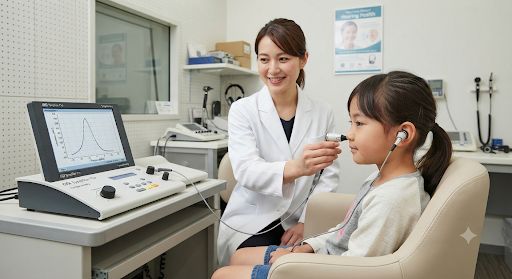
Newborn hearing screening generally follows a benchmark called the “1-3-6 rule”:
- By 1 month: finish screening
- By 3 months: complete a detailed hearing exam
- By 6 months: start support such as hearing aids, if needed
In Japan, the steps look like this:
- Initial test (usually within 3 days of birth)
- Confirmation test (usually within 1 week of birth)
- CMV (cytomegalovirus) urine test (within 3 weeks of birth)
- Detailed hearing exam (by around 3 months at the latest)
- Starting support (by around 6 months at the latest)
Let’s look at each step.
Initial Test (Usually Within 3 Days of Birth)
This is the first test, done at the hospital where your baby was born while you’re still staying there. The baby’s response to sound is checked with automated ABR while they sleep.
The result is either “pass” or “refer.” If it’s a pass, screening ends here.
If it’s a refer, your baby moves on to the confirmation test. Right after birth, fluid can remain in the ears and make it harder to get a clear response. Try not to worry too much about a refer at this stage.
Confirmation Test (Usually Within 1 Week of Birth)
Babies who got a refer on the initial test are tested once more. Ideally, this is done before you’re discharged, while you’re still in the hospital.
Many babies pass at this stage. If the result is still refer, your baby moves on to the CMV urine test and the detailed hearing exam.
Under the August 2026 revision, a refer result should lead to the next step rather than repeated retesting. Instead of “let’s just wait and try again,” the current approach is to move forward early.
CMV Urine Test (Within 3 Weeks of Birth)
This test checks your baby’s urine and is recommended when the confirmation test is still refer. It’s often available at the hospital where you gave birth, and it’s covered by national health insurance.
After 3 weeks, it becomes hard to tell whether an infection was present from birth, so timing is very important. We’ll explain more below.
Detailed Hearing Exam (By Around 3 Months at the Latest)
This exam is done at a designated ENT (ear, nose and throat) clinic or hospital (jibi-inkōka, 耳鼻咽喉科). While screening is a quick sorting step, this exam finds out how well your baby can actually hear.
It usually combines tests such as:
- ABR (auditory brainstem response): a more detailed version of the screening test that checks how loud a sound needs to be before the brain responds
- ASSR (auditory steady-state response): checks hearing at different pitches, from low to high
- Ear examination and eardrum tests: checks things like fluid in the middle ear
ABR and ASSR are done while your baby sleeps. Some hospitals may use medicine to help the baby fall asleep.
Only certain hospitals offer this exam, so ask the hospital where you gave birth about the referral and how to book. This is the stage where you’ll find out whether there is hearing loss, and if so, how much.
“What Is Tympanometry? A Simple Guide to the Test Procedure and Understanding Type A, B, and C Results” provides a detailed explanation of tympanometry, a test used to evaluate middle ear function. Feel free to check it out!
Starting Support (By Around 6 Months at the Latest)

If the detailed exam shows hearing loss, the goal is to start support by around 6 months of age at the latest.
There’s no single right approach. Options include hearing aids, cochlear implants and sign language. You’ll decide together with doctors and support organizations, based on your child’s hearing and your family’s wishes.
If your baby is placed under observation instead, their hearing will be checked regularly as they grow.
Hearing loss can affect both ears or just one.
For more information about hearing loss in one ear, please read “Unilateral Hearing Loss: Causes, Symptoms, Treatment, and Ways to Improve Hearing in One Ear (2026 Guide)“.
For more information about hearing aids and cochlear implants, please see “What Are Hearing Aids? A Complete Beginner’s Guide to Types, Costs, and How to Choose the Right One” and “What Is a Cochlear Implant? Eligibility, Surgery Costs, and How It Sounds Explained“.
If Your Baby Gets a “Refer” Result
The first thing to know: “refer” does not mean “your baby has hearing loss.” Think of it as a sign that says, “Let’s take a closer look.”
The numbers may help put your mind at ease. According to Osaka Prefecture’s guidebook, about 0.9% of babies screened in fiscal year 2023 got a refer result. And of the babies who then had a detailed exam, about 37% were found to have normal hearing.
Move to the Next Step Instead of Retesting Again and Again
In the past, you often heard explanations like “we’ll wait a while and retest a few times.”
However, the national notice issued in August 2026 states clearly that after a refer result, babies should not be retested over and over, but should move on to the next step, such as the confirmation test or the detailed exam.
Moving forward early means you can be reassured sooner if everything is fine, and support can start sooner if it’s needed.
What to Do After a Refer Result
- Check with the hospital when the next tests (confirmation test, CMV test, detailed exam) will be
- Check that the result is recorded in your Maternal and Child Health Handbook (Boshi Kenkō Techō, 母子健康手帳)
- Don’t hesitate to ask hospital staff or your municipality’s public health nurse (hokenshi, 保健師) about anything you’re unsure or worried about
In some municipalities, a public health nurse may contact you after checking the test results. You don’t have to handle this alone, so lean on the support that’s available.
The CMV (Cytomegalovirus) Test
If the confirmation test is still refer, it’s strongly recommended that your baby have a urine test within 3 weeks (21 days) of birth.
Cytomegalovirus is a very common virus that most people catch at some point in childhood. However, if a baby is infected in the womb during pregnancy, it can be one of the causes of hearing loss present from birth.
Why “Within 3 Weeks”?
To find out whether the infection was present from birth, the urine needs to be tested within the first 3 weeks. After that, it becomes hard to tell it apart from an infection caught after birth.
Also, if the baby is found to have been infected from birth, medication may help improve hearing or slow hearing loss. The benefits of treatment have been shown when it starts within 2 months of birth, so early testing matters.
Key Points About the Test
- It only requires a urine sample, so it’s gentle on your baby
- The urine test within 3 weeks of birth is covered by national health insurance
- It’s often available at the hospital where you gave birth, ideally while you’re still staying there
- • Under the August 2026 revision, if there are unavoidable circumstances, the test may be done after a refer on the initial test
If the hospital hasn’t mentioned it, try asking, “What about the CMV urine test?” In Japanese: 「CMVの尿検査はどうなりますか?」 (CMV no nyō-kensa wa dō narimasu ka?)
Costs and Public Subsidies
Many municipalities in Japan cover all or part of the cost of newborn hearing screening. In fiscal year 2023, 90.8% of municipalities offered public funding for it.
However, the amount and conditions vary quite a bit by municipality. Here are some examples:
| Municipality | Main Conditions |
| Tokyo | Use the “Newborn Hearing Screening Voucher” provided when submitting the pregnancy notification. The voucher is valid until the baby reaches 50 days of age. Tests performed after the expiration date must be paid for out of pocket. |
| Sakai City (Osaka Prefecture) | Tests must be performed within 30 days of birth. Subsidies cover up to ¥5,000 for automated ABR and ¥1,500 for OAE. |
As of November 2026. Please check your municipality’s website for the latest information.
Things to Check
- Whether you received the voucher (jushinhyō or jukenhyō, 受診票・受検票) when you submitted your pregnancy notification
- The voucher’s expiration date
- The subsidy limit and roughly how much you might need to pay yourself
- The procedure if you give birth away from your registered address, such as in your hometown or another prefecture (some municipalities offer a refund afterward)
Note that the CMV urine test (within 3 weeks of birth) after a refer on the confirmation test is covered by health insurance, not by the screening subsidy.
[2026 Update] What Changed Under the New National Notice
On August 17, 2026, Japan’s Children and Families Agency partly revised its rules (official notice) on newborn hearing screening. Here are the points that matter most to parents.
| What Has Changed | What It Means for Parents |
| Automated ABR is recommended for both the initial screening and the follow-up screening. | Babies can be screened using a more reliable method. |
| Hospitals that use OAE should also establish systems that allow babies to receive automated ABR screening. | Differences in screening methods depending on the hospital where a baby is born are less likely. |
| If the result is “Refer,” babies should proceed to the next stage rather than undergoing repeated screening tests. | Parents can receive a definitive result sooner. |
| Follow-up screening and CMV testing should preferably be performed while the baby is still hospitalized. | Parents may have fewer additional hospital visits after discharge. |
| When necessary, CMV testing may be performed based on the results of the initial hearing screening. | It becomes easier to complete CMV testing within the first three weeks after birth. |
| Midwives are explicitly permitted to perform newborn hearing screening without a physician’s direct instruction. | Hearing screening becomes more accessible even for babies born at midwife-led birth centers. |
The notice also calls for a “roadmap” for parents of babies who get a refer result, showing what to expect from testing through to support. If your municipality gives you one, be sure to take a look.
After a Pass: Keep a Gentle Eye on Things
If your baby passed, that’s great news.
That said, some hearing loss can appear later as a child grows, for example due to an infection present from birth or certain genes.
There’s no need to worry too much, but it’s reassuring to keep these points in mind:
- Have hearing checked as part of your baby’s 1-month checkup and regular infant health checkups (nyūyōji kenshin, 乳幼児健診)
- If something concerns you, such as your baby not startling at loud noises or not turning when you call their name, ask for advice early
- You can consult your pediatrician, an ENT doctor, or your municipality’s public health nurse
“What Is the OTOF Gene? Understanding Genetic Hearing Loss and Auditory Neuropathy“, “What Is the GJB2 Gene? Understanding the Most Common Cause of Congenital Hearing Loss” and “What Is the SLC26A4 Gene? Understanding Congenital Hearing Loss, Enlarged Vestibular Aqueduct, and Pendred Syndrome” introduces genes commonly associated with congenital hearing loss. Please take a look for more information.
Frequently Asked Questions
Is newborn hearing screening mandatory?
No. It’s done with the parents’ consent. But because it’s so important for noticing hearing difficulties early, we recommend having it done.
How much does it cost?
It depends on the hospital and municipality. Many municipalities offer subsidies, and using the voucher usually means you pay nothing or only a small amount. Check with your local municipal office for details.
What if I give birth outside my registered municipality?
Your municipality’s voucher may not be accepted at a hospital in another area. Even so, some municipalities will refund part of the cost if you apply afterward, so keep your receipt.
What if my baby wasn’t tested during our hospital stay?
Some medical institutions test babies born at other hospitals. Since the voucher has an expiration date, contact your municipality or hospital as soon as possible.
Does the test hurt?
No. Soft sounds are simply played while your baby sleeps.
My baby got a refer result, but they seem to respond to sounds at home.
It’s hard, even for specialists, to judge hearing accurately just by watching a baby. For your own peace of mind, make sure your baby has the recommended tests.
Summary
- Almost every baby in Japan now has newborn hearing screening
- “Refer” doesn’t mean “hearing loss.” It’s a sign to take a closer look
- If the confirmation test is still refer, don’t forget the CMV urine test within 3 weeks of birth
- Since the August 2026 revision, the approach is to move to the next step early instead of retesting again and again
- Subsidies differ by municipality, so check your voucher and its expiration date
My wife has hearing loss, so when our child was born, we were very anxious about this test result. Waiting for results can feel like forever, but simply knowing how the tests work and what comes next can make it a little easier.
If anything is unclear, you don’t have to figure it out alone. Reach out to your hospital or your municipality’s public health nurse.
References
Joint Committee on Infant Hearing (JCIH): Year 2019 Position Statement — Executive Summary

コメント