Your ears started ringing out of nowhere, and now a worrying thought keeps coming back: could this be a brain tumor, or even a stroke?
Let’s start with the good news. Most tinnitus is not a sign of anything serious, and it is rarely caused by a problem in the brain. It is most often linked to hearing loss in the inner ear.
My wife has hearing loss and tinnitus, a high ringing and a lower hum, and I have tinnitus myself now and then. In this guide, I will walk you through the few cases where tinnitus can be linked to the brain or nerves, and the warning signs that mean you should see a doctor soon.
In this article
- Why most tinnitus is not a brain problem
- Acoustic neuroma, stroke, and pulsatile tinnitus
- Warning signs, and when to call for emergency help
- Who to see and what tests to expect
- Can tinnitus damage your brain?

- Is Tinnitus a Sign of Something Serious in the Brain?
- Brain and Nerve Conditions That Can Cause Tinnitus
- When to See a Doctor: Warning Signs
- Who to See and What Tests to Expect
- Can the Type of Sound Tell You If It Is Serious?
- Can Tinnitus Damage Your Brain?
- If Your Tests Come Back Normal
- Living in Japan?
- FAQ
- Key Takeaways
Is Tinnitus a Sign of Something Serious in the Brain?
Usually, no. Tinnitus is very common. Around 10 to 15 percent of people have it, and the UK’s NHS notes that it is not usually a sign of anything serious and may get better by itself.
In most cases, there is no real sound inside the ear. One common theory is that when the inner ear sends less sound to the brain, for example because of age-related or noise-related hearing loss, the brain turns up its own activity to make up for it. That extra activity can be heard as ringing, buzzing, or humming.
Learn more about why hearing loss can lead to tinnitus.
Think of headaches. Most headaches come from everyday things like tiredness, tight shoulders, or not enough sleep. But a sudden, severe headache unlike anything you have had before is a reason to get help right away. Tinnitus is similar: most of it is harmless, but a few patterns are worth knowing.
For the bigger picture on causes, types, and treatment, see our guide to tinnitus.
Brain and Nerve Conditions That Can Cause Tinnitus
Here are the three situations people most often worry about. None of them is common, but knowing what they look like can help you decide when to get checked.
Acoustic neuroma (vestibular schwannoma)
An acoustic neuroma, also called a vestibular schwannoma, is a non-cancerous (benign) tumor. It grows on the nerve that carries hearing and balance signals from the inner ear to the brain. It is uncommon: about 1 in 100,000 people are diagnosed each year, most often between the ages of 30 and 60.
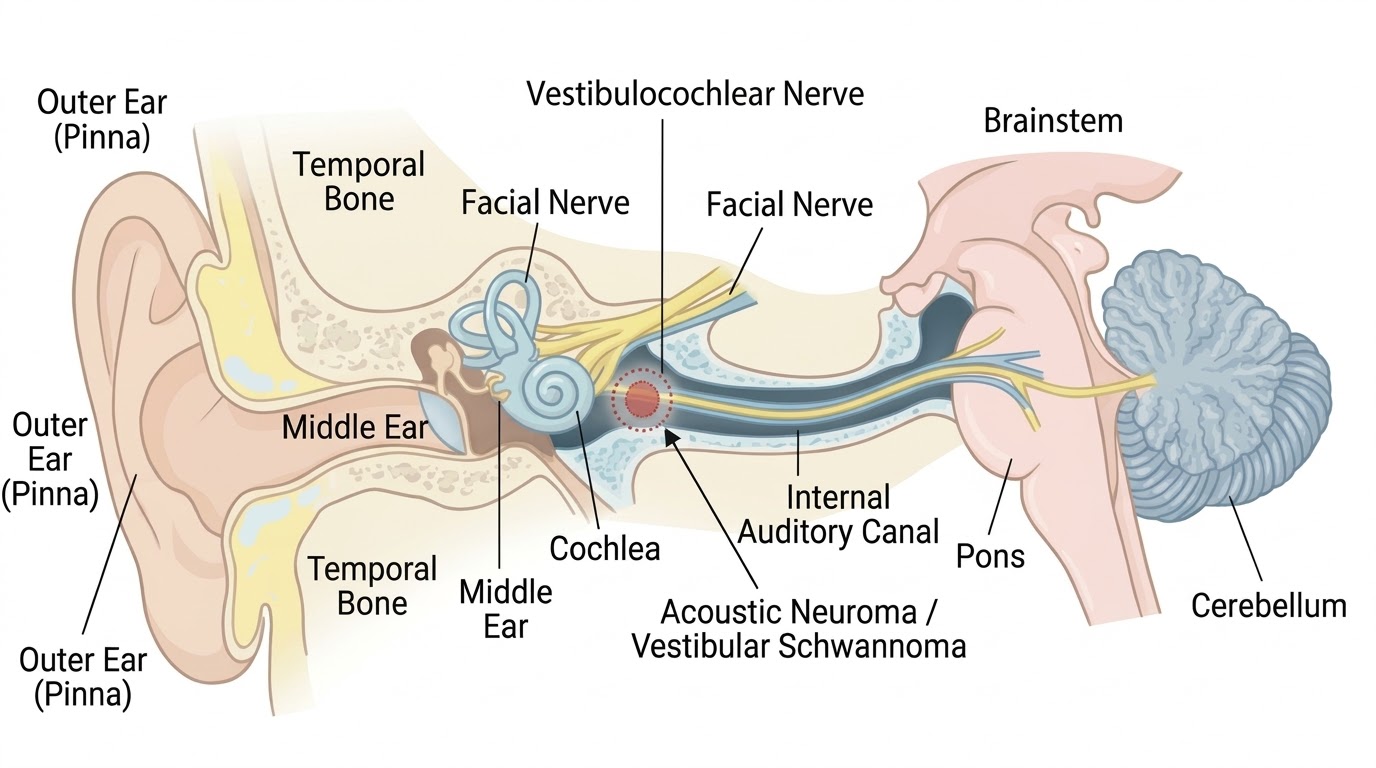
Because it usually grows on one side, the symptoms usually show up on one side too:
- hearing loss in one ear, or one ear that hears noticeably worse than the other
- tinnitus, often in that same ear
- dizziness or problems with balance
These symptoms usually develop slowly. Many of these tumors grow very slowly or not at all, and small ones are often just watched with regular MRI scans. Sometimes, though, the first sign is a sudden drop in hearing, so a sudden loss in one ear is worth checking too.
The key word here is one-sided. Tinnitus in both ears with similar hearing on both sides is a different picture. If you notice your hearing getting worse in one ear only, our guide to hearing loss in one ear explains the possible causes.
Stroke: sudden hearing loss with dizziness
A stroke happens when blood flow to part of the brain is blocked or a blood vessel bleeds. The inner ear gets its blood supply from a small artery near the back of the brain. In rare cases, a stroke in that area can cause sudden hearing loss, tinnitus, and spinning dizziness (vertigo), sometimes before other stroke signs appear.
Stroke is an uncommon cause of sudden hearing loss. But because it can look like an inner ear problem at first, doctors take sudden hearing loss together with vertigo seriously, and may use an MRI scan to check.
Sudden hearing loss is worth treating quickly whatever the cause. See our guide to sudden hearing loss for what to do and how soon.
Pulsatile tinnitus: a sound that beats with your pulse
If you hear a whooshing or thumping sound in time with your heartbeat, it is called pulsatile tinnitus. It is much less common than ordinary ringing tinnitus.
Pulsatile tinnitus is often caused by a change in blood flow near the ear. Some causes involve blood vessels in the head or neck, such as hardened arteries, and these need medical care. Many others have nothing to do with the brain:
- blood pumping harder than usual, for example after hard exercise, during pregnancy, with anemia, or with an overactive thyroid
- ear problems that make body sounds easier to hear, such as glue ear (fluid behind the eardrum) or a hole in the eardrum
So pulsatile tinnitus does not automatically mean a brain problem. But you cannot tell the cause yourself, and the NHS advises asking for an urgent GP appointment if your tinnitus beats in time with your pulse.
When to See a Doctor: Warning Signs
Here is everything above in one checklist.
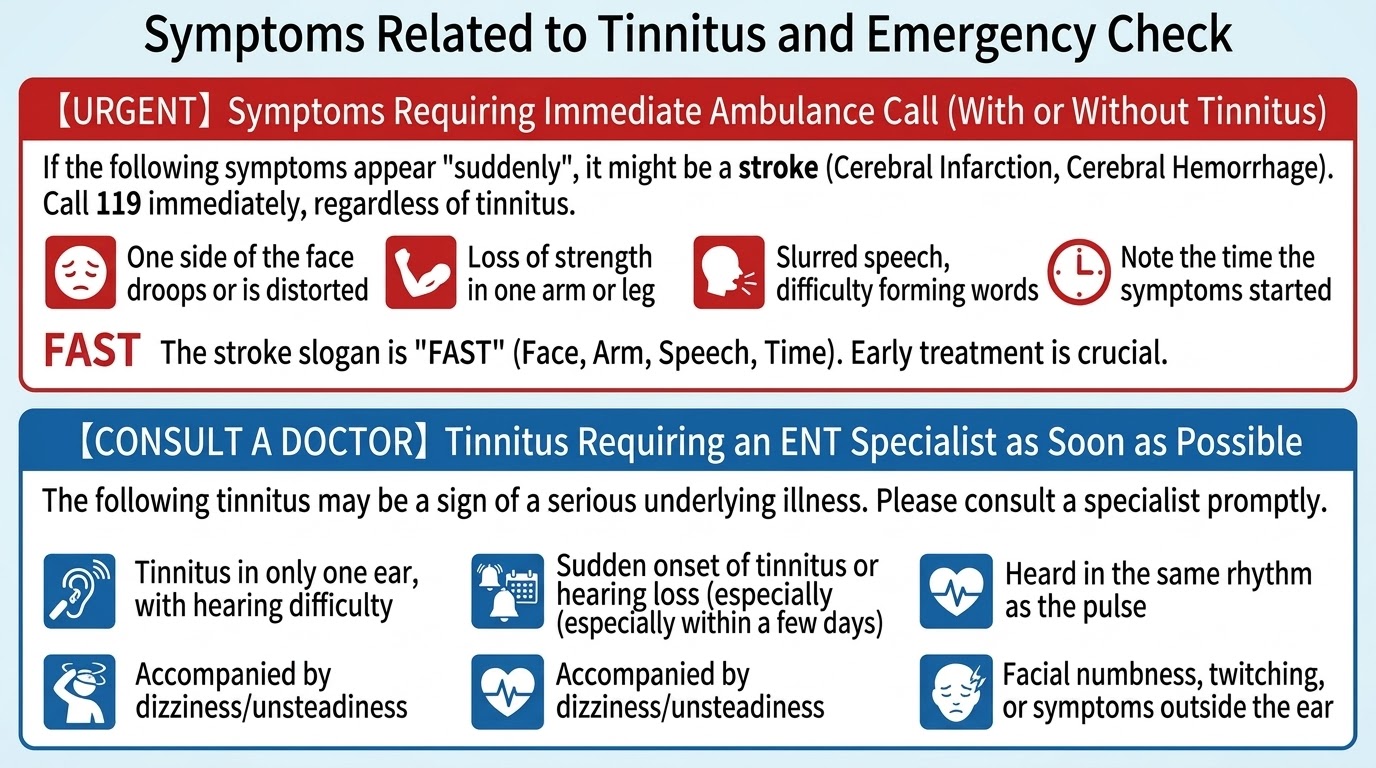
Call emergency services now: BE FAST
If any of these appear suddenly, with or without tinnitus, it could be a stroke. Do not wait to see if it passes. Call your local emergency number right away, and do not drive yourself to the hospital.
- B – Balance: sudden dizziness, loss of balance, or trouble walking
- E – Eyes: sudden blurred or double vision, or loss of sight in one or both eyes
- F – Face: one side of the face droops, or the smile looks uneven
- A – Arm: one arm (or leg) is weak or numb
- S – Speech: slurred speech, trouble finding words, or confusion
- T – Time: time to call for help, and note when the symptoms started
You may also see the shorter version, FAST (Face, Arm, Speech, Time), which is used by the NHS and the American Stroke Association. BE FAST adds balance and eyes, because a stroke at the back of the brain can show up that way.
The NHS also says to get emergency help if tinnitus comes after a head injury, or together with sudden hearing loss, weakness in the face, or vertigo.
See a doctor soon
- tinnitus in one ear only, especially with hearing loss in that ear
- tinnitus or hearing loss that started suddenly, especially within the last few days
- tinnitus with dizziness or balance problems
- tinnitus that beats in time with your pulse
- numbness in your face, or other symptoms beyond your ears
If any of these fit, try not to wait it out. Sudden hearing loss in particular is best treated as early as possible.
No rush, but still worth mentioning
- tinnitus in both ears that has stayed about the same for weeks or longer
- you notice it in quiet rooms, but you can get on with your day
This kind of tinnitus is usually not urgent. Still, the NHS suggests seeing a GP if you have tinnitus regularly or all the time, if it is getting worse, or if it is affecting your sleep, concentration, or mood. If you have some hearing loss behind it, hearing aids can make tinnitus stand out less for many people.
Who to See and What Tests to Expect
For most people, the first stop is a family doctor (GP or primary care doctor), who can look in your ears and refer you on. Depending on where you live, you may see an audiologist (a hearing specialist) or an ear, nose, and throat (ENT) doctor next. You do not need to start with a brain specialist.
A typical visit includes:
- Questions: when it started, one ear or both, what it sounds like, whether it beats with your pulse, and whether you feel dizzy
- An ear exam and a hearing test: the 2026 US guideline says everyone with tinnitus should have a full hearing evaluation
- An MRI scan, only if needed: the same guideline limits imaging to people with specific concerning features. For example, hearing loss or tinnitus on one side only is a reason doctors look more closely
So if your doctor does not order a scan, that usually means nothing in your exam pointed to a problem that a scan would find. If tests suggest something in the brain, you will be referred to the right specialist.
To see each step in more detail, read our guide to how doctors test for tinnitus.
Can the Type of Sound Tell You If It Is Serious?
It would be handy if a high-pitched ring meant danger and a low hum meant you were fine. Unfortunately, ringing, buzzing, hissing, or humming on its own does not tell you whether tinnitus is linked to a brain problem.
What matters more is the pattern:
- one ear, or both?
- sudden, or slowly over time?
- does it beat with your pulse?
- does it come with hearing loss, dizziness, or symptoms in your face, arms, or legs?
Can Tinnitus Damage Your Brain?
You may have read that tinnitus happens in the brain, and wondered if that means your brain is being harmed. It is true that research has found long-lasting tinnitus is linked to changes in how certain brain networks work, such as the ones that handle attention and rest. That is part of why tinnitus can be hard to tune out.
But being linked to changes in brain activity does not mean tinnitus is a sign of brain disease. A science fact-check by Science Feedback rated the claim that tinnitus is a warning sign your brain is dying as inaccurate. Ads that use this kind of fear are often selling pills or supplements, which are not backed by good evidence for tinnitus.
If Your Tests Come Back Normal
Hearing that nothing serious was found is a real relief. Still, if the sound is still there, you may feel a bit let down.
Tinnitus tends to feel louder the more you worry about it. Knowing it is not a brain problem can be the first step toward it slowly fading into the background. Our guide on how long it takes to get used to tinnitus explains what that path often looks like.
If worry or low mood is the hardest part, CBT for tinnitus is the best-studied way to reduce distress. For all the options side by side, see our guide to tinnitus treatment options.
Living in Japan?
In Japan, you can usually go straight to an ENT clinic (耳鼻咽喉科, jibi-inkōka) without a referral, and that is the usual first stop for tinnitus. If the ENT doctor suspects a brain problem, you may be referred to a neurosurgery or neurology department. For stroke signs, call 119 for an ambulance.
FAQ
Is tinnitus in one ear a sign of a brain tumor?
Usually not. Most one-sided tinnitus has an ear-related cause. But an acoustic neuroma often starts with hearing loss and tinnitus in one ear, so if you have tinnitus in one ear along with hearing loss in that ear, get a hearing test.
Can tinnitus in both ears be a brain tumor?
It is unlikely. Acoustic neuromas in both ears are rare and are usually linked to a genetic condition called neurofibromatosis type 2 (NF2). If your hearing changes in a way that worries you, see a doctor.
Do I need a brain scan for tinnitus?
Most people do not. Your doctor will decide based on your history, ear exam, and hearing test. A scan is usually considered when there is a specific concern, such as symptoms on one side only.
I have had tinnitus for years. Will it turn into something serious?
Long-lasting tinnitus is not known to turn into a brain disease. But if it changes, for example it moves to one ear, your hearing drops, or you start feeling dizzy, get checked again.
Key Takeaways
- Most tinnitus is not a sign of a brain problem.
- Tinnitus in one ear with hearing loss, sudden tinnitus, tinnitus with dizziness, or tinnitus that beats with your pulse: see a doctor soon.
- Sudden problems with balance, eyes, face, arm, or speech: call emergency services now.
- The type of sound alone cannot tell you if it is serious.
Searching late at night can make the worry bigger. A checkup and a hearing test are often the quickest way to put your mind at ease.
References
- NHS. Tinnitus. https://www.nhs.uk/conditions/tinnitus/
- NHS. Acoustic neuroma (vestibular schwannoma). https://www.nhs.uk/conditions/acoustic-neuroma/
- NHS. Stroke: Symptoms. https://www.nhs.uk/conditions/stroke/symptoms/
- National Institute on Deafness and Other Communication Disorders (NIDCD). Vestibular Schwannoma (Acoustic Neuroma) and Neurofibromatosis. https://www.nidcd.nih.gov/health/vestibular-schwannoma-acoustic-neuroma-and-neurofibromatosis
- American Academy of Otolaryngology–Head and Neck Surgery Foundation (AAO-HNSF). Clinical Practice Guideline: Tinnitus Update (news release, October 2026). https://www.entnet.org/resource/living-with-ringing-in-your-ears-updated-guideline-supports-a-personalized-evidence-based-approach-to-tinnitus/
- Aroor S, Singh R, Goldstein LB. BE-FAST (Balance, Eyes, Face, Arm, Speech, Time): Reducing the Proportion of Strokes Missed Using the FAST Mnemonic. Stroke. 2017;48(2):479–481. https://doi.org/10.1161/STROKEAHA.116.015169
- Kim HA, Lee H. Recent Advances in Understanding Audiovestibular Loss of a Vascular Cause. J Stroke. 2017;19(1):61–66. https://doi.org/10.5853/jos.2016.00857
- Tinnitus UK. Pulsatile tinnitus. https://tinnitus.org.uk/pulsatile-tinnitus
- Husain FT, Khan RA. Review and Perspective on Brain Bases of Tinnitus. 2023. https://pmc.ncbi.nlm.nih.gov/articles/PMC10752862/
- Science Feedback. Tinnitus isn’t a sign of brain death, even though it arises in the brain; no cure for tinnitus currently exists. 2021. https://science.feedback.org/review/tinnitus-isnt-a-sign-of-brain-death-even-though-it-arises-in-the-brain-no-cure-for-tinnitus-currently-exists/


コメント