Maybe a doctor or audiologist has mentioned “TRT” to you. Or maybe you came across tinnitus retraining therapy while searching for something, anything, that might help with the ringing. Either way, it is hard to tell from the name what it actually involves, how long it takes, or whether it works.
In short, TRT combines counseling about tinnitus with sound therapy, so that you gradually get used to the sound. It does not switch tinnitus off, and it is not a cure. The aim is for tinnitus to bother you less, and to take up less of your attention, until it fades into the background of daily life.
I have tinnitus myself now and then. My wife has hearing loss and tinnitus too, a high ringing and a lower hum. Because nobody else can hear it, tinnitus is hard to explain to the people around you, and I wanted this guide to give a clear, honest picture of one of the best-known approaches.
In this article
- What TRT is, and what it aims to do
- The two parts: counseling and sound therapy
- What happens in treatment, and how long it takes
- What the research says, and what to do if it is not working
- How to find a clinic, and common questions
What Is Tinnitus Retraining Therapy (TRT)?
Tinnitus retraining therapy is a structured treatment program for tinnitus. It grew out of a model of tinnitus described by the neuroscientist Pawel Jastreboff in 1990, and was developed into a treatment with the British ear specialist Jonathan Hazell in the early 1990s. It is now offered in many countries.
The goal of TRT is not silence. It is habituation: reaching the point where you can hear the tinnitus if you listen for it, but it no longer worries you or pulls your attention. There is still no treatment that reliably removes tinnitus, so this is what most tinnitus care aims for.
For a wider picture of what causes tinnitus and when to get it checked, see our tinnitus guide.
Why Can You Get Used to Tinnitus?
A few years ago I moved to a place where planes flew close overhead. At first, I noticed every single one, and it really bothered me. Then one day I realized I had stopped noticing them. The planes were just as loud as before. My brain had simply decided they were not worth my attention.
That is habituation, and most of us have experienced it: the hum of a new refrigerator, traffic outside a new home, a ticking clock. TRT tries to put the same natural process to work on tinnitus.
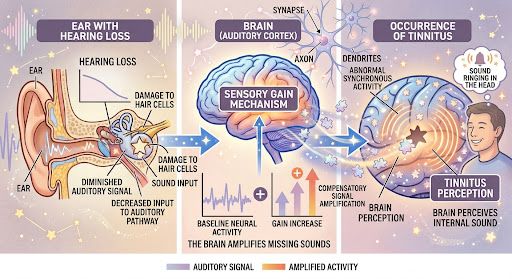
Tinnitus is often linked to hearing loss. One explanation is that when the ear sends less sound to the brain, the brain turns up its own sensitivity, and that extra activity is heard as a sound. Then a second thing happens. If the sound feels threatening (“What if this never stops?” “Is something wrong with me?”), you start to listen for it. The more you listen for it, the louder it seems, and the more worried you feel. That loop is what makes tinnitus so tiring.
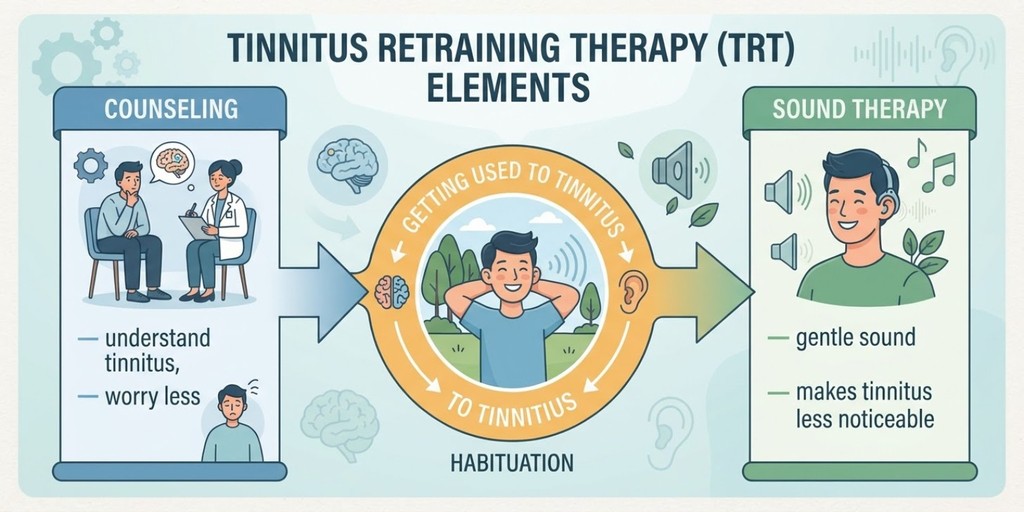
TRT works on both sides of that loop. Counseling takes away the fear, and sound makes the tinnitus less noticeable, so the brain can start to treat it like the planes.
The Two Parts of TRT
1. Counseling: understanding your tinnitus
TRT starts with education and counseling, usually from an audiologist or doctor trained in the method. This is sometimes called directive counseling, because it follows a set plan. It typically covers:
- How tinnitus is produced, in plain terms
- Why tinnitus is rarely a sign of something dangerous
- How worry and attention make it seem louder
- How sound and time can help you get used to it
This part matters more than people expect. Once tinnitus makes sense, it is less frightening, and once it is less frightening, it tends to pull at your attention less.
2. Sound therapy: making tinnitus less noticeable
The second part is sound therapy. Tinnitus stands out most in silence, so TRT uses low-level, steady sound to keep the background from being too quiet. Common sources are:
- Sound generators: small devices worn in or behind the ear that produce a soft, steady “shhh” noise
- Hearing aids or combination devices: for people who also have hearing loss (more on this below)
- Sound in your surroundings: a fan, soft music, or nature sounds at home, especially in quiet rooms and at night
How Loud Should the Sound Be?
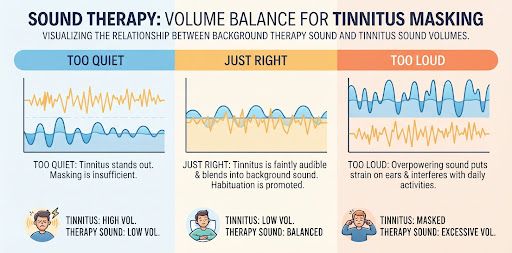
In TRT, the sound is usually set so that you can still just hear your tinnitus underneath it. The two sounds blend together, but the tinnitus has not disappeared. This level is often called the mixing point.
The idea is that the brain can only learn to ignore a sound it can still hear. Covering tinnitus completely is a different approach, called masking. It can bring quick relief, but it is not the main goal of TRT.
That said, you do not need to obsess over the exact level. One small study found that people did about as well when the sound fully covered their tinnitus as when it was set at the mixing point. What matters most is using a comfortable, not-too-loud sound regularly in everyday life.
What Happens in TRT: Step by Step
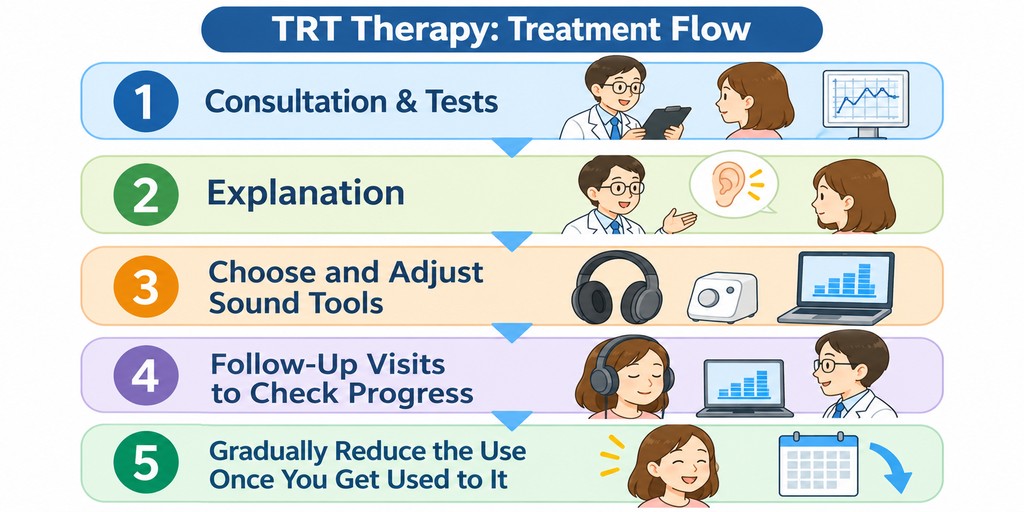
Every clinic runs TRT a little differently, but the general flow looks like this:
- Assessment: a hearing test, measurements of your tinnitus, and questionnaires about how much it affects your sleep, mood, and daily life
- Counseling: your results are explained, along with how tinnitus works and what to expect from treatment
- Choosing and fitting a sound source: based on your hearing, a sound generator, hearing aid, or combination device is chosen and adjusted
- Follow-up visits: you use sound in daily life and return regularly to review progress, adjust settings, and go over the counseling again
- Tapering off: as tinnitus bothers you less, you and your clinician gradually reduce how much you rely on the devices
Who Is TRT For?
TRT is meant for tinnitus that has been around for a while and is bothering you. It is not a first step for tinnitus that has just started.
If your tinnitus came on suddenly, especially with a sudden drop in hearing, get medical care right away. That can be a sign of sudden hearing loss, which is best treated quickly. The same goes for tinnitus in one ear only, tinnitus that beats with your pulse, dizziness, or tinnitus after a head injury. Get those checked before starting any tinnitus program.
How Long Does TRT Take?
TRT is not a quick fix. Habituation happens slowly, so programs usually run for many months. Treatment of around 12 months, with another 6 months of continued sound use, is a common pattern, and one well-known TRT clinic says it usually works with patients for about two years, while most notice a clear improvement within the first 6 to 12 months.
Expect ups and downs along the way. Tiredness, stress, or a bad night’s sleep can make tinnitus seem louder for a while. Those dips are usually temporary, so try to judge progress over months, not days.
Whether or not you follow a formal program, our guide to getting used to tinnitus covers how long it usually takes and what else can help along the way.
If You Also Have Hearing Loss
Tinnitus and hearing loss often go together. When hearing loss is present, TRT programs often use a hearing aid as the sound source. A hearing aid brings back the everyday sounds you have been missing, and that extra sound can make tinnitus less noticeable at the same time. Some hearing aids also include a built-in sound generator, so the two can be combined in one device.
Which device suits you depends on your hearing and your tinnitus, so it is best decided with your clinician after a hearing test, rather than buying something on your own first. For the basics, see our guide to what hearing aids are and how they work.
Does TRT Work? What the Research Says
Many people say TRT has helped them, and clinics around the world use it. But the research picture is more mixed than many websites suggest, and it is worth knowing.
- The largest trial (2019): a study in the United States followed 151 adults with bothersome tinnitus and hearing that was mostly normal, for 18 months. People received full TRT, TRT counseling with a placebo sound device, or the clinic’s usual standard of care (counseling and advice on using sound). All three groups improved, but there was no clear difference between them.
- A smaller trial (2017): a study of 39 adults with hearing loss, who all wore hearing aids with a built-in sound generator, compared TRT with standard care. Both groups improved and kept the benefit for 18 months, and TRT appeared somewhat more effective.
- An older review (2010): a Cochrane review found only one suitable trial, which suggested TRT worked better than masking, but the evidence was too limited to draw firm conclusions.
So what does this mean for you? One reasonable reading is that the ingredients of TRT (understanding your tinnitus, less fear, and avoiding silence) help many people, even if the exact TRT protocol is not the only way to get there.
National guidelines reflect this. The UK’s NICE guideline did not make a recommendation for TRT itself. It noted that the original protocol leaves little room for people to shape their own care plan, and that the TRT studied in research often differs from the TRT delivered in clinics today. Instead, NICE recommends that everyone receives tinnitus support alongside whatever approach suits them, such as hearing aids or psychological therapies.
If TRT Doesn’t Seem to Be Working
- Give it time. Judging after a few weeks is too early for a habituation-based program.
- Check the sound. Too loud, too quiet, or used too little can all hold progress back. Ask your clinician to review the settings.
- If worry or poor sleep is the biggest problem, ask about cognitive behavioral therapy (CBT). It has strong evidence for reducing tinnitus distress and can be used instead of, or alongside, sound-based approaches.
- If everyday sounds feel painfully loud, you may also have hyperacusis, which may need to be addressed first.
TRT not working for you does not mean nothing will. It means another approach may suit you better.
Cost and Finding a TRT Clinic
Cost
Costs vary widely by country, clinic, and insurance. As well as the appointments and tests, you may need to pay for a sound generator or hearing aid. Before you start, ask the clinic to explain the full cost, including follow-up visits and any devices.
Finding a clinic
Not every clinic offers TRT, and some offer a modified version. Some ways to look:
- Ask your family doctor, ENT doctor, or audiologist whether they offer TRT or can refer you
- Look for a tinnitus clinic or an audiology clinic that lists TRT or tinnitus management among its services
- Ask how the clinic runs its program: how long it lasts, how often you visit, and which devices it uses
Living in Japan?
In Japan, tinnitus is usually seen at an ENT clinic (耳鼻咽喉科, jibi-inkōka), which starts with a hearing test. TRT is offered at some ENT clinics and at hospitals with a tinnitus clinic (耳鳴り外来). If a hearing aid may be part of your treatment, an ENT doctor who is a certified hearing aid consultant (補聴器相談医) can help. The Japan Audiological Society’s Tinnitus Practice Guideline (2019, in Japanese) treats counseling and sound therapy as core approaches.
FAQ
Can TRT cure tinnitus?
No. TRT aims to help you get used to tinnitus so that it no longer bothers you. Many people notice it less often over time, but the sound itself usually remains.
What is the difference between sound therapy and TRT?
Sound therapy is the use of sound to make tinnitus less noticeable. TRT is a structured program that combines sound therapy with specific counseling, delivered by a trained clinician over many months.
Should the sound be loud enough to cover my tinnitus?
In TRT, the usual aim is a level where you can still just hear your tinnitus. There is no need to turn it up. Loud sound can also be hard on your ears.
Can I do TRT at home with an app?
An app alone is not TRT, because TRT relies on counseling and devices fitted by a clinician. But you can use its ideas at home: avoid silence and play a gentle sound you like. Our sound therapy guide, linked above, explains how.
How is TRT different from CBT?
TRT combines counseling with sound to help you habituate. CBT is a psychological therapy that helps you change how you think about and react to tinnitus. Both aim to reduce distress, and some people use both.
Summary
- TRT combines counseling and sound therapy to help you get used to tinnitus. It is not a cure.
- The sound is usually set so you can still just hear your tinnitus. It does not need to be loud.
- Programs often last a year or more, so judge progress over months.
- If you have hearing loss, a hearing aid is often part of TRT.
- Research shows that people improve with TRT, but also with other counseling-based care. If TRT does not suit you, CBT and other approaches can help.
- Sudden, one-sided, or pulsing tinnitus, dizziness, or a head injury means seeing a doctor first.
References
- Tinnitus Retraining Therapy Trial Research Group; Scherer RW, Formby C. Effect of Tinnitus Retraining Therapy vs Standard of Care on Tinnitus-Related Quality of Life: A Randomized Clinical Trial. JAMA Otolaryngol Head Neck Surg. 2019;145(7):597–608. PubMed
- Bauer CA, Berry JL, Brozoski TJ. The effect of tinnitus retraining therapy on chronic tinnitus: A controlled trial. Laryngoscope Investig Otolaryngol. 2017;2(4):166–177. PubMed Central
- Tyler RS, Noble W, Coelho CB, Ji H. Tinnitus Retraining Therapy: Mixing Point and Total Masking Are Equally Effective. Ear Hear. 2012;33(5):588–594.
- Phillips JS, McFerran D. Tinnitus Retraining Therapy (TRT) for tinnitus. Cochrane Database Syst Rev. 2010;(3):CD007330. Cochrane
- Gold SL, Formby C, Scherer RW. The Tinnitus Retraining Therapy Counseling Protocol as Implemented in the Tinnitus Retraining Therapy Trial. Am J Audiol. 2021;30(1):1–15. ASHA
- NICE. Tinnitus: assessment and management (NG155). NICE
- AudiologyOnline. Ask the Experts: Tinnitus Retraining Therapy timeline. AudiologyOnline
- Japan Audiological Society. Tinnitus Practice Guideline 2019 (Kanehara, in Japanese). Minds


コメント