
Is tinnitus keeping you awake at night?
During the day you barely notice it. But once you are in bed and the room goes quiet, the ringing suddenly seems much louder. And after a bad night, it often feels even harder to ignore the next day. Tinnitus and sleep tend to affect each other, and it is easy to get stuck in that loop.
I have tinnitus myself now and then. My wife has tinnitus too, a high ringing and a lower hum. So I know how much a quiet bedroom can make it stand out.
This guide covers what you can try tonight, the sleep habits that help over time, and what to do if you still cannot sleep.
In this article
- Why tinnitus and poor sleep feed each other
- Why tinnitus seems louder at night
- How to use soft sound at bedtime
- Everyday habits that help you sleep
- What to do if sleepless nights keep going
Tinnitus and Sleep Affect Each Other
Tinnitus can make it harder to fall asleep, and poor sleep can make tinnitus harder to ignore. Many people find themselves going round and round with the two.
Sleep problems are common among people with tinnitus, although studies report a wide range of numbers. Research also suggests that insomnia can make tinnitus more distressing and affect quality of life.
Here is how the loop often looks:
- At night, the room goes quiet and the tinnitus stands out
- You cannot sleep, and you start to worry about not sleeping
- Tiredness builds up
- The next day, the tinnitus is harder to ignore
- You start to dread going to bed
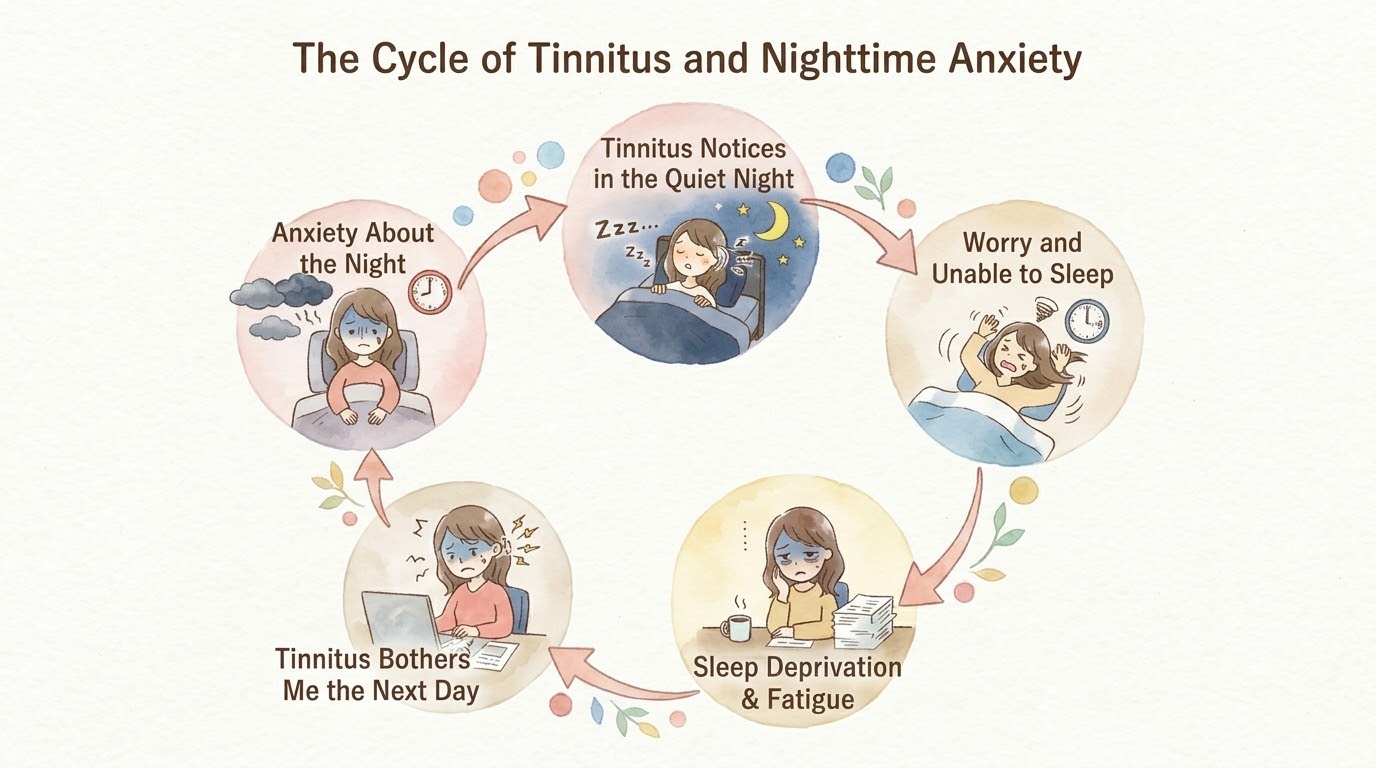
The good news is that this works the other way too. If you can ease even one part of the loop, the rest often gets a little easier. The sections below go through ways to do that, one by one.
Can lack of sleep cause tinnitus?
Some people notice tinnitus for a while after a run of short nights or a tiring week. But it is not clear that lack of sleep on its own causes tinnitus.
What we can say is that when you are tired or stressed, tinnitus tends to be more noticeable and more bothersome.
If your tinnitus does not go away, or if you suddenly lose hearing in one ear, do not assume it is just poor sleep. See a doctor. Sudden hearing loss in one ear can be sudden hearing loss, which is best treated quickly.
Why Does Tinnitus Seem Louder at Night?
The main reason is simple: there is less sound around you.
Think of a busy café. You would never hear someone’s phone vibrating at the next table. But in a quiet bedroom at night, you can hear the fridge humming in the kitchen.
Tinnitus works the same way. During the day, it is mixed in with everyday sounds. At night, it may not actually be louder. It is just easier to hear. For more on what tinnitus is and why it happens, see our guide to tinnitus.
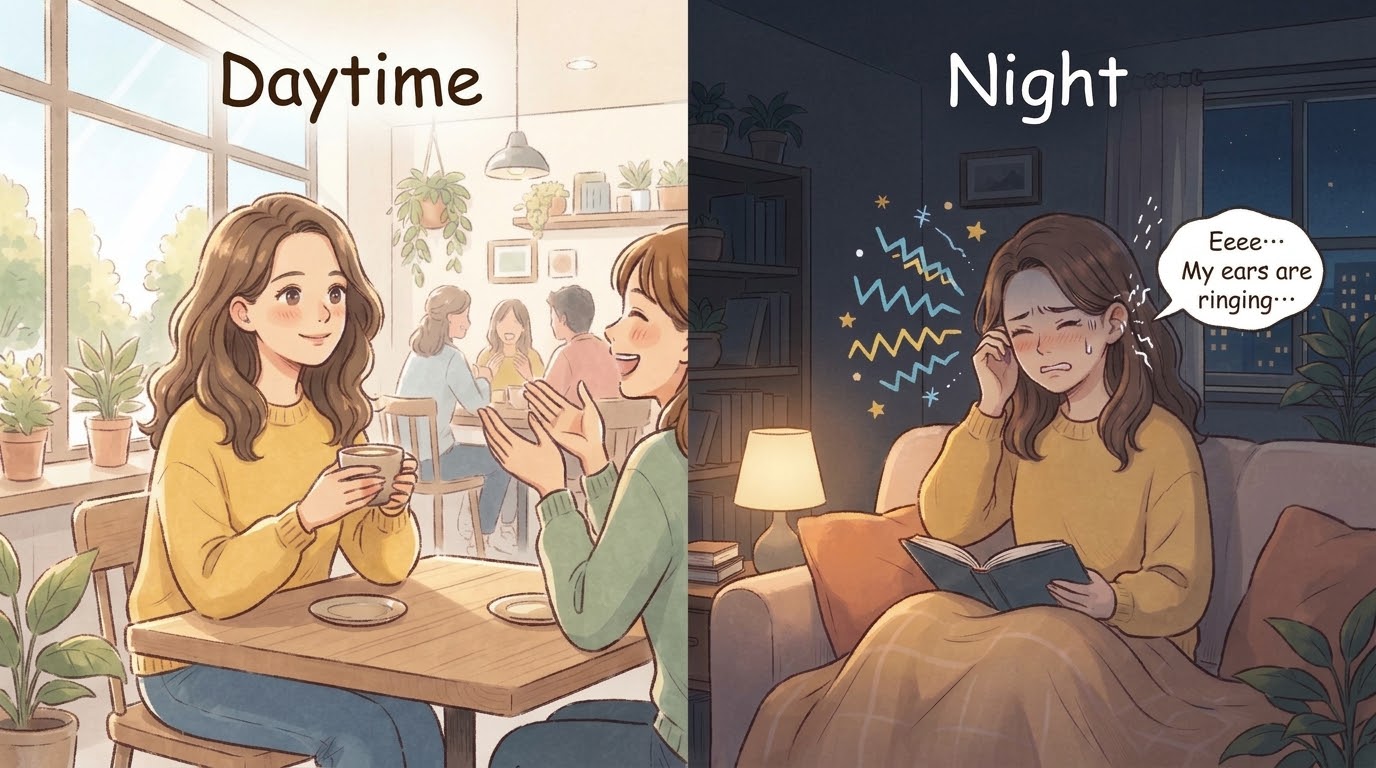
Then the worry kicks in: “I have to be up early. I need to sleep now.” That pressure wakes your mind up and pulls your attention back to the sound. So the next sections look at two things: the silence and the pressure to sleep.
At Bedtime, Let a Soft Sound Help
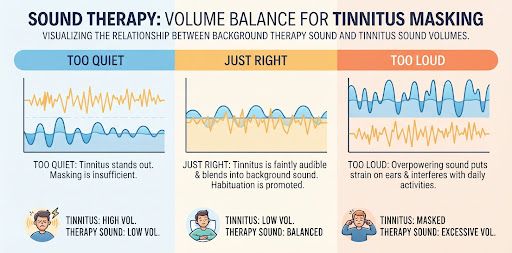
If silence is the problem, adding a little sound to the room is a simple place to start. This is the same idea as sound therapy, used at bedtime.
Aim for a level where you can still just hear your tinnitus, with the added sound blending around it. You are not trying to drown it out. Turning the sound up too high can keep you awake and put extra strain on your ears.
Sounds people often use at night:
- Nature sounds, such as rain, waves, or a flowing stream
- A steady “shhh” sound, like a fan or white noise
- Slow, calm music without lyrics
Music with lyrics can pull your attention into the words, so for bedtime, something without lyrics usually works better.
Speaker or earbuds? Sleeping in earbuds can make your ears sore when you turn over. A small speaker on your bedside table, or your phone’s speaker at low volume with a sleep timer, is often the simplest option. If you share a bed, a pillow speaker or soft sleep headband are other choices. Whatever you use, keep the volume low.
If you would rather cover the tinnitus completely, that approach is called tinnitus masking. It uses a different volume level from sound therapy, so it is worth reading about both.
Everyday Habits That Help You Sleep
Next, a few habits that support sleep itself. These are based on general sleep advice from the UK’s NHS and the US Centers for Disease Control and Prevention (CDC). You do not need to try them all at once. Pick one or two that seem doable.
Wake up at the same time every day
Try to get up at about the same time every day, including weekends, even after a bad night. A steady wake-up time helps set your body clock, so you start to feel sleepy at a more regular time at night. Opening the curtains and getting some daylight soon after you wake up can help too.
It is often easier to fix your wake-up time than to force yourself to fall asleep earlier.
Go to bed when you feel sleepy
Going to bed only when you actually feel sleepy, rather than at a set time when you are wide awake, can make falling asleep easier.
If you cannot sleep, get up for a while
If you have been lying awake for a while, you do not have to keep your eyes shut and wait. Get up, go somewhere quiet with low light, and do something relaxing, such as reading or listening to calm music. Go back to bed when you feel sleepy.
Lying in bed listening to your tinnitus and getting frustrated can teach your body that bed is a place for being awake.
Keep screens and bright light low in the evening
Bright screens before bed can make you feel more alert. Try to put your phone and other devices away for a while before bedtime, and keep the room lighting soft.
If you play a sound to fall asleep, start it and then turn the screen off, using a timer.
Watch caffeine and alcohol
Try to avoid caffeine (coffee, tea, energy drinks) in the afternoon and evening. Alcohol may help you drop off, but it can make sleep worse later in the night, so a nightcap is best avoided.
Avoid daytime naps
Napping during the day can make it harder to sleep at night. If you are very tired, try to keep going until your usual bedtime.
Stay active during the day
Regular exercise during the day helps sleep. Even a walk counts. Try to avoid hard exercise in the last few hours before bed.
Ease the Pressure to Fall Asleep
On sleepless nights, the hardest part is often the feeling that you must fall asleep.
Everyone needs a different amount of sleep. Instead of counting hours, think about how you feel during the day. If you are not struggling with sleepiness, you are probably getting enough.
It also helps to have one way to relax before bed. A warm bath, gentle stretching, slow breathing, or a book can all work. Choose whatever suits you, and try to give yourself some time to wind down before bed.
If Sleepless Nights Keep Going
If you have tried these changes and still cannot sleep, or you feel exhausted during the day, please do not deal with it alone.
Who to talk to
- About your tinnitus: a doctor (often an ENT specialist) or an audiologist. Many people feel calmer just from having their ears checked and their tinnitus explained. Our guide on how doctors test for tinnitus explains what to expect.
- About your sleep: your family doctor. They may refer you to a sleep clinic if another sleep problem is suspected, such as sleep apnea. Loud snoring or pauses in breathing at night are worth mentioning.
The UK’s NICE guideline on tinnitus recommends that doctors ask people with tinnitus whether it affects their sleep, and if needed, use a sleep questionnaire such as the Insomnia Severity Index (ISI). In other words, “I can’t sleep” is an important thing to bring up at your appointment.
CBT for insomnia (CBT-I)
For long-lasting sleep problems, there is a treatment called cognitive behavioral therapy for insomnia (CBT-I). With a trained professional, you gradually change unhelpful thoughts about sleep and habits such as when you go to bed and how long you stay in bed.
Major guidelines, including those from the American College of Physicians and the European Sleep Research Society, recommend CBT-I as the first treatment for chronic insomnia. It can be delivered in person, and the European guideline also includes digital programs. A review of studies in adults with tinnitus also found that CBT improved insomnia.
Ask your doctor whether CBT-I is available where you live, either in person or online.
CBT can also help with the worry and distress that come from the tinnitus itself. Our guide to CBT for tinnitus explains how it works.
If you are prescribed sleeping pills
A doctor may sometimes prescribe sleeping pills when insomnia is severe. In the UK, for example, they are usually given only for a short time, because they can have side effects and some can lead to dependence.
If you take them, follow your doctor’s instructions on dose and timing. Do not take more than prescribed, and do not mix them with alcohol. If you want to stop, or feel they are not working, talk to your doctor rather than stopping suddenly on your own.
Also keep in mind that sleeping pills help with sleep. They are not a treatment for tinnitus itself.
Living in Japan?
In Japan, you can see an ENT clinic (耳鼻咽喉科, jibi-inkōka) for tinnitus, and your family doctor or a sleep clinic for sleep problems. The Ministry of Health, Labour and Welfare’s Sleep Guide 2023 (in Japanese) gives similar advice: keep a regular wake-up time, get morning light, avoid caffeine in the evening and alcohol before bed, and get out of bed when you cannot sleep. CBT-I is still offered at a limited number of places, so ask your doctor what options are available.
FAQ
Why do I only notice my tinnitus when I go to bed?
Often the tinnitus is there during the day too, but everyday sounds cover it up. In a quiet bedroom, it stands out, so it feels like it only happens at night. A soft bedtime sound can help.
Is there a best sleeping position for tinnitus?
Some people say their tinnitus feels different depending on how they lie, but there is no position that is proven to be best. Sleep in whatever position is comfortable. If you notice a whooshing or thumping sound in time with your heartbeat (pulsatile tinnitus), especially when lying down, it is worth getting it checked by a doctor. The same goes for tinnitus in one ear only that does not go away.
Is it okay to leave a sound playing all night?
Some people keep a soft sound on all night. Others prefer a timer that stops it after they fall asleep. Either way, keep the volume low, where you can still just hear your tinnitus.
If I start sleeping better, will my tinnitus go away?
Not necessarily. Many people find tinnitus bothers them less once they sleep better, but the sound may still be there. The usual goal is to get used to tinnitus so it no longer runs your day. Our guide on how long it takes to get used to tinnitus explains what that process looks like.
Key Takeaways
- Tinnitus and poor sleep often feed each other, but easing one part of the loop can help the rest.
- Tinnitus seems louder at night mainly because the room is quiet.
- At bedtime, a soft sound at a level where you can still just hear your tinnitus can make it easier to fall asleep.
- Keep a regular wake-up time, go to bed when sleepy, get up if you cannot sleep, and go easy on caffeine, alcohol, and naps.
- If sleepless nights keep going, talk to a doctor. Ask about CBT-I, the recommended first treatment for chronic insomnia.
You do not need to change everything at once. Tonight, try playing a soft sound. That is a good place to start.
References
- National Institute for Health and Care Excellence (NICE). Tinnitus: assessment and management (NG155). 2020. https://www.nice.org.uk/guidance/ng155
- Curtis F, Laparidou D, Bridle C, et al. Effects of cognitive behavioural therapy on insomnia in adults with tinnitus: Systematic review and meta-analysis of randomised controlled trials. Sleep Medicine Reviews. 2021;56:101405. https://doi.org/10.1016/j.smrv.2020.101405
- Qaseem A, Kansagara D, Forciea MA, Cooke M, Denberg TD; Clinical Guidelines Committee of the American College of Physicians. Management of chronic insomnia disorder in adults: a clinical practice guideline from the American College of Physicians. Annals of Internal Medicine. 2016;165(2):125–133. https://doi.org/10.7326/M15-2175
- Riemann D, Espie CA, Altena E, et al. The European Insomnia Guideline: An update on the diagnosis and treatment of insomnia 2023. Journal of Sleep Research. 2023;32(6):e14035. https://doi.org/10.1111/jsr.14035
- NHS. Insomnia. https://www.nhs.uk/conditions/insomnia/
- Centers for Disease Control and Prevention (CDC). About Sleep. https://www.cdc.gov/sleep/about/index.html
- Ministry of Health, Labour and Welfare, Japan. Sleep Guide 2023 for Health Promotion (in Japanese). https://www.mhlw.go.jp/stf/seisakunitsuite/bunya/kenkou_iryou/kenkou/suimin/index.html


コメント