
Has your tinnitus ever left you wondering, “What if this never stops?” or “What if something is seriously wrong?”
For many people, it is not just the sound itself that makes tinnitus hard. It is the worry, and the feeling that you cannot stop focusing on it. That is where psychological therapy, such as counseling and cognitive behavioral therapy (CBT), can really help.
My wife has tinnitus, a high ringing and a lower hum. I have tinnitus myself now and then.
This guide explains what therapy for tinnitus is, how it works, how to get started, and what you can try on your own. If you are new to tinnitus, our guide to tinnitus covers the basics.
In this article
- Therapy for tinnitus eases the distress, rather than switching the sound off
- How counseling, CBT, and mindfulness differ
- How to get started, including online CBT
- Simple things you can try from today
What Is Psychological Therapy for Tinnitus?
Psychological therapy for tinnitus is a treatment that eases the distress and worry that tinnitus can cause.
To be clear from the start: it does not make the sound disappear. The goal is to get to a point where the sound is still there but bothers you much less, and where tinnitus no longer stops you from doing the things you want to do.
“Can talking really change tinnitus?” you might be thinking. It is a fair question. But this is not a fringe idea. Major guidelines in the UK and the US recommend CBT for people whose tinnitus is bothering them. It is one of the best-studied treatments for tinnitus.
Why Worry Makes Tinnitus Feel Worse
Tinnitus often feels louder and more distressing the more you focus on it.
Think of a ticking clock at night. Once you notice it, it is hard to stop hearing it. The clock has not got any louder, but from the moment it bothers you, it seems to fill the room. Tinnitus can work in a similar way.
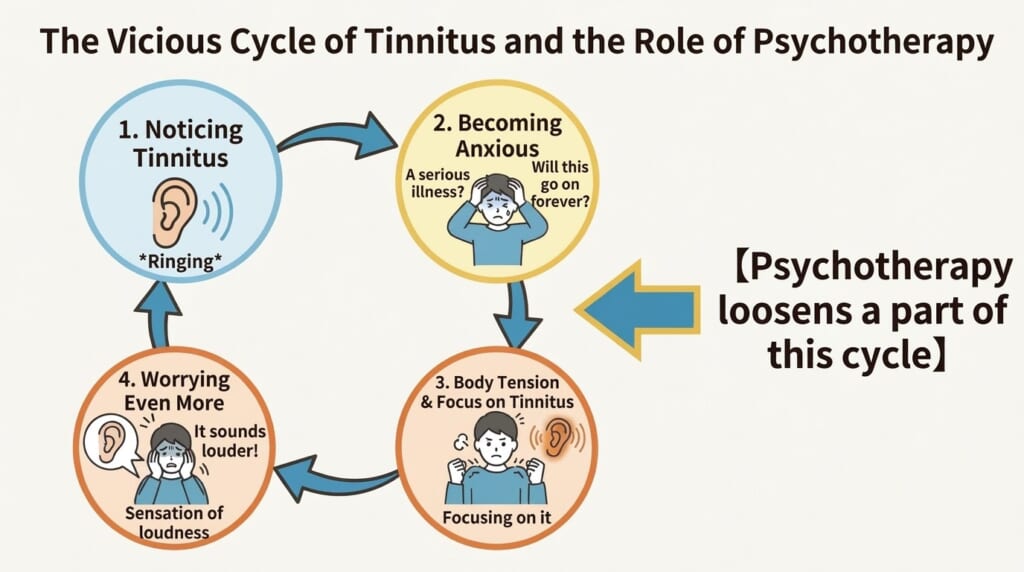
Here is how the tinnitus–anxiety loop often looks:
- You notice the tinnitus
- You worry: “What if it is something serious? What if it never stops?”
- Your body tenses up, and your attention keeps going back to the sound
- The tinnitus feels even louder and harder to bear
Once you are caught in this loop, the distress can keep growing, even when the sound itself has not changed. Therapy helps loosen the loop at one or more points, so you can step out of it.
The good news is that the brain can also learn to tune tinnitus out.
I once moved to a place where planes flew close overhead. At first the noise bothered me a lot. But at some point, I realized I had stopped noticing it. My brain had learned that this sound did not need my attention.
Many people with tinnitus go through a similar change over time. Our guide on how long it takes to get used to tinnitus explains what that process usually looks like.
Types of Therapy for Tinnitus
There are a few types of psychological therapy for tinnitus. Some people use just one, and others combine them.
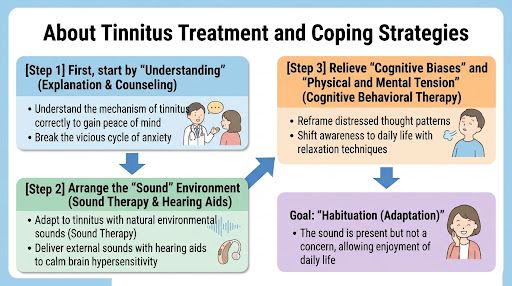
Education and counseling: the usual first step
The first step is usually simply learning about tinnitus from a doctor or audiologist.
They explain why tinnitus happens, that it is usually not a sign of a serious illness, and that many people find it bothers them less over time. For a lot of people, just understanding what the sound is takes away a big part of the worry.
It is a bit like a haunted house. Once you know how the tricks work, it is much less scary. Tinnitus is similar: understanding it removes some of the fear of the unknown.
Cognitive behavioral therapy (CBT)
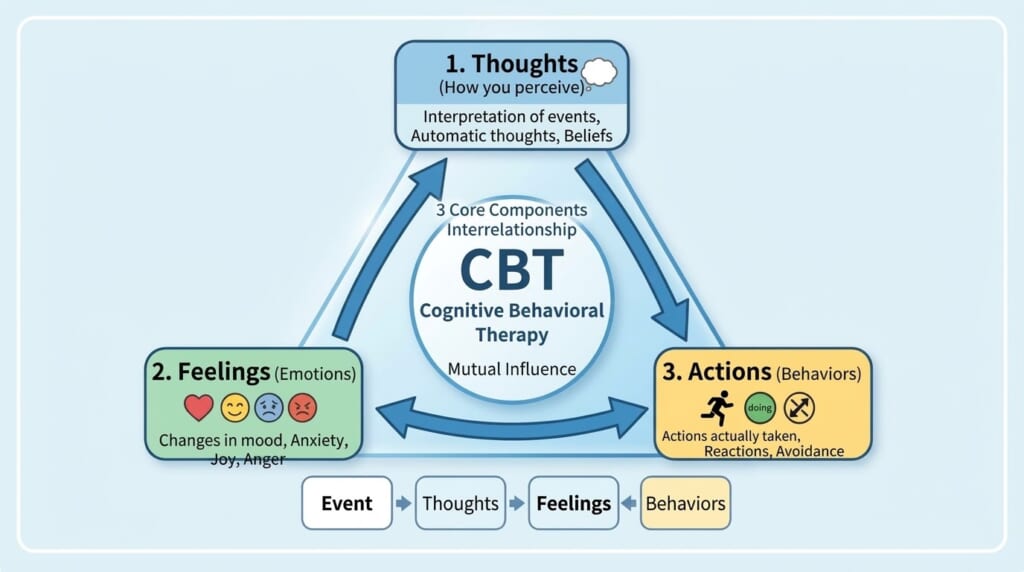
CBT helps you gradually change how you think about tinnitus and what you do because of it.
For example, if you hear the ringing and think, “This will be like this forever,” it is easy to feel low. If you can reframe that as, “It comes and goes, and there are times when I do not notice it,” you may feel a little lighter.
On the behavior side, someone who has stopped going out or given up hobbies because of tinnitus might work on getting back to them, one small step at a time.
A Cochrane review from 2020, which brought together 28 studies with over 2,700 people, found that CBT may reduce the impact of tinnitus on quality of life by the end of treatment. Programs in the studies lasted from a few weeks to a few months, and some were delivered online rather than face to face.
Mindfulness and ACT (acceptance and commitment therapy)
Mindfulness is the practice of paying attention to the present moment and noticing thoughts and sensations without judging them as good or bad.
ACT takes a similar approach. Instead of trying to push tinnitus away, you make room for it, and you spend your time and energy on the things that matter to you.
Both are closely related to CBT. A review of studies found that mindfulness-based programs reduced tinnitus distress right after treatment, but the long-term effects are still being studied.
Relaxation
Learning to relax your body can help ease tension. Simple methods include slow breathing and progressive muscle relaxation, where you tense a muscle group and then let it go.
However, there is not strong evidence that relaxation alone makes a big difference to tinnitus distress. It is best seen as a helpful extra alongside other approaches.
How to Get Started
The path depends on where you live, but it often looks like this.
- Get your ears checked. See a doctor (often an ENT specialist) or an audiologist first, to check for ear problems or hearing loss. Our guide on how doctors test for tinnitus explains what to expect.
- Fill in a questionnaire. You may be asked to fill in a short questionnaire about how much tinnitus affects your daily life, such as the Tinnitus Handicap Inventory (THI), and sometimes one about mood or anxiety.
- Learn about tinnitus. Your doctor or audiologist explains the results, how tinnitus works, and what to expect.
- Psychological support if needed. If tinnitus is still bothering you, you may be offered CBT or a related therapy with a psychologist or trained practitioner.
The questionnaires are not there to say it is all in your head. They help measure how much tinnitus is affecting you, and whether treatment is helping.
What a stepped approach looks like (UK example)
In the UK, the NICE guideline suggests a stepped approach for adults whose tinnitus still affects their wellbeing after initial support:
- Step 1: digital (online) tinnitus-focused CBT, provided by psychologists
- Step 2: a group program, such as mindfulness-based cognitive therapy, ACT, or CBT
- Step 3: one-to-one tinnitus-focused CBT with a psychologist
If one step does not help, or you would rather not try it, you can move on to the next. Other countries organize care differently, but this gives you a sense of the options to ask about.
How Well Does It Work?
Therapy usually helps in the sense that you notice tinnitus less and it gets in the way less, rather than the sound becoming quieter.
Here is what research suggests so far:
- CBT may reduce the impact of tinnitus on daily life (low to moderate certainty of evidence)
- It may also slightly improve low mood
- It is still unclear how long the benefits last after treatment ends
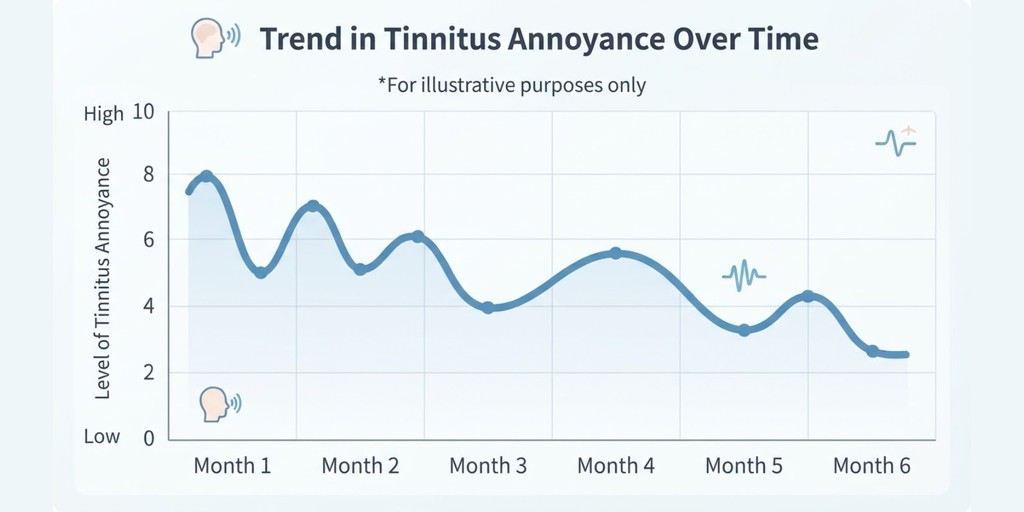
Do not worry if you do not feel a difference straight away. Most people find it gets easier gradually, with ups and downs along the way.
Things You Can Try on Your Own
The ideas behind therapy can also help in everyday life.
- Avoid total silence. Tinnitus stands out in a quiet room. Soft music or background sounds can make it less noticeable. Our guide to sound therapy explains how to choose sounds and set the volume.
- Try not to keep checking it. Listening out again and again to see whether it is louder today keeps your attention on it.
- Go easy on searching online. Reading lots of worrying stories tends to make anxiety grow. Write your questions down and ask your doctor instead.
- Keep doing what you enjoy. Giving up hobbies or going out less leaves more time to focus on tinnitus. Keep going as much as you can.
- Look after your sleep. Tinnitus is often harder to ignore when you are tired. See our guide on how to sleep with tinnitus.
Sometimes, the harder you try not to think about tinnitus, the more you notice it. It may help to tell yourself, “It is okay if I notice it. I will carry on with what I am doing anyway.”
How Therapy Fits With Other Treatments
Therapy is often combined with other approaches.
- Tinnitus retraining therapy (TRT): combines counseling with sound therapy to help you get used to tinnitus. See our guide to tinnitus retraining therapy.
- Hearing aids: if you also have hearing loss, hearing aids can make everyday sounds easier to hear, and some people find their tinnitus less noticeable as a result.
- Medication: a doctor may sometimes prescribe medicine for anxiety or sleep problems, but there is no medicine that switches tinnitus off. Talk to your doctor about whether it is right for you.
When to Get Help Sooner
Please do not try to cope alone if any of these apply:
- You have felt low for weeks, or nothing feels enjoyable anymore
- You have not been able to sleep for many nights in a row
- You have had thoughts of harming yourself or that you would be better off not here
If so, talk to your doctor about your mood as well as your tinnitus. If you ever feel you might act on thoughts of harming yourself, contact your local crisis line or emergency services right away.
Also, if you suddenly lose hearing in one ear and tinnitus starts at the same time, it could be sudden hearing loss. See a doctor as soon as possible. In this case, getting checked comes before therapy.
Living in Japan?
In Japan, the usual first step is an ENT clinic (耳鼻咽喉科, jibi-inkōka). The Japan Audiological Society’s tinnitus guideline (2019, in Japanese) strongly recommends education and counseling and CBT. CBT for tinnitus is still offered at a limited number of hospitals, and at the time of the guideline it was not covered by national health insurance, so check the cost in advance. A Japanese clinical trial published in 2026 found that a smartphone app delivering CBT reduced tinnitus distress, but it is not yet available as a treatment. If you need someone to talk to, the Ministry of Health, Labour and Welfare’s Mamorouyo Kokoro site (in Japanese) lists phone and chat support services.
FAQ
Will therapy make my tinnitus go away?
Therapy does not aim to remove the sound. It aims to reduce how much tinnitus bothers you, so it gets in the way of life less. Over time, many people find there are more and more moments when they simply forget about it.
If my doctor suggests therapy, does that mean they think it is all in my head?
No. Your tinnitus is a real sound that you are really hearing. Therapy starts from that: the sound is real, and the aim is to reduce the distress around it.
Can I do CBT for tinnitus on my own, or online?
Yes, to some extent. Online CBT programs and self-help books can teach you the main ideas, and online CBT is the first step in the UK’s NICE guideline. If your tinnitus is causing a lot of distress, though, working with a trained professional is more reassuring. Ask your doctor or audiologist what is available near you.
Is there medication for tinnitus anxiety?
A doctor may prescribe medicine for anxiety, low mood, or sleep in some cases, but it does not treat the tinnitus itself, and some medicines have side effects. Decide together with your doctor whether it makes sense for you.
Does mindfulness help tinnitus?
It may help some people. Studies suggest mindfulness-based programs can reduce tinnitus distress in the short term. It does not change the sound itself, and long-term results are still being studied.
Key Takeaways
- Therapy for tinnitus eases the distress and worry, rather than switching the sound off.
- Worry and focus can make tinnitus feel worse, and therapy helps break that loop.
- Education and counseling usually come first. CBT has the strongest evidence, and mindfulness and ACT are related options.
- Online CBT is a common starting point, with group or one-to-one therapy if needed.
- If your mood is very low, or tinnitus came with sudden hearing loss, get help sooner.
Tinnitus often feels bigger the more you focus on it. By understanding how it works and changing how you respond to it, little by little, many people find it gets much easier to live with. If it is bothering you, a good first step is to talk to your doctor or an audiologist.
References
- Fuller T, Cima R, Langguth B, Mazurek B, Vlaeyen JWS, Hoare DJ. Cognitive behavioural therapy for tinnitus. Cochrane Database of Systematic Reviews. 2020;1:CD012614. https://doi.org/10.1002/14651858.CD012614.pub2
- National Institute for Health and Care Excellence (NICE). Tinnitus: assessment and management (NG155). 2020. https://www.nice.org.uk/guidance/ng155
- Tunkel DE, Bauer CA, Sun GH, et al. Clinical practice guideline: tinnitus. Otolaryngology–Head and Neck Surgery. 2014;151(2 Suppl):S1–S40. https://doi.org/10.1177/0194599814545325
- Rademaker MM, Stegeman I, Ho-Kang-You KE, Stokroos RJ, Smit AL. The effect of mindfulness-based interventions on tinnitus distress: a systematic review. Frontiers in Neurology. 2019;10:1135. https://doi.org/10.3389/fneur.2019.01135
- Wasano K, et al. Mobile application as a digital therapeutic for chronic tinnitus: a randomized clinical trial. JAMA Otolaryngology–Head & Neck Surgery. 2026;152(7):677–685. https://doi.org/10.1001/jamaoto.2026.0858
- Japan Audiological Society. Clinical Practice Guidelines for Tinnitus 2019 (in Japanese). https://minds.jcqhc.or.jp/summary/c00511/

コメント