
“You’ll just have to learn to live with it.” If a doctor has said this to you about your tinnitus, you may have left the appointment feeling more worried, not less. Live with it for how long? And is waiting really the only option?
The short answer: getting used to tinnitus is possible for many people, but there is no fixed timeline. It usually happens gradually over months, sometimes longer, with good days and bad days along the way. And there is a lot you can do to help it along.
I have tinnitus myself now and then. My wife has tinnitus too, a high ringing and a lower hum. I know how hard it is to stop thinking about it once you start noticing it. This guide explains what “getting used to it” really means, how long it tends to take, and where to start.
In this article
- What getting used to tinnitus (habituation) actually means
- How long it usually takes
- What to do when you are told to “live with it”
- Things that can slow your progress
- Signs that mean you should see a doctor soon
What Does “Getting Used to Tinnitus” Mean?
Getting used to tinnitus does not mean the sound goes away. It means the sound is still there, but you notice it less often, and it no longer runs your sleep, mood, or day. This is called habituation.
Your brain does this with sounds all the time. Think of the hum of a fridge or an air conditioner. You hear them, but after a while they stop reaching your attention, because your brain has decided they do not matter. A Japanese ENT specialist who works with tinnitus patients explains that our sense of sound adapts easily in this way, and that once people understand their tinnitus and spend time in surroundings that draw attention away from it, many stop being troubled by it, even if the sound remains.
I experienced something similar when I moved to a place near a flight path. At first, every plane bothered me. Then one day I realized I had stopped noticing them.
The opposite also happens. If tinnitus feels threatening (“What if something is seriously wrong?”), the brain keeps watch over it, and that makes it harder to tune out. Worry and attention are thought to play a big part in how bothersome tinnitus becomes. For the bigger picture of causes and types, see our guide to tinnitus.
How Long Does It Take to Get Used to Tinnitus?
This is the question most people ask first. The honest answer is that it varies a lot from person to person, and there is no set timeline. Here is what the evidence suggests:
- If your tinnitus is new: tinnitus that comes on suddenly often fades on its own, frequently within about six months.
- If it has lasted a long time: it often becomes milder over the years, and sometimes disappears. A Japanese ENT specialist who uses hearing aids and counseling reports that once patients properly understand their tinnitus, it gradually bothers them less, and many stop being troubled by it within about a year, even though the sound itself remains.
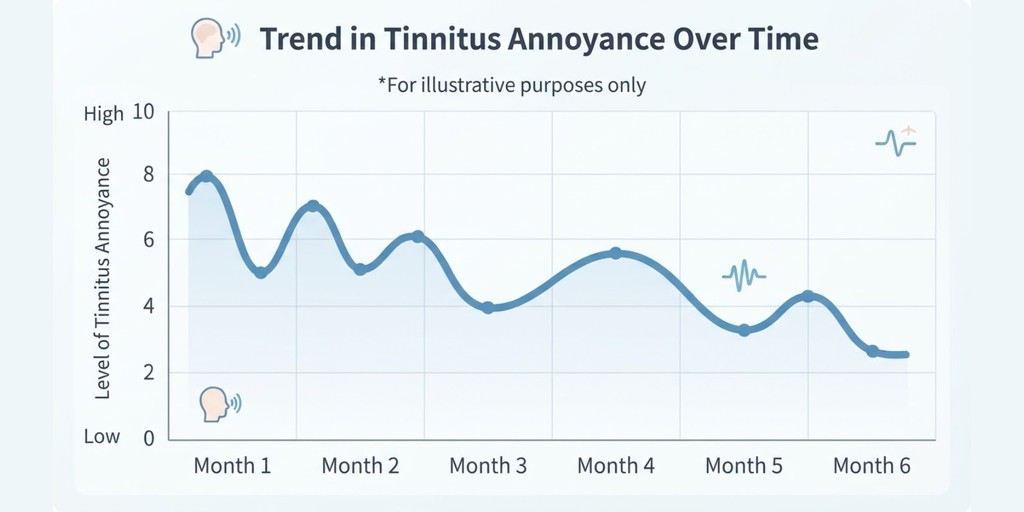
- What research shows: a review of clinical trials found that tinnitus tended to bother people a little less over time, even during periods when they were not receiving treatment. But the amount of change varied widely from person to person.
So if you have not adjusted after a few weeks, that does not mean something is wrong. Gradual improvement over months, sometimes years, with ups and downs, is the common pattern. Because good days and bad days come and go, it helps to compare how you feel now with a few months ago, rather than day by day.
Some treatments are built around habituation and follow a set time frame. Tinnitus retraining therapy (TRT), for example, usually runs for a year or more.
Told to “Live With It”? Here Is What That Should Mean
“Learn to live with it” can sound like being brushed off. But what it should mean is this: once anything serious has been ruled out, the next step is finding ways to help you get used to the sound.
The UK’s NICE guideline recommends that, at the first appointment, people with tinnitus are reassured that:
- Tinnitus is common
- It may go away on its own
- It often comes with hearing loss, but is not often linked to other physical health problems
- There are many ways to manage it that help many people live well with tinnitus
In other words, “live with it” is not the same as “there is nothing you can do.” There are real ways to support habituation. Here is where to start.
How to Get Used to Tinnitus: Step by Step
Guidelines in several countries point to the same core approaches: education and counseling about tinnitus, sound therapy, and psychological therapy such as cognitive behavioral therapy (CBT). Below, they are arranged in a rough order of where to begin. You do not need to do everything. Start with what fits you.
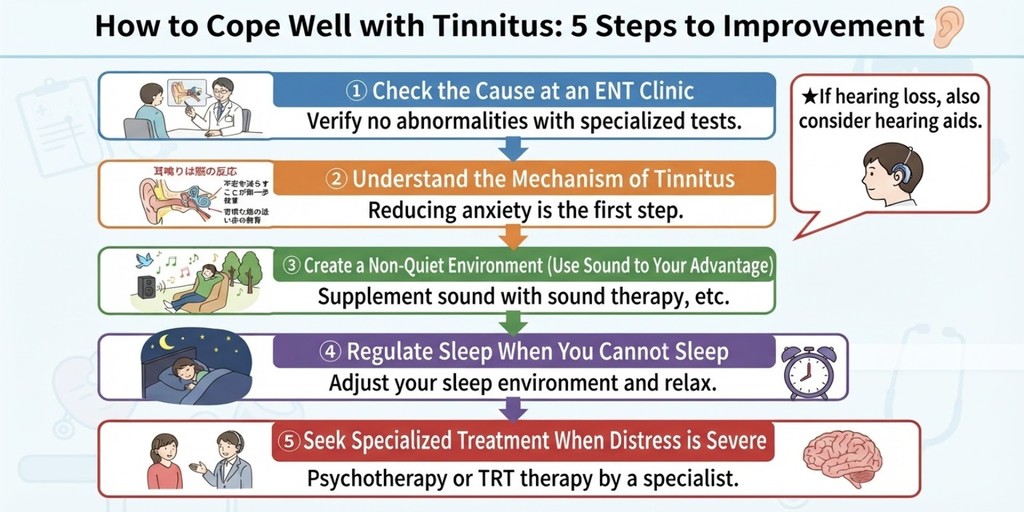
Step 1: Get your ears and hearing checked
The first step is to see a doctor (often an ENT specialist) or an audiologist, who can examine your ears and test your hearing. Most tinnitus comes with some degree of hearing loss, but sometimes a treatable cause is found.
For many people, simply hearing “this is not a sign of something dangerous” takes a lot of the fear away. Less fear means your brain has less reason to keep watching the sound, which is exactly what habituation needs.
Wondering what that check-up involves? See how doctors test for tinnitus for each step, from the hearing test to scans.
Step 2: Understand how tinnitus works
Next, learn why tinnitus happens and why it can feel so loud and intrusive. Some clinics explain this with diagrams or simple models.
Once you understand that the sound is not harming you, the way you react to it starts to change. In the Japanese specialist’s experience mentioned above, this kind of understanding is where getting used to tinnitus begins.
Step 3: Avoid silence and let sound help
Tinnitus stands out most in quiet places. Playing low-level background sound, such as the radio, soft music, rain sounds, or a fan, makes your surroundings richer and the tinnitus less noticeable. This is called sound therapy.
The aim is not to drown tinnitus out, but to make it blend into the background. Our sound therapy guide explains which sounds to use, how loud to play them, and when.
If you also have hearing loss, hearing aids can bring back everyday sounds you have been missing, and for some people that makes tinnitus less noticeable too.
Step 4: If you cannot sleep, work on sleep
Many people find tinnitus hardest at bedtime, when everything is quiet. A run of bad nights can create a cycle: tiredness and worry make tinnitus more noticeable, which makes sleep harder.
Simple changes can help, such as keeping a soft sound on in the bedroom rather than total silence, and giving yourself time to wind down before bed.
Our guide on how to sleep with tinnitus explains how to use bedtime sound, which habits help, and when to ask about insomnia treatment.
Step 5: If it is really getting you down, ask about specialist help
If tinnitus is affecting your mood, work, or daily life, treatments that ease the emotional side can help. CBT helps you change how you think about and react to tinnitus, and it has good evidence for reducing tinnitus distress.
Our guide to CBT for tinnitus explains how counseling, CBT, and mindfulness work, and how to get started, including online CBT.
Tinnitus retraining therapy, mentioned above, is another structured option that combines counseling and sound over many months.
Things That Can Slow Your Progress
Some things that feel helpful can actually make tinnitus stand out more.
Keeping everything quiet
When you have tinnitus, it is natural to want peace and quiet. But in silence, tinnitus becomes more noticeable, not less. Specialists say that trying to keep things quiet is one of the most common mistakes people with tinnitus make.

Checking on it again and again
“Is it louder today?” “Is it still there?” Every time you stop to listen, your attention goes straight back to the sound. Since attention is thought to play a big part in how bothersome tinnitus feels, frequent checking tends to keep it in the spotlight.
Rather than forcing yourself not to think about it, try to gradually build up the time you spend absorbed in something else, or in places with some background sound. Over time, that makes it easier for your attention to drift away from the tinnitus.
Hoping a pill will switch it off
There is currently no medicine with good evidence for directly treating long-term tinnitus. A doctor may prescribe medication for related problems such as sleep or anxiety, but it works best alongside counseling and sound, not as the only plan.
In the same way, be careful with products that promise to make tinnitus disappear. Many have little evidence behind them, so it is worth checking with a doctor or audiologist first.
When to See a Doctor Soon
Most tinnitus is not a sign of anything dangerous. But do not wait to get used to it if any of the following apply. The NICE guideline groups these by how urgently they should be checked.
Get help right away (the same day):
- Tinnitus with sudden weakness of the face, other sudden nerve symptoms, or a severe, uncontrolled spinning feeling (vertigo)
- Signs of a possible stroke. Call emergency services
- Thoughts of harming yourself. Contact emergency services or a crisis line right away
Be seen within 24 hours:
- Tinnitus together with hearing loss that came on suddenly (over three days or less). This can be sudden hearing loss, which is best treated quickly
Book an appointment soon:
- Tinnitus that is causing so much distress that it stops you from doing your usual daily activities
- Tinnitus in one ear only that does not go away, or tinnitus with hearing loss in one ear
- Tinnitus that pulses in time with your heartbeat (pulsatile tinnitus), which can sometimes be related to blood flow and is worth checking
If you have already been told to “wait and see,” it is fine to go back if your tinnitus changes or if any of these signs appear.
Living in Japan?
In Japan, tinnitus is usually seen at an ENT clinic (耳鼻咽喉科, jibi-inkōka), which will start with a hearing test. The Japan Audiological Society’s Tinnitus Practice Guideline (2019, in Japanese) lists education and counseling, sound therapy, and CBT as treatments for tinnitus. Some hospitals also have a dedicated tinnitus clinic (耳鳴り外来).
FAQ
Will it take years to get used to my tinnitus?
It depends on the person. Some people stop being bothered within a few months, while others take longer. Understanding tinnitus and using sound can help the process along. Try to look back over months rather than days.
If I stop paying attention to it, will my tinnitus go away?
Not necessarily. You can stop being bothered by tinnitus even if the sound remains, and that counts as getting used to it. That said, tinnitus does sometimes fade on its own.
I had got used to it, but now I notice it again. Why?
Stress, illness, or poor sleep can bring tinnitus back into focus for a while. Habituation has ups and downs, and things often settle again. If the sound changes a lot, or you notice new hearing loss, see a doctor.
Is it normal to feel anxious or low because of tinnitus?
Yes, many people do, especially early on. It is worth mentioning to your doctor, because the emotional side of tinnitus can be treated too.
Key Takeaways
- Getting used to tinnitus means noticing it less, not the sound disappearing.
- There is no fixed timeline. Gradual improvement over months or longer, with ups and downs, is common.
- “Live with it” does not mean “do nothing.” Get checked, understand tinnitus, avoid silence, protect your sleep, and ask for specialist help if needed.
- Total silence, constant checking, and relying on pills alone can slow progress.
- Sudden hearing loss, sudden nerve symptoms or vertigo, one-sided or pulsing tinnitus, and strong distress mean seeing a doctor soon.
Everyone’s path with tinnitus is a little different. Take it one step at a time, and find what works for you.
References
- National Institute for Health and Care Excellence (NICE). Tinnitus: assessment and management (NG155). 2020. NICE
- Phillips JS, McFerran DJ, Hall DA, Hoare DJ. The natural history of subjective tinnitus in adults: a systematic review and meta-analysis of no-intervention periods in controlled trials. Laryngoscope. 2018;128(1):217–227. DOI
- Mori K. [Tinnitus that is dangerous, tinnitus best left unattended, and misunderstood tinnitus] (in Japanese). Web Iji Shinpo. 2023 (updated 2026). Web Iji Shinpo
- Nitta S. [Sound therapy for tinnitus using hearing aids] (in Japanese). Web Iji Shinpo. 2021. Web Iji Shinpo
- Japan Audiological Society. Tinnitus Practice Guideline 2019 (Kanehara, in Japanese).


コメント