
Have you noticed a ringing or buzzing in your ears around the same time your hearing started to slip?
You are not imagining the connection. Hearing loss and tinnitus very often show up together.
My wife has moderate hearing loss and tinnitus, a high ringing and a lower hum, and I have tinnitus myself now and then. In this guide, I will explain why hearing loss can lead to tinnitus, in plain words, and what can help when you have both.
For the bigger picture on tinnitus types and when to see a doctor, see our guide to tinnitus.
In this article
- Why hearing loss and tinnitus so often go together
- How sound reaches your brain, and why the brain “turns up the volume”
- How the pitch of your tinnitus relates to your hearing loss
- How hearing aids and other options can help
- When sudden hearing loss with tinnitus needs a doctor quickly
- Hearing Loss and Tinnitus Often Go Together
- Why Does Hearing Loss Cause Tinnitus?
- Does the Pitch of Your Tinnitus Match Your Hearing Loss?
- What If Your Hearing Test Is Normal?
- What Helps When You Have Hearing Loss and Tinnitus?
- Sudden Hearing Loss With Tinnitus: See a Doctor Quickly
- Living in Japan?
- FAQ
- Key Takeaways
Hearing Loss and Tinnitus Often Go Together
Most people with tinnitus have some degree of hearing loss. The US National Institute on Deafness and Other Communication Disorders (NIDCD) describes hearing loss as strongly linked to tinnitus.
It is especially common with the slow, age-related hearing loss many of us get as we get older, and with hearing loss caused by loud noise.
That said, not everyone with hearing loss develops tinnitus.
The most important thing to know first: tinnitus that comes with gradual hearing loss is usually not a sign of anything dangerous. The UK’s NHS notes that tinnitus is not usually a sign of anything serious.
Simply understanding why it happens can make it feel a little less scary.
Why Does Hearing Loss Cause Tinnitus?
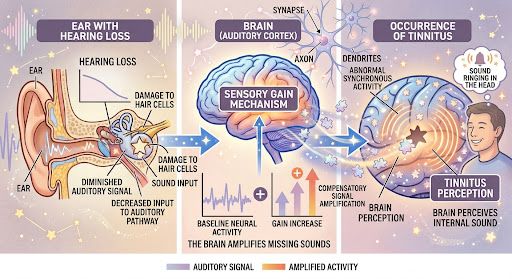
In one sentence: when less sound reaches the brain, the brain turns up its sensitivity to make up for it, and that extra activity can be heard as a sound.
Let’s go through it step by step.
How sound reaches your brain
When you hear something, the sound travels like this:
- Sound enters your ear canal and makes your eardrum vibrate.
- The vibration passes to the cochlea, a small snail-shaped organ deep in your ear.
- Tiny hair cells inside the cochlea turn the vibration into electrical signals.
- Those signals travel along the hearing nerve to the brain, which recognizes them as sound.
So your ears are the collectors and converters. The part that actually “hears” is your brain.
When hair cells are damaged, fewer signals reach the brain
Hair cells get their name from the tiny hair-like bundles on top of them. They are the parts that pick up sound vibrations.
Aging, loud noise, some illnesses, and some medicines can damage these cells. When that happens, sound is not turned into signals as well as before.
This is called sensorineural hearing loss, meaning hearing loss that starts in the inner ear or the nerve. You can read more in our guides to hair cells and sensorineural hearing loss.
The brain turns up its sensitivity
So what does the brain do when fewer signals arrive?
A leading theory is that the brain tries to make up for the missing sound by turning up its own activity in the areas that handle hearing. NIDCD describes this as one of the main ideas researchers are studying.
Here is a simple way to picture it.
Imagine listening to a radio station with a weak signal. The voice is quiet, so you turn the volume up. The voice gets a little clearer, but the background hiss gets louder too.
Something similar seems to happen in the brain. With the sensitivity turned up, tiny bits of nerve activity that you would normally never notice start to come through as a sound. That is thought to be what tinnitus is for many people with hearing loss.
Scientists have not worked out every detail yet. This is the explanation with the most support so far, not the final word.
Does the Pitch of Your Tinnitus Match Your Hearing Loss?
Many people hear a high-pitched ring rather than a low hum. Why?
It may come down to which sounds you are missing. A study from the University of Nottingham found that the pitch of tinnitus often falls within the range of pitches where a person’s hearing is reduced.
Age-related and noise-related hearing loss usually affect high-pitched sounds first. That may be why a high ringing is such a common type of tinnitus.
But it is not a perfect match, and it varies from person to person. The sound alone cannot tell you the cause, so if it worries you, a hearing test is the best way to find out what is going on.
What If Your Hearing Test Is Normal?
Some people have tinnitus even though their hearing test comes back “normal.”
Research from Mass Eye and Ear in Boston, funded in part by the US National Institutes of Health (NIH), found that adults with long-lasting tinnitus and normal hearing tests were more likely to show signs of damage to the hearing nerve. A standard hearing test does not pick up this kind of damage, which is sometimes called “hidden hearing loss.”
This supports the same idea: even when the test looks normal, the brain may be getting less information from the ear than before.
If your results were normal, our guide to how doctors test for tinnitus explains what the tests show and what “normal” means.
What Helps When You Have Hearing Loss and Tinnitus?
With this kind of tinnitus, the goal is usually not to make the sound disappear completely. It is to help it fade into the background so it bothers you less.
Here are the main options.
Start with a hearing test
If your tinnitus keeps going, the first step is a hearing test with an audiologist or an ear, nose, and throat (ENT) doctor. You may find you have some hearing loss you had not noticed.
The 2026 update of the US tinnitus guideline from the American Academy of Otolaryngology–Head and Neck Surgery Foundation (AAO-HNSF) says everyone with tinnitus should have a full hearing evaluation.
Knowing your hearing level helps you choose the right next step. See our guide to how doctors test for tinnitus to know what to expect.
Use hearing aids to bring sound back to the brain
If you have hearing loss, hearing aids are one of the first things to consider. NIDCD, the NHS, and the AAO-HNSF guideline all include hearing aids as an option for people with tinnitus and hearing loss.

Going back to the radio: hearing aids are like making the signal stronger. When everyday sounds reach the brain clearly again, the brain does not need to turn its sensitivity up so far, and many people find their tinnitus less noticeable.
Hearing aids also make the world around you louder, so the tinnitus has more company and stands out less.
A few things are worth knowing:
- They do not make tinnitus go away for everyone. Results vary from person to person.
- Fitting matters. Tinnitus UK notes that the benefit is greater when hearing aids are properly fitted to your hearing loss.
- Wear them through the day. Tinnitus UK recommends wearing them during your waking hours for the most benefit.
- Give it a few weeks. It usually takes a little while to get used to new hearing aids.
Some hearing aids also have a built-in sound generator that plays a soft, steady sound. Your audiologist can tell you whether that might suit you.
For the basics on types, costs, and how to choose, see our guide to hearing aids.
Avoid complete silence
Have you noticed your tinnitus seems loudest in a quiet room? With fewer sounds around you, the tinnitus has nothing to blend into.
Playing soft background sounds, such as gentle music, a fan, or nature sounds, can help the tinnitus blend in. This is called sound therapy. Our guide to sound therapy for tinnitus explains which sounds to use and how loud to play them.
Retraining and counseling
Tinnitus Retraining Therapy (TRT) combines sound therapy, often with hearing aids or sound generators, with counseling. The aim is to help you get used to the sound over time. You can read more in our guide to TRT.
Counseling and cognitive behavioral therapy (CBT) can also help reduce how much tinnitus bothers you. To see every option side by side, see our guide to tinnitus treatment options.
Sudden Hearing Loss With Tinnitus: See a Doctor Quickly
Everything above is about hearing loss that comes on slowly.
If you suddenly lose hearing in one ear and notice tinnitus at the same time, that is different. It may be sudden sensorineural hearing loss, which is best treated as early as possible.
Do not wait to see if it gets better. See a doctor as soon as you can. Our guide to sudden hearing loss explains what to do.
Living in Japan?
In Japan, you can usually go straight to an ENT clinic (耳鼻咽喉科, jibi-inkōka) without a referral, and that is the usual first stop for tinnitus. Japan’s tinnitus guideline (2019 edition, Japan Audiological Society) also lists hearing aids as one of the options for treating tinnitus.
FAQ
Can tinnitus cause hearing loss?
No. It usually works the other way around. Hearing loss is a common reason for tinnitus, but tinnitus itself does not damage your hearing. Loud tinnitus can make it harder to hear things, though, so it is worth getting your hearing checked.
Will my tinnitus go away if my hearing comes back?
It depends on the type of hearing loss. Some kinds, like sudden hearing loss treated early, can improve. Age-related and noise-related hearing loss usually cannot be reversed. But that does not mean you are stuck with bothersome tinnitus. Many people find it fades into the background over time with hearing aids, sound therapy, and other support.
Do hearing aids help tinnitus, or can they make it worse?
Hearing aids are generally regarded as safe, and for many people with hearing loss they make tinnitus less noticeable. The first few weeks can feel strange while you get used to them. If sounds seem too loud or your tinnitus bothers you more, ask your audiologist to check the settings.
Do supplements help tinnitus from hearing loss?
The 2026 AAO-HNSF guideline recommends against routinely using medications or dietary supplements to treat tinnitus. Be careful with products that promise to stop tinnitus, and talk to a doctor before trying anything new.
Key Takeaways
- Hearing loss is the most common reason for tinnitus.
- When less sound reaches the brain, the brain turns up its sensitivity, like turning up a weak radio and hearing more hiss.
- Hearing aids can help by bringing sound back to the brain, and sound therapy and TRT are other options.
- Sudden hearing loss with tinnitus: see a doctor quickly.
If tinnitus has been bothering you, a hearing test is a good first step. It is often the start of finding what helps.
References
- National Institute on Deafness and Other Communication Disorders (NIDCD). Tinnitus.
- NHS. Tinnitus.
- Tinnitus UK. Hearing aids.
- Tinnitus UK. Tinnitus and hearing aids.
- American Academy of Otolaryngology–Head and Neck Surgery Foundation (AAO-HNSF). Clinical Practice Guideline: Tinnitus Update (news release, October 2026).
- Sereda M, Edmondson-Jones M, Hall DA. Relationship between tinnitus pitch and edge of hearing loss in individuals with a narrow tinnitus bandwidth. International Journal of Audiology. 2015;54(4):249–256.
- NIH Research Matters. Cochlear nerve damage associated with tinnitus. January 9, 2024.
- Vasilkov V, Caswell-Midwinter B, Zhao Y, et al. Evidence of cochlear neural degeneration in normal-hearing subjects with tinnitus. Scientific Reports. 2023;13:19870.
- Mayo Clinic News Network. Mayo Clinic Q and A: Tinnitus can interfere with hearing but doesn’t cause hearing loss.


コメント