Have you read about tinnitus treatments online and ended up more confused than before? Sound machines, hearing aids, therapy, pills, supplements, new devices… it is hard to tell which ones are worth your time.
Maybe a doctor even told you, “There is no cure, so you will have to live with it.” That can feel like a door closing. But it is not the whole story. There is no proven way to switch long-lasting tinnitus off yet, but there are well-studied treatments that can make it much less bothersome.
My wife has hearing loss and tinnitus, a high ringing and a lower hum, and I have tinnitus myself now and then. This guide lines up the main treatment options side by side, shows where the evidence stands for each, and helps you decide where to start based on what bothers you most.
In this article
- Is there a cure for tinnitus?
- The main treatment options at a glance
- Where to start, based on what bothers you most
- Medicines, supplements, and newer devices like Lenire
- What you can do at home, and when to see a doctor soon
- Is There a Cure for Tinnitus?
- First Step: Get Your Ears and Hearing Checked
- Tinnitus Treatment Options at a Glance
- A Closer Look at Each Option
- Where to Start: Match the Option to What Bothers You Most
- Medicines, Supplements, and Quick-Relief Products
- Newer Treatments Being Studied
- What You Can Do at Home
- See a Doctor Soon If…
- Living in Japan?
- FAQ
- Key Takeaways
Is There a Cure for Tinnitus?
The short answer: not yet. No medicine, device, or surgery has been shown to make long-lasting tinnitus go away for everyone. Research is active, but none of it has produced a proven cure so far.
So what does treatment aim for? It aims to make tinnitus less noticeable and less distressing, so that you can sleep, focus, and enjoy your day even if the sound is still there.
Think of a ticking clock in a new bedroom. On the first night, you hear every tick. A few weeks later, the clock is still ticking, but you hardly notice it. Most tinnitus treatment is about helping your brain make that same shift.
How much tinnitus bothers you does not depend on loudness alone. The same sound can feel much louder on a stressful day or in a silent room at night. That is good news, because it means the burden can shrink even when the sound itself stays.
And sometimes tinnitus does improve. If it is linked to something treatable, such as earwax, an ear infection, or a side effect of a medicine, dealing with that cause can help. That is why the first step is a checkup.
First Step: Get Your Ears and Hearing Checked
Before choosing a treatment, it helps to know what is going on. Depending on where you live, you may start with a family doctor, an audiologist (a hearing specialist), or an ear, nose, and throat (ENT) doctor.
The visit usually includes questions about your tinnitus, a look inside your ears, and a hearing test. The latest US guideline (2026) says everyone with persistent, bothersome tinnitus should have a full hearing evaluation. Many people with tinnitus also have some hearing loss, and that changes which treatments make sense.
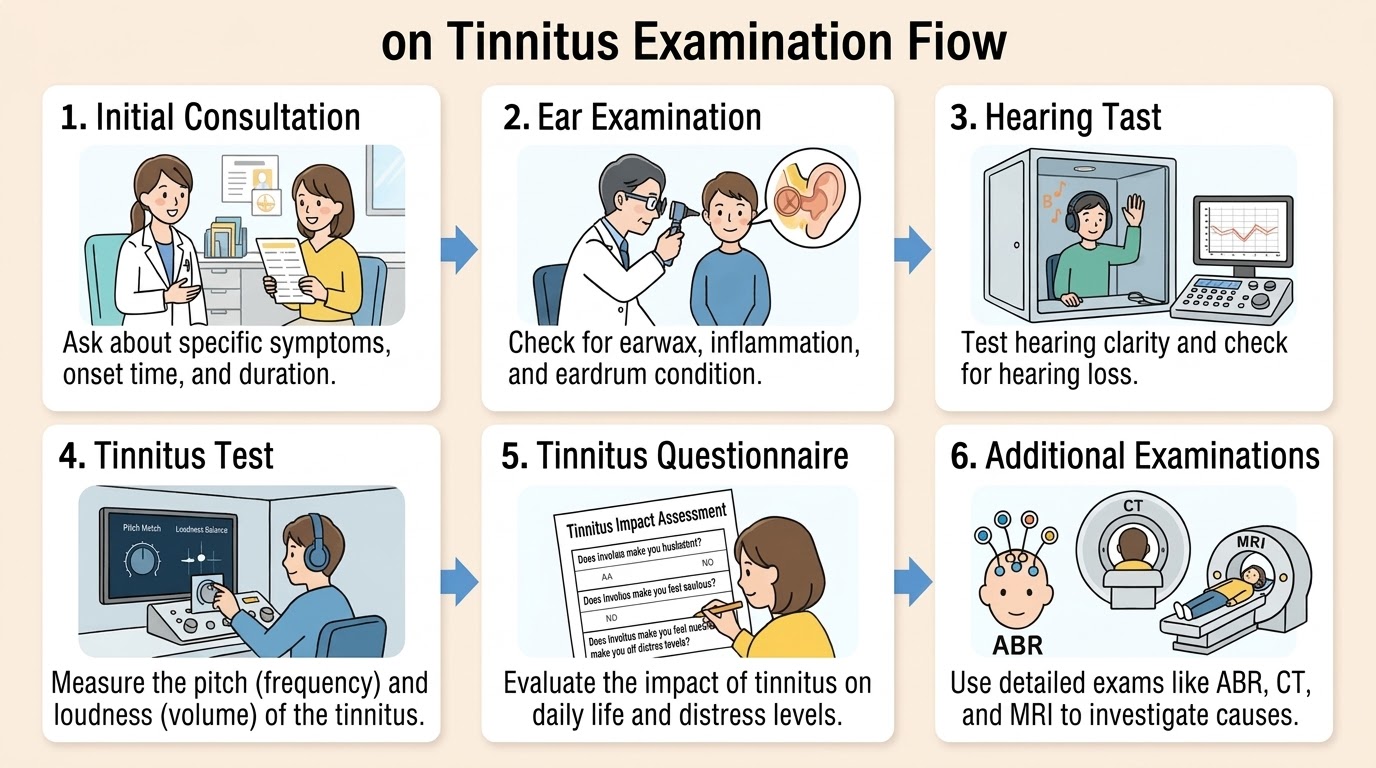
To see each test step by step, read our guide to how doctors test for tinnitus.
If your hearing dropped suddenly along with the tinnitus, do not wait to see if it passes. It may be sudden hearing loss, which is best treated as soon as possible.
Tinnitus Treatment Options at a Glance
Here are the main options, with a plain summary of where the evidence stands. This is based mainly on the UK’s NICE guideline (2020) and the US guideline from the American Academy of Otolaryngology–Head and Neck Surgery Foundation (AAO-HNSF, updated in 2026).
| Option | What it does | Where the evidence stands |
|---|---|---|
| Education and counseling | Explains tinnitus and what to expect, so it feels less threatening | A core part of care in major guidelines |
| Hearing aids (if you have hearing loss) | Bring back outside sound, so tinnitus stands out less | Recommended when hearing loss affects communication |
| CBT and related therapies | Change how you react to tinnitus | The best-studied way to reduce distress |
| Sound therapy | Soft background sound that makes tinnitus less noticeable | Widely used, but research quality is limited |
| Tinnitus retraining therapy (TRT) | Counseling plus sound over many months | Offered at some clinics; results vary |
| Masking | A louder sound that covers tinnitus | Short-term relief; tinnitus usually returns |
| Medicines and supplements | Treat related problems, such as poor sleep or low mood | Not recommended for tinnitus itself |
| Newer devices and brain stimulation | Neuromodulation devices, rTMS | Still being studied; rTMS is not recommended |
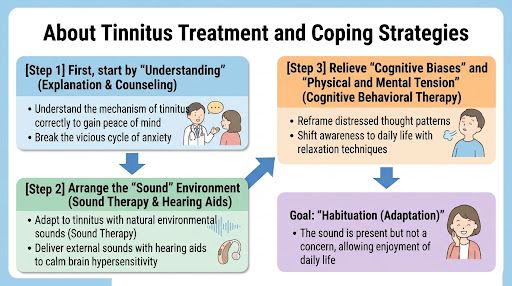
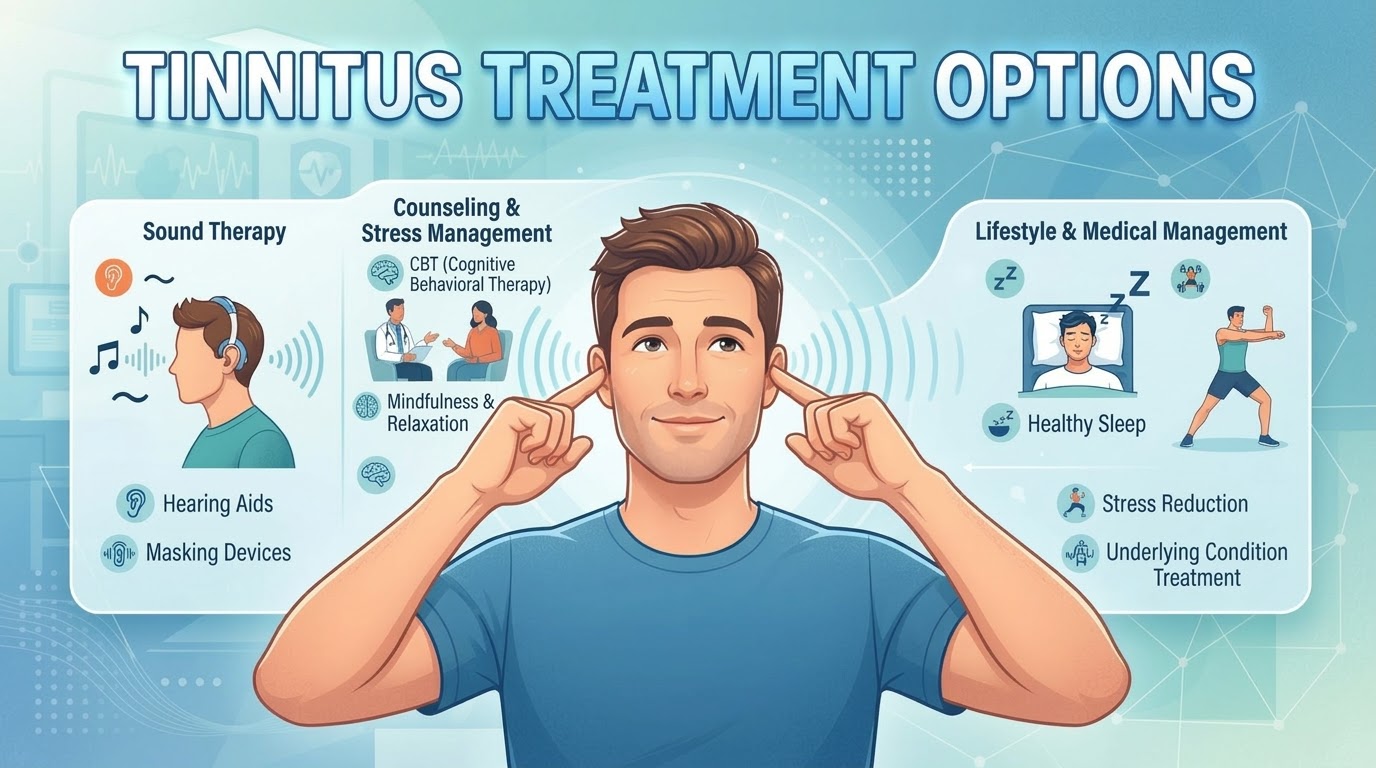
The first four, education, hearing aids when needed, CBT, and sound, are the core of tinnitus care today. Many people use more than one at the same time.
A Closer Look at Each Option
Education and counseling
Learning that tinnitus is very common, and that it is rarely a sign of something dangerous, can take a lot of the fear away.
Less fear often means less attention on the sound, and less attention means it bothers you less. It sounds simple, but it really matters.
Hearing aids, if you have hearing loss
Many people with tinnitus also have some hearing loss, sometimes without realizing it. When the ears send less sound to the brain, tinnitus can stand out more.
Hearing aids bring everyday sounds back. It is a bit like turning on the lights in a dark room: once there is more to see, one small spot no longer grabs all your attention. Some hearing aids also have a built-in sound generator for tinnitus.
NICE recommends offering hearing aids to people with tinnitus whose hearing loss affects their ability to communicate, but not to people with no hearing loss. To learn more, see our guide to what hearing aids are and how they work.
CBT and related therapies
Cognitive behavioral therapy (CBT) does not make the sound quieter. Instead, it helps you change the thoughts and habits that keep tinnitus in the spotlight. A Cochrane review (2020) found that CBT may reduce the impact tinnitus has on daily life.
NICE suggests a stepped approach: start with a digital CBT program, then move on to group or one-to-one therapy if needed. To learn how it works and how to get started, see our guide to CBT for tinnitus.
Sound therapy
Tinnitus is most noticeable in silence. Sound therapy fills that silence with soft background sound, such as a fan, rain sounds, gentle music, or an app.
The key is the volume. Sound therapy usually keeps it quiet enough that you can still just hear your tinnitus, so your brain can slowly learn to tune it out. Our guide to sound therapy explains which sounds to try and how loud to play them.
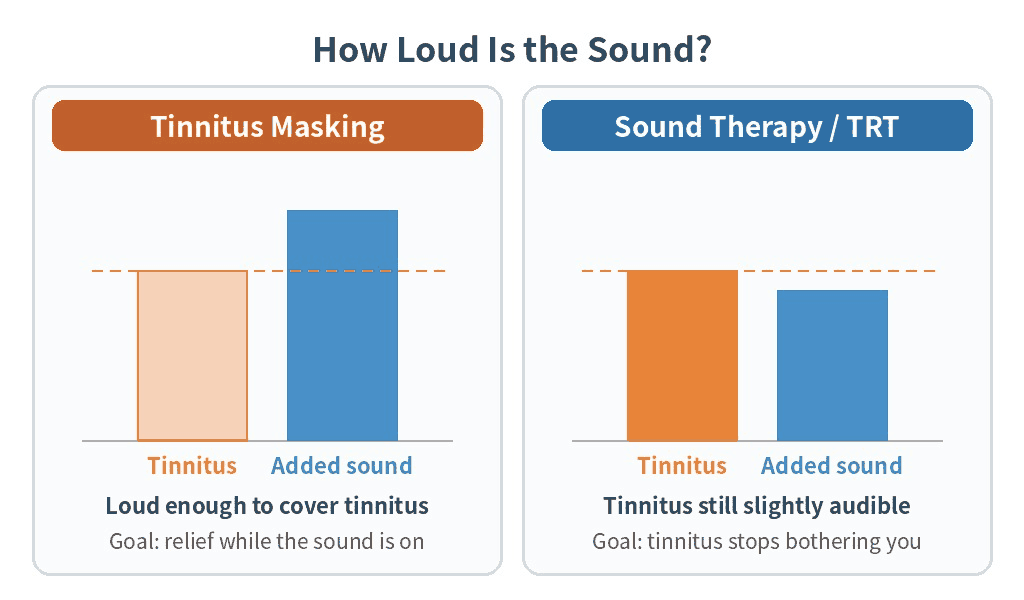
Using a louder sound to cover tinnitus completely is called tinnitus masking. It can bring relief while the sound is playing, but the tinnitus usually comes back when it stops.
Tinnitus retraining therapy (TRT)
TRT combines counseling about how tinnitus works with low-level sound, usually over many months. It is offered at some specialist clinics, and studies so far show mixed results. See our guide to tinnitus retraining therapy (TRT) for how it works and how long it takes.
Where to Start: Match the Option to What Bothers You Most
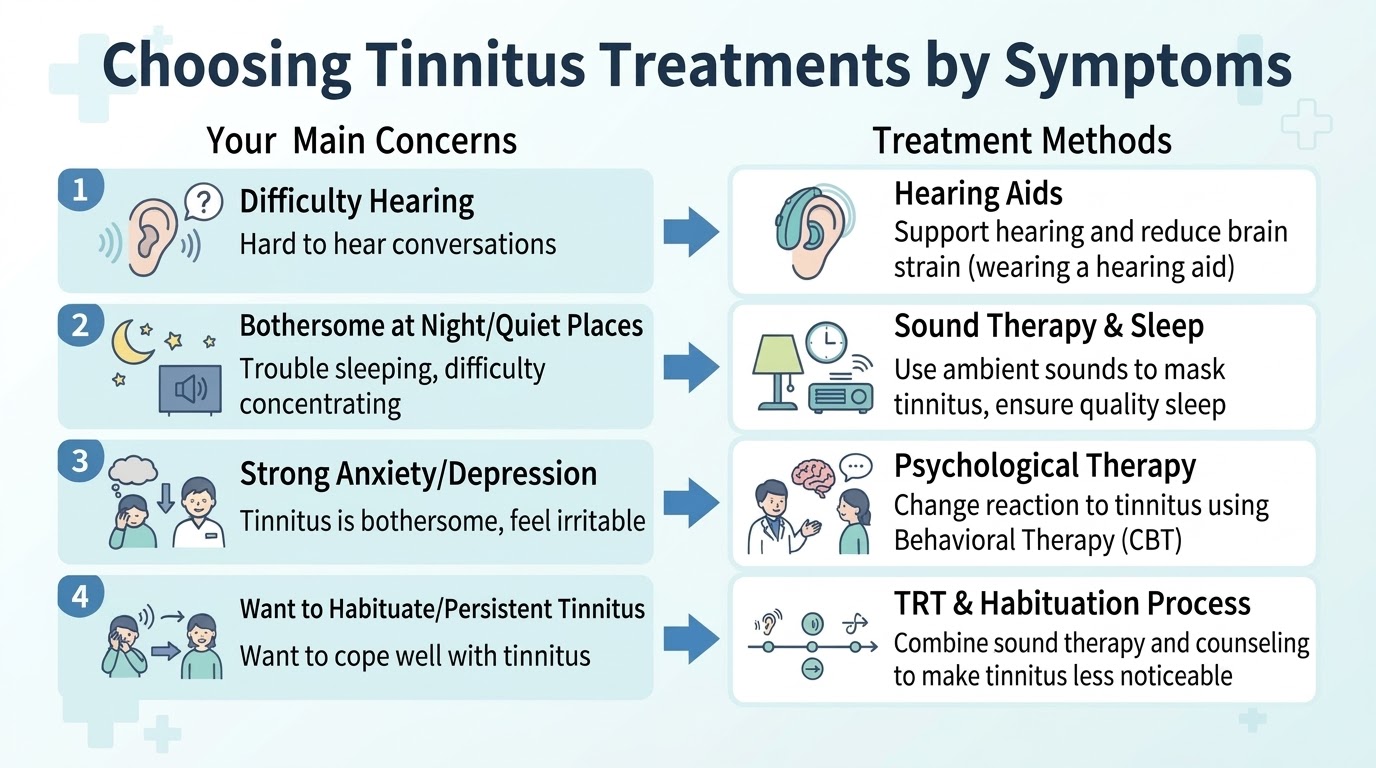
If you are wondering which one is right for you, start with what bothers you most. This is a rough guide, not a rule. Your doctor or audiologist will help you decide.
- You also struggle to follow conversations: start with a hearing test, then talk about hearing aids.
- It is worst at night or in quiet rooms: try soft background sound and better sleep habits. See how to sleep with tinnitus.
- You are scared it means something serious: get checked, and ask your doctor to explain what they found.
- It is dragging your mood down, or you feel anxious and stuck: ask about CBT.
- It has lasted for months and you want to get used to it: sound therapy or TRT, along with a realistic idea of the timeline.
- You just need a break from it right now: masking or a louder background sound can bring short-term relief.
None of these work overnight. Most people have good weeks and bad weeks, and things get easier little by little. Our guide on how long it takes to get used to tinnitus explains what that path often looks like.
Medicines, Supplements, and Quick-Relief Products
You may be wondering if there is a pill for this. Unfortunately, no medicine has been shown to reliably treat tinnitus itself.
The 2026 US guideline recommends against routinely using medicines or dietary supplements to treat tinnitus. NICE specifically advises against betahistine, a medicine sometimes prescribed for tinnitus.
That does not mean medicines are never used. A doctor may prescribe them to:
- treat an underlying condition, such as an ear infection or Ménière’s disease
- help with problems that often come with tinnitus, such as poor sleep, anxiety, or depression
Over-the-counter tablets, drops, and supplements sold for tinnitus relief are not backed by good evidence. If you want to try one, talk to a doctor or pharmacist first, especially if you take other medicines.
Newer Treatments Being Studied
Many people search for a tinnitus breakthrough. Here is where some of the newer approaches stand.
- Sound plus tongue stimulation (bimodal neuromodulation): a device called Lenire plays sounds through headphones while sending mild electrical pulses to the tongue. It received FDA De Novo authorization in the US in March 2023. In the main trial, published in 2024, 112 adults used sound alone for six weeks, then sound plus tongue stimulation for six weeks, and more people improved in the second stage. But there was no group using a fake device, and one of the authors works for the company that makes it, so we cannot yet say how it compares with other treatments.
- Magnetic brain stimulation (rTMS): this has been studied for years, but the 2026 US guideline recommends against it for tinnitus.
- Digital CBT programs: NICE already suggests a digital CBT program as a first step for tinnitus distress, and new apps are being tested in clinical trials, including in Japan.
New treatments are exciting, but their benefits and risks are still being worked out. For now, the core options above are the best place to start.
What You Can Do at Home
Alongside treatment, everyday habits can make tinnitus easier to live with. None of these will make tinnitus go away, but they can help it fade into the background.
- Avoid total silence. Soft music or ambient sound makes tinnitus less noticeable.
- Protect your sleep. Being tired makes tinnitus harder to ignore.
- Take care of stress. Stress can make tinnitus feel louder and harder to ignore.
- Protect your ears from loud sound. Use earplugs at concerts, and keep earbud volume comfortable.
- Be careful with promises of an instant fix. No treatment today can stop tinnitus instantly.
See a Doctor Soon If…
Most tinnitus is not a sign of something serious. Still, get checked soon if:
- it started suddenly, or your hearing dropped suddenly
- you hear it in one ear only
- it pulses in time with your heartbeat
- it comes with dizziness, weakness in your face, or follows a head injury
- it is affecting your sleep or mood every day
If tinnitus is making you feel hopeless, or you have thoughts of harming yourself, please contact a doctor or your local emergency or crisis line right away. You do not have to handle this alone.
For the causes and types of tinnitus, see our guide to tinnitus.
Living in Japan?
In Japan, you can usually go straight to an ENT clinic (耳鼻咽喉科, jibi-inkōka) without a referral. The Japan Audiological Society publishes a Tinnitus Practice Guideline (2019, in Japanese) that covers education and counseling, medicines including Kampo (herbal) medicines, sound therapy with hearing aids or sound generators, and CBT. A Japanese clinical trial of a smartphone CBT app was also published in 2026.
FAQ
Is there a new tinnitus cure in 2026?
Not yet. The US guideline was updated in 2026, and newer devices are being studied, but no treatment has been shown to make tinnitus go away for everyone. Be careful with products and ads that promise a cure.
Can tinnitus go away on its own?
Short spells often fade within hours or days. When tinnitus lasts longer, it may still improve if a cause is found and treated. Even when the sound stays, many people find it bothers them much less over time.
What is the best treatment for tinnitus?
It depends on what is behind it and what bothers you most. If you have hearing loss, hearing aids are often a good first step. For worry, low mood, or feeling stuck, CBT has the strongest evidence. Sound therapy can help, especially at night.
Are there tablets or over-the-counter medicines that work?
No medicine has been shown to treat tinnitus itself, and supplements are not recommended. Doctors may prescribe medicine for related problems, such as poor sleep or anxiety.
How long does treatment take?
It depends on the treatment. TRT, for example, usually runs over many months. Progress tends to come in waves, so try not to judge it day by day.
Key Takeaways
- There is no proven cure for tinnitus yet, but there are good ways to make it bother you less.
- Start with a checkup and a hearing test.
- The core options are education, hearing aids if you have hearing loss, CBT, and sound.
- Medicines and supplements are not recommended for tinnitus itself. Newer devices are still being studied.
- Start with what bothers you most, and give it time.
You do not have to figure this out alone. A doctor or audiologist can help you find the mix that works for you.
References
- Adams ME, et al. Clinical Practice Guideline: Tinnitus Update. Otolaryngol Head Neck Surg. 2026. (AAO-HNSF news release, October 12, 2026) https://www.entnet.org/resource/living-with-ringing-in-your-ears-updated-guideline-supports-a-personalized-evidence-based-approach-to-tinnitus/
- National Institute for Health and Care Excellence (NICE). Tinnitus: assessment and management (NG155). 2020. https://www.nice.org.uk/guidance/ng155
- Fuller T, Cima R, Langguth B, Mazurek B, Vlaeyen JWS, Hoare DJ. Cognitive behavioural therapy for tinnitus. Cochrane Database Syst Rev. 2020;1:CD012614. https://doi.org/10.1002/14651858.CD012614.pub2
- Boedts M, Buechner A, Khoo SG, et al. Combining sound with tongue stimulation for the treatment of tinnitus: a multi-site single-arm controlled pivotal trial. Nat Commun. 2024;15:6806. https://doi.org/10.1038/s41467-024-50473-z
- Wasano K, et al. Mobile Application as a Digital Therapeutic for Chronic Tinnitus: A Randomized Clinical Trial. JAMA Otolaryngol Head Neck Surg. 2026;152(7):677–685. https://doi.org/10.1001/jamaoto.2026.0858
- Japan Audiological Society. Tinnitus Practice Guideline 2019 (Kanehara, in Japanese). https://minds.jcqhc.or.jp/summary/c00511/


コメント