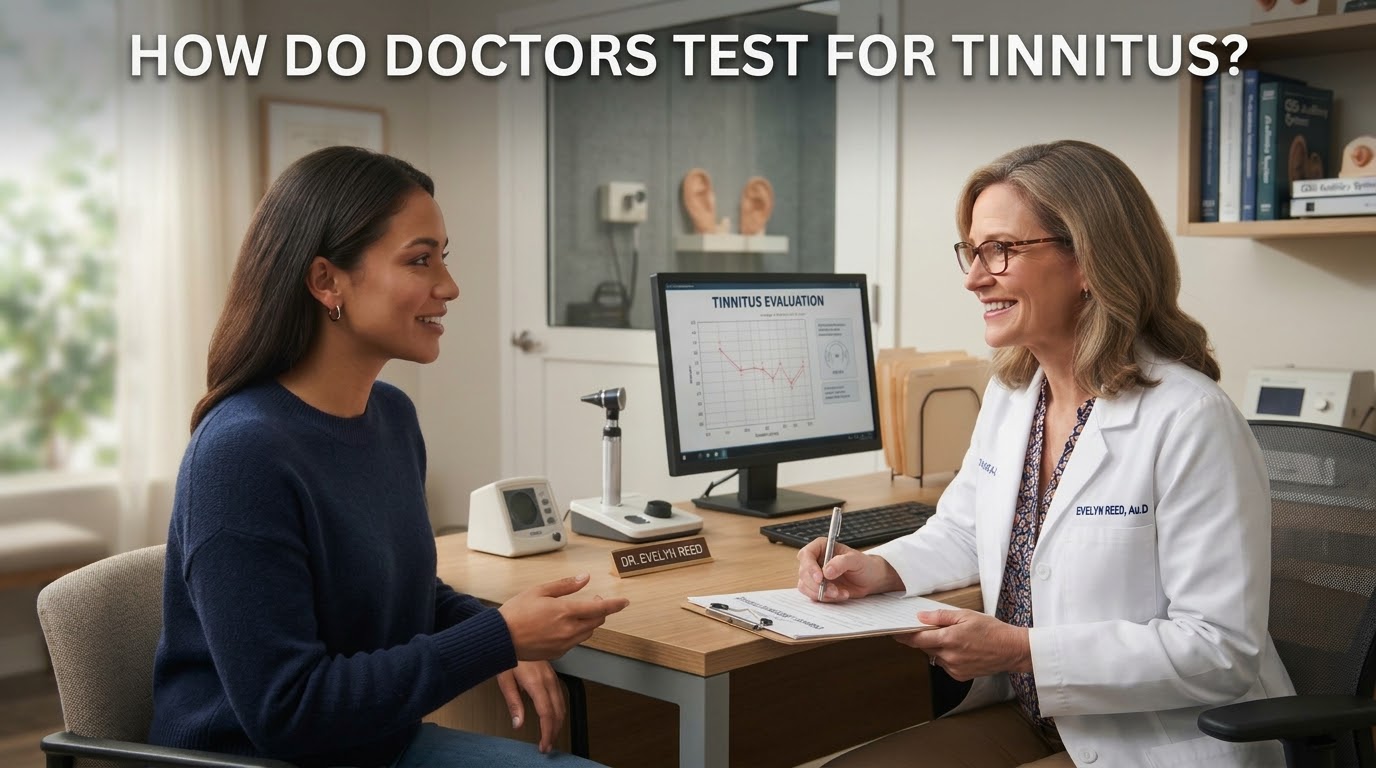
Your ears have started ringing, and it does not seem to be going away. It is natural to wonder whether something is wrong, and to feel a little nervous about seeing a doctor. What will they actually do? Will any of it hurt?
The short answer: a tinnitus check-up usually starts with a conversation, a look inside your ears, and a hearing test. Some clinics also measure what your tinnitus sounds like or ask you to fill in a questionnaire. Scans such as MRI are only used in certain situations. None of the usual tests are painful.
My wife has hearing loss and tinnitus, a high ringing and a lower hum, and I have tinnitus myself now and then. This guide walks you through each step, so you know what to expect before you go. For the bigger picture of tinnitus, see our guide to tinnitus.
In this article
- What to note down before your appointment
- Who to see first, and when to go urgently
- Each test, step by step
- What it means if everything looks normal
- Common questions about pain, cost, and online tests
Before Your Appointment: What to Note Down
Before you go, it helps to jot down a few notes about your tinnitus.
Tinnitus has many possible causes, and tests alone do not always explain it. That is why what you tell the doctor is one of the most useful clues they have.
Try to note:
- When it started, and whether it came on suddenly or gradually
- Whether you hear it in one ear or both
- What it sounds like (ringing, buzzing, hissing, humming, or a whooshing in time with your heartbeat)
- Whether it changes, for example louder at night or in quiet rooms
- Any hearing loss, dizziness, or a blocked feeling in the ear
- How much it bothers you (sleep, concentration, mood)
- Past ear problems, and whether you are around loud noise at work or for hobbies
- Any medicines you take
It is easy to forget things once you are sitting in the exam room. A quick note on your phone is plenty.

Who Should You See First?
In many countries, the first stop is your family doctor, also called a GP or primary care doctor. They will look in your ears for simple causes, such as earwax or an ear infection, and may check your hearing. If needed, they can refer you to an ear, nose, and throat (ENT) doctor, an audiologist (a hearing specialist), or both. In some places, you can book a hearing test with an audiologist directly.
Do not wait for a routine appointment if:
- Your hearing dropped suddenly, in one or both ears
- Tinnitus comes with vertigo (a spinning feeling) or weakness in your face
- It started after a head injury
These need urgent care. A sudden drop in hearing may be sudden hearing loss, which is best treated quickly.
Tinnitus that pulses in time with your heartbeat, or that you only hear in one ear, is also worth getting checked soon.
What Happens at a Tinnitus Appointment
A typical check-up follows roughly these steps:
- Talking about your tinnitus
- Looking inside your ears
- A hearing test
- Measuring your tinnitus (at some clinics)
- Questionnaires
- Scans and other tests, only when needed
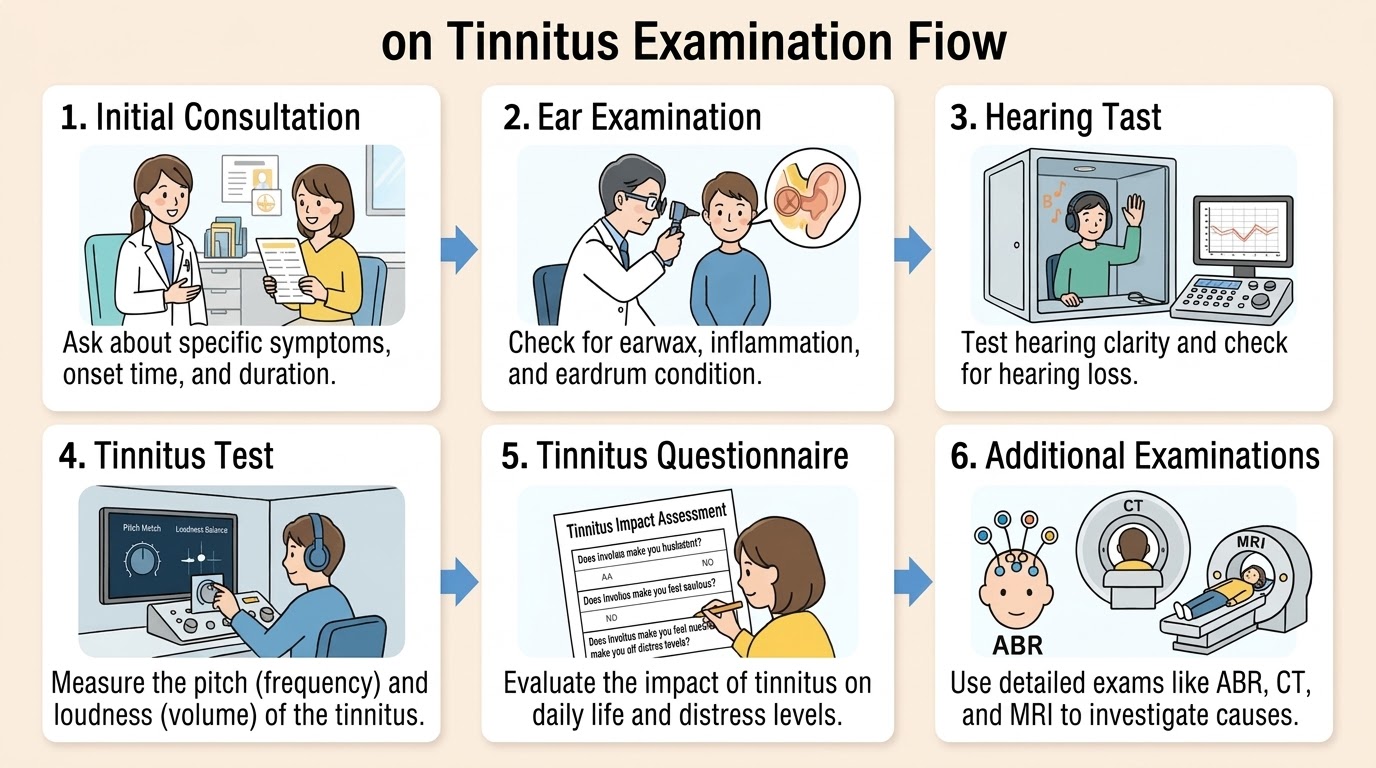
The order can change, and you will not necessarily have every test, or have them all on the same day. Think of this as a map of what might happen.
1. Talking About Your Tinnitus
The doctor will ask about your tinnitus, your health, and your daily life. This is where your notes come in handy.
They will also ask how tinnitus affects your sleep and mood. Some may gently ask whether it has ever made you feel hopeless or like harming yourself. The latest US guideline (2026) recommends asking about this, because tinnitus can be very hard to live with. It is a routine question, so answer honestly. It helps them find the right support for you.
2. Looking Inside Your Ears
Using a small light called an otoscope, the doctor looks into your ear canal and at your eardrum. They check for earwax, an infection, or fluid behind the eardrum.
If a middle-ear problem is suspected, you may also have tympanometry, a quick test that checks how well your eardrum moves.
3. A Hearing Test
Many people with tinnitus also have some hearing loss, sometimes without noticing it. So a hearing test is one of the most important parts of the check-up. Both US and UK guidelines recommend one for people with tinnitus.
The main test is called pure-tone audiometry. You sit in a quiet room, wear headphones, and press a button or raise your hand each time you hear a beep. The beeps get quieter until you can only just hear them.
There are two parts. Sound through the headphones (air conduction) tests your whole hearing pathway. A small vibrating band behind your ear (bone conduction) sends sound straight to the inner ear. Comparing the two gives clues about where a hearing problem might be.
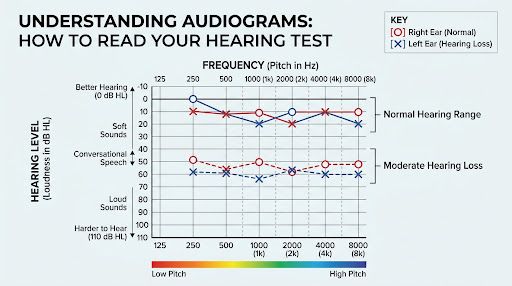
The results are drawn on a chart called an audiogram. To learn how to read it, see what a decibel is and how to read an audiogram.
4. Measuring Your Tinnitus (at Some Clinics)
Nobody else can hear your tinnitus. So some clinics compare it with sounds they play to you, to describe it more clearly:
- Pitch matching: you listen to tones of different pitches and pick the one closest to your tinnitus. This is the “frequency” of your tinnitus, measured in hertz (Hz). The higher the number, the higher the sound.
- Loudness matching: you adjust a tone until it seems about as loud as your tinnitus.
- Minimum masking level: the clinician finds how loud a noise needs to be to cover your tinnitus.
- Residual inhibition: after a short burst of noise, they check whether your tinnitus stays quieter for a little while.
For example, the result might be “a high pitch around 4,000 Hz that a fairly soft noise can cover.”
Whether you have these tests depends on where you live and where you are seen. In Japan, for example, they are a standard part of a tinnitus check. In the UK, the NICE guideline does not recommend pitch and loudness matching to assess tinnitus, so you may not have them there. If you do not have them, it does not mean anything was missed.
The idea of covering tinnitus with sound is also used as a way to get relief. You can read more in our guide to tinnitus masking.
5. Questionnaires
How loud tinnitus sounds and how much it bothers you are not always the same. Some people are very troubled by quiet tinnitus, while others barely notice a loud one.
That is why you may be asked to fill in a short questionnaire about how tinnitus affects your daily life. Common ones include the Tinnitus Handicap Inventory (THI) and the Tinnitus Functional Index (TFI). You may also be asked about sleep, worry, or low mood.
These questions are not a way of saying it is “all in your head.” They help the clinician understand how hard things are for you, and they can show later whether things are getting better.
6. Scans and Other Tests, Only When Needed
Most people with tinnitus do not need a scan. Both US and UK guidelines advise against routine scans when tinnitus is in both ears, does not pulse, and comes with no other warning signs.
A scan may be suggested if:
- You hear tinnitus in one ear only, or your hearing is clearly worse on one side
- Your tinnitus pulses in time with your heartbeat
- You have other signs, such as dizziness or weakness in your face
The most common scan is an MRI, which shows the hearing nerves and brain in detail. One reason is to rule out a rare, usually non-cancerous growth on the hearing nerve. A CT scan may be used to look at the bones of the ear, or when MRI is not possible. For tinnitus that pulses, scans of the blood vessels may be used.
Being offered a scan does not mean the doctor expects to find something serious. Most of the time, it is to be on the safe side.
Some clinics also use other hearing tests, such as auditory brainstem response (ABR), which records how the hearing nerve responds to sound through small pads on your head. If you have dizziness, balance tests may be added.
What If They Say Everything Looks Normal?
Sometimes, after all the tests, you hear: “Everything looks normal.” It is a relief, but it can also be frustrating. So what is this noise, then?
In fact, it is common for tests not to find a clear cause. A normal result means no condition needing urgent treatment was found. It does not mean your tinnitus is imaginary.
There is no treatment yet that reliably makes tinnitus go away. But there are proven ways to make it bother you less over time. If you were told you will “just have to get used to it,” see getting used to tinnitus for what that looks like and what helps.
What Comes After the Tests?
If a cause is found, such as earwax, an ear infection, or a hearing problem, that will be treated first.
If tinnitus continues, the next steps usually focus on making it less bothersome. These may include learning how tinnitus works, cognitive behavioral therapy (CBT), sound enrichment (using gentle background sound), and, for people with hearing loss, hearing aids. Many people find that hearing everyday sounds again makes tinnitus less noticeable.
If your tinnitus was measured, the results can also help set up sound-based approaches.
Living in Japan?
In Japan, you can go straight to an ENT clinic (耳鼻咽喉科, jibi-inkōka) without a referral. A hearing test is almost always done, and many clinics also measure tinnitus pitch, loudness, and masking using a standard method set out by the Japan Audiological Society. These tests are covered by national health insurance. Some hospitals also run a tinnitus clinic (耳鳴り外来). The society’s Tinnitus Practice Guideline (2019, in Japanese) treats counseling, sound therapy, and CBT as core approaches.
FAQ
Do tinnitus tests hurt?
No. The hearing test and tinnitus measurements just involve listening through headphones. ABR uses small pads stuck to your skin. An MRI is noisy and you need to lie still in a narrow tube, but it does not hurt. If small spaces make you anxious, tell the staff beforehand.
How much does a tinnitus evaluation cost?
It depends on your country, your health system or insurance, and which tests you need. A scan usually costs more than a hearing test. Ask your clinic or insurer before your visit if you are unsure.
Can I test my tinnitus at home or online?
Online tone players can help you describe the pitch of your tinnitus to a doctor. But they cannot check your hearing or look for causes, so they do not replace a proper check-up. If you try one, keep the volume low, especially with earbuds.
Do I need an MRI for tinnitus?
Usually not. An MRI is mainly considered when tinnitus is in one ear only, your hearing differs between ears, your tinnitus pulses, or you have other symptoms. Your doctor will explain if they think you need one.
Key Takeaways
- A tinnitus check-up usually starts with questions, an ear exam, and a hearing test.
- Some clinics also measure the pitch and loudness of your tinnitus. Whether they do depends on where you are seen.
- Questionnaires show how much tinnitus affects your life.
- Scans are not routine. They are mainly for one-sided or pulsing tinnitus, or tinnitus with other signs.
- “Normal results” do not mean it is imaginary, and there are ways to make tinnitus bother you less.
If tinnitus is worrying you, you do not have to sort it out on your own. Making that first appointment is a good place to start.
References
- National Institute for Health and Care Excellence (NICE). Tinnitus: assessment and management (NG155). 2020. https://www.nice.org.uk/guidance/ng155
- Adams ME, et al. Clinical Practice Guideline: Tinnitus Update. Otolaryngol Head Neck Surg. 2026. https://aao-hnsfjournals.onlinelibrary.wiley.com/doi/abs/10.1002/ohn.70418
- American Academy of Otolaryngology–Head and Neck Surgery Foundation. Living With Ringing in Your Ears? Updated Guideline Supports a Personalized, Evidence-Based Approach to Tinnitus (press release, October 12, 2026). https://www.entnet.org/resource/living-with-ringing-in-your-ears-updated-guideline-supports-a-personalized-evidence-based-approach-to-tinnitus/
- Tunkel DE, et al. Clinical Practice Guideline: Tinnitus. Otolaryngol Head Neck Surg. 2014;151(2 Suppl):S1–S40.
- NHS. Tinnitus. https://www.nhs.uk/conditions/tinnitus/
- Japan Audiological Society. Tinnitus Practice Guideline 2019 (Kanehara, in Japanese).


コメント