
Have you ever noticed your tinnitus getting louder when you are tired, or when you are under a lot of pressure?
You have probably heard people say, “Tinnitus is caused by stress.” Research does show that stress and tinnitus are linked. But it is not as simple as “stress causes tinnitus,” and it is not clear that stress alone is to blame.
My wife has hearing loss and tinnitus, a high ringing and a lower hum. She says it seems to come on more often when she feels unwell than when she is just tired. I have tinnitus myself now and then.
In this guide, I will go through what we know about stress and tinnitus, what to check before deciding “it’s just stress,” and what you can do. For the bigger picture of tinnitus, see our guide to tinnitus.
In this article
- What research says about stress and tinnitus
- Why stress can make tinnitus louder and harder to ignore
- Signs to get checked before blaming stress
- What a doctor may do, and what you can try yourself
Can Stress Cause Tinnitus?
The short answer: stress often makes tinnitus feel louder and more bothersome. Whether stress can actually start tinnitus is less clear.
What the research shows
A Swedish survey of more than 12,000 adults found that stress was linked to tinnitus about as strongly as exposure to loud noise. Stress seemed to matter most in the step from mild tinnitus to more severe, bothersome tinnitus.
A 2021 review that brought together research on stress and tinnitus found a similar pattern. Many people with tinnitus said it felt louder and more annoying when they were stressed. But not everyone felt that way, and not everyone said stress started or worsened their tinnitus.
UK hearing charities describe it the same way: stress can be a trigger, or make tinnitus worse, and tinnitus can in turn make you more stressed.
Why “stress causes tinnitus” is hard to prove
Here is the tricky part. Having tinnitus is stressful in itself.
So does stress lead to tinnitus, or does tinnitus lead to stress? Researchers have not fully worked out which way the link runs, and it probably goes both ways for many people.
You may see the phrase “stress-induced tinnitus” online. But there is no simple test that can show stress is the only cause. That is why it is a good idea not to write it off as “just stress” and to get your ears checked at least once.
Why Tinnitus Spikes When You’re Stressed
There are a few reasons stress can make tinnitus stand out more.
Your attention locks onto the sound
Have you ever lain awake on a tiring night and suddenly noticed the hum of the fridge? The sound has not changed. But once you notice it, it is hard to stop hearing it.
Tinnitus works in a similar way. When you are stressed, your brain is on high alert and more likely to pick up the sound. Then come the thoughts: “It’s back again.” “Is it getting worse?” The worry makes you listen for it more, and the tinnitus seems louder. This is often called the tinnitus and anxiety loop.
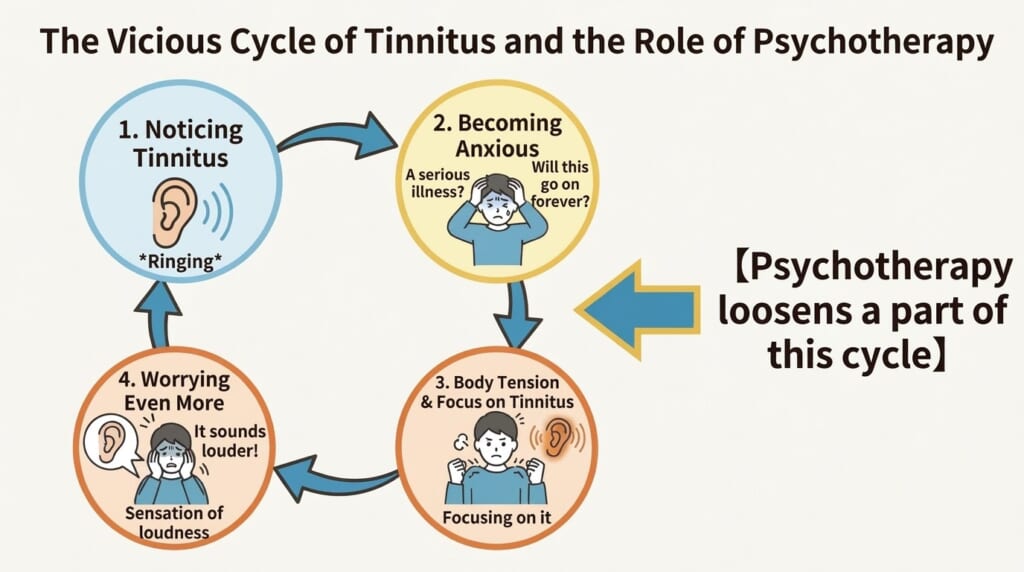
Our guide to CBT for tinnitus explains how counseling and CBT can help loosen this loop.
Your body stays in “fight or flight” mode
Long-term stress keeps your body in a tense, alert state, sometimes called “fight or flight.” Researchers are studying how stress hormones and the nervous system may affect the way the ear and brain handle sound.
There is still a lot we do not know. But “when I can’t rest, my tinnitus feels worse” is something many people recognize.
Poor sleep makes it harder to ignore
When stress keeps you awake, the quiet bedroom makes tinnitus easier to notice. After a bad night, it can be harder to ignore during the day too. Another loop.
Our guide on how to sleep with tinnitus covers bedtime sound and sleep habits.
A spike is often temporary
Many people notice their tinnitus flares up during a stressful week and settles down again once things calm. A spike like this does not usually mean your ears are getting worse. Still, if a flare-up does not settle, or it comes with any of the signs below, get it checked.
Check These Signs Before Blaming Stress
Stress and tiredness often make tinnitus stand out. But sometimes there is an ear problem behind it. See a doctor soon, rather than waiting and assuming it is stress, if:
- tinnitus started suddenly, especially with hearing loss
- you have dizziness, a spinning feeling (vertigo), or weakness in your face
- it is in one ear only and does not go away
- you hear a beat that matches your pulse
- your ear feels blocked or full
- it is getting worse, or affecting your sleep, focus, or mood
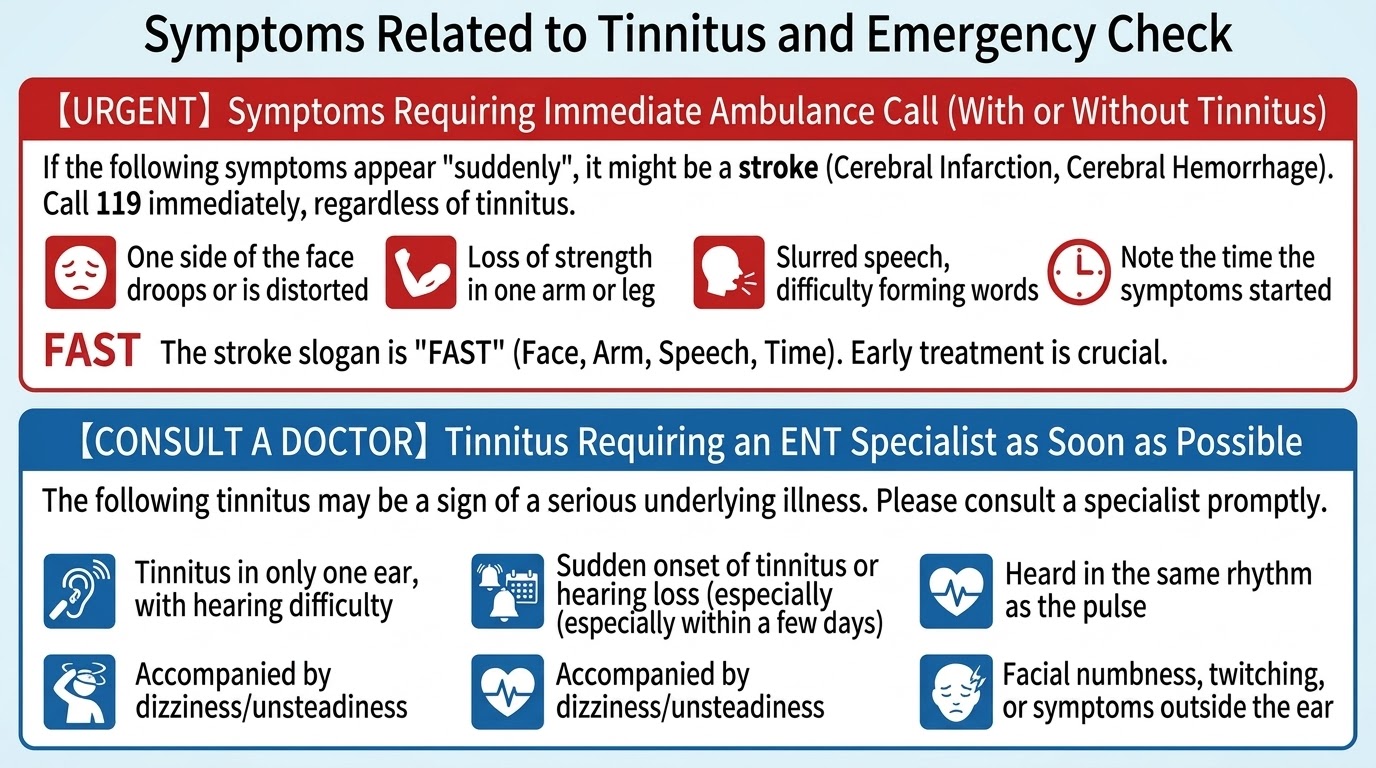
The NHS advises getting emergency help if tinnitus comes with sudden hearing loss, weakness in the face, or vertigo, or if it starts after a head injury.
Ear problems that stress may be linked to
For a few ear conditions, researchers have looked at stress, tiredness, or poor sleep as possible triggers. The exact causes are not known, but watch for these together with tinnitus:
- Sudden hearing loss in one ear: this may be sudden sensorineural hearing loss. Its cause is usually unknown, and studies have listed psychological factors such as depression among possible risk factors. It is best treated as early as possible, so see a doctor right away.
- A blocked feeling with a low roaring or humming sound: this may be low-frequency hearing loss. A 2024 study found that people with this condition had slept worse, and had more stressful life events, than people without it.
- Repeated spells of spinning dizziness, with hearing changes and a full feeling in the ear: this may be Ménière’s disease. MedlinePlus, from the US National Library of Medicine, lists stress among its risk factors.
A high-pitched ringing is a very common type of tinnitus. The sound alone cannot tell you whether something is wrong, so look at the other signs: one ear only, hearing changes, or dizziness.
Getting checked can ease the worry too
There is one more benefit to seeing a doctor: it can calm your mind.
When tinnitus keeps going, many people start to worry about their brain. Hearing “we didn’t find anything serious” can be a real relief. If that worry is on your mind, our guide on whether tinnitus can be a sign of a brain tumor or stroke explains the warning signs.
What Happens When You See a Doctor?
In many countries, you start with a general doctor (a GP or primary care doctor), who may refer you to an audiologist or an ear, nose, and throat (ENT) doctor.
They will ask when it started, what it sounds like, which ear, and whether you have other symptoms. A hearing test is a key step. The 2026 US tinnitus guideline from the American Academy of Otolaryngology–Head and Neck Surgery Foundation (AAO-HNSF) says everyone with tinnitus should have a full hearing evaluation.
You may also be asked about stress, sleep, and mood. This is not because the doctor thinks it is “all in your head.” It helps them understand how much the tinnitus is affecting you and choose the right support.
To see each test step by step, see our guide to how doctors test for tinnitus.
What Helps With Stress-Related Tinnitus?
Even when stress is part of the picture, the approach is the same as for other tinnitus. The goal is usually not to make the sound disappear. It is to make it bother you less.
Education, counseling, and CBT
Learning how tinnitus works, and that it is rarely dangerous, takes a lot of fear out of it.
Cognitive behavioral therapy (CBT) helps you change how you react to the sound and the worried thoughts around it. The AAO-HNSF guideline names CBT as one of the approaches that helps, and the NHS usually offers digital CBT first. If stress and worry are making your tinnitus harder to live with, this is often a good fit.
Relaxation
Relaxation methods, such as slow breathing or tensing and then relaxing your muscles one group at a time, are easy to try at home. UK hearing charities suggest regular relaxation to help calm the stress response.
On its own, though, relaxation has less evidence than CBT for easing tinnitus. Think of it as a helpful extra, alongside other support.
→ Learn how to do progressive muscle relaxation step by step
Everyday things you can try
- Make time to rest. Even a few minutes of doing nothing can help on busy days.
- Avoid total silence. Soft music, a fan, or nature sounds can help tinnitus blend in. Our guide to sound therapy explains which sounds to use and how loud to play them.
- Try not to keep checking it. Listening for the sound again and again keeps your attention on it.
- Limit late-night searching. Reading scary stories online can make the worry grow. Save your questions for your doctor.
- Keep doing the things you enjoy. Giving up hobbies or going out less leaves more room for tinnitus to take over.
To learn what to expect over time, see our guide on how long it takes to get used to tinnitus.
Do Medicines Help Tinnitus From Stress?
No medicine is approved specifically to treat tinnitus.
When anxiety, low mood, or sleep problems are severe, a doctor may prescribe medicine for those problems. That can help you feel better overall, but it does not switch the tinnitus off. The 2026 AAO-HNSF guideline advises against routinely using medicines or supplements to treat tinnitus itself.
Be careful with products that promise to stop tinnitus, and talk to a doctor before trying anything new.
When to Get Help for Your Mental Health
Please talk to a doctor about your mental health, not just your ears, if:
- you feel low most of the time, or nothing feels enjoyable
- you have not been sleeping for days
- you have thoughts of harming yourself
If you have thoughts of harming yourself, please contact a doctor or your local emergency or crisis line right away. You do not have to manage this alone.
Living in Japan?
In Japan, you can usually go straight to an ENT clinic (耳鼻咽喉科, jibi-inkōka) without a referral. Japan’s Tinnitus Practice Guideline (2019 edition, Japan Audiological Society) includes education and counseling, and psychological therapy such as CBT, among its treatment options. For mental health support, the Ministry of Health, Labour and Welfare’s “Mamorouyo Kokoro” website lists phone and chat services (in Japanese).
FAQ
Will my tinnitus go away if my stress goes away?
For some people, tinnitus becomes much less noticeable once stress eases. But tinnitus often has another cause too, such as hearing loss, so it may not disappear completely. Many people find it fades into the background over time with the right support.
Can stress cause tinnitus in one ear?
Stress or tiredness can make tinnitus stand out for a while. But if tinnitus stays in one ear only, get your ears checked. If you also have hearing loss or dizziness, see a doctor soon.
Can stress cause tinnitus with dizziness?
Stress can make you feel lightheaded, but tinnitus with dizziness or a spinning feeling should be checked by a doctor. It may be a sign of an inner ear problem.
My tinnitus itself is stressing me out. What can I do?
That is very common. Understanding how tinnitus works helps many people worry less, so a check-up and a talk with your doctor is a good start. CBT is one of the best-studied ways to make tinnitus less distressing.
Key Takeaways
- Stress often makes tinnitus feel louder and more bothersome, but stress alone is rarely proven to be the cause.
- Stress and tinnitus can feed each other in a loop.
- Sudden onset, one ear only, hearing loss, or dizziness: see a doctor rather than assuming it is stress.
- Counseling, CBT, rest, and soft background sound can all help.
Getting checked is often the first step to feeling calmer about it. From there, try what fits your life, one step at a time.
References
- Baigi A, Oden A, Almlid-Larsen V, Barrenäs ML, Holgers KM. Tinnitus in the General Population With a Focus on Noise and Stress: A Public Health Study. Ear and Hearing. 2011;32(6):787–789.
- Elarbed A, Fackrell K, Baguley DM, Hoare DJ. Tinnitus and stress in adults: a scoping review. International Journal of Audiology. 2021;60(3):171–182.
- Patil JD, Alrashid MA, Eltabbakh A, Fredericks S. The association between stress, emotional states, and tinnitus: a mini-review. Frontiers in Aging Neuroscience. 2023;15:1131979.
- He X, Huang C, Jiang F, Lan H, Huang Y, Liu M, Lai D. The role of stimuli of life events and sleep quality in the incidence of acute low-tone sensorineural hearing loss. Frontiers in Neurology. 2024;15:1480216.
- Xie W, Karpeta N, Tong B, et al. Etiological analysis of patients with sudden sensorineural hearing loss: a prospective case–control study. Scientific Reports. 2023;13:5221.
- MedlinePlus (US National Library of Medicine). Meniere disease.
- NHS. Tinnitus.
- National Institute on Deafness and Other Communication Disorders (NIDCD). Tinnitus.
- RNID. Managing tinnitus and stress.
- Tinnitus UK. Tinnitus and stress.
- American Academy of Otolaryngology–Head and Neck Surgery Foundation (AAO-HNSF). Clinical Practice Guideline: Tinnitus Update (news release, October 2026).


コメント