
Do your shoulders and neck stay tight after a long day, even when you try to relax?
“Just relax” is easier said than done. That’s where progressive muscle relaxation, or PMR, comes in. You tense a group of muscles on purpose, then let them go. That’s it. You don’t need any equipment, and you can do it in a chair or in bed.
If you have tinnitus, a quiet night can make the sound stand out, and your body can tense up along with it. I have tinnitus myself now and then, so I know how hard it can be to stop noticing it. I also do a quick shoulder-and-neck version of PMR during breaks from desk work.
In this guide, I’ll go through how to do PMR step by step, what to check before you start, and what it can and can’t do for tinnitus. For the bigger picture of tinnitus, see our guide to tinnitus.
In this article
- What progressive muscle relaxation is
- How to do it, body part by body part, plus a 2-minute version
- Who should be careful before starting
- Whether it helps tinnitus, and what research says
What Is Progressive Muscle Relaxation?
Progressive muscle relaxation means tensing a group of muscles, then releasing them, one part of the body at a time. It’s called “progressive” because you work your way through the body, for example from your hands up to your face, then down to your legs.
The method was introduced by Dr. Edmund Jacobson, an American physician, in the 1920s. That’s why you may also see it called Jacobson’s relaxation technique. Today it’s widely used to help with stress and sleep, and you’ll find it in many hospital and health service guides.
Why tense your muscles first?
When you’re stressed, your muscles tighten without you noticing. It’s surprisingly hard to feel that you’re holding tension.
Try this: make a tight fist for a few seconds, then open your hand. Notice how your hand feels a little loose and warm afterward?
PMR is practice in feeling that difference: tense versus relaxed. Once you know the difference, you start to catch yourself in daily life: “Oh, my shoulders are up again.” And you can let them drop.
Does PMR Help Tinnitus?
Let me be honest first: there is no good evidence that PMR makes the tinnitus sound itself quieter.
Relaxation is widely used in tinnitus care. But when the UK’s National Institute for Health and Care Excellence (NICE) reviewed the research for its tinnitus guideline, it found the evidence on relaxation was mixed and, overall, not favorable. Some of the studies also had weaknesses, so NICE has called for better research.
So is it pointless? I don’t think so. The goal of PMR isn’t to switch tinnitus off. It’s to ease the tension in your body and mind.
When tinnitus bothers you, it’s easy to fall into a loop: you worry, your body tenses, and you pay even more attention to the sound. Our guide on whether stress can cause tinnitus explains this loop in more detail.
To loosen that loop, doctors and audiologists often recommend learning how tinnitus works, and talking therapies such as cognitive behavioral therapy (CBT). Think of PMR as a helpful extra alongside these. You can read more in our guides to CBT for tinnitus and tinnitus treatment options.
Before You Start: Setup and Safety
PMR is simple and safe for most people. Still, a few things are worth knowing.
Getting ready
- Find a quiet place where you won’t be interrupted
- Sit in a comfortable chair, or lie on your back (either is fine)
- Loosen anything tight, such as a belt or a watch
- Allow 5 to 15 minutes. Starting short is fine
If you lie on your back and your lower back feels sore, a pillow under your knees can help.
Tense firmly, but never to the point of pain
Squeeze firmly, but stop well before pain or cramping. You don’t need to use all your strength. If you squeeze too hard and get a cramp in your foot or strain your neck, that defeats the purpose.
When to skip a step, or check with your doctor first
- Skip any area that is injured or painful. You can relax it without tensing it.
- If you have back problems, muscle spasms, or long-term pain, or a serious health condition such as high blood pressure, check with your doctor or health care team before you start.
- If you feel unwell or get pain during the exercise, stop.
How to Do Progressive Muscle Relaxation (Basic Steps)
Every body part follows the same pattern:
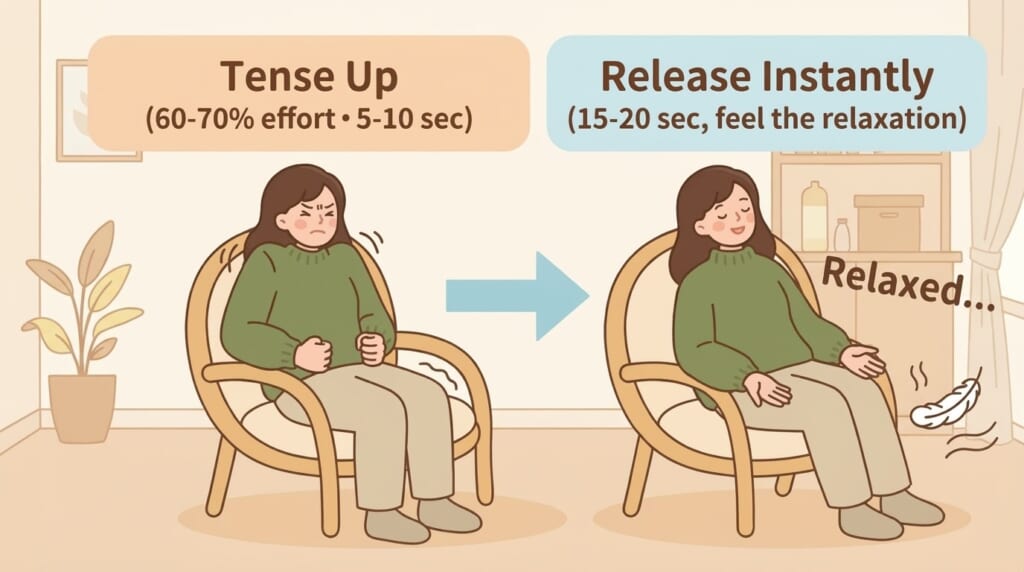
- Breathe in and tense the muscles for about 5 to 10 seconds
- Breathe out and let go all at once
- Stay relaxed and notice the loose, heavy feeling for about 10 to 20 seconds
Step 3 is the most important. Take your time and really notice how the muscles feel once they let go.
Step by step, body part by body part
Start with your hands, then work your way through your body. Once or twice for each area is enough.
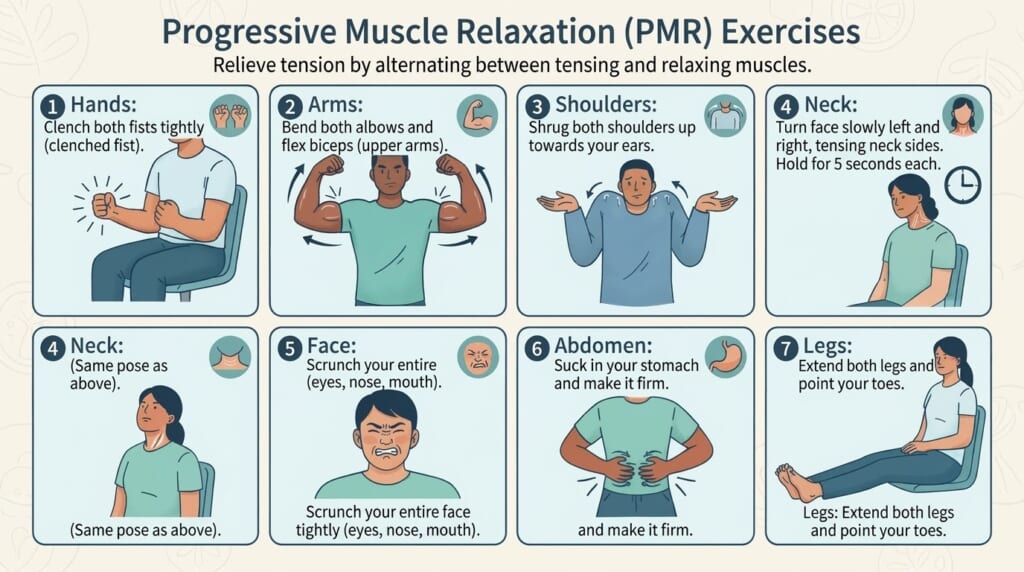
1. Hands
Make tight fists with both hands. Then slowly open them and rest them on your lap.
2. Arms
Keep your fists closed and bend your elbows, bringing your fists toward your shoulders, as if showing off your biceps. Slowly lower your arms back to your lap.
3. Shoulders
Lift your shoulders up toward your ears. Then let them drop, and let them sink as low as they want to go.
4. Neck
Slowly turn your head to the right and feel the tension along the side of your neck. Slowly come back to the center. Repeat on the left. Be extra gentle here, and only move as far as feels comfortable.
5. Face
Squeeze your eyes and mouth shut, as if scrunching your whole face toward your nose. Then let go, until your jaw feels loose and your mouth falls slightly open.
6. Stomach
Pull your belly button in toward your spine. Then let your stomach go soft.
7. Legs
Stretch both legs out in front of you and point your toes. Then slowly lower your legs and let them relax.
To finish, stay still for a little while and enjoy the feeling of your whole body being relaxed.
When you’re done
If you’re going to sleep, there’s nothing more to do. Just rest.
If you’re going back to work or chores, wiggle your fingers and toes, open and close your hands a few times, and stretch. Some people also count slowly backward from 5 to 1. Take your time getting up.
Short on Time? The 2-Minute Shoulder-and-Neck Version
If you don’t have time for the full routine, just doing your shoulders and neck still helps. This is the version I use most during breaks from desk work. You can do it at your desk or in bed.
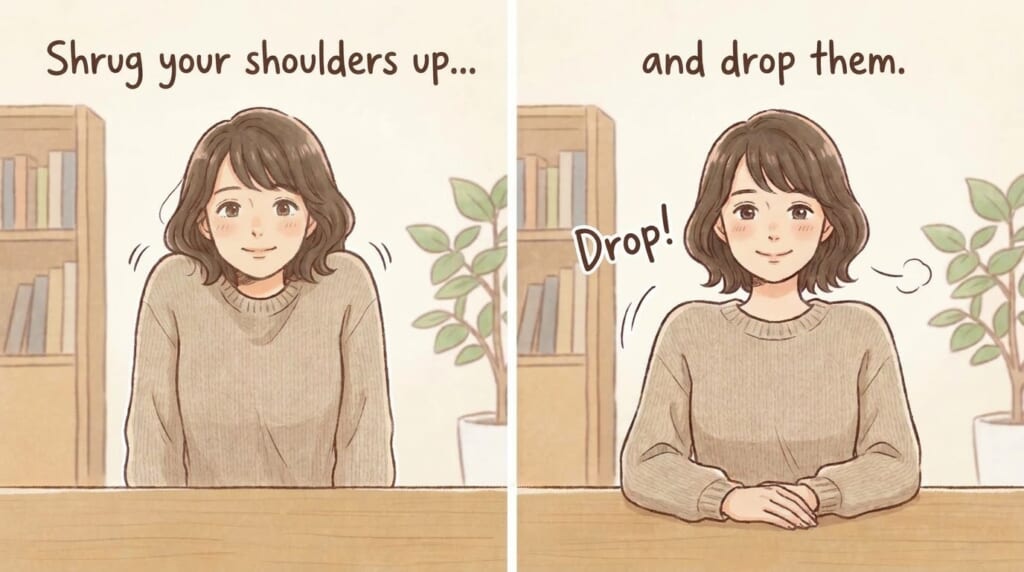
- Lift your shoulders toward your ears and hold for about 5 seconds
- Let them drop, and notice the relaxed feeling for about 15 seconds
- Repeat 3 times
- Finally, slowly turn your head to each side, tensing and then releasing your neck in the same way
Doing PMR at Bedtime
Once you’re in bed, lie on your back and work through your body, starting with your hands.
If you get sleepy halfway through, that’s fine. Just let yourself fall asleep. Feeling your body loosen up matters more than finishing every step. Many people find PMR helps them drift off.
If you have tinnitus, a silent bedroom can make the sound easier to notice. Some people find PMR easier with soft background sound, such as a fan or quiet nature sounds. Our guide on how to sleep with tinnitus has more bedtime tips.
→ Learn what white noise is and how to use it safely at bedtime
Tips for Sticking With It
- Do it at about the same time each day. Fitting it into a routine, like before bed or after a bath, makes it easier to keep going.
- Don’t worry if you can’t feel it at first. Noticing the relaxed feeling is a skill, and it gets easier with practice over a few weeks.
- Try not to check your tinnitus afterward. Listening for whether it got quieter pulls your attention back to the sound. The goal is to relax your body.
- Mix it with other things that relax you. Slow breathing, gentle stretching, or music you enjoy all go well with PMR.
To see what to expect as you adjust to tinnitus over time, read our guide on how long it takes to get used to tinnitus.
When to See a Doctor
PMR is something you can do on your own to relax. But in these cases, get your ears checked first instead of waiting to see if relaxation helps:
- tinnitus started suddenly, especially with hearing loss
- you have dizziness or a spinning feeling (vertigo)
- tinnitus stays in one ear only
- tinnitus is affecting your sleep, focus, or mood
If your hearing drops suddenly, see a doctor as soon as possible. Sudden hearing loss is best treated early.
FAQ
Who shouldn’t do progressive muscle relaxation?
Skip any area that is injured or painful. If you have back problems, muscle spasms, long-term pain, or a serious health condition such as high blood pressure, check with your doctor first. Stop if you feel unwell during the exercise.
How long does it take to work?
Some people feel a little looser after the first try. But learning to really notice the relaxed feeling usually takes some practice. Try it regularly for a few weeks, without pressure.
Does PMR help with anxiety?
PMR is often used to ease the physical tension that comes with stress and anxiety, and many people find it calming. It’s not a replacement for treatment, though. If anxiety is affecting your daily life, talk to a doctor.
Can I use an audio guide?
Yes. Many people find it easier to follow a recorded voice at first, especially to learn the order of the muscle groups. Once you know the steps, you can do it from memory.
Can children do PMR?
Yes. Simple versions are often taught to children and teenagers to help them relax. Keep it gentle and playful, and skip anything that hurts.
Will PMR cure my tinnitus?
No. There’s no evidence that it makes the tinnitus sound go away. Think of it as a way to ease tension when tinnitus makes you feel tight and on edge.
Key Takeaways
- PMR means tensing a muscle group, then letting it go, to notice and release tension.
- Tense firmly but never to the point of pain, and skip injured or painful areas.
- Check with your doctor first if you have back problems, muscle spasms, long-term pain, or a serious health condition.
- It won’t switch tinnitus off, but it can help on nights when tinnitus leaves you tense.
Why not start tonight? Lift your shoulders up toward your ears, then let them drop.
References
- NHS inform (Scotland). Progressive muscle relaxation. https://www.nhsinform.scot/healthy-living/mental-wellbeing/breathing-and-relaxation-exercises/progressive-muscle-relaxation
- Michigan Medicine (Healthwise). Stress Management: Doing Progressive Muscle Relaxation. https://uofmhealth.org/health-library/uz2225
- Michigan Medicine (Healthwise). Progressive Muscle Relaxation. https://uofmhealth.org/health-library/ta4146
- Cleveland Clinic. Everything You Need To Know About Progressive Muscle Relaxation. https://health.clevelandclinic.org/progressive-muscle-relaxation-pmr/
- UW Osher Center for Integrative Health. Progressive Muscle Relaxation and Progressive Relaxation – Handout. https://kb.wisc.edu/osher/page.php?id=150528
- US Department of Veterans Affairs, Whole Health Library. Progressive Muscle Relaxation. https://www.va.gov/WHOLEHEALTHLIBRARY/docs/Progressive-Muscle-Relaxation.pdf
- Oxford Health NHS Foundation Trust (CAMHS). Progressive muscle relaxation. https://oxfordhealth.nhs.uk/camhs/self-care/sleep/relaxation/progressive-muscle-relaxation/
- NICE. Tinnitus: assessment and management (NG155). Research recommendation NG155/9: relaxation strategies. https://www.nice.org.uk/about/what-we-do/research-and-development/research-recommendations/NG155/9


コメント