
Have you ever felt like there is water in your ear, or like your ear is blocked and sounds seem muffled?
When your ear feels blocked, you may assume that earwax is the cause and try cleaning your ear. However, a feeling of fullness or blockage in the ear can have many causes, including hearing loss and problems affecting the inner ear.
One possible cause is low-frequency sensorineural hearing loss.
Low-frequency sensorineural hearing loss is a type of hearing loss in which sounds in the lower frequency range become harder to hear. It can cause symptoms such as a feeling of fullness or pressure in the ear, difficulty hearing low-pitched sounds, and hearing your own voice as unusually loud or echoing inside your ear.
In this article, we will explain low-frequency sensorineural hearing loss in simple terms, including its symptoms and possible causes, how it differs from Ménière’s disease and sudden sensorineural hearing loss, how it is diagnosed and treated, and when you should see a healthcare professional.
- Do You Have a Feeling of Ear Fullness or Difficulty Hearing Low Sounds?
- What Is Low-Frequency Sensorineural Hearing Loss?
- What Symptoms Can Occur With Low-Frequency Sensorineural Hearing Loss?
- What Causes Low-Frequency Sensorineural Hearing Loss?
- How Is Low-Frequency Sensorineural Hearing Loss Diagnosed?
- Treatment for Low-Frequency Sensorineural Hearing Loss
- Can Low-Frequency Sensorineural Hearing Loss Get Better on Its Own?
- When Should You See a Doctor for Difficulty Hearing Low Sounds?
- Conditions That Can Be Mistaken for Low-Frequency Sensorineural Hearing Loss
- Frequently Asked Questions About Low-Frequency Sensorineural Hearing Loss
- Can Low-Frequency Sensorineural Hearing Loss Be Cured?
- Can Low-Frequency Sensorineural Hearing Loss Come Back?
- Is Low-Frequency Sensorineural Hearing Loss the Same as Ménière’s Disease?
- Is Low-Frequency Sensorineural Hearing Loss the Same as Sudden Sensorineural Hearing Loss?
- Can a Feeling of Ear Fullness Alone Be a Sign of Low-Frequency Sensorineural Hearing Loss?
- What Kind of Doctor Should I See If I Have Difficulty Hearing Low Sounds?
- Summary
Do You Have a Feeling of Ear Fullness or Difficulty Hearing Low Sounds?

A feeling of fullness or blockage in the ear, or difficulty hearing low-pitched sounds, can be one of the symptoms of low-frequency sensorineural hearing loss. However, similar symptoms can also be caused by other conditions, such as earwax buildup or problems affecting the middle ear.
First, let’s take a look at the symptoms that may suggest low-frequency sensorineural hearing loss.
Do You Have Any of These Symptoms?
- A feeling that your ear is blocked or plugged
- A feeling that there is water in your ear
- Difficulty hearing low-pitched voices or sounds
- Your own voice sounds unusually loud or echoes in your ear
- Ringing or other sounds in your ear (tinnitus)
- A sudden change in hearing in one ear
- Your hearing improves and worsens repeatedly
Do any of these symptoms sound familiar?
You may think that your ear is simply blocked and try cleaning it with a cotton swab or other ear-cleaning tool. But what if the problem does not improve?
Sometimes, what feels like a blocked ear is actually a change in your hearing.
If you notice a sudden or unusual change in the way you hear, it is important to have your ears and hearing checked by a healthcare professional rather than assuming that earwax is the cause.
What Is Low-Frequency Sensorineural Hearing Loss?
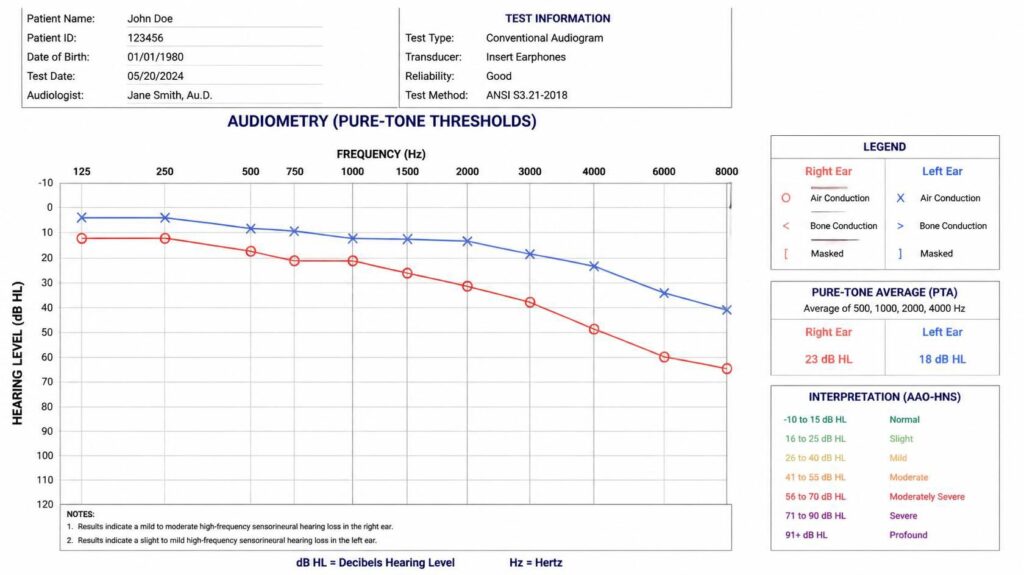
Low-frequency sensorineural hearing loss is a type of sensorineural hearing loss in which hearing becomes worse mainly in the lower frequency range.
Unlike some other types of hearing loss, it may affect certain frequencies more than others. Some people first notice it as a feeling that their ear is blocked or that sounds have become muffled, rather than simply feeling that everything sounds quieter.
Here, we will explain the basic characteristics of low-frequency sensorineural hearing loss in simple terms.
A Type of Sensorineural Hearing Loss That Mainly Affects Low Frequencies
Sensorineural hearing loss occurs when there is a problem with the inner ear or the nerves and pathways involved in hearing.
As the name suggests, low-frequency sensorineural hearing loss mainly affects the ability to hear lower-pitched sounds.
We prepared article of Sensorineural hearing loss. So, please refer it.
RegardingSensorineural hearing loss↗
How Is It Different From More Common Types of Hearing Loss?
There are many different types of sensorineural hearing loss, and the frequencies that are affected can vary.
For example, age-related hearing loss often affects high-frequency sounds first. In contrast, low-frequency sensorineural hearing loss mainly affects lower-frequency sounds.
When high-frequency hearing is reduced, sounds may still seem loud enough, but understanding what someone is saying can become more difficult, especially when there is background noise.
With low-frequency sensorineural hearing loss, lower-pitched sounds become harder to hear.
| Sound Frequency | How It May Be Heard |
| Low-pitched sounds | More difficult to hear |
| Mid-range sounds | Relatively easier to hear |
| High-pitched sounds | Relatively easier to hear |
Low-frequency sensorineural hearing loss often develops suddenly or over a relatively short period of time, with changes in hearing occurring over several days or less in some cases.
The degree of hearing loss can also range from mild to moderate.
What Symptoms Can Occur With Low-Frequency Sensorineural Hearing Loss?

Low-frequency sensorineural hearing loss does not simply make sounds seem quieter. It can also cause a feeling of fullness in the ear, changes in the way your own voice sounds, and other symptoms.
Here are some of the most common symptoms explained in simple terms.
A Feeling of Fullness or Pressure in the Ear
With low-frequency sensorineural hearing loss, some people notice a feeling of fullness or pressure in the affected ear rather than simply feeling that they cannot hear well.
When hearing in the low-frequency range changes, sounds may seem muffled or less clear, which can make the ear feel blocked.
Difficulty Hearing Low-Pitched Sounds
Low-frequency sensorineural hearing loss can reduce hearing at lower frequencies, such as 125 Hz, 250 Hz, and 500 Hz.
These frequencies are found in low-pitched sounds, including deep male voices and the lower sounds produced by drums and other musical instruments.
As a result, sounds in this lower range may become more difficult to hear.
Tinnitus
Tinnitus is also a common symptom associated with low-frequency sensorineural hearing loss.
Many people imagine tinnitus as a high-pitched ringing or buzzing sound. However, tinnitus can also be heard as a low-pitched sound, and some people with low-frequency sensorineural hearing loss may notice this type of tinnitus.
Your Own Voice May Sound Loud or Echo in Your Ear
We hear our own voice through two main pathways: air conduction, in which sound travels through the outer and middle ear, and bone conduction, in which vibrations travel through the bones of the skull to the inner ear.
This is one reason why a recording of your voice can sound different from the way you hear yourself when you speak. A recording mainly reaches your ears through air conduction, while your own voice is normally heard through both air and bone conduction.
When your hearing changes, the way you perceive your own voice can also change. You may notice that your voice sounds unusually loud, muffled, or as if it is echoing inside your ear.
It Usually Does Not Cause Vertigo
Low-frequency sensorineural hearing loss generally does not cause vertigo. However, some people may experience a mild sense of dizziness or imbalance.
If you experience strong or repeated episodes of vertigo, it is important to consider other conditions, such as Ménière’s disease.
The inner ear contains not only structures involved in hearing but also structures that help maintain balance.
Changes in the fluid balance inside the inner ear may affect both hearing and balance. However, vertigo does not occur in everyone with low-frequency sensorineural hearing loss.
Therefore, the absence of vertigo does not rule out low-frequency sensorineural hearing loss.
What Causes Low-Frequency Sensorineural Hearing Loss?
The exact cause of low-frequency sensorineural hearing loss is not always clear.
However, changes in the fluid inside the inner ear, particularly the endolymph, are thought to play a role in some cases.
Let’s look at what is currently thought to contribute to this condition and how it may be related to Ménière’s disease.
The Exact Cause Is Often Unknown
In many cases, the exact cause of low-frequency sensorineural hearing loss cannot be identified.
Several factors may be involved, including changes in the condition of the inner ear.
Changes in the Inner Ear May Be Involved
The inner ear contains a fluid called endolymph. Under normal conditions, the amount and pressure of this fluid are carefully regulated.
A condition known as endolymphatic hydrops, in which the amount or pressure of endolymph becomes abnormal, is thought to be associated with low-frequency sensorineural hearing loss in some cases.
However, the presence of endolymphatic hydrops does not necessarily mean that a person has Ménière’s disease.
How Is It Related to Ménière’s Disease?
Have you ever heard of Ménière’s disease?
You may have seen news reports about professional singers or other performers taking a break from their activities because of Ménière’s disease.
Low-frequency sensorineural hearing loss and Ménière’s disease have something in common: both have been associated with changes in the fluid balance of the inner ear, including endolymphatic hydrops.
Endolymphatic hydrops refers to an abnormal increase or pressure-related change involving endolymph within the inner ear.
However, low-frequency sensorineural hearing loss and Ménière’s disease are not the same condition.
Low-frequency sensorineural hearing loss generally occurs without vertigo. In contrast, Ménière’s disease is characterized by recurrent episodes of vertigo along with symptoms such as hearing loss, tinnitus, and a feeling of fullness or pressure in the ear.
Some people who experience repeated episodes of low-frequency hearing loss may later be diagnosed with Ménière’s disease. This does not mean that everyone with recurrent low-frequency hearing loss will develop Ménière’s disease.
For this reason, it is important to monitor not only changes in hearing but also whether episodes of vertigo occur repeatedly.
How Is Low-Frequency Sensorineural Hearing Loss Diagnosed?
A feeling of fullness or pressure in the ear alone is not enough to determine whether low-frequency sensorineural hearing loss is the cause. Similar symptoms can be caused by earwax buildup, problems with the middle ear, or other conditions.
A healthcare professional can examine your ears and perform hearing tests to determine how well you can hear different frequencies. They may also check for other possible causes of your symptoms.
See an Ear, Nose and Throat (ENT) Specialist
If the feeling of fullness or blockage in your ear does not go away, consider seeing an ear, nose and throat (ENT) specialist.
For example, earwax can sometimes become impacted or pushed deeper into the ear when people try to clean their ears themselves. An ENT specialist can check whether earwax or another ear problem is causing your symptoms.
Even if the problem is not low-frequency sensorineural hearing loss, an examination can help identify the actual cause.
A Pure-Tone Hearing Test Can Check Your Hearing at Different Frequencies
A pure-tone hearing test is the familiar hearing test in which you listen for beeps and indicate when you can hear them.
During routine hearing screenings, only certain frequencies may be tested. However, a full pure-tone audiogram can measure hearing across a wider range of frequencies, from low to high.
This is particularly important when low-frequency hearing loss is suspected because your hearing may be relatively good at higher frequencies while being reduced at lower frequencies.
The test helps determine which frequencies are difficult to hear and how loud a sound needs to be before you can detect it.
Other Possible Conditions May Need to Be Ruled Out
A feeling of fullness or blockage in the ear can have many different causes.
For this reason, it can be difficult to determine the cause based on symptoms alone. Rather than trying to diagnose yourself, it is better to have your ears and hearing evaluated by a healthcare professional.
An ENT specialist can consider your symptoms, examine your ears, perform hearing tests, and determine whether additional tests are needed.
Treatment for Low-Frequency Sensorineural Hearing Loss

Treatment for low-frequency sensorineural hearing loss is not the same for everyone.
The treatment approach may depend on your hearing test results, symptoms, how suddenly the hearing loss developed, and how long you have had the symptoms.
Depending on the situation, treatment may include medication and monitoring your hearing over time.
Treatment Depends on Your Symptoms and Hearing
There is no single treatment that is appropriate for every person with low-frequency sensorineural hearing loss.
Because changes in the fluid balance of the inner ear may be involved in some cases, treatment may focus on factors that are thought to be related to the inner ear and its fluid balance.
Your healthcare professional will decide on the most appropriate treatment based on your individual symptoms and hearing test results.
Treatment With Medication
Medication may be used to treat low-frequency sensorineural hearing loss, depending on the individual situation.
The type of medication prescribed is determined by a healthcare professional based on factors such as your symptoms, hearing loss, and how long ago the symptoms began.
Examples of medications that may be used include:
- Corticosteroids
- Osmotic diuretics, such as isosorbide
- ATP preparations
- Vitamin preparations
Treatment is not standardized for everyone. Your healthcare professional will consider your hearing, symptoms, and the course of the condition when deciding how to treat you.
Although these medications are used in clinical practice, their ability to improve hearing has not been clearly established for every patient.
Hearing Tests May Be Repeated to Monitor Your Progress
Low-frequency sensorineural hearing loss may improve over time, but hearing can sometimes become worse again after it has improved.
For this reason, your healthcare professional may repeat hearing tests to monitor changes in your hearing.
Comparing hearing test results over time can help determine whether your hearing is improving, remaining stable, or becoming worse.
What If It Keeps Coming Back?
If episodes of low-frequency hearing loss repeatedly occur, the possibility of Ménière’s disease may need to be considered.
This does not mean that everyone with recurrent low-frequency hearing loss will develop Ménière’s disease. However, if your symptoms repeatedly return, it is important to discuss them with your healthcare professional.
Keeping track of changes in your hearing, tinnitus, ear fullness, and any episodes of vertigo can also be useful when discussing your symptoms with an ENT specialist.
Can Low-Frequency Sensorineural Hearing Loss Get Better on Its Own?

Low-frequency sensorineural hearing loss can sometimes improve over time, even without treatment.
However, not everyone recovers naturally, and symptoms can return even after hearing has improved. For this reason, you should not assume that you can simply wait for the problem to go away.
If you notice a change in your hearing, it is important to have your ears and hearing checked by an ENT specialist or other healthcare professional.
Some People May Recover Naturally
In some cases, hearing affected by low-frequency sensorineural hearing loss may improve naturally over time.
However, this does not happen to everyone.
Even if there is a possibility that your hearing will improve on its own, it is still important to have your hearing evaluated rather than simply waiting and seeing what happens.
In particular, seek medical attention promptly if your hearing suddenly changes or if you also experience symptoms such as tinnitus, a feeling of fullness in the ear, or vertigo.
A sudden change in hearing can sometimes be caused by conditions that require early diagnosis and treatment.
Symptoms Can Return Even After They Improve
Low-frequency sensorineural hearing loss may improve over time, but the symptoms can return.
In other words, feeling better once does not necessarily mean that the problem will never happen again.
If you experience repeated episodes of hearing loss, ear fullness, or other related symptoms, it is a good idea to discuss them with an ENT specialist and have your hearing checked.
When Should You See a Doctor for Difficulty Hearing Low Sounds?
You may think that a feeling of fullness in your ear is nothing more than a blocked ear.
However, a change in the way you hear can sometimes indicate hearing loss or another condition affecting the ear.
You should consider seeing an ENT specialist if your hearing suddenly changes, if you have tinnitus or vertigo, or if the symptoms keep coming back.
Here are some situations in which you should seek medical attention.
If Your Hearing Suddenly Changes
If your hearing suddenly changes—for example, you wake up and notice that one ear does not hear as well as usual, or sounds suddenly seem muffled—you should seek medical attention as soon as possible.
Sudden hearing loss can be caused by conditions such as sudden sensorineural hearing loss, for which early evaluation and treatment are important.
Do not wait several days assuming that the problem will go away on its own.
The sooner the cause of a sudden hearing change is identified, the sooner appropriate treatment can be considered.
If the Feeling of Ear Fullness Continues
A feeling of fullness or blockage in the ear can be caused by earwax buildup or problems affecting the middle ear.
However, it can also occur with inner-ear conditions such as low-frequency sensorineural hearing loss and Ménière’s disease.
If the feeling of fullness continues, keeps coming back, or is accompanied by difficulty hearing, you should have your ears and hearing evaluated by an ENT specialist.
If You Also Have Tinnitus or Vertigo
If you have tinnitus or vertigo along with a feeling of ear fullness or hearing loss, it is important to seek medical attention.
These symptoms can occur with low-frequency sensorineural hearing loss, but they can also be associated with other conditions, including Ménière’s disease and sudden sensorineural hearing loss.
If you experience repeated episodes of vertigo, an ENT specialist may need to consider how your symptoms have changed over time and whether your hearing has also changed.
If vertigo occurs together with symptoms such as difficulty speaking, weakness or numbness in an arm or leg, loss of consciousness, or a severe headache, seek emergency medical care. These symptoms can sometimes indicate a serious neurological condition.
If the Symptoms Keep Coming Back
Low-frequency sensorineural hearing loss can improve and then return.
If episodes of low-frequency hearing loss repeatedly occur, especially when they are accompanied by recurrent vertigo, your healthcare professional may need to consider whether Ménière’s disease could be involved.
This does not mean that recurrent low-frequency hearing loss will necessarily lead to Ménière’s disease.
However, if your symptoms keep coming back, do not simply assume that everything is fine because the symptoms improved again on their own.
Consider seeing an ENT specialist and having a hearing test to better understand what is happening.
Conditions That Can Be Mistaken for Low-Frequency Sensorineural Hearing Loss
A feeling of fullness or blockage in the ear does not necessarily mean that you have low-frequency sensorineural hearing loss.
Similar symptoms can be caused by a number of other conditions, including:
- Earwax buildup
- Middle ear infections and other middle ear problems
- Eustachian tube dysfunction
- Sudden sensorineural hearing loss
- Ménière’s disease
- Other types of sudden sensorineural hearing loss
Because these conditions can have similar symptoms, it can be difficult to determine the cause based on symptoms alone.
| Condition or Cause | Main Features | How It Differs From Low-Frequency Sensorineural Hearing Loss |
| Earwax buildup | Accumulated earwax can cause a blocked or full feeling in the ear and reduced hearing. | Hearing may improve after the impacted earwax is removed. |
| Middle ear infection | Inflammation or fluid behind the eardrum can cause ear pain, fullness, and hearing loss. | The problem affects the middle ear, whereas low-frequency sensorineural hearing loss mainly involves the inner ear. |
| Eustachian tube dysfunction | Difficulty equalizing pressure in the ear can cause fullness, muffled hearing, or an unusual sensation when hearing your own voice. | It may be related to changes in air pressure or problems affecting the nose and throat. |
| Sudden sensorineural hearing loss | Hearing suddenly becomes worse, often in one ear. Tinnitus or vertigo may also occur. | Sudden changes in hearing require prompt medical evaluation because early treatment may be important. |
| Ménière’s disease | Hearing loss, tinnitus, and a feeling of fullness in the ear can occur along with recurrent episodes of vertigo. | It can share several symptoms with low-frequency sensorineural hearing loss, so the pattern and progression of symptoms are important when distinguishing between them. |
| Other types of sudden sensorineural hearing loss | Hearing can suddenly become worse for a variety of reasons. | The underlying cause can affect the appropriate treatment and expected course, so self-diagnosis is difficult. |
Acute low-frequency sensorineural hearing loss is generally considered a condition distinct from sudden sensorineural hearing loss.
Research has also reported differences between these conditions in areas such as the age groups affected, patterns of hearing loss, and how the condition progresses over time.
If your hearing suddenly changes, it is important not to assume that the cause is simply low-frequency hearing loss. A healthcare professional can perform the appropriate examinations and hearing tests to determine what may be causing the change.
Frequently Asked Questions About Low-Frequency Sensorineural Hearing Loss
If you have been researching low-frequency sensorineural hearing loss, you may have questions such as:
- Can it get better on its own?
- Does it come back?
- Is it the same as Ménière’s disease?
- Is it the same as sudden sensorineural hearing loss?
Here are some common questions about low-frequency sensorineural hearing loss, explained in simple terms.
Can Low-Frequency Sensorineural Hearing Loss Be Cured?
In some cases, hearing may improve with treatment or naturally over time.
However, recovery is not guaranteed, and symptoms can return.
For this reason, you should not assume that it is safe to leave the condition untreated simply because it may improve on its own.
If you experience a change in your hearing, consult an ENT specialist or other healthcare professional.
Can Low-Frequency Sensorineural Hearing Loss Come Back?
Yes. Low-frequency sensorineural hearing loss can improve and then return in some people.
Some people who experience repeated episodes of low-frequency hearing loss may later be diagnosed with Ménière’s disease.
However, having repeated episodes does not necessarily mean that you will develop Ménière’s disease.
Is Low-Frequency Sensorineural Hearing Loss the Same as Ménière’s Disease?
No. They are not the same condition.
Both conditions have been associated with changes in the fluid balance of the inner ear, including endolymphatic hydrops.
Low-frequency sensorineural hearing loss can occur without vertigo. Ménière’s disease, on the other hand, is characterized by recurrent episodes of vertigo along with symptoms such as hearing loss, tinnitus, and a feeling of fullness or pressure in the ear.
Because the symptoms can overlap, the pattern and progression of symptoms are important when distinguishing between the two.
Is Low-Frequency Sensorineural Hearing Loss the Same as Sudden Sensorineural Hearing Loss?
No. Low-frequency sensorineural hearing loss and sudden sensorineural hearing loss are generally considered different conditions.
Low-frequency sensorineural hearing loss can develop suddenly or over a relatively short period of time, but it mainly affects lower-frequency sounds.
Sudden sensorineural hearing loss can involve different ranges of frequencies and is characterized by a sudden loss of hearing, often in one ear.
Because sudden hearing loss can require prompt evaluation and treatment, you should seek medical attention quickly if your hearing suddenly changes.
Can a Feeling of Ear Fullness Alone Be a Sign of Low-Frequency Sensorineural Hearing Loss?
A feeling of fullness or blockage in the ear alone does not necessarily mean that you have low-frequency sensorineural hearing loss.
There are many possible causes, including impacted earwax, Eustachian tube dysfunction, middle ear problems, and inner-ear conditions.
If the feeling continues or is accompanied by changes in hearing, it is a good idea to have your ears and hearing checked.
What Kind of Doctor Should I See If I Have Difficulty Hearing Low Sounds?
If low-pitched sounds are becoming difficult to hear or sounds seem muffled, consider seeing an ENT specialist.
An ENT specialist can examine your ears and perform hearing tests to determine whether there is hearing loss and what may be causing your symptoms.
Summary
Low-frequency sensorineural hearing loss is a type of sensorineural hearing loss that mainly affects hearing in the lower frequency range.
Some people first notice symptoms such as:
- A feeling of fullness or blockage in the ear
- A feeling that there is water in the ear
- Difficulty hearing low-pitched sounds or voices
- Their own voice sounding unusually loud, muffled, or as if it is echoing inside the ear
- Tinnitus
The exact cause is not always clear, but changes in the fluid balance of the inner ear, including endolymphatic hydrops, are thought to be involved in some cases.
Low-frequency sensorineural hearing loss shares some features with Ménière’s disease, but the two conditions are not the same. Low-frequency sensorineural hearing loss can occur without vertigo, while recurrent episodes of vertigo are an important feature of Ménière’s disease.
In some cases, hearing can improve naturally over time. However, this does not happen to everyone, and symptoms can return even after hearing has improved.
For this reason, you should not assume that everything is fine simply because your hearing gets better on its own.
If your hearing suddenly changes, or if you experience symptoms such as tinnitus, a feeling of fullness in the ear, or vertigo, seek medical attention promptly. Repeated episodes of hearing changes should also be evaluated by an ENT specialist.
Even when your ear simply feels blocked, there can be many possible causes, ranging from common problems such as earwax buildup to conditions that affect hearing.
If the feeling of fullness continues or your hearing seems different from usual, having your ears examined and getting a hearing test can help determine what is happening.
If you notice a sudden change in your hearing, don’t simply assume that your ear is blocked—have your hearing checked.
We prepared article of hearing loss. So, please refer it.

コメント