When tinnitus is loud and you are tired of it, the most natural wish is simple: “I just want to stop hearing it for a while.” Tinnitus masking is built around that wish. It uses an outside sound, loud enough to cover the tinnitus, so that for a time you cannot hear it.
The short answer: masking can bring relief while the sound is playing, and some people find that very helpful. But the tinnitus usually comes back when the sound stops, and today most clinics use sound in a gentler way that helps you get used to tinnitus over time.
My wife has hearing loss and tinnitus, a high ringing and a lower hum, and I have tinnitus myself now and then. This guide explains how masking works, what the research says, and how it compares with sound therapy and tinnitus retraining therapy (TRT).
In this article
- What tinnitus masking is
- How sound covers tinnitus, and how masking is set up
- Masking devices, hearing aids, and apps
- Does masking work? Benefits and limits
- How it differs from sound therapy and TRT
What Is Tinnitus Masking?
Tinnitus masking means playing a sound that is loud enough that you can no longer hear your tinnitus. A device made for this is called a tinnitus masker. A “masker” is simply something that covers or hides.
Think of a busy café. When everyone is talking at once, it is hard to hear the person at the next table. Masking works the same way: the outside sound fills your ears, and the tinnitus gets lost in it.
The idea is not new. People have used outside sound to cope with tinnitus for more than a century. Classic maskers were small devices worn in or behind the ear that played a steady “shhh” noise.
There is also a different way to use sound: keeping it quiet enough that you can still just hear your tinnitus, so that your brain slowly learns to tune it out. That approach is called sound therapy, and we compare the two below. For the bigger picture of tinnitus, see our guide to tinnitus.
How Sound Covers Tinnitus
Tinnitus stands out most in silence. Maybe you have noticed it yourself: the moment you lie down in a quiet bedroom, the ringing suddenly seems louder.

When there is little sound around you, the brain turns up its sensitivity to pick up even small sounds, and tinnitus is one of them. Add outside sound, and the tinnitus becomes less noticeable by comparison. Masking takes this one step further, turning the outside sound up until the tinnitus cannot be heard at all.
Some people notice something extra. After listening to a masking sound for a while, their tinnitus stays quieter, or even disappears, for a short time after the sound is switched off. This is called residual inhibition. It is temporary. For many people it lasts from seconds to a few minutes, sometimes longer, and some people do not experience it at all.
How Masking Is Set Up at a Clinic
When masking is used as a treatment, a clinic usually starts by measuring your tinnitus. The steps often look like this:
- Pitch matching: you listen to tones of different pitches and pick the one closest to your tinnitus
- Loudness matching: you compare a tone with your tinnitus to estimate how loud it seems
- Masking level: the clinician finds how loud a noise needs to be to cover your tinnitus
- Residual inhibition test: after about a minute of noise, they check whether your tinnitus stays quieter for a while
Since nobody else can hear your tinnitus, tests like these help put it into numbers. The results guide which sound to use and how loud to set it. Common choices are a band of noise around the pitch of your tinnitus, or broadband “white” noise that mixes many pitches together.
To see where these tests fit into a full check-up, from the first questions to scans, see how doctors test for tinnitus.
Masking Devices, Hearing Aids, and Apps
Masking sound can come from a few kinds of sources:
- Ear-level sound generators: small devices worn like a hearing aid that play a steady noise. Many can be set either to cover tinnitus or to play more quietly.
- Hearing aids with a tinnitus feature: many modern hearing aids include a built-in sound generator. For people with hearing loss, simply hearing everyday sounds again can make tinnitus less noticeable. See our guide to what hearing aids are and how they work.
- Apps, sound machines, and speakers: phone apps, bedside sound machines, a fan, or rain sounds can all provide background noise at home.
Ear-level devices and hearing aids are best chosen and adjusted with an audiologist or doctor after a hearing test, rather than bought on your own first.
One caution applies to all of them. To cover tinnitus, the sound often needs to be fairly loud. Listening to loud sound through earbuds or headphones for long periods is hard on your ears, so keep the volume comfortable, and do not turn it up just to drown the tinnitus out.
Does Tinnitus Masking Work?
While the sound is on, masking can give real relief. When tinnitus feels unbearable, a stretch of time without hearing it can help you relax, focus, or fall asleep.
The research is more limited. A Cochrane review in 2012 looked at six trials with 553 people. It found that using sound-making devices did not lead to a clear change in tinnitus loudness or severity compared with other approaches, such as education, counseling, or relaxation techniques. But the studies were few and of low quality, and the authors stressed that a lack of evidence is not the same as evidence that it does not work. No side effects were reported from the devices.
It also helps to know the limits:
- The tinnitus usually comes back when the sound stops. Masking gives relief while it is playing. It does not remove tinnitus itself.
- It does not work the same for everyone. Masking tends to work best when hearing loss is not severe. In a few people, tinnitus cannot be fully masked, or it takes a loud sound to cover it.
- Some people feel their tinnitus is louder afterward. Early studies found that, in a few people, tinnitus seemed louder than usual for a while after the masking sound stopped, then gradually returned to normal. If that happens to you, tell your clinician.
Because of these limits, many clinics now use sound differently, as part of sound therapy or TRT.
Masking vs. Sound Therapy and TRT
The main differences are how loud the sound is and what you are aiming for.
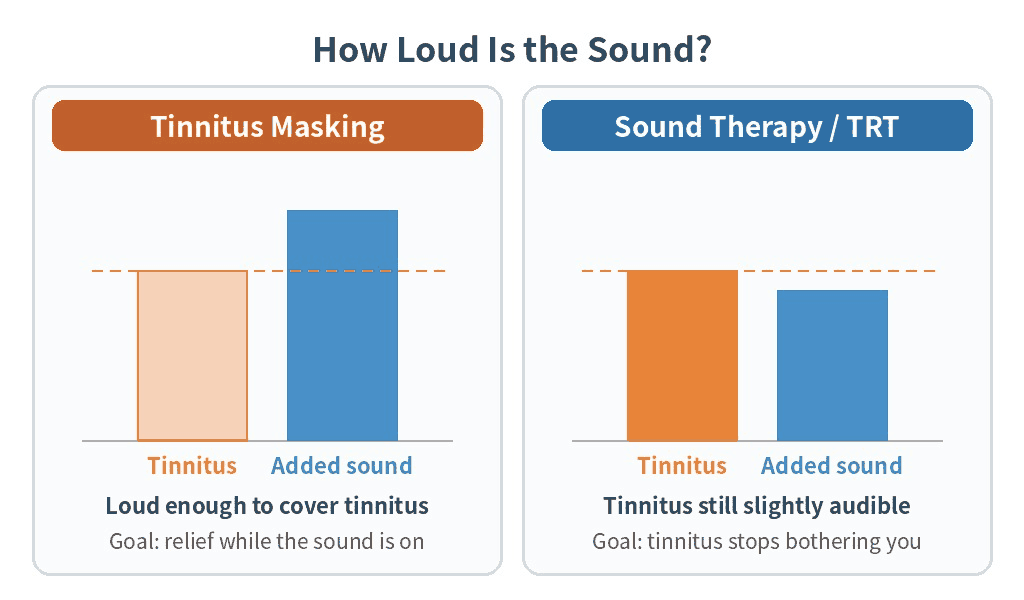
- Sound level: masking covers the tinnitus completely. Sound therapy and TRT usually keep it slightly audible underneath.
- Goal: masking aims for relief right now. Sound therapy and TRT aim for you to gradually get used to tinnitus, so it bothers you less even without sound.
- When the sound stops: with masking, tinnitus tends to come back. As you get used to it, tinnitus tends to bother you less, sound or no sound.
- Counseling: masking can be used on its own. TRT always combines sound with counseling about how tinnitus works.
In tinnitus retraining therapy (TRT), the thinking is that your brain can only learn to ignore a sound it can still hear. Covering tinnitus completely may give it fewer chances to do that.
That said, the exact level is not something to worry about too much. One small study found that people did about as well with full masking as with a level where tinnitus was still slightly audible. What seems to matter most is using a comfortable sound regularly, along with understanding your tinnitus.
National guidelines reflect this broader view. The latest US guideline (2026) names cognitive behavioral therapy (CBT), hearing aids, and sound enrichment among the strategies that can help, while noting that no single approach works for everyone. The UK’s NICE guideline found limited evidence for sound therapy and has called for more research.
If you want to know what getting used to tinnitus looks like and how long it can take, see getting used to tinnitus.
When to See a Doctor First
Before you try to cover tinnitus with sound, it is worth getting your ears and hearing checked. See a doctor soon, rather than waiting, if:
- Tinnitus started suddenly, or your hearing dropped suddenly
- You hear it in one ear only
- It pulses in time with your heartbeat
- It comes with dizziness or a feeling of fullness in the ear
If your hearing dropped suddenly, it may be sudden hearing loss, which is best treated quickly.
Living in Japan?
In Japan, tinnitus is usually seen at an ENT clinic (耳鼻咽喉科, jibi-inkōka), which starts with a hearing test. Some hospitals also have a tinnitus clinic (耳鳴り外来). The Japan Audiological Society’s Tinnitus Practice Guideline (2019, in Japanese) treats counseling, sound therapy using hearing aids or sound generators, and CBT as core approaches. Clinics that offer masking alone seem to be uncommon, so if you are interested, ask before your visit.
FAQ
Can masking make tinnitus worse?
For most people, no. In a few people, tinnitus seems louder for a while after a masking sound stops, then settles back to normal. Using very loud sound for long periods can also be hard on your ears. If either worries you, talk to your clinician.
Is it okay to mask tinnitus at night?
Playing a fan, rain sounds, or soft noise at bedtime is a common way to make tinnitus less noticeable. Many experts suggest keeping it quiet enough that you can still just hear your tinnitus, which may help you get used to it over time.
Tinnitus masker or hearing aid: which is better?
It depends on your hearing. If you have hearing loss, a hearing aid, often with a built-in sound generator, may help with both hearing and tinnitus. If your hearing is normal, a sound generator may be suggested instead. A hearing test is the best way to decide.
Is there a tinnitus masking app?
Yes, there are many apps that play masking or background sounds. Keep the volume comfortable, especially with earbuds. Our sound therapy guide, linked above, explains which sounds to try and how loud to play them.
Can masking cure tinnitus?
No. Masking can hide tinnitus while the sound is playing, but it usually comes back when the sound stops. Think of it as a way to get relief, not a way to make tinnitus go away.
Key Takeaways
- Tinnitus masking uses a sound loud enough to cover tinnitus. It can bring relief while it is playing.
- The tinnitus usually returns when the sound stops, and research on masking is limited.
- Sound therapy and TRT keep tinnitus slightly audible and aim to help you get used to it over time.
- Keep any sound comfortable, especially with earbuds.
- Sudden, one-sided, or pulsing tinnitus, or tinnitus with dizziness, means seeing a doctor first.
If tinnitus is so hard that you want to hide it, you do not have to handle it alone. A doctor or audiologist can help you find the approach that suits you.
References
- Hobson J, Chisholm E, El Refaie A. Sound therapy (masking) in the management of tinnitus in adults. Cochrane Database Syst Rev. 2012;(11):CD006371. Cochrane
- Roberts LE, Moffat G, Baumann M, Ward LM, Bosnyak DJ. Residual inhibition functions overlap tinnitus spectra and the region of auditory threshold shift. J Assoc Res Otolaryngol. 2008;9(4):417–435. DOI
- Tyler RS, Babin RW, Niebuhr DP. Some observations on the masking and post-masking effects of tinnitus. J Laryngol Otol. 1984;98(S9):150–156. DOI
- Vernon J, Meikle MB. Tinnitus masking: unresolved problems. In: Tinnitus (Ciba Foundation Symposium 85). 1981.
- Tyler RS, Noble W, Coelho CB, Ji H. Tinnitus retraining therapy: mixing point and total masking are equally effective. Ear Hear. 2012;33(5):588–594.
- American Academy of Otolaryngology–Head and Neck Surgery Foundation. Clinical Practice Guideline: Tinnitus Update (press release, October 12, 2026). AAO-HNSF
- National Institute for Health and Care Excellence (NICE). Tinnitus: assessment and management (NG155). 2020. NICE
- Japan Audiological Society. Tinnitus Practice Guideline 2019 (Kanehara, in Japanese).


コメント