Have you ever heard that playing white noise can help you sleep better or focus?
These days, it’s easy to find. There are white noise machines, phone apps, and hours-long videos on YouTube. Many parents use it to help their baby settle down at night, too.
My wife has moderate hearing loss, and she lives with tinnitus: a high ringing and a lower hum. I get tinnitus now and then myself. So on this blog, we’ve talked a lot about how a little bit of sound can make a quiet room easier to be in.
In this guide, I’ll go through what white noise actually is, whether it really works, and what to keep in mind if you’re using it for a baby or for tinnitus, based on what research shows so far.
In this article
- What white noise is, and how it differs from pink and brown noise
- What research says about white noise for sleep and focus
- How to use it safely for babies: where to put the machine, how loud, and how long
- Using white noise with tinnitus, and safe volume levels
- How to choose a white noise machine or app
What Is White Noise?
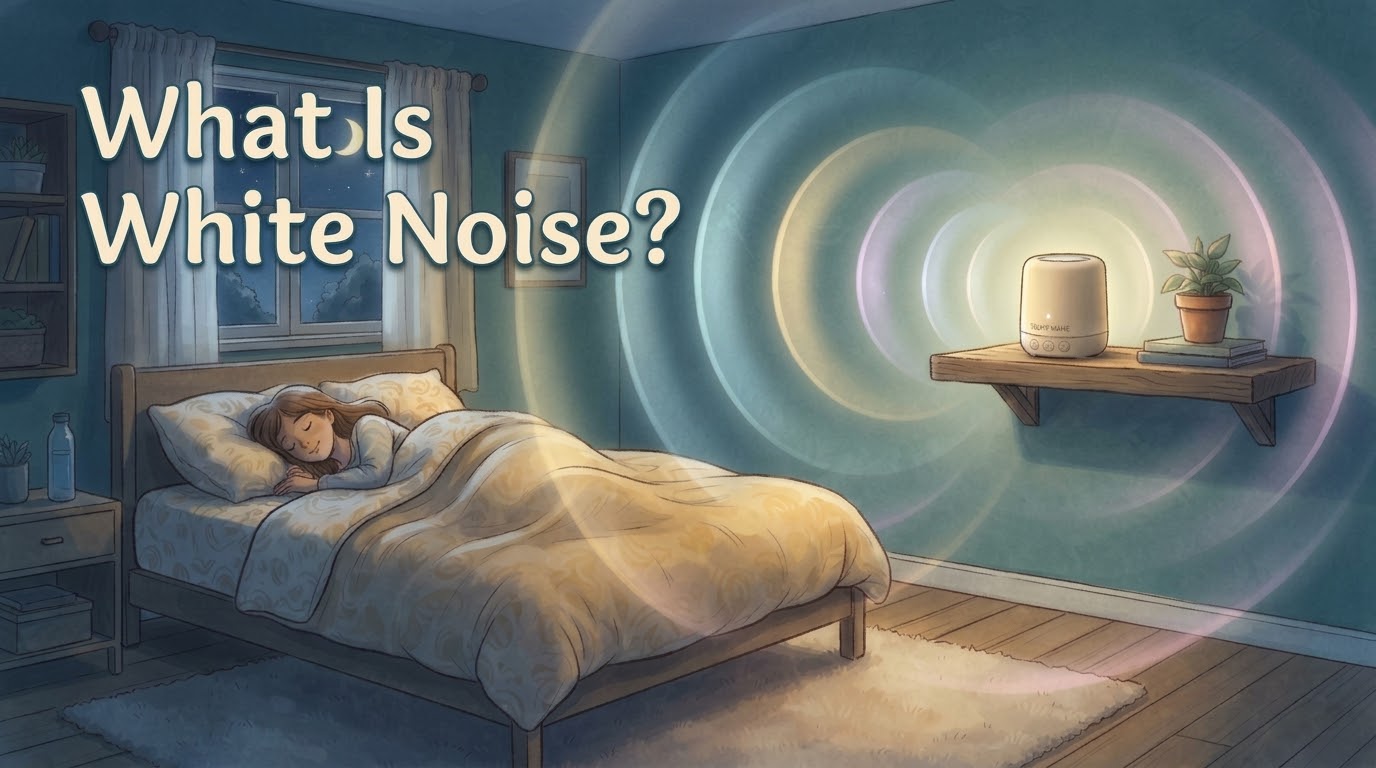
White noise is a sound that mixes all pitches, from low to high, at about the same strength.
To your ears, it sounds like a steady hiss, a bit like “shhh.” Think of the static on an old TV, or a radio that isn’t tuned to any station.
The name comes from light. When you mix all the colors of the rainbow, you get white light, right? In the same way, white noise contains all the pitches of sound mixed together. That’s why it’s called “white.”
Everyday sounds like a fan, an air conditioner, or an air purifier running in the background are close to white noise, too.
The Hiss From Headphones and Speakers Is Also Called White Noise
In the audio world, people use the term in a slightly different way.
Have you ever noticed a faint hiss coming from your earbuds or speakers, even when nothing is playing? That hiss is also a mix of many pitches, so people often call it white noise. You may also hear it called the noise floor.
It comes from the electronics inside, such as the amplifier, the part that makes the sound louder. It’s easiest to notice in a quiet room or at low volume, and some people notice it when they turn on noise cancelling. In most cases, it’s a normal part of how the device works, not a sign that something is broken.
In this guide, I’m talking about the other kind of white noise: the kind you play on purpose to help you sleep or focus.
White Noise vs Pink Noise vs Brown Noise
White noise has a few cousins, such as pink noise and brown noise. The difference is the balance of low and high sounds.
| Type | Sound balance | What it sounds like |
|---|---|---|
| White noise | All pitches at about the same strength | A hiss (TV static, a fan) |
| Pink noise | Higher pitches get a little softer | A steady rush (rain, a waterfall) |
| Brown noise | Higher pitches get much softer, so low sounds lead | A deep rumble (distant waterfall, low wind) |
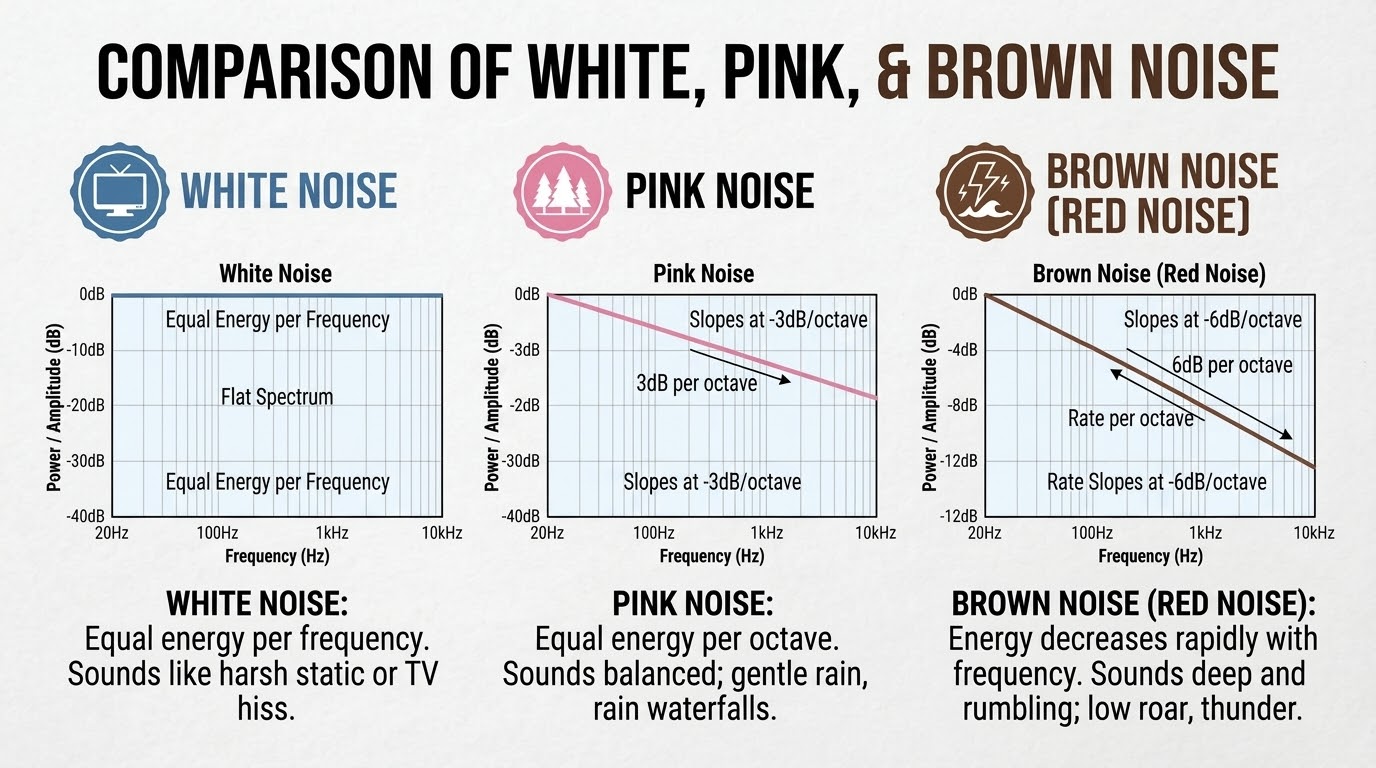
For the technically curious: every time the pitch doubles (one octave up), pink noise gets about 3 dB softer, and brown noise gets about 6 dB softer.
Because white noise has a lot of high sound in it, some people find it a bit harsh or tinny. If that’s you, pink or brown noise may feel calmer.
That said, apps and machines don’t always use these names the same way. Rather than going by the name, listen and pick the one that feels most comfortable to you.
Does White Noise Work? What Research Says
It works by blending in background sounds
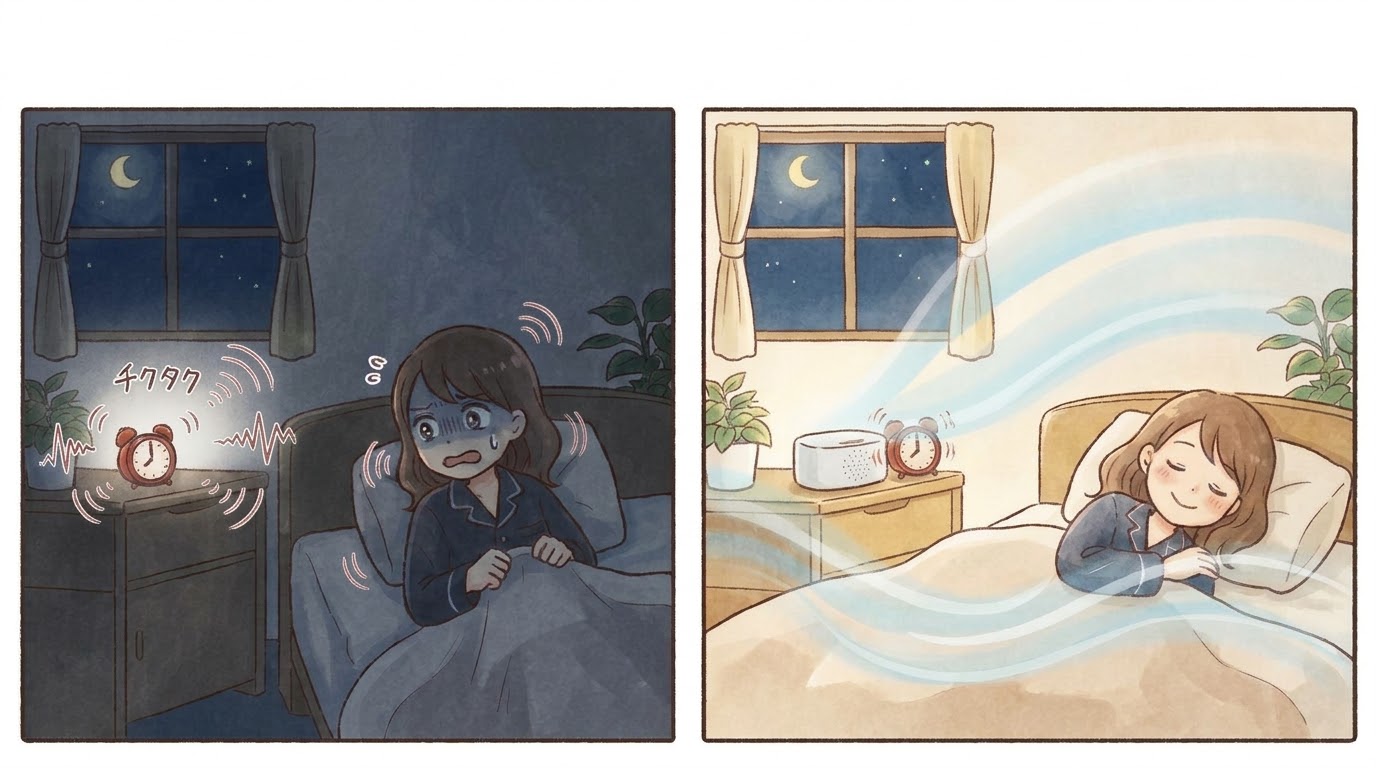
The main thing white noise does is help other sounds blend in. This is called masking.
Think about a busy café. You probably don’t notice the conversation at the next table. But in a quiet library, even a whisper can catch your attention.
Playing white noise softly is like laying down a “carpet” of sound in your room. Sudden noises, such as cars outside, a door closing, or someone moving around the house, stand out less.
Is white noise good for sleep? The evidence is mixed
Plenty of people feel they sleep better with white noise. But when researchers pull the studies together, the results are mixed.
A 2021 review looked at 38 studies on continuous noise, such as white noise, and sleep. Some studies found it helped sleep, others found it disturbed sleep, and the reviewers rated the overall quality of the evidence as very low.
A 2022 review of 34 studies also found no strong evidence that it clearly works. On the other hand, the short-term studies didn’t report harmful effects either.
So here’s where things stand: white noise may help some people, but it doesn’t work for everyone. It’s most worth a try if your bedroom has sounds that bother you, like traffic or a partner who snores.
Is white noise good for studying? It depends on the person
Some people like to play white noise while they study or work.
A 2024 review of studies found that young people with ADHD symptoms did slightly better on tasks that need focus (such as attention tests and school-like tasks) while listening to white or pink noise.
But young people without ADHD symptoms did slightly worse.
In other words, some people focus better with a little sound, and others focus better in quiet. If white noise distracts you, there’s no need to force it.
Tips for Using White Noise for Sleep
If you want to try white noise at bedtime, here are some tips:
- Play it softly through a speaker: Placing the speaker a little away from your pillow, rather than right next to your head, spreads the sound more gently
- Keep it quiet enough to talk over: It only needs to be loud enough to blend in background sounds. Louder doesn’t mean better
- Use a timer: Setting it to turn off after 30 minutes to an hour, around the time you fall asleep, is a simple way to keep things safe
- Don’t sleep with earbuds in: That means sound playing right next to your eardrums for hours. Use a speaker at night instead
- Rain or a stream is fine too: You don’t have to stick to white noise. Pick whatever sound helps you relax
To unwind before bed, you could also try progressive muscle relaxation, a simple way to release tension in your body.
If tinnitus is what keeps you up, our guide on how to sleep with tinnitus has more tips.
White Noise for Babies: How to Use It Safely
Some research shows it can help babies fall asleep
Many parents use white noise to help their baby sleep.
A small study published in 1990 in Archives of Disease in Childhood looked at 40 newborns, 2 to 7 days old, split into two groups. In the group that heard white noise, 16 out of 20 babies (80%) fell asleep within 5 minutes. In the group that didn’t, only 5 out of 20 (25%) did.
Still, this was a small, older study. It doesn’t mean white noise will work the same way for every baby.
Volume and placement matter most
The thing to watch most closely is volume.
In 2014, a study in Pediatrics, the journal of the American Academy of Pediatrics (AAP), tested 14 infant sleep machines at their maximum volume.
- At 30 cm (about 1 foot) from the machine, roughly where it would be if attached to a crib rail, all 14 machines went over 50 dBA, the level recommended for hospital nurseries (dBA is a type of decibel)
- 3 machines went over 85 dBA. Played at that level for 8 hours, that would go over the noise limit set for adults at work
- On average, the machines measured 79 dBA at 30 cm, 71 dBA at 1 m (about 3 feet), and 63 dBA at 2 m (about 6.5 feet). The farther away, the quieter
The research team suggested the following:
- Place the machine as far from your baby as you can. Don’t put it in the crib or on the crib rail
- Keep the volume as low as possible
- Use it only for short periods (turn it off once your baby is asleep, or use a timer)
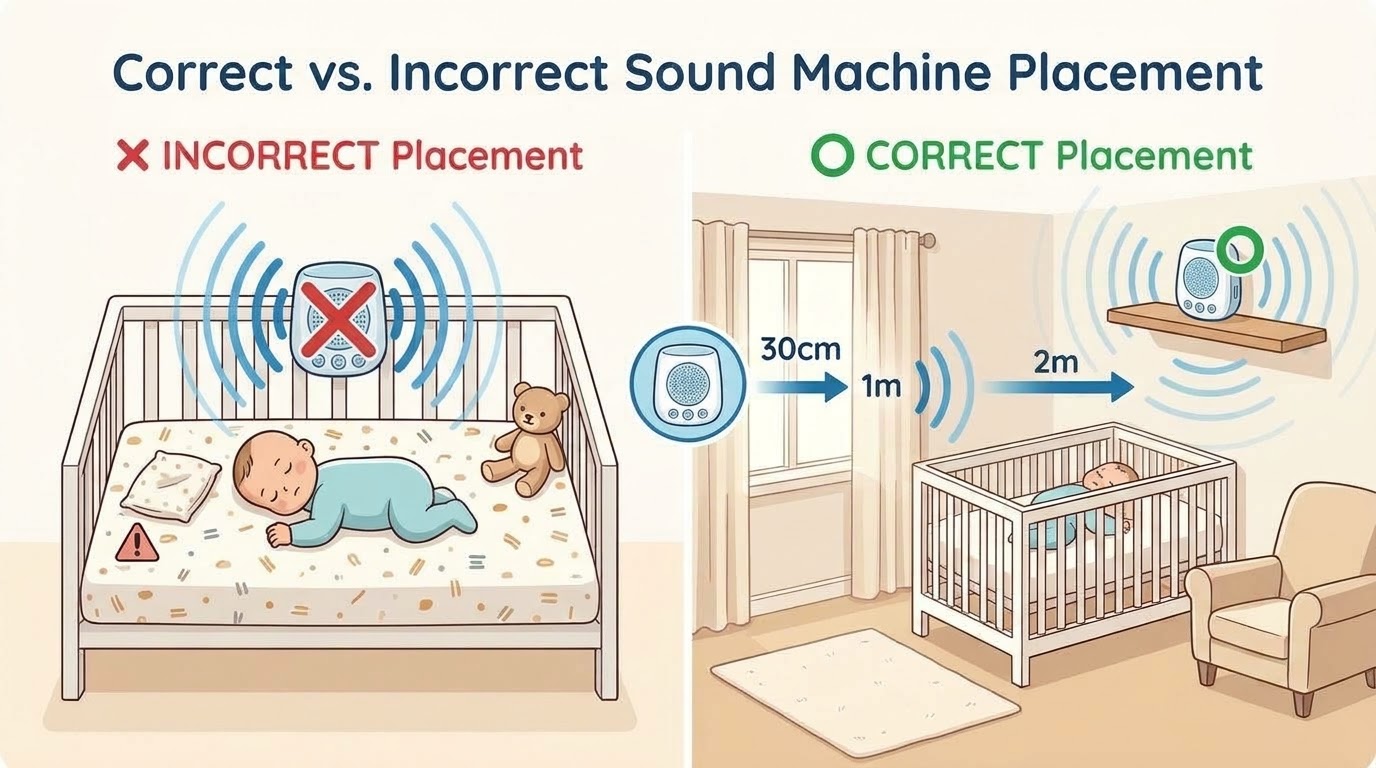
The AAP’s parenting website, HealthyChildren.org, gives similar advice: if you use a sound machine, place it as far from your baby’s head as possible and use it for short periods only.
There’s rarely any need to run a machine at full volume. Start at a level where you can just barely hear it.
To get a feel for decibel levels, our guide What Is a Decibel (dB)? has a chart of everyday sounds. A sound meter app on your phone can also give you a rough idea of how loud the machine is.
How long should you use white noise for a baby?
From what I could find, there’s no set age at which you should stop. And there’s still a lot we don’t know about the effects of long-term use.
So a good default is to turn it off once your baby is asleep, or to set a timer. As your child grows, you can slowly add other bedtime routines too, like reading a picture book or singing a lullaby.
If you have concerns, talk to your pediatrician or bring it up at a checkup.
Using White Noise With Tinnitus
It can make tinnitus less noticeable, not make it go away
Tinnitus tends to stand out most in a quiet room. Playing white noise softly can help the tinnitus blend into the background, so some people find it less bothersome.
But white noise doesn’t make the tinnitus itself go away. You may see videos that claim a certain frequency will stop your tinnitus, but there’s no solid evidence that they work.
In sound therapy for tinnitus, the sound is usually set so you can still hear your tinnitus a little, and the goal is to get used to it over time. That guide covers how to choose sounds and how long to keep going.
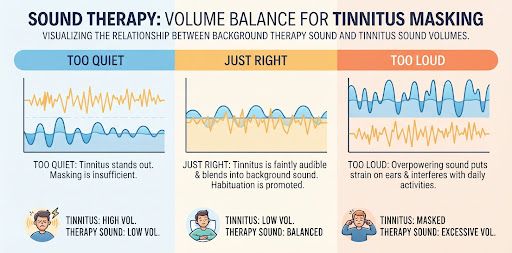
Using sound loud enough to cover the tinnitus completely is called tinnitus masking.
If sounds feel painful, don’t push through
If you have hyperacusis, where everyday sounds feel too loud or even painful, even soft white noise may feel uncomfortable. If so, stop and talk to an ear, nose and throat (ENT) doctor or an audiologist.
Also, see a doctor first, before trying sound at home, if your tinnitus started suddenly, comes with hearing loss, or stays in one ear only.
Hearing loss can change how white noise sounds
Many people with hearing loss find high-pitched sounds harder to hear. That means white noise may sound different to them than it does to someone with typical hearing.
If the “shhh” is hard to hear, a lower sound like rain or brown noise might suit you better. Try a few and see which one feels easiest to listen to.
How Loud Is Safe?
White noise is the kind of sound people tend to leave on for hours. That’s exactly why the volume matters.
- Through a speaker: Aim for about background music level, quiet enough that it doesn’t get in the way of a conversation
- Through headphones or earbuds: The WHO and the International Telecommunication Union (ITU) suggest keeping to 80 dB or lower for adults and 75 dB or lower for children, for up to 40 hours a week
- A simple habit: Keeping the volume around 60% of the maximum and resting your ears for about 10 minutes every hour is a rough starting point. Volume percentages differ by device, so check your phone’s headphone level meter if it has one
On a train or a plane, it’s tempting to turn white noise up to drown out the noise around you. But that adds more strain on your ears. For more, see Can Headphones and Earbuds Cause Hearing Loss?
Choosing a White Noise Machine or App
Start with your phone
You don’t need to buy a machine right away. Your phone is a great way to try it first.
- iPhone: Go to Settings > Accessibility > Audio & Visual > Background Sounds. You can choose sounds like Balanced Noise, Bright Noise, Dark Noise, rain, and ocean, and turn on Stop Sounds with a Timer (iOS 15 or later)
- Android: Features vary by phone. A sleep or ambient sound app with a built-in timer is handy
- YouTube: There are plenty of long videos, but a loud ad can pop up in the middle. If you use it at bedtime, keep an eye on the volume and the ads
What to look for in a white noise machine
If you plan to use white noise every night, a dedicated machine can be handy. It also means you don’t need your phone next to your pillow.
Here’s what to check:
- Sound options: Can you choose white, pink, or brown noise, a fan sound, or nature sounds like rain or waves?
- Looping: Machines that repeat a short recording can have a noticeable “seam” where the loop restarts, which bothers some people
- Volume control: Can you turn it down to a very low level in small steps? How quiet it can go matters more than how loud it can get
- Timer: Does it turn off by itself after 30 minutes, an hour, and so on?
- Power: A rechargeable one is easy to take on trips
- For a baby: Does it still work well placed across the room? Is its maximum volume not too loud?
Whatever machine you choose, keep the volume low and make good use of the timer.
FAQ
Is white noise bad for you?
Used at a low volume, there aren’t many reports of harm so far. But listening to loud sound for long stretches can strain your ears. Keeping the volume low and using a timer is the safe way to go.
Is it OK to play white noise all night?
Some people play it softly all night. But there’s no need to keep it on after you fall asleep. For babies, using it for short periods and turning it off once they’re asleep is what the research team and the AAP suggest.
Is white noise bad for babies?
Research on long-term effects is limited. What we do know is that some machines can get loud, especially up close. If you use one, keep it far from your baby, keep the volume low, and use it for short periods.
Is pink noise better than white noise for sleep?
Some studies have linked pink noise to deeper sleep. But often-cited studies, such as a 2017 study in older adults, used special equipment that played short bursts of pink noise timed to brain waves. That’s different from playing pink noise in the background all night. Which one is better depends on the person, so go with the one you find more comfortable.
Is white noise good for studying?
It depends. In a 2024 review, young people with ADHD symptoms did slightly better with white or pink noise, but those without ADHD symptoms did slightly worse. Try it and see.
What if white noise doesn’t help?
It doesn’t suit everyone. Try pink noise or rain sounds, or skip it altogether. If you have trouble sleeping night after night, talk to a doctor.
Can I use white noise if I have hearing loss?
Yes. But if high-pitched sounds are hard for you to hear, white noise may be hard to hear or sound different. Lower sounds may be easier to listen to, so try a few.
Key Takeaways
- White noise mixes all pitches at about the same strength, like a steady “shhh.” Pink and brown noise lean toward lower sounds.
- The research on sleep and focus is mixed. It may help some people, but not everyone.
- For babies, place the machine far away, keep it quiet, and use it for short periods.
- It won’t make tinnitus go away, but it can help tinnitus stand out less.
- With headphones, keep the volume down and take regular breaks.
Louder isn’t better. Start quietly, and find the way of using it that works for you.
References
- Riedy SM, et al. Noise as a sleep aid: A systematic review. Sleep Medicine Reviews. 2021;56:101385. PubMed
- Capezuti E, et al. Systematic review: auditory stimulation and sleep. Journal of Clinical Sleep Medicine. 2022;18(6):1697-1709. PMC
- Nigg JT, et al. Systematic Review and Meta-Analysis: Do White Noise or Pink Noise Help With Task Performance in Youth With ADHD or With Elevated Attention Problems? J Am Acad Child Adolesc Psychiatry. 2024;63(8):778-788. PubMed
- Spencer JA, et al. White noise and sleep induction. Archives of Disease in Childhood. 1990;65(1):135-137. PubMed
- Hugh SC, et al. Infant Sleep Machines and Hazardous Sound Pressure Levels. Pediatrics. 2014;133(4):677-681. PubMed
- American Academy of Pediatrics (HealthyChildren.org). How Noise Affects Your Child. HealthyChildren.org
- Papalambros NA, et al. Acoustic Enhancement of Sleep Slow Oscillations and Concomitant Memory Improvement in Older Adults. Frontiers in Human Neuroscience. 2017;11:109.
- WHO. Safe listening devices and systems: a WHO-ITU standard. WHO
- Apple Support. Use Background Sounds to help with sleep, focus, and more. Apple
コメント