

“Can hearing loss be treated with gene therapy?”“Could gene therapy help babies born with hearing loss?”“Is gene therapy for hearing loss available in my country?”
If you are expecting a baby or have a child with hearing loss, you may have questions like these.
Until recently, treatment for hearing loss has mainly focused on improving access to sound with hearing aids or cochlear implants. However, researchers are now developing gene therapies that target the underlying genetic causes of hearing loss.
In particular, research into OTOF-related hearing loss has made significant progress. Clinical studies in humans have reported improvements in hearing after OTOF gene therapy, and clinical trials are also being conducted in Japan.
However, gene therapy does not currently work for all types of hearing loss, and these treatments are not yet established as standard treatment.
In this article, we explain gene therapy for hearing loss in simple terms, starting with the basics of what genes are. We will also look at how OTOF gene therapy works, the latest research, clinical trials in Japan, genetic testing, and what gene therapy could mean for babies born with hearing loss.
If you don’t know about hard of hearing clearly, please refer article of hard of hearing.
- What Is Gene Therapy for Hearing Loss?
- Why Can Changing a Gene Affect Hearing?
- Which Types of Hearing Loss Could Be Treated With Gene Therapy?
- OTOF-Related Hearing Loss and Gene Therapy
- Has Gene Therapy for Hearing Loss Actually Started?
- Can Gene Therapy Treat Hearing Loss in Babies?
- What Are the Benefits and Challenges of Gene Therapy for Hearing Loss?
- Do You Need Genetic Testing to Receive Gene Therapy?
- Frequently Asked Questions About Gene Therapy for Hearing Loss
- Can Hearing Loss Be Completely Cured With Gene Therapy?
- Can Babies Receive Gene Therapy for Hearing Loss?
- If My Child Has Genetic Hearing Loss, Can They Definitely Receive Gene Therapy?
- Will I Still Need Hearing Aids After Gene Therapy?
- Where Can I Get Genetic Testing for Hearing Loss?
- When Will Gene Therapy for Hearing Loss Become a Common Treatment?
- Is Hearing Loss Hereditary?
- Conclusion: Gene Therapy Could Become an Option for Hearing Loss in the Future
- References
What Is Gene Therapy for Hearing Loss?
Some types of hearing loss are caused by changes in genes. These are known as genetic hearing loss.
Gene therapy aims to improve hearing by addressing the genetic cause of hearing loss. Depending on the specific genetic change, gene therapy may provide a functional copy of a gene that is not working properly, helping restore its normal function.
Before looking at how gene therapy works, let’s first take a look at what genes are and how changes in genes can lead to hearing loss.
What Exactly Is a Gene?

Before getting into the details of gene therapy, let’s start with a simple question: What exactly is a gene?
Simply put, a gene is like an instruction manual for building and maintaining the body.
Different genes contain instructions for different functions in the body. Some of the genes that work in the ear are involved in developing and maintaining the cells that detect sound, converting sound into electrical signals, and transmitting those signals to the auditory nerve.
If a gene has a harmful change, the instructions may not work properly. As a result, the cells or processes that depend on that gene may not function normally, which can affect hearing.
Genetic Changes Can Cause Hearing Loss

A large number of genes are involved in how the ear and auditory system work.
If one of these genes has a harmful change, it can affect the hair cells in the inner ear, the auditory nerve, or the way cells communicate with each other. These problems can eventually lead to hearing loss.
Hearing loss caused by changes in genes is generally called genetic hearing loss.
We inherit one copy of most genes from our mother and one copy from our father. There are several different patterns of inheritance for genetic hearing loss.
One of the most common is called autosomal recessive inheritance. In this type of inheritance, a child may develop hearing loss when they inherit a disease-causing variant in both copies of a particular gene—one from each parent.
This means that having a parent with hearing loss does not necessarily mean that their child will have hearing loss. Likewise, a baby can have genetic hearing loss even when neither parent has hearing loss themselves.
In my own family, my wife has hearing loss, but our children do not. Neither of my wife’s parents has hearing loss either.
What Happens During Gene Therapy?

Gene therapy aims to address the underlying genetic problem.
Depending on the condition, doctors may deliver a functional copy of a gene to the cells where it is needed. The goal is to restore the gene’s function and, ultimately, improve hearing.
A simplified version of the process is:
Restore the function of the gene -> produce the necessary protein -> restore cell function -> aim to improve hearing
The exact approach varies depending on the gene involved and the type of hearing loss.
Why Can Changing a Gene Affect Hearing?
Hearing is much more than simply detecting sound with the outer ear.
Normal hearing requires many different structures and processes, including the eardrum, middle-ear bones, hair cells in the inner ear, auditory nerve, and communication between cells.
Many genes are involved in these processes. If a gene does not work properly, it can interfere with the way sound is converted into electrical signals or how those signals are transmitted to the auditory nerve.
As a result, changes in certain genes can lead to hearing loss.
Hearing Requires Many Different Cells and Proteins
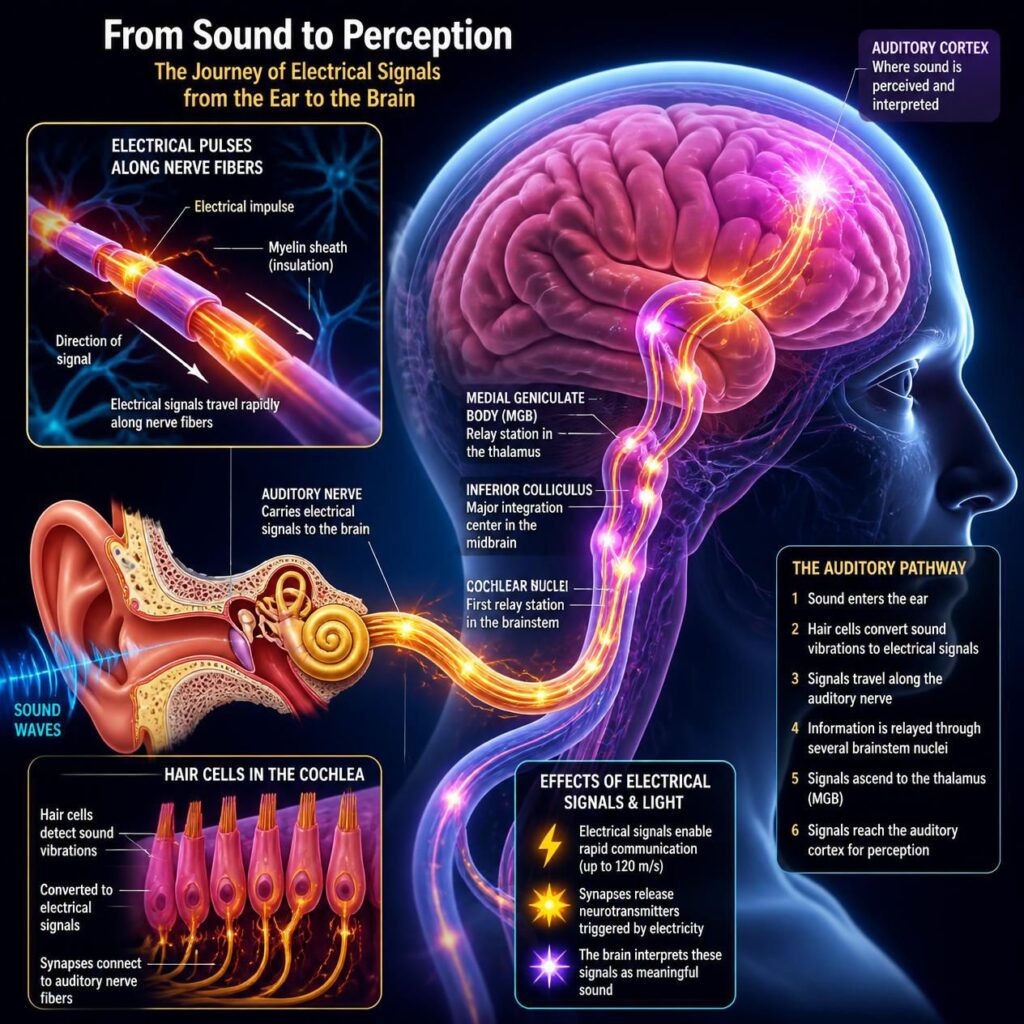
Let’s briefly look at how we hear.
Many people think of hearing as something that simply happens in the ear. In reality, the ear converts sound vibrations into electrical signals that can be processed by the brain.
A simplified pathway looks like this:
Sound -> eardrum -> middle-ear bones -> inner ear -> hair cells -> auditory nerve -> brain
The visible part of the ear is called the pinna, or auricle. It helps collect sound and direct it into the ear canal.
The sound then travels through the ear canal and reaches the eardrum. Behind the eardrum are three tiny bones called the ossicles. When the eardrum vibrates, the ossicles vibrate as well and help amplify and transmit these vibrations toward the inner ear.
The vibrations eventually reach the cochlea, a spiral-shaped structure in the inner ear. Inside the cochlea are specialized sensory cells called hair cells, which convert mechanical vibrations into electrical changes.
These electrical changes trigger a series of processes inside the hair cells, ultimately leading to the release of neurotransmitters.
One important protein involved in this process is otoferlin. Otoferlin plays a key role in the release of neurotransmitters from inner hair cells, allowing auditory information to be transmitted to the auditory nerve.
This is particularly important when discussing OTOF-related hearing loss, because the OTOF gene provides the instructions for making otoferlin.
Genetic Changes Can Affect How the Ear Works

Genes associated with genetic hearing loss can play important roles in the hair cells of the inner ear, the auditory nerve, or the communication between cells.
When a harmful genetic variant affects one of these genes, the corresponding protein may not be produced correctly or may not function properly.
As a result, important processes involved in hearing can be disrupted, potentially leading to hearing loss.
This is one reason why researchers are investigating whether gene therapy can restore the function of specific genes and improve hearing.
Which Types of Hearing Loss Could Be Treated With Gene Therapy?
There are many different types of genetic hearing loss, and many different genes can be involved.
However, not every type of genetic hearing loss is currently a candidate for gene therapy.
Research is at different stages depending on the gene involved. Some potential treatments are still being studied in animals or other preclinical models, while others have progressed to clinical trials involving humans.
Hearing Loss Caused by Genetic Changes
Some of the more common types of genetic hearing loss include:
- OTOF-related hearing loss
- GJB2-related hearing loss
- SLC26A4-related hearing loss
- TMC1-related hearing loss
OTOF-related hearing loss can sometimes have features similar to auditory neuropathy spectrum disorder (ANSD).
ANSD is a hearing disorder in which sound can reach the inner ear, but the transmission of auditory information to the brain does not work normally. As a result, a person may have particular difficulty understanding speech, especially in noisy environments.
If you would like to learn more about auditory neuropathy spectrum disorder, we have a separate article that explains it in more detail.
Regarding auditory neuropathy↗
And we prepared article of genes. So, please refer it.
Not All Genetic Hearing Loss Can Be Treated With Gene Therapy
Unfortunately, gene therapy cannot currently treat all types of genetic hearing loss.
Gene therapy for hearing loss is still being researched and has not yet become a standard treatment.
This is not just the case in Japan. The same is true around the world.
As research progresses, more types of genetic hearing loss may eventually become candidates for gene therapy. However, it may take time before these treatments become available for a wider range of genetic conditions.
Research Is Progressing for Specific Genetic Causes of Hearing Loss
Genes associated with genetic hearing loss include:
- OTOF
- TMC1
- TMPRSS3
- PCDH15
- GJB2
- GJB6
- KCNQ4
Researchers are also investigating gene therapy for many other genes associated with hearing loss.
The stage of research varies considerably from one gene to another. Some treatments are still mainly being studied in animals or other preclinical models, while others have progressed to clinical trials involving people.
Seeing a long list of gene names can be confusing, especially if you are a parent who is simply trying to understand your child’s hearing loss.
Among the different genetic hearing loss treatments currently being investigated, OTOF gene therapy is one of the leading examples that has progressed to human clinical trials.
OTOF-Related Hearing Loss and Gene Therapy
The OTOF gene provides the instructions for making a protein called otoferlin, which plays an important role in transmitting auditory information from inner hair cells in the inner ear to the auditory nerve.
When there is a harmful variant in the OTOF gene, otoferlin may not function properly. This can interfere with the transmission of auditory information to the auditory nerve.
Research into gene therapy for OTOF-related hearing loss aims to provide a functional copy of the OTOF gene and restore the missing function.
Because of this, OTOF gene therapy is currently one of the most closely watched areas of research in genetic hearing loss.
What Is the OTOF Gene?
The OTOF gene provides the instructions for making otoferlin, a protein that is essential for transmitting auditory information from inner hair cells to the auditory nerve.
Otoferlin plays an important role in the release of neurotransmitters from inner hair cells. These neurotransmitters allow auditory information to be passed on to the auditory nerve.
We have a separate article that explains the OTOF gene and its relationship with hearing loss in more detail.
What Happens When There Is a Change in the OTOF Gene?
When there is a harmful variant in the OTOF gene, otoferlin may not be produced properly or may not function normally.
Otoferlin plays an important role in the release of neurotransmitters from inner hair cells, which is necessary for transmitting auditory information to the auditory nerve.
As a result, the inner ear may be able to detect sound and generate electrical changes in the hair cells, but the signal may not be transmitted normally to the auditory nerve.
In simple terms, the ear can detect sound, but the signal is not effectively passed along the auditory pathway to the brain.
This is why people with OTOF-related hearing loss can have difficulty understanding speech even when some parts of the hearing system are still functioning.
Why Is OTOF Gene Therapy Getting So Much Attention?
There are several reasons why OTOF gene therapy has attracted significant attention.
The main reasons include:
- The genetic cause can be clearly linked to a single gene.
- Important inner-ear structures can remain relatively intact.
- Otoferlin plays a critical role in neurotransmitter release from inner hair cells.
- Providing a functional copy of OTOF could potentially restore the missing function.
- Technical challenges related to delivering the OTOF gene have been addressed through advances in gene therapy technology.
- Most importantly, hearing improvements have actually been reported in human clinical studies.
These factors make OTOF-related hearing loss a particularly promising target for gene therapy research.
It is also important to understand what gene therapy is actually trying to do.
Gene therapy does not necessarily mean repairing a damaged gene inside the ear and returning the entire auditory system to its original state.
In many current gene therapy approaches for hearing loss, the goal is instead to provide a functional copy of a gene that is not working properly and restore the function that is missing.
This distinction is important.
Depending on the genetic cause, some forms of genetic hearing loss can involve changes to the structure or development of the inner ear itself. If the necessary structures are severely damaged or absent, simply providing a functional gene may not be enough to restore hearing.
In OTOF-related hearing loss, however, important structures of the inner ear can remain relatively preserved. The main problem may be the missing or dysfunctional otoferlin needed for communication between inner hair cells and the auditory nerve.
This combination—a relatively preserved inner ear and a specific missing genetic function—is one of the reasons OTOF-related hearing loss has become an important target for gene therapy research.
Has Gene Therapy for Hearing Loss Actually Started?
Gene therapy for hearing loss is no longer limited to research in laboratories.
In particular, OTOF gene therapy has already reached human clinical trials, and improvements in hearing have been reported in participants.
However, these treatments have not yet become standard medical treatment. Researchers are still studying their safety, how long the benefits last, and which patients are most likely to benefit.
Clinical trials investigating OTOF gene therapy are also being conducted in Japan.
Gene Therapy for Hearing Loss Has Reached Clinical Trials
Many gene therapy approaches for genetic hearing loss are still in the preclinical research stage, meaning they are mainly being studied in animals or laboratory models.
OTOF gene therapy, however, has progressed further. Clinical trials involving people have already been conducted, and improvements in hearing have been reported.
This is an important step because it means researchers are beginning to evaluate whether these treatments can actually work in people, rather than only in laboratory or animal studies.
Hearing Improvements Have Actually Been Reported
Clinical trials of OTOF gene therapy have already reported improvements in hearing in people with OTOF-related hearing loss.
In a study conducted in China, 42 people with congenital hearing loss caused by OTOF variants received OTOF gene therapy. Hearing recovery was observed in 90% of participants.
The improvements were maintained during follow-up for up to 2.5 years.
However, there are some important limitations to keep in mind.
The study was a single-arm clinical trial, meaning there was no separate control group for comparison. More research is therefore needed to understand the long-term safety of the treatment and which patients are most likely to benefit.
The results are promising, but they do not mean that OTOF gene therapy is already an established cure for genetic hearing loss.
Is OTOF Gene Therapy Available to Everyone?
Unfortunately, not yet.
OTOF gene therapy is still being studied in clinical trials, so it is not currently a treatment that anyone can simply request and receive.
Eligibility depends on factors such as the specific genetic cause of hearing loss, age, hearing status, and the requirements of the individual clinical trial.
An OTOF Gene Therapy Clinical Trial Is Also Being Conducted in Japan
Clinical trials for OTOF gene therapy are also being conducted in Japan.
If you or your child may be eligible and you are interested in participating, you can check the official Japanese clinical trial registry for the latest information and eligibility requirements.
Check the OTOF gene therapy clinical trial in Japan
https://jrct.mhlw.go.jp/latest-detail/jRCT2033250730?utm_source=chatgpt.com
Can Gene Therapy Treat Hearing Loss in Babies?
If you are expecting a baby or have recently become a parent, you may be wondering:
“If my baby is born with hearing loss, could gene therapy treat it?”
The short answer is: possibly in the future for certain genetic types of hearing loss, but not for every baby with hearing loss today.
OTOF gene therapy is one example that has already reached human clinical trials and has shown promising results.
However, it is important to remember that congenital hearing loss can have many different causes, and gene therapy is currently only being investigated for specific genetic conditions.
There Are Many Possible Causes of Hearing Loss in Babies
Not all congenital hearing loss is caused by a genetic variant.
Possible causes include:
- Genetic factors
- Congenital infections, such as congenital cytomegalovirus (CMV) infection
- Structural differences or abnormalities of the inner ear
- Factors related to pregnancy, birth, or the newborn period
- Cases where the exact cause cannot be identified
This is why identifying the cause of a baby’s hearing loss can be an important part of the evaluation.
We also have a separate article that explains congenital hearing loss in more detail.
If a Baby Has Genetic Hearing Loss, Can They Receive Gene Therapy?
Not necessarily.
Even if a baby’s hearing loss is caused by a genetic variant, that does not automatically mean that gene therapy is available.
The specific gene involved is very important.
Researchers are developing gene therapies for only certain genetic causes of hearing loss, and each treatment is at a different stage of development.
For example, OTOF-related hearing loss is currently one of the genetic forms of hearing loss being actively investigated in human clinical trials.
Therefore, not every child with genetic hearing loss can currently receive gene therapy.
Genetic testing may help identify the cause of hearing loss and determine whether a child could potentially be eligible for a clinical trial or other targeted treatment.
Early Detection and Early Support Are Important

Early detection and early support are extremely important when a baby has hearing loss.
Hearing plays an important role in the development of speech, language, and communication. Identifying hearing loss early can help families and healthcare professionals consider appropriate support as soon as possible.
Of course, spoken language is not the only way to communicate. Children can also communicate through sign language and other communication methods, and these can be very effective.
For families who want to use spoken language, however, early access to sound and appropriate support can make it easier for a child to develop listening and spoken-language skills.
For parents, learning a new language such as sign language can also take time and effort. What matters most is finding a communication approach that works well for the child and family.
One important tool for early detection is newborn hearing screening.
Newborn hearing screening is usually performed within the first few days after birth. It is designed to identify babies who may have hearing loss so that they can receive further testing if necessary.
We also have a separate article that explains newborn hearing screening in more detail.
Regarding newborn hearing screening↗
If a baby receives a “refer” result on newborn hearing screening, it means that the baby did not pass the initial screening and needs additional testing.
Importantly, a “refer” result does not necessarily mean that the baby has permanent hearing loss.
There are several reasons why a newborn may not pass the initial screening. For example, fluid or other material remaining in the ear after birth can sometimes affect the test result.
This is why a repeat hearing test is usually performed.
If the baby does not pass the follow-up screening either, the next step may include a more detailed hearing evaluation, tests to investigate the possible cause, and discussions about appropriate support, including hearing aids or cochlear implants when appropriate.
The important thing for parents to remember is that a “refer” result is a reason for follow-up, not a diagnosis by itself.
What Are the Benefits and Challenges of Gene Therapy for Hearing Loss?
Gene therapy has the potential to target the underlying genetic cause of certain types of hearing loss.
Unlike hearing aids and cochlear implants, which primarily help people make better use of the hearing they have, gene therapy aims to address the biological cause of hearing loss itself.
However, gene therapy also has important limitations. It cannot currently be used for every type of hearing loss, only certain genetic causes are being targeted, and researchers still need to learn more about its long-term safety and effectiveness.
| Potential Benefits | Challenges |
| May target the underlying cause of certain types of hearing loss | Not all types of hearing loss are eligible |
| May potentially restore some hearing function in the future | Only a limited number of genes are currently being targeted |
| Offers a different treatment approach from hearing aids and cochlear implants | Long-term safety needs to be carefully evaluated |
| May offer the possibility of treatment early in life | Many treatments are still in the research or clinical trial stage |
It is important to remember that these are potential benefits. Gene therapy for hearing loss is still an emerging field, and researchers are continuing to study how effective and safe these treatments are.
Do You Need Genetic Testing to Receive Gene Therapy?
Whether someone may be eligible for gene therapy depends largely on which gene is causing their hearing loss.
For this reason, genetic testing can provide important information when doctors are investigating the cause of hearing loss and considering whether a person could potentially benefit from a targeted treatment or clinical trial.
However, genetic testing does not always identify the cause of hearing loss.
Genetic Testing Can Help Identify the Cause of Hearing Loss

Many different genes can cause or contribute to genetic hearing loss.
Without genetic testing, it may be difficult to determine which gene is responsible for a person’s hearing loss.
Genetic testing can help identify certain genetic variants that may be responsible for hearing loss.
Because current gene therapy approaches only target specific genes, genetic testing may also help doctors determine whether a person has a genetic cause that is currently being investigated as a potential target for gene therapy.
However, having a genetic diagnosis does not automatically mean that gene therapy is available.
Genetic Testing Does Not Always Find the Cause
Genetic variants are not the only possible cause of hearing loss.
Hearing loss can also result from infections, structural differences in the ear, environmental factors, and other causes that are not detected through genetic testing.
As a result, genetic testing may not identify the cause of someone’s hearing loss.
If no genetic cause is identified, that does not mean the hearing loss is not real or that there is no possible treatment. It simply means that the cause was not identified through that particular genetic test.
And if the hearing loss is not caused by a genetic change that can currently be targeted by gene therapy, gene therapy would not be expected to improve the hearing loss at this time.
What Are the Benefits of Genetic Testing?

Genetic testing may provide several useful benefits, including:
- Providing clues about the underlying cause of hearing loss
- Potentially helping determine whether someone may be eligible for future research or clinical trials
- Providing information about the possibility of passing a genetic condition on to other family members
Genetic testing can therefore be useful not only for understanding a person’s hearing loss, but also for making informed decisions about their future care and family planning.
In my own family, my wife had genetic testing before our children were born because we were concerned about whether her hearing loss might be passed on to our children.
Our children ultimately do not have hearing loss.
If you are worried about whether hearing loss could be passed on to your child, talking with a healthcare professional or a genetic counselor may also be helpful.
Genetic counseling can help you understand what genetic testing can and cannot tell you, what the results may mean for your child, and what options may be available to your family.
Frequently Asked Questions About Gene Therapy for Hearing Loss
When it comes to gene therapy for hearing loss, parents and people with hearing loss often have questions such as:
“Can gene therapy completely cure hearing loss?”“Can babies receive gene therapy?”“Will I still need hearing aids after gene therapy?”
Here are answers to some of the most common questions, based on what we currently know about gene therapy for hearing loss.
Can Hearing Loss Be Completely Cured With Gene Therapy?
Not at this time.
Some clinical studies have reported improvements in hearing after gene therapy, particularly for certain genetic types of hearing loss.
However, it is still too early to say that gene therapy can completely restore normal hearing or permanently cure hearing loss.
Can Babies Receive Gene Therapy for Hearing Loss?
At present, gene therapy for hearing loss is not available as a standard treatment at medical institutions.
These treatments are still being investigated in clinical trials.
In Japan, some people may be able to consider participating in a clinical trial if they meet the specific eligibility requirements.
Whether a baby or child can participate depends on factors such as the specific genetic cause of hearing loss, age, hearing status, and the requirements of the individual clinical trial.
If My Child Has Genetic Hearing Loss, Can They Definitely Receive Gene Therapy?
Unfortunately, no.
Gene therapy is currently being developed for only certain genetic causes of hearing loss.
Even if genetic testing confirms that a child has genetic hearing loss, there may not yet be a gene therapy available for the specific gene involved.
Eligibility also depends on the requirements of each clinical trial.
Will I Still Need Hearing Aids After Gene Therapy?
Possibly.
Gene therapy does not necessarily restore hearing to a normal level.
If hearing remains impaired after treatment, a person may still benefit from hearing aids or other hearing support.
In other words, receiving gene therapy does not automatically mean that hearing aids will no longer be necessary.
Where Can I Get Genetic Testing for Hearing Loss?
If you are interested in genetic testing for hearing loss, you can start by talking with an ear, nose and throat (ENT) specialist or another healthcare professional who evaluates hearing loss.
Depending on your situation, they may discuss genetic testing with you or refer you to an appropriate specialist or genetic counseling service.
When Will Gene Therapy for Hearing Loss Become a Common Treatment?
Unfortunately, there is no clear answer yet.
Gene therapy for hearing loss is developing rapidly, but many treatments are still in clinical trials or earlier stages of research.
Researchers need more information about their effectiveness, safety, long-term outcomes, and which patients are most likely to benefit.
It is therefore difficult to predict exactly when gene therapy will become a widely available treatment.
Is Hearing Loss Hereditary?
There are several different patterns of inheritance, and not all hearing loss is inherited.
Some types of hearing loss are caused by genetic variants and can be passed from parents to their children.
However, a child can also have hearing loss even when both parents have normal hearing.
In other words, you cannot simply say that hearing loss is always inherited.
If you are concerned about whether hearing loss may run in your family, you can talk with an ENT specialist or healthcare professional about genetic testing and genetic counseling.
Conclusion: Gene Therapy Could Become an Option for Hearing Loss in the Future
Gene therapy for hearing loss is a new treatment approach that aims to improve hearing by restoring or supplementing the function of genes involved in hearing.
At present, gene therapy is not available for all types of genetic hearing loss. However, OTOF-related hearing loss is one of the most promising examples, with hearing improvements reported in human clinical trials.
Clinical trials for OTOF gene therapy are also being conducted in Japan, and research is gradually moving closer to potential clinical use.
However, gene therapy has not yet become a standard treatment for hearing loss.
For this reason, if hearing loss is diagnosed, it is important not to wait for gene therapy. Instead, families should consider currently available treatment and support options, such as hearing aids and cochlear implants, as early as appropriate.
If genetic hearing loss is suspected, genetic testing may also provide useful information. It may help identify the possible cause of hearing loss and, in some cases, determine whether a person could potentially be eligible for future research or targeted treatments.
If you are worried about questions such as:
- “Could hearing loss be passed on to my child?”
- “Could my child inherit my hearing loss?”
- “Will there be a treatment in the future?”
you do not have to figure everything out on your own.
Talking with an ENT specialist, genetic counselor, or other qualified healthcare professional can help you understand your options and make informed decisions for yourself or your child.
References
Jiang L, et al. Multicentre gene therapy for OTOF-related deafness followed up to 2.5 years. Nature. 2026.
https://www.nature.com/articles/s41586-026-10393-y?utm_source=chatgpt.com
Qi J, et al. AAV gene therapy for autosomal recessive deafness 9: a single-arm trial. Nature Medicine. 2025.
https://www.nature.com/articles/s41591-025-03773-w?utm_source=chatgpt.com
Lv J, et al. AAV1-hOTOF gene therapy for autosomal recessive deafness 9: a single-arm trial. The Lancet. 2024.
https://pubmed.ncbi.nlm.nih.gov/38280389/?utm_source=chatgpt.com
Gene therapy for hereditary hearing loss. Hearing Research. 2024.
https://pubmed.ncbi.nlm.nih.gov/39616957/
International expert consensus on gene therapy for hereditary hearing loss: Based on clinical trials.
https://pubmed.ncbi.nlm.nih.gov/41135524/?utm_source=chatgpt.com


コメント