

“Your child was perfectly fine a moment ago, but suddenly wakes up crying in the middle of the night and keeps touching their ear…”
If you’re a parent, a moment like this can be scary. One possible cause is a middle ear infection, also known as otitis media.
Middle ear infections are very common in young children, and they often develop after a cold. In many cases, they get better within a week or two with appropriate treatment.
However, an ear infection can sometimes last longer or temporarily affect your child’s hearing if it is left untreated.
In this article, we’ll explain the basics of childhood ear infections in simple terms, even if you know very little about ear health.
We’ll cover:
- What a middle ear infection actually is
- Signs that can be easy to miss in young children
- When to see a doctor and what treatment may involve
- Simple things you can do at home to help prevent ear infections
My own son has had a middle ear infection, so I’ll also share a little about what we experienced as a family.
- What Is a Middle Ear Infection?
- Don’t Miss These Signs of an Ear Infection in Your Child
- Signs of an Ear Infection in Babies
- Signs of an Ear Infection in Toddlers and Young Children
- Types of Middle Ear Infections
- Should You Take Your Child to the Doctor?
- How Are Middle Ear Infections Treated?
- Treatment for Otitis Media with Effusion
- How Do Middle Ear Infections Affect Hearing?
- What Can You Do at Home to Help Prevent Ear Infections?
- Frequently Asked Questions About Childhood Ear Infections
- Summary: If Something Doesn’t Seem Right, Have Your Child’s Ears Checked
- Reference
What Is a Middle Ear Infection?
A middle ear infection, also called otitis media, is an infection and inflammation in the middle ear, the space behind the eardrum.
You may have heard the term “ear infection” many times, but you might not know exactly what happens inside the ear.
A Simple Look at How the Ear Works
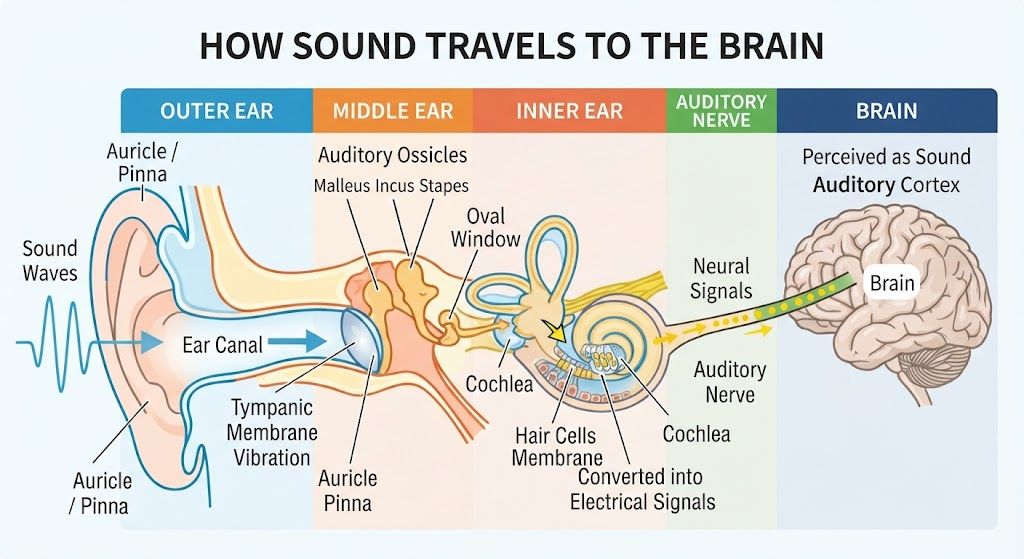
The ear can be roughly divided into three main parts:
- Outer ear: The part we can see, including the ear canal that leads to the eardrum.
- Middle ear: The small space behind the eardrum. It contains tiny bones that help carry sound.
- Inner ear: The deeper part of the ear, where sound vibrations are converted into signals that are sent to the brain.
The middle ear is connected to the back of the nose and throat by a narrow tube called the Eustachian tube.
When a child has a cold, viruses or bacteria in the nose and throat can sometimes travel through the Eustachian tube into the middle ear. This can cause inflammation and lead to a middle ear infection.
Why Are Children More Likely to Get Ear Infections?
Children are more likely to develop ear infections because their Eustachian tubes are different from those of adults.
In young children, the tubes are shorter, wider, and more horizontal, making it easier for bacteria or viruses from the nose and throat to reach the middle ear.
Children also catch colds frequently, and young children may not yet know how to blow their noses properly. When they repeatedly sniff mucus back into their nose, it may make it easier for germs to move toward the middle ear.
As children grow, their Eustachian tubes gradually become more like those of adults. This is one reason why ear infections tend to become less common as children get older.
Don’t Miss These Signs of an Ear Infection in Your Child
The most common symptoms of a middle ear infection include:
- Ear pain
- Fever
- Fluid or discharge from the ear
- Difficulty hearing
Ear discharge is fluid or pus that comes out of the ear canal.
However, young children often cannot tell you, “My ear hurts.” Instead, they may show other signs that something is wrong.
The signs can also vary depending on the child’s age, so let’s look at some things parents should watch for.
Signs of an Ear Infection in Babies

Babies who are not yet talking cannot tell you that their ear hurts. Instead, they may show changes in their behavior or feeding.
Look out for signs such as:
- Repeatedly touching or pulling on their ear
- Being more fussy or irritable than usual
- Suddenly waking up and crying hard during the night
- Crying more when lying down or drinking less milk than usual
- Having a fever
- Fluid coming from the ear or yellowish stains appearing on their pillow
These signs do not always mean that your baby has an ear infection. However, if several of them appear, especially after a cold, it is a good idea to have your child checked by a doctor.
Signs of an Ear Infection in Toddlers and Young Children
Once children can talk, they may be able to tell you that something is wrong with their ears. However, they may not always describe their symptoms clearly.
Watch for signs such as:
- Saying “My ear hurts” or “My ear feels funny”
- Not responding when you call their name as often as they used to
- Turning the TV volume up higher than usual
- Asking you to repeat yourself more often
- Turning one ear toward you when trying to listen
A child who suddenly seems not to hear you may simply be distracted. But if this happens repeatedly, especially after a cold, it could be a sign that their hearing is temporarily affected by an ear infection.
What Happened in Our Family
My son has also had a middle ear infection.
One day, while he had a cold, he suddenly told me, “My ear hurts.” I asked him, “Can you hear me?” and he replied, “I can’t hear.”
We took him to an ENT doctor right away, and he was diagnosed with a middle ear infection.
If your child starts complaining about their ear or seems to have trouble hearing while they have a cold, it’s worth paying attention to these changes.
Types of Middle Ear Infections
There are several types of middle ear infections. The three main types parents should know about are acute otitis media, otitis media with effusion, and chronic otitis media.
One type parents should be especially aware of is otitis media with effusion (OME). It often causes little or no pain, which can make it difficult to notice.
| Acute otitis media | Otitis media with effusion | Chronic otitis media | |
| Pain | Common | Usually none | Usually mild or none |
| Fever | Often present | Usually none | Usually none |
| How easy is it to notice? | Usually easy to notice | Easy to miss | May be noticed because of ear discharge |
| Possible effect on hearing | Temporary hearing loss | Hearing difficulties may persist | Hearing problems can continue and may worsen |
Acute Otitis Media
Acute otitis media (AOM) is the most common type of middle ear infection. When people simply say “an ear infection,” they are often referring to this type.
It commonly develops when bacteria or viruses associated with a cold or inflammation in the nose and throat travel through the Eustachian tube into the middle ear.
AOM is especially common in children around 1 to 2 years old.
Typical symptoms include:
- Ear pain
- Fever
- Difficulty hearing
If pus builds up behind the eardrum, the pressure can sometimes cause the eardrum to rupture. When this happens, fluid or pus may drain from the ear.
Otitis Media with Effusion

The name otitis media with effusion (OME) may sound complicated. Simply put, it means that fluid has built up behind the eardrum.
The fluid may remain after an acute ear infection has gone away. OME can also develop when conditions such as allergies, sinus problems, or enlarged adenoids interfere with the normal ventilation of the middle ear.
The tricky thing about OME is that there may be no pain or fever.
The main symptoms are usually:
- Hearing difficulties
- A feeling of pressure or fullness in the ear
Because there may be no obvious pain, parents can easily miss it.
For example, if your child does not respond when you call their name, you might think they are simply busy playing or ignoring you. But sometimes, they may actually have trouble hearing you.
If your child repeatedly seems not to respond when spoken to, it is worth having their ears and hearing checked by an ENT doctor.
Doctors often use a test called tympanometry to check how well the eardrum and middle ear are functioning.
We prepared article of tympanometry. So, please refer it.
Chronic Otitis Media
Chronic otitis media is a condition in which inflammation in the middle ear continues for a long time.
If a hole in the eardrum does not close properly, fluid or discharge may continue to come from the ear, and hearing difficulties may persist.
In some cases, a condition called cholesteatoma can develop. This occurs when abnormal skin tissue builds up in the middle ear and can gradually damage the surrounding bones.
This is why it is important to have persistent ear problems properly evaluated and treated rather than leaving them untreated for a long time.
Should You Take Your Child to the Doctor?

If you think your child may have a middle ear infection, it is generally a good idea to see a doctor. An ENT doctor (ear, nose and throat doctor) can examine the eardrum and check what is happening inside the ear.
A pediatrician can also examine your child, but an ENT doctor may be able to take a closer look at the eardrum and perform treatments such as removing mucus from the nose when necessary.
Rather than waiting too long and hoping the infection will go away on its own, pay attention to your child’s symptoms and seek medical advice when needed.
When to See a Doctor Soon
Consider having your child seen by a doctor if:
- They complain of ear pain or repeatedly touch or pull on their ear
- Fluid or discharge is coming from the ear
- They have recently had a cold and continue to have trouble responding when you call them
When Your Child Needs Prompt Medical Attention
Seek medical attention promptly if your child:
- Has a high fever of 38.5°C (101.3°F) or higher that continues
- Seems unusually weak, sleepy, or unwell
- Has redness or swelling behind the ear, or the ear appears to be pushed forward
- Has dizziness or unusual movement or weakness of the face
These symptoms can sometimes indicate a more serious infection or complication, so they should not be ignored.
What Should You Do If Your Child Develops Ear Pain at Night or on a Holiday?
Ear pain from a middle ear infection can sometimes feel worse at night. If your child suddenly wakes up crying and complaining of ear pain, it can be difficult to know what to do.
- If your child has no fever and otherwise seems well, you can use a pain reliever such as acetaminophen if it has previously been recommended or prescribed for your child, and arrange to see an ENT doctor the next day.
- Gently cooling the area around the ear with a cold pack wrapped in a towel may help relieve the pain temporarily.
- If you are unsure whether your child needs urgent medical attention, you can contact your local pediatric medical advice service. In Japan, parents can call #8000, the Children’s Medical Telephone Consultation Service, for advice from a nurse or pediatrician.
If fluid is coming from the ear, gently wipe only the fluid that has reached the outside of the ear with clean gauze.
Do not put cotton swabs deep into the ear canal.
How Are Middle Ear Infections Treated?

Treatment depends on the type and severity of the ear infection.
Hearing the word “surgery” can be frightening for parents, but most children with middle ear infections can be treated with medication and outpatient care.
Treatment for Acute Otitis Media
Treatment for acute otitis media depends on how severe the infection is.
- Mild cases: Antibiotics may not be necessary. Doctors may recommend pain relief and watching the child closely for 2–3 days. Many mild ear infections improve on their own.
- Moderate to severe cases: Antibiotics may be prescribed to treat the infection.
- If your child has a lot of nasal mucus: An ENT doctor may remove the mucus from the nose, which can help improve the symptoms.
- If the pain or fever is severe: A procedure called a myringotomy may be performed. This involves making a small opening in the eardrum to drain fluid or pus from the middle ear. The opening usually heals within a few days.
Most acute middle ear infections improve within one to two weeks.
If your child is prescribed antibiotics, follow the doctor’s instructions carefully. Do not stop the medication on your own just because your child’s symptoms have improved.
It is also important to follow up with the doctor as recommended, even when your child seems to be feeling better. This helps make sure that the infection has completely cleared and that fluid has not remained behind the eardrum.
Treatment for Otitis Media with Effusion
For otitis media with effusion (OME), doctors often first treat any underlying problems, such as allergies, sinus problems, or other conditions affecting the nose and throat.
In many cases, doctors may monitor the condition for around three months, because the fluid behind the eardrum often goes away on its own.
If the fluid does not clear and hearing difficulties continue, treatments such as the following may be considered:
- Myringotomy: A small opening is made in the eardrum to drain the fluid.
- Ear tube placement: A small ventilation tube, also called a tympanostomy tube, is placed in the eardrum to help air move into the middle ear and prevent fluid from building up again. The tube may stay in place for several months to around two years, depending on the child and the type of tube used.
Treatment for Chronic Otitis Media
If your child has ongoing ear discharge, doctors may use medication such as ear drops to control the infection.
If a hole in the eardrum does not close on its own, surgery may sometimes be needed to repair the eardrum or improve hearing.
The good news is that when an ear infection is diagnosed and treated early, treatment is often relatively straightforward.
If your child develops symptoms of an ear infection, having them checked early and following the treatment plan until the ear has recovered can help prevent the problem from becoming long-lasting.
How Do Middle Ear Infections Affect Hearing?

A middle ear infection can temporarily make it harder for a child to hear.
When fluid or pus builds up behind the eardrum, it interferes with the normal movement of the eardrum and the tiny bones in the middle ear. As a result, sounds may not be transmitted properly to the inner ear.
This type of hearing loss is called conductive hearing loss.
In many cases, the hearing improves once the middle ear infection and the fluid behind the eardrum have cleared.
We prepared article of conductive hearing loss. So, please refer it.
Regarding conductive hearing loss↗
Why Is It Important If the Problem Lasts a Long Time?
The main concern is when hearing difficulties continue for a long time, such as with persistent otitis media with effusion.
Young children learn language by listening to the people around them. If they have difficulty hearing for an extended period, it may affect their development and everyday communication.
For example, they may:
- Develop speech and language skills more slowly
- Have unclear pronunciation
- Have difficulty hearing teachers or following conversations at daycare or school
The impact can be greater when both ears are affected by otitis media with effusion.
“My Child Doesn’t Respond When I Call” Can Be an Important Sign
Young children do not always say, “I can’t hear well.”
If a child has had hearing difficulties since birth or their hearing gradually becomes weaker, they may not realize that their hearing is different from other people’s.
That’s why a parent’s observation can be so important.
If you notice that your child has recently stopped responding when you call their name, don’t simply assume they are ignoring you or not paying attention.
It may be worth having their ears and hearing checked by an ENT doctor.
If you would like to learn more about hearing loss in children, see our article “What Causes Hearing Loss in Children? What Parents Should Watch For.”
What Can You Do at Home to Help Prevent Ear Infections?
You cannot prevent every ear infection, but there are several things you can do to help lower your child’s risk.
- Keep your child’s nose clear: Babies cannot blow their own noses, so a nasal aspirator can be helpful when they have a lot of mucus. Keeping nasal congestion under control may help reduce the chance of an ear infection.
- Teach your child to blow their nose gently: Try to avoid repeated forceful sniffing or blowing the nose too hard. When your child is old enough, teach them to blow one nostril at a time, gently.
- Avoid feeding your baby while they are lying completely flat: Feeding in a flat position may allow milk to flow toward the Eustachian tubes. Keeping your baby’s head slightly elevated during feeding may help.
- Avoid prolonged pacifier use: Long-term or frequent pacifier use may increase the risk of middle ear infections in some children.
- Avoid secondhand smoke: Exposure to cigarette smoke can increase a child’s risk of developing ear infections. Keeping your child’s environment smoke-free is an important part of prevention.
- Keep vaccinations up to date: Vaccines such as the pneumococcal vaccine can help protect children from infections that may contribute to ear infections. Follow your local vaccination schedule.
- Take colds and nasal symptoms seriously: Most colds get better on their own, but if symptoms last longer than expected or your child seems to be getting worse, consider talking to a doctor.
Once children start daycare or preschool, they are often exposed to more colds and other infections. This can make ear infections more common.
If your child gets ear infections repeatedly, it is not your fault as a parent. Do what you reasonably can, but don’t blame yourself. Some children are simply more prone to ear infections, especially when they are young.
Frequently Asked Questions About Childhood Ear Infections
Are ear infections contagious?The ear infection itself is not contagious.
However, the cold or other respiratory infection that triggered the ear infection can spread from person to person. This is why siblings or children at daycare may sometimes develop colds and ear infections around the same time.
Does my child need to stay home from daycare or preschool?
If your child only has an ear infection and has no fever and feels well enough to participate normally, they can often return to daycare or preschool.
However, if they have a fever, significant ear pain, or otherwise feel unwell, it is better to keep them home and let them rest.
Daycare and preschool policies can vary, so check with your child’s facility if you are unsure.
Can my child take a bath or go swimming?
If your child has no fever and feels well, taking a bath is usually fine.
A small amount of water getting into the outer ear while washing their hair generally does not make a middle ear infection worse.
However, if your child has ear discharge, has ear tubes, or wants to go swimming, ask their doctor whether swimming is appropriate.
Can my child fly with an ear infection?
Changes in air pressure during takeoff and landing can make ear pain worse when a child has an ear infection or congestion.
If your child has an ear infection and you are planning to fly, it is a good idea to talk to an ENT doctor beforehand.
Why does my child keep getting ear infections?
Young children are more likely to get repeated ear infections because their Eustachian tubes are still developing, and they also tend to catch colds frequently.
Ear infections are especially common during the first few years of life.
If your child keeps getting ear infections, talk with an ENT doctor about possible contributing factors, such as nasal problems, allergies, or frequent exposure to infections in daycare or preschool.
Summary: If Something Doesn’t Seem Right, Have Your Child’s Ears Checked
Middle ear infections are very common in children, and almost any child can develop one.
The good news is that most ear infections can be treated successfully, especially when they are recognized early and treated appropriately.
Here are three signs parents should remember:
- Your child keeps touching their ear or suddenly starts crying at night, especially when they have a cold.
- Your child does not respond when you call them or starts turning the TV volume up higher than usual.
- Fluid or discharge is coming from their ear.
If you notice even one of these signs, don’t simply assume it will go away on its own.
Consider having your child’s ears checked by an ENT doctor, especially if the symptoms continue or your child seems to have trouble hearing.
As parents, we know our children better than anyone. Sometimes, that little feeling of “Something seems different” is the first clue that something needs attention.
A simple checkup can give you peace of mind—and if your child does have an ear infection, getting treatment early can help prevent the problem from lasting longer than necessary.
Reference
American Academy of Pediatrics(AAP)The Diagnosis and Management of Acute Otitis Media
CDC(Centers for Disease Control and Prevention)Ear Infection Basics

コメント