
When you hear the word “hearing loss,” do you imagine someone who cannot hear anything at all?
In fact, hearing loss means having difficulty hearing sounds or understanding speech. You don’t have to be completely deaf to experience hearing loss.
There are several types of hearing loss, and each can affect the way you hear in different ways.
- Conductive hearing loss: Sounds seem quieter than they should.
- Sensorineural hearing loss: Sounds may seem distorted, making speech difficult to understand.
- Mixed hearing loss: A combination of both types, where sounds may seem quieter and distorted.
These are the three main types of hearing loss, classified by where the problem occurs in the ear.
You may have also come across terms such as “sudden hearing loss” or “age-related hearing loss.” These describe hearing loss based on its cause or how it develops, rather than the part of the hearing system affected. Depending on the underlying condition, hearing loss may fall into one of the three categories above.
In this article, we’ll explain the differences between conductive, sensorineural, and mixed hearing loss in simple terms, including how they affect your hearing and how they can be identified.
If you’d like to learn more about hearing loss in general, including its symptoms, causes, diagnosis, and treatment options, see our article of hearing loss.
- The Three Main Types of Hearing Loss
- Comparing the Three Types of Hearing Loss
- Understanding the Differences Through Visual Examples
- How to Find Out Which Type of Hearing Loss You Have
- Are Sudden and Age-Related Hearing Loss Different Types?
- Other Ways to Classify Hearing Loss
- Tips for Communicating with People Who Have Hearing Loss
- Frequently Asked Questions About Hearing Loss
- Conclusion
The Three Main Types of Hearing Loss
The type of hearing loss you have depends on which part of your hearing system is affected.
First, let’s take a quick look at how your ears work.
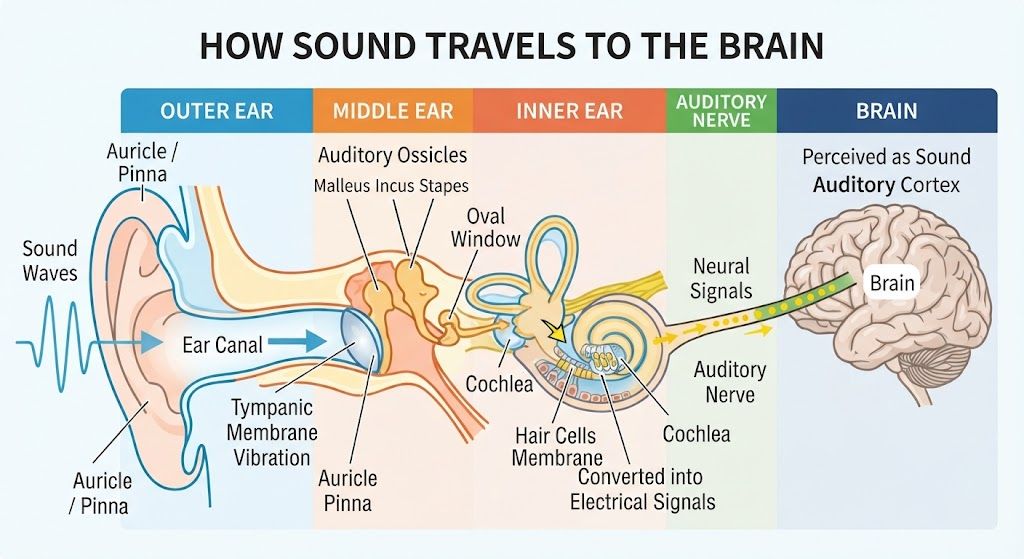
The ear is divided into three main parts: the outer ear, the middle ear, and the inner ear.
- Outer ear: The part that includes the visible ear and the ear canal leading to the eardrum. It collects sound and directs it toward the eardrum.
- Middle ear: The air-filled space behind the eardrum. Three tiny bones, called the ossicles, amplify the vibrations of the eardrum and transmit them to the inner ear.
- Inner ear: This contains a spiral-shaped structure called the cochlea, which converts sound vibrations into electrical signals that travel to the brain.
Sound enters the ear as vibrations in the air. These vibrations travel through the outer ear, middle ear, and inner ear before the resulting signals reach the brain through the auditory nerve.
It’s only when the brain processes these signals that we recognize them as sound.
The Type of Hearing Loss Depends on Where the Problem Occurs
Hearing loss can be classified according to which part of this process is affected.
- Conductive hearing loss: A problem in the outer or middle ear prevents sound from traveling efficiently to the inner ear.
- Sensorineural hearing loss: A problem in the inner ear or auditory nerve affects how sound is detected or transmitted to the brain.
- Mixed hearing loss: Both conductive and sensorineural hearing loss are present.
The names can help you remember the differences. Conductive refers to the transmission of sound, while sensorineural refers to problems involving the sensory structures of the inner ear or the nerves that carry sound information.
Once you understand this basic distinction, the three main types of hearing loss become much easier to understand.
Comparing the Three Types of Hearing Loss
Here is a simple comparison of the three main types of hearing loss.
| Conductive Hearing Loss | Sensorineural Hearing Loss | Mixed Hearing Loss | |
| Where the problem occurs | Outer or middle ear | Inner ear or auditory nerve | Both |
| How sounds may seem | Quieter than normal | Distorted or difficult to understand | Quieter and potentially distorted |
| Common causes | Earwax blockage, middle ear infections, or a perforated eardrum | Aging, noise exposure, or sudden sensorineural hearing loss | Chronic middle ear disease combined with damage to the inner ear, such as age-related hearing loss |
| Treatment | Often improves with appropriate treatment, depending on the cause | Treatment depends on the cause; some conditions can improve, but permanent damage may be difficult to reverse | Treatment may improve the conductive component, while the sensorineural component may remain |
| Does speaking louder help? | It may help | It may have limited benefits, especially when speech sounds distorted | It may help somewhat, but distortion can remain |
| Can hearing aids help? | Often effective, depending on the cause and severity | May help, but proper fitting and adjustment are important | May help, but adjustment can be more complex |
Let’s take a closer look at each type.
Conductive Hearing Loss: When Sounds Seem Quieter
Conductive hearing loss occurs when a problem in the outer or middle ear prevents sound from reaching the inner ear efficiently.
As a result, sounds may seem quieter than they normally would.
Imagine what it sounds like when you have earplugs in. You can still hear sounds, but they seem muffled or reduced in volume.
Conductive hearing loss can be caused by problems such as a buildup of earwax or a middle ear infection. In many cases, hearing can improve when the underlying cause is treated.
We prepared article of conductive hearing loss. So, please refer it.
Learn more about conductive hearing loss →
Sensorineural Hearing Loss: When Sounds Are Distorted
Sensorineural hearing loss occurs when the inner ear or auditory nerve is affected.
Sounds may seem quieter, distorted, or unclear. You might be able to hear someone speaking but still struggle to understand what they are saying.
This is because hearing is not just about detecting sound. The auditory system also needs to distinguish the different sounds that make up speech.
Age-related hearing loss, noise-induced hearing loss, and sudden sensorineural hearing loss are examples of conditions associated with sensorineural hearing loss.
Damage to the sensory hair cells in the inner ear is often permanent, and current treatments cannot fully restore these damaged structures. However, treatment options such as hearing aids may help, and some conditions, including sudden sensorineural hearing loss, may improve with prompt medical treatment.
We prepared article of Sensorineural hearing loss. So, please refer it.
Learn more about sensorineural hearing loss →
With sensorineural hearing loss, sounds may seem quieter than normal, but the way loudness is perceived can also change. This is known as loudness recruitment. Learn more about how it works and why loud sounds can feel uncomfortable in our detailed guide to loudness recruitment.
Learn more about loudness recruitment↗
Mixed Hearing Loss: When Sounds Are Both Quieter and Distorted
Mixed hearing loss occurs when a person has both conductive and sensorineural hearing loss.
In other words, sound may have difficulty reaching the inner ear, and the inner ear may also have difficulty processing it normally.
This can make hearing particularly challenging. Sounds may seem too quiet at one volume, yet louder sounds may become uncomfortable without making speech much clearer.
Imagine trying to adjust the focus of a camera. The image is already blurry, and changing its brightness does not make the details sharp again.
Mixed hearing loss can be more complicated to manage because treatment needs to address both components. Treating the conductive problem may improve hearing, but the sensorineural component may still affect speech understanding.
We prepared article of mixed hearing loss. So, please refer it.
Learn more about mixed hearing loss →
Understanding the Differences Through Visual Examples
It can be difficult to imagine what it means to hear distorted sounds.
After all, sound and speech are invisible. So let’s use something visual to help explain the differences between the three types of hearing loss.
How People with Typical Hearing Perceive Text

The original image is sharp and clear, and you can easily read the sentence, “It’s a beautiful day today.”
This is a simple way to represent how speech may sound to someone without hearing difficulties.
How People with Conductive Hearing Loss May Perceive Text

Imagine the letters becoming smaller and lighter. They are harder to see, but their shapes remain clear.
This represents conductive hearing loss, in which sounds may seem quieter than normal.
If you make the letters bigger, they become easier to read. In the same way, speaking a little louder may help someone with conductive hearing loss hear you more clearly.
However, this does not mean that speaking louder will always solve the problem. The effect depends on the underlying cause and the person’s hearing.
How People with Sensorineural Hearing Loss May Perceive Text

Now imagine that the letters are covered with a mosaic effect, making them blurry and difficult to recognize.
This represents one way to understand sensorineural hearing loss, in which sounds may be distorted and speech can be difficult to understand.
You might still be able to guess the sentence because it is familiar and easy to understand.
In most cases of sensorineural hearing loss, the ability to hear high-pitched sounds is also reduced, so it is not simply a matter of sounds being blurred, as illustrated in this image.
How People with Mixed Hearing Loss May Perceive Text

Imagine that the letters are both small and faint, with a mosaic effect on top.
This represents mixed hearing loss, which combines reduced sound transmission with problems affecting how sound is perceived.
Making the letters bigger may help somewhat, but it will not remove the mosaic effect. And if you enlarge them too much, they may become uncomfortable to look at.
In a similar way, increasing the volume may help someone with mixed hearing loss hear sounds more easily, but it may not make speech clearer. Depending on the person, loud sounds may also become uncomfortable.
These visual examples are simplified illustrations rather than exact representations of how every person with hearing loss experiences sound. Actual hearing difficulties vary from person to person.
How to Find Out Which Type of Hearing Loss You Have
The most reliable way to determine which type of hearing loss you have is to visit an ear, nose, and throat (ENT) specialist for a hearing evaluation.
Two tests commonly used to assess hearing and the condition of the middle ear are pure-tone audiometry and tympanometry.
Comparing Air Conduction and Bone Conduction in a Hearing Test
Pure-tone audiometry is the familiar test in which you listen for beeping sounds through headphones and press a button whenever you hear one.
At an ENT clinic, your hearing may be tested in two different ways.
- Air conduction: Sounds are delivered through headphones or earphones and travel through the outer ear, middle ear, and inner ear, following the normal route of hearing.
- Bone conduction: A small vibrator is placed against the bone behind your ear. The vibrations bypass the outer and middle ears and stimulate the inner ear through the skull.
Comparing the results helps the clinician identify where the problem may be occurring.
| Air Conduction | Bone Conduction | Difference Between the Two | |
| Conductive hearing loss | Reduced | Usually normal | Present |
| Sensorineural hearing loss | Reduced | Reduced | Usually absent |
| Mixed hearing loss | Reduced | Reduced | Present |
In conductive hearing loss, bone conduction is often relatively normal because the inner ear can still detect sound, while air conduction is affected by a problem in the outer or middle ear.
In sensorineural hearing loss, both air and bone conduction are reduced because the problem affects the inner ear or, in some cases, the auditory nerve.
In mixed hearing loss, both are reduced, but air conduction is generally worse than bone conduction because both conductive and sensorineural components are present.
These patterns help clinicians distinguish the three types of hearing loss. The results must still be interpreted by a qualified professional, taking the full hearing test and other clinical findings into account.
Tympanometry: Checking the Condition of the Middle Ear
Tympanometry is a test that changes the air pressure in the ear canal to measure how the eardrum moves.
It can help identify problems involving the middle ear, such as fluid behind the eardrum or reduced eardrum mobility. It may also provide information about a perforated eardrum, depending on the test findings.
Because many middle ear problems can cause conductive hearing loss, tympanometry can help clinicians investigate its possible cause.
However, tympanometry alone cannot determine every type of hearing loss. It is usually interpreted alongside hearing tests and an examination of the ear.
We prepared article of tympanometry. So, please refer it.
Learn more about tympanometry →
If You Notice Changes in Your Hearing, See an ENT Specialist
Hearing test apps can provide a rough indication of your hearing ability, but they cannot reliably determine whether you have conductive, sensorineural, or mixed hearing loss.
A professional evaluation is important because the appropriate treatment depends on the cause of the hearing problem.
In particular, sudden sensorineural hearing loss requires urgent medical attention. Starting treatment promptly may improve the chances of recovery.
If your hearing suddenly becomes worse, seek medical care immediately rather than waiting to see whether it improves on its own.
Are Sudden and Age-Related Hearing Loss Different Types?
When researching hearing loss, you may come across terms such as sudden hearing loss, noise-induced hearing loss, and age-related hearing loss.
It can be confusing to see so many different names. However, these terms describe hearing loss from a different perspective than conductive, sensorineural, and mixed hearing loss.
There are two main ways to classify hearing loss:
- By the part of the hearing system affected: Conductive, sensorineural, or mixed hearing loss.
- By its cause or how it develops: Age-related, noise-induced, or sudden hearing loss, among others.
For example, age-related hearing loss is generally sensorineural hearing loss caused by changes associated with aging.
Here are some examples of how these terms relate to one another.
| Condition or Cause | Common Type of Hearing Loss |
| Age-related hearing loss | Sensorineural |
| Noise-induced hearing loss | Sensorineural |
| Sudden sensorineural hearing loss | Sensorineural |
| Ototoxic hearing loss (hearing damage caused by certain medications or chemicals) | Sensorineural |
| Ménière’s disease | Sensorineural |
| Middle ear infection | Often conductive; it can sometimes contribute to mixed hearing loss if additional inner ear damage occurs |
| Earwax blockage | Conductive |
| Congenital hearing loss (hearing loss present at birth) | Conductive, sensorineural, or mixed, depending on the cause |
As you can see, many well-known causes of hearing loss are associated with sensorineural hearing loss.
However, the relationship is not always straightforward. The type of hearing loss depends on the underlying condition and which parts of the hearing system are affected.
Other Ways to Classify Hearing Loss
Hearing loss can also be classified in other ways, depending on its severity or the difficulties a person experiences.
Classification by Severity
Hearing loss is often classified according to the quietest sounds a person can hear, measured in decibels hearing level (dB HL).
The following table provides a general guide to hearing loss severity.
| Degree of Hearing Loss | Hearing Level | What It May Feel Like |
| Mild | Approximately 25–45 dB HL | Quiet speech or whispers may be difficult to hear |
| Moderate | Approximately 46–70 dB HL | Following ordinary conversations may become difficult |
| Severe | Approximately 71–95 dB HL | Even loud speech may be difficult to hear |
| Profound | Approximately 96 dB HL or greater | Even very loud speech close to the ear may be difficult to hear |
The higher the hearing threshold in decibels, the louder a sound generally needs to be for the person to hear it.
These ranges are a simplified guide. The exact thresholds used to classify hearing loss can vary between clinical guidelines and countries. Hearing ability may also differ across frequencies, so a person’s degree of hearing loss is not always the same for every sound.
Even mild hearing loss can cause significant difficulties in everyday life, especially when listening to conversations in noisy environments. So, don’t assume that mild hearing loss is nothing to worry about.
Unilateral Hearing Loss: Hearing Loss in One Ear
Hearing loss does not always affect both ears. Sometimes, it affects only one ear. This is called unilateral hearing loss.
Because the other ear may hear relatively well, unilateral hearing loss can be difficult for others to notice.
However, it can cause several challenges, including difficulty identifying where sounds are coming from and understanding speech in noisy environments.
APD (Auditory Processing Disorder)
Auditory processing disorder (APD) is a term used to describe difficulties processing and understanding sounds, particularly speech, even when a person can hear sounds.
The difficulty is thought to involve how the brain processes auditory information rather than simply how sound enters the ear. As a result, some people with auditory processing difficulties may have normal results on standard hearing tests but still struggle to understand spoken language.
APD is generally discussed separately from conductive, sensorineural, and mixed hearing loss because those categories describe problems involving different parts of the hearing system.
However, the everyday difficulties can overlap. For example, a person may frequently ask others to repeat themselves or find it especially difficult to follow conversations when several people are talking at once.
If you can hear sounds but often struggle to understand what people are saying, particularly in noisy environments, auditory processing difficulties may be worth discussing with a qualified healthcare professional.
We prepared article of APD. So, please refer it.
Tips for Communicating with People Who Have Hearing Loss
Understanding the different types of hearing loss can help you communicate more effectively with people who have difficulty hearing.
Many people assume that speaking louder is the best way to communicate with someone who has hearing loss. While increasing your volume may help in some cases of conductive hearing loss, it is not always effective, especially when speech sounds distorted.
Many people with hearing loss have sensorineural hearing loss, which can make speech difficult to understand even when it is loud enough to hear.
In these situations, how you speak can be just as important as how loudly you speak.
Here are some practical tips:
- Speak clearly and a little more slowly. Give the listener enough time to process what you are saying, but avoid exaggerating your pronunciation.
- Use a comfortable volume. Speaking too loudly can make sounds uncomfortable or even harder to understand.
- Face the person when speaking. Make sure your face and mouth are visible so they can use visual cues, such as lip movements and facial expressions.
- Rephrase what you said if necessary. Simply repeating the same words may not help. Try using different words or a shorter sentence instead.
- Reduce background noise. Turn off the television, move away from noisy areas, or choose a quieter place to talk.
Some older adults with hearing loss may also experience a phenomenon called loudness recruitment. This means that sounds can seem very quiet at lower levels but become uncomfortably loud when the volume increases slightly.
For these individuals, speaking much louder than normal can cause discomfort without making speech easier to understand.
The same principle applies to hearing aids. Simply making sounds louder is not always enough. Hearing aids need to be properly fitted and adjusted to suit the individual’s hearing needs.
A little consideration can make everyday conversations much easier and more comfortable for everyone.
Frequently Asked Questions About Hearing Loss
What Is the Most Common Type of Hearing Loss?
Sensorineural hearing loss is very common. Age-related hearing loss, which develops as people get older, is also usually sensorineural.
Many people with hearing loss experience some degree of sensorineural hearing loss, although the type and severity vary from person to person.
Can Sensorineural Hearing Loss Be Cured?
Sensorineural hearing loss caused by permanent damage to the inner ear is often difficult to reverse completely.
However, the outlook depends on the underlying cause. Some conditions, including sudden sensorineural hearing loss, may improve with prompt medical treatment.
If your hearing suddenly becomes worse, seek medical attention immediately. Early treatment may improve the chances of recovery.
Can Conductive Hearing Loss Be Cured?
In many cases, conductive hearing loss can improve with appropriate treatment, depending on the cause.
For example, hearing may return to normal after impacted earwax is removed. Middle ear infections and other problems may also improve with medication or surgery, depending on the condition.
An ENT specialist can determine the cause and recommend appropriate treatment.
How Can I Find Out Which Type of Hearing Loss I Have?
The best way is to have a hearing evaluation at an ear, nose, and throat (ENT) clinic.
Pure-tone audiometry measures your hearing through air conduction and bone conduction. Comparing the results helps the clinician determine whether the problem is mainly conductive, sensorineural, or a combination of both.
Which Doctor Should I See for Hearing Loss?
You should visit an ear, nose, and throat (ENT) specialist.
An ENT specialist can examine your ears, arrange hearing tests, investigate possible causes, and recommend appropriate treatment.
If your hearing loss develops suddenly, seek medical attention urgently rather than waiting for a routine appointment.
Conclusion
Do you now have a better understanding of the different types of hearing loss and how they affect the way people hear?
Here are the key points to remember:
- Hearing loss is classified into three main types based on where the problem occurs: conductive, sensorineural, and mixed hearing loss.
- Conductive hearing loss often makes sounds seem quieter, while sensorineural hearing loss can make sounds distorted or speech difficult to understand.
- Mixed hearing loss combines features of both conductive and sensorineural hearing loss.
- Many people with hearing loss have a sensorineural component, so simply speaking louder does not always make communication easier.
- A hearing evaluation at an ENT clinic can help determine which type of hearing loss you have.
Because we cannot see sound or speech, it can be difficult to understand what hearing loss actually feels like. Someone may appear to hear you but still struggle to understand your words.
I hope this article has helped you better understand what hearing difficulties can be like, even if you do not have hearing loss yourself.
We prepared article of hearing loss. So, please refer it.


コメント