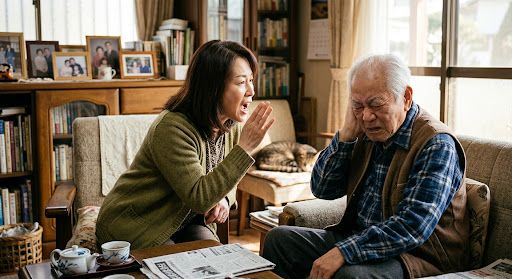
Do you find yourself raising your voice when talking to a parent whose hearing has started to decline?
You speak louder because they seem unable to hear you, only to hear them say, “You don’t have to shout! I can hear you!”
If you help care for an older parent, this may sound familiar.

It might seem strange that someone who struggles to hear ordinary speech can still find a loud voice uncomfortable or even painfully loud. But there is a reason for this. It can be related to a hearing condition called auditory recruitment.
In this article, we’ll explain why shouting can make communication more difficult, what auditory recruitment means in simple terms, and how you can make conversations easier for your parent or loved one starting today.
- Why Shouting Can Make Things Worse for Someone with Hearing Loss
- What Is Auditory Recruitment?
- Why Does Auditory Recruitment Happen?
- Signs of Auditory Recruitment: A Checklist for Family Members
- How Is Auditory Recruitment Diagnosed?
- Can Auditory Recruitment Be Cured? How Can You Manage It?
- How Family Members Can Make Conversations Easier
- What Happens If Hearing Loss Is Left Untreated? The Link Between Hearing Loss and Dementia
- Financial Assistance for Buying Hearing Aids
- Frequently Asked Questions
- Summary
- Reference
Why Shouting Can Make Things Worse for Someone with Hearing Loss
Here’s the main point:
- Many people with age-related hearing loss experience a condition in which quiet sounds are difficult to hear, but louder sounds can suddenly become uncomfortably loud. This is called auditory recruitment.
- Speaking louder does not necessarily make words easier to understand. Instead, it may simply make the sound more uncomfortable.
- What matters most is not how loudly you speak, but how clearly you communicate. Speak slowly, pronounce your words clearly, and face the person when talking.
In other words, speaking louder does not always mean communicating better. Let’s take a closer look at why.
What Is Auditory Recruitment?
Auditory recruitment is a condition that can occur in people with sensorineural hearing loss. It causes sounds to become uncomfortably loud over a relatively small increase in volume.
You might think of hearing loss as simply being unable to hear sounds clearly. But that is not the whole story. Some people with hearing loss also find that certain sounds seem much louder than expected.
Quiet Sounds Are Hard to Hear, but Loud Sounds Suddenly Become Uncomfortable
Imagine that a person with normal hearing can hear a sound at a comfortable volume. Someone with auditory recruitment may not be able to hear that same sound at all.
However, once the volume reaches a certain level, the sound may suddenly seem just as loud as it does to someone with normal hearing—or even uncomfortably loud.
Think of a TV remote. You turn the volume up by just one step, but the sound suddenly seems much louder than you expected. This is similar to what auditory recruitment can feel like.
The Range of Comfortable Volume Becomes Much Narrower
For someone with normal hearing, there is usually a fairly wide range between a sound that is too quiet to hear and one that is uncomfortably loud.
For someone with auditory recruitment, that comfortable range can become much narrower.
| When Sounds Become Audible | When Sounds Become Uncomfortably Loud | Comfortable Listening Range | |
| Person with normal hearing | Relatively quiet sounds | Much louder sounds | Wide |
| Person with auditory recruitment | Sounds must be louder before they can be heard | At a volume that may be close to what a person with normal hearing finds loud | Narrow |
This is why raising your voice just a little can sometimes make someone with auditory recruitment say, “That’s too loud!”
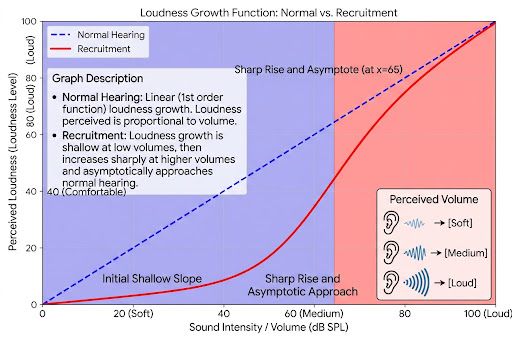
The situation can be even more complicated because the level of sound that feels uncomfortable varies depending on its pitch. High-pitched sounds and sudden noises, such as dishes clattering together, can be particularly unpleasant for some people.
Sounds May Be Loud, but Words Are Still Difficult to Understand
Even when sounds seem loud, the ability to distinguish speech sounds may still be reduced.
As a result, a person may hear your voice as loud and uncomfortable without being able to make out what you are saying.
This can be frustrating for both the person with hearing loss and the family member trying to communicate with them.
What Types of Hearing Loss Can Cause Auditory Recruitment?
Auditory recruitment is particularly associated with sensorineural hearing loss, which involves problems in the inner ear or the auditory system.
It may occur in conditions such as:
- Age-related hearing loss: Hearing loss that develops as people get older.
- Sudden sensorineural hearing loss: A sudden loss of hearing, often affecting one ear.
- Noise-induced hearing loss: Hearing damage caused by exposure to loud sounds.
- Ménière’s disease: An inner-ear condition that can cause hearing loss, dizziness, and ringing in the ears.
Because age-related hearing loss is common among older adults, auditory recruitment may be one reason why your parent finds loud speech uncomfortable. However, not everyone with age-related hearing loss experiences it.
If you are new to the subject of hearing loss, you may also find our guide to the different types of hearing loss helpful.
Related article: What Are the Different Types of Hearing Loss? A Simple Guide to Conductive, Sensorineural, and Mixed Hearing Loss
Why Does Auditory Recruitment Happen?
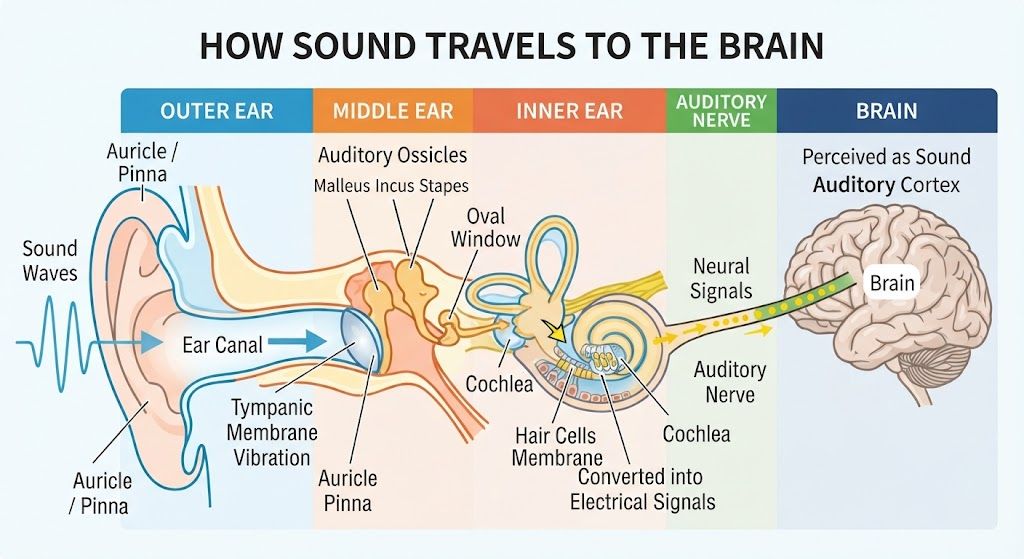
Auditory recruitment is thought to be related to damage to tiny sensory cells in the inner ear called hair cells. In particular, the role of the outer hair cells helps explain how this condition can develop.
In simple terms, outer hair cells act like an automatic volume control system inside your ear.
- For quiet sounds: Outer hair cells help amplify sounds, making them easier to hear.
- For loud sounds: They reduce their amplifying effect, helping the ear respond to a wide range of sound levels.
When these cells are damaged, the ear loses some of its ability to amplify quiet sounds. As a result, soft sounds may be difficult to hear, while louder sounds can still be perceived as very loud.
The difference between the level at which a sound becomes audible and the level at which it becomes uncomfortably loud can therefore become much smaller.
This is one way to understand why someone with hearing loss may struggle to hear ordinary conversation but find a raised voice uncomfortable.
However, the exact mechanisms behind auditory recruitment are complex, and some details are still not fully understood.
We prepared article of hair cells. So, please refer it.
Signs of Auditory Recruitment: A Checklist for Family Members
Have you noticed any of the following behaviors in your parent or loved one? These signs may suggest that loud sounds are uncomfortable for them, possibly because of auditory recruitment.
- □ They often ask you to repeat yourself, but complain when you speak louder.
- □ They frequently say things like, “Don’t shout!” or “That’s too loud!”
- □ They turn up the TV volume but dislike sudden sound effects or applause.
- □ They have started avoiding crowded places or noisy family gatherings.
- □ They remove their hearing aids because the sounds seem too loud or uncomfortable.
Please keep in mind: This checklist cannot diagnose auditory recruitment. These behaviors can have other causes, too. If you are concerned about your parent’s hearing, consult an ear, nose, and throat (ENT) specialist for a proper hearing assessment.
How Is Auditory Recruitment Diagnosed?
Auditory recruitment can be assessed through specialized hearing tests performed by an ear, nose, and throat (ENT) specialist or an audiologist, depending on the healthcare system. These tests can help identify the type of hearing loss and determine whether auditory recruitment may be present.
Common tests include the following.
SISI Test (Short Increment Sensitivity Index)
During this test, the patient listens to a sound that is already loud enough to hear. The sound is then increased very slightly, usually by 1 decibel (dB), at brief intervals.
People with normal hearing may have difficulty noticing such a small change in volume. People with auditory recruitment may be more likely to detect these small increases.
ABLB Test (Alternate Binaural Loudness Balance Test)
This test is generally used when there is a difference in hearing between the two ears.
Sounds are played alternately through each ear, and their volume is adjusted to compare how loud they seem. If auditory recruitment is present in the ear with hearing loss, the perceived difference in loudness between the ears may decrease as the volume increases.
Self-Recording Audiometry
During this test, the patient listens to sounds that change in volume and presses a button when they can hear them. The equipment automatically records the responses, allowing the examiner to assess changes in hearing sensitivity.
These tests rely partly on the patient’s responses, so it is important to explain the procedure clearly and help them feel comfortable. If you accompany your parent to an appointment, your support can help them feel more at ease.
If your parent has ongoing hearing difficulties, it may also be helpful to consult an ENT specialist with experience in hearing disorders.
Can Auditory Recruitment Be Cured? How Can You Manage It?
Unfortunately, there is currently no established treatment that directly cures auditory recruitment itself. Hearing loss caused by aging or damage to the inner ear also generally cannot be fully reversed.
You may come across books, supplements, or other products claiming to restore hearing. However, there is limited scientific evidence that these products can reverse established hearing loss.
That does not mean you have to give up. There are practical ways to manage hearing difficulties and make everyday conversations more comfortable.
Hearing Aids Can Help Find a Comfortable Listening Level
Most modern hearing aids are digital devices that can be adjusted to suit different hearing needs, including different sound frequencies.
Many models also have features that limit excessively loud sounds to a level that the wearer can tolerate.
In other words, hearing aids are not simply devices that make every sound louder. They can amplify softer sounds while limiting louder ones, helping the wearer hear within a more comfortable range.
If your parent says that hearing aids are “just too noisy” and keeps taking them out, the settings may need to be adjusted. This does not necessarily mean that hearing aids are unsuitable for them.
A hearing care professional can adjust the devices based on the person’s hearing test results, listening needs, and tolerance for loud sounds. Several follow-up appointments may be needed to achieve a comfortable setting.
For more information, see our guide to choosing hearing aids.
We prepared article of hearing aids. So, please refer it.
Be Careful About the Difference Between Hearing Aids and Personal Sound Amplifiers
Hearing aids and personal sound amplifiers may look similar, but they are different products.
In Japan, hearing aids are regulated medical devices. Personal sound amplifiers sold online or in electronics stores are generally not medical devices.
Many personal sound amplifiers simply increase the volume of surrounding sounds. For someone with auditory recruitment, this may make certain sounds uncomfortably loud rather than making speech easier to understand.
If your parent has hearing difficulties, it is best to consult an ENT specialist and discuss appropriate hearing support before purchasing a device.
If Hearing Loss Occurs Suddenly, Seek Medical Attention Immediately
Sudden sensorineural hearing loss can sometimes be treated more effectively when medical care begins promptly. Early assessment and treatment may improve the chances of hearing recovery.
If your parent suddenly loses hearing, particularly in one ear, do not assume it is simply part of getting older. Seek medical attention from an ENT specialist as soon as possible.
How Family Members Can Make Conversations Easier
Even today, you may hear people say, “Just speak louder, and they’ll understand!” when talking to someone with hearing loss.
However, speaking louder can have the opposite effect on someone with auditory recruitment.
Think of it this way: when your eyesight changes, there may be a particular focus that helps you see clearly. Hearing also has a range of sound levels that makes listening comfortable. For someone with auditory recruitment, that range can be very narrow.
Instead of simply raising your voice, try changing the way you communicate.
| What NOT to Do | What Works Better |
| Shout or speak very loudly | Speak in a calm voice, just a little louder than usual if needed |
| Talk too quickly or rush through your words | Speak slowly and clearly, with short pauses between phrases |
| Speak from behind or from the side | Face the person and make sure you have their attention before speaking |
| Keep your mouth covered with a mask while speaking, when it is safe and appropriate to uncover it | Make your mouth visible when possible, and speak clearly without exaggerating your mouth movements |
| Talk while the TV is playing | Turn off the TV and other background noise, such as a fan or extractor fan, when possible |
| Repeat the same words more loudly when they do not understand | Try rephrasing the sentence using simpler or different words |
| Give important information verbally and expect the person to remember it | Write down important details, such as appointment times or medication instructions |
You do not always need to speak loudly to be understood. Simply facing the person, speaking clearly, and opening your mouth naturally as you speak can make a real difference.
For more practical tips, see our guide to making conversations easier for people with hearing loss.
What Happens If Hearing Loss Is Left Untreated? The Link Between Hearing Loss and Dementia
It is not a good idea to ignore hearing loss simply because someone is getting older.
Hearing loss is recognized as one of the important risk factors for dementia that may be possible to address or reduce. Research suggests that hearing difficulties may contribute to social isolation and reduced participation in everyday activities.
When it becomes difficult to follow conversations, people may find socializing tiring and gradually spend less time talking with others. This can reduce opportunities for social interaction and contribute to feelings of isolation.
For someone with auditory recruitment, conversations may be even more exhausting because louder voices can feel uncomfortable. As a result, they may avoid conversations more often.
Addressing hearing difficulties and finding ways to make communication easier can help people stay connected with family and friends.
Can Hearing Aids Help Prevent Dementia?
At the European Academy of Neurology (EAN) Congress in June 2026, researchers reported findings suggesting that adults with both epilepsy and hearing loss who used hearing aids had a 23% lower risk of developing dementia than those who did not use hearing aids. The analysis used electronic health record data covering more than 250 million people.
However, these findings do not prove that hearing aids directly prevent dementia. The results relate to a specific group of people, and further research is needed to understand the relationship between hearing aid use and dementia risk.
It would therefore be misleading to say that wearing hearing aids guarantees protection against dementia. Still, maintaining the ability to communicate comfortably and enjoy conversations is an important part of everyday life.
For more information, see our article about the relationship between hearing loss and dementia.
Financial Assistance for Buying Hearing Aids
Hearing aids can be expensive, but you may be able to get financial assistance to help cover the cost.
The support available depends on where you live and whether you meet certain eligibility requirements.
In Japan, for example, there are two main types of assistance:
- For people with a disability certificate for hearing loss: Financial assistance for hearing aids may be available through Japan’s disability support system.
- For people with mild to moderate hearing loss who do not have a disability certificate: Some local governments offer their own hearing aid subsidies.
For example, Yokohama City continued its hearing aid subsidy program for people with mild to moderate hearing loss in fiscal year 2026. The program is intended to help eligible residents access hearing support, recognizing hearing loss as one of the risk factors associated with dementia.
Eligibility requirements, subsidy amounts, and application procedures vary by municipality.
If you live in Japan, try searching online for your city or town’s name followed by “hearing aid subsidy” (補聴器 助成). You can also contact your local government office or a community support center for older adults to find out what assistance may be available.
If you live outside Japan, check with your local government or healthcare provider to learn about hearing aid funding programs in your area.
We prepared article of hearing aids subsidy in Japan. So, please refer it.
Learn more hearing aids subsidy↗
Frequently Asked Questions
Is it okay to speak loudly to someone who is wearing hearing aids?
It is usually better to speak clearly at a comfortable volume rather than shout.
My parent says their hearing is fine and refuses to see a doctor. What should I do?
Try approaching the subject gently and focusing on the benefits of getting their hearing checked.
Can someone with auditory recruitment still use hearing aids?
Yes. Many people with auditory recruitment can benefit from hearing aids when they are properly adjusted.
Can young people experience auditory recruitment, too?
Yes. Auditory recruitment is not limited to older adults.
Summary
- People with hearing loss may find loud voices uncomfortable because auditory recruitment can narrow the range between sounds that are too quiet to hear and sounds that feel uncomfortably loud.
- Speaking louder does not necessarily make words easier to understand. It may simply make the sound more uncomfortable.
- To communicate more effectively, face the person, speak slowly and clearly, and make sure they can see your mouth when possible.
- Although auditory recruitment itself cannot currently be cured, properly adjusted hearing aids can help make everyday sounds more comfortable.
- Hearing loss is associated with an increased risk of dementia, so it is worth seeking professional advice if you or a loved one is having difficulty hearing.
Speaking loudly may seem like a natural way to help someone who cannot hear well. However, even when your intentions are good, raising your voice can sometimes make conversations more tiring and uncomfortable.
Try making a few small changes to the way you communicate. Speaking calmly, facing your parent, and choosing a quiet place to talk can make everyday conversations easier and more enjoyable for both of you.
We prepared article of hearing loss. So, please refer it.
Reference
Recruitment of Neurons and Loudness
OHC response recruitment and its correlation with loudness recruitment


コメント