
Choosing your first hearing aid can feel overwhelming. With several types available—including Behind-the-Ear (BTE), Receiver-in-Canal (RIC), In-the-Ear (ITE), pocket hearing aids, and bone conduction hearing aids—it can be difficult to know which one is right for you.
In this guide, you’ll learn the key differences between each type of hearing aid, including their features, advantages, disadvantages, typical price ranges, and who they’re best suited for. Whether you have mild or profound hearing loss, this article will help you understand your options and choose the hearing aid that best fits your hearing needs and lifestyle.
We prepared article of hearing aids. So, please refer it.
What Are the Different Types of Hearing Aids?
There are several types of hearing aids, each with its own design, sound quality, comfort, and suitability for different levels of hearing loss. Understanding the differences can help you choose the right hearing aid for your needs.
Let’s take a look at the five main types of hearing aids.
Behind-the-Ear (BTE) Hearing Aids

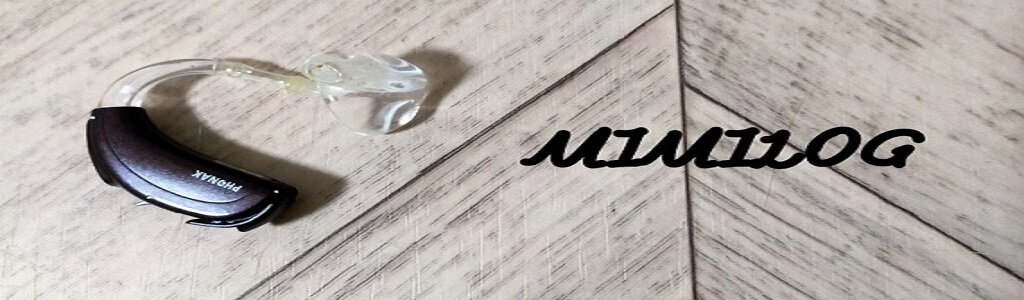
Behind-the-Ear (BTE) hearing aids are the most common and recognizable type of hearing aid.
The microphone, amplifier, and processor are housed in a small case that sits behind the ear. Sound is delivered into the ear through a tube connected to an earmold or ear tip.
BTE hearing aids are suitable for a wide range of hearing loss, from mild to profound, and are known for their durability, powerful amplification, and ease of handling.
If you’d like to learn more, check out our complete guide to Behind-the-Ear (BTE) hearing aids.
Receiver-in-Canal (RIC) Hearing Aids
Receiver-in-Canal (RIC) hearing aids look similar to BTE models but use a thin wire instead of a sound tube.
The receiver (speaker) sits inside the ear canal rather than inside the main device. This design allows sound to be delivered more directly into the ear, often providing clearer and more natural sound quality.
RIC hearing aids are one of the most popular choices for adults because they combine a discreet appearance with excellent sound performance.
In-the-Ear (ITE) Hearing Aids

In-the-Ear (ITE) hearing aids are custom-made to fit inside your outer ear or ear canal.
Because they fit inside the ear, they are much less noticeable than BTE hearing aids. They are a good option for people who prefer a more discreet hearing aid.
However, because the microphone and receiver are positioned close together, ITE hearing aids are generally more prone to feedback (whistling) than BTE or RIC models, especially at higher amplification levels.
For more information, see our detailed guide to In-the-Ear (ITE) hearing aids.
Regarding in the ear hearing aids↗
Pocket Hearing Aids
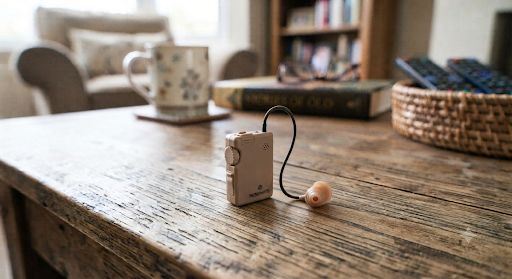
Pocket hearing aids (also called body-worn hearing aids) consist of a larger main unit that is carried in a pocket or clipped to clothing.
The sound is delivered through wired earphones connected to the main device.
Although they are generally more affordable, the cable can be inconvenient during daily use. However, their larger controls make them easy to operate, making them a practical choice for older adults or people with limited hand dexterity.
Today, relatively few manufacturers still produce pocket hearing aids, as smaller digital models have become more popular.
Learn more in our guide to Pocket Hearing Aids.
Bone Conduction Hearing Aids
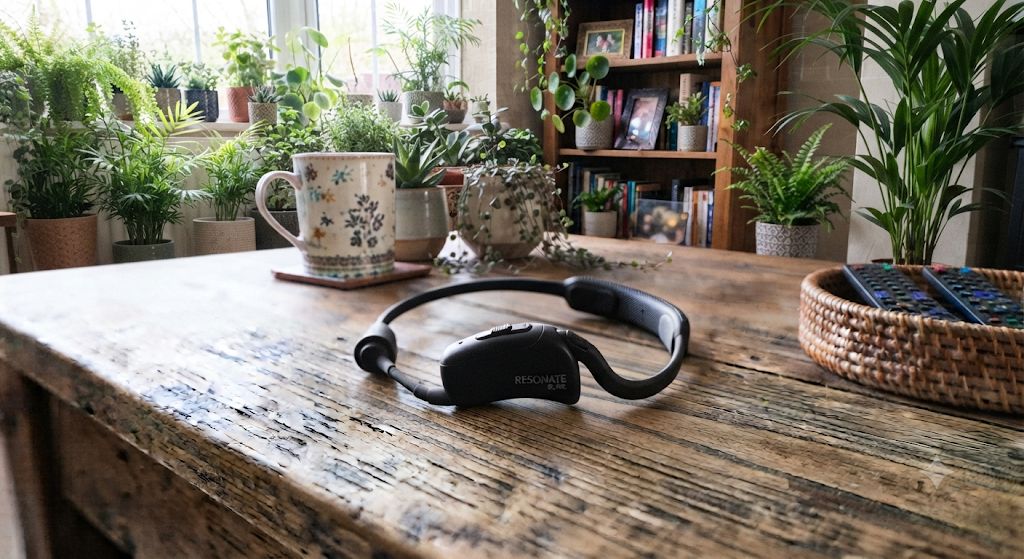
Bone conduction hearing aids transmit sound by sending vibrations through the skull or cartilage instead of the ear canal.
They are mainly recommended for people with conductive hearing loss, mixed hearing loss, or conditions affecting the outer or middle ear, such as chronic ear infections.
Because they bypass the damaged parts of the ear, bone conduction hearing aids can provide clearer hearing when conventional hearing aids are not suitable.
Read our complete guide to Bone Conduction Hearing Aids to learn more.
Regarding bone – conduction type↗
Hearing Aid Types Compared
Each type of hearing aid has its own strengths and weaknesses. Comparing factors such as appearance, price, suitability for severe hearing loss, wireless features, and battery options can help you decide which model best fits your lifestyle.
| Type | Discreetness | Price | Suitable for Severe Hearing Loss | Bluetooth | Rechargeable Models |
|---|---|---|---|---|---|
| Behind-the-Ear (BTE) | ★★☆☆☆ | ★★☆☆☆ | ◎ | ◎ | ◎ |
| Receiver-in-Canal (RIC) | ★★★★☆ | ★★★☆☆ | ○ | ◎ | ◎ |
| In-the-Ear (ITE) | ★★★★★ | ★★★★☆ | ○ | ○ | ○ |
| Pocket (Body-worn) | ★☆☆☆☆ | ★☆☆☆☆ | ◎ | × | ○ |
| Bone Conduction | ★★☆☆☆ | ★★★★☆ | Specialized Use | △ | ○ |
Note: Prices and available features vary by manufacturer and model.
Recommended Hearing Aids for Different Types of Hearing Loss
The best hearing aid depends on your level of hearing loss, the condition of your ears, and your daily lifestyle. Here are some general recommendations.
Mild Hearing Loss
- Behind-the-Ear (BTE)
- Receiver-in-Canal (RIC)
- In-the-Ear (ITE)
Moderate Hearing Loss
- Behind-the-Ear (BTE)
- Receiver-in-Canal (RIC)
- In-the-Ear (ITE)
- Pocket (Body-worn)
Severe to Profound Hearing Loss
- Behind-the-Ear (BTE)
- Receiver-in-Canal (RIC) (high-power models)
Single-Sided Hearing Loss (Unilateral Hearing Loss)
- Behind-the-Ear (BTE)
- Receiver-in-Canal (RIC)
- In-the-Ear (ITE)
Depending on the cause of hearing loss, specialized solutions such as CROS/BiCROS hearing aids or bone conduction devices may also be recommended.
Outer or Middle Ear Problems
If you have conditions affecting the outer or middle ear—such as conductive hearing loss, mixed hearing loss, or chronic ear infections—a bone conduction hearing aid may be a better option than a conventional air-conduction hearing aid.
Choosing a Hearing Aid Based on Your Lifestyle
Because you’ll likely wear your hearing aid every day, it’s important to choose one that fits not only your hearing needs but also your lifestyle. Here are some general recommendations based on what matters most to you.
First-Time Hearing Aid Users
If you’re buying your first hearing aid, these types are usually the easiest to adapt to:
- Behind-the-Ear (BTE)
- Receiver-in-Canal (RIC)
- In-the-Ear (ITE)
If You Want a More Discreet Hearing Aid
If keeping your hearing aid as invisible as possible is your priority, an In-the-Ear (ITE) hearing aid is usually the best choice.
If You Frequently Use a Smartphone
Many modern BTE and RIC hearing aids offer excellent Bluetooth connectivity for streaming phone calls, music, and other audio directly from your smartphone.
If You Enjoy Listening to Music
For people who regularly listen to music, BTE and RIC hearing aids often provide the best sound quality and wireless streaming features.
If You Don’t Want to Change Batteries
A rechargeable hearing aid is the most convenient option. Simply place it in its charger overnight instead of replacing disposable batteries.
What to Consider When Choosing a Hearing Aid
Choosing the right hearing aid involves more than simply selecting a style. Your hearing level, comfort, ease of use, maintenance requirements, and professional fitting all play an important role in long-term satisfaction.
For a more detailed guide, be sure to read our article on how to choose a hearing aid.
Hearing Level
Different hearing aids are designed to support different degrees of hearing loss, from mild to profound.
If you have severe or profound hearing loss, a hearing aid may not provide enough benefit on its own. In these cases, your hearing care professional may recommend evaluating whether a cochlear implant is a better option.
If your hearing loss is mild, you may also want to consider lower-cost alternatives depending on your needs. For example, if your main goal is simply hearing television more clearly, a TV listening device or TV speaker designed to improve speech clarity may be sufficient.
Comfort and Fit
Comfort is essential because you’ll likely wear your hearing aid for many hours each day.
With BTE hearing aids, a custom earmold can improve comfort, sound quality, and stability. ITE hearing aids are also custom-made to fit the shape of your ear.
Many RIC hearing aids can use soft silicone domes instead of custom earmolds, allowing for a comfortable fit without taking an ear impression.
Since some hearing aids feel heavier than others, choosing one that’s comfortable for extended daily use is important.
Ease of Use
A hearing aid should be easy to operate, especially if you use features such as Bluetooth audio streaming.
Look for models with intuitive controls and companion smartphone apps that make it easy to adjust volume, switch listening programs, and manage wireless connections.
Because hearing aids pack many features into a very small device, choosing one that’s simple to use can make a big difference in everyday life.
Maintenance
Some hearing aids require more maintenance than others.
For example, disposable-battery models need regular battery replacement, while BTE hearing aids may occasionally require tubing replacement. All hearing aids also need routine cleaning, wax filter replacement, and protection from moisture.
If you’d like to minimize maintenance, a rechargeable RIC hearing aid is often one of the most convenient options.
If you use disposable hearing aid batteries, always keep them away from children and pets. Button batteries can cause life-threatening injuries if swallowed and require immediate emergency medical attention.
To learn more, read our complete guide to hearing aid batteries.
The Importance of a Professional Hearing Aid Fitting
The most important factor in hearing aid success isn’t the model—it’s how well the hearing aid is programmed for your specific hearing loss.
Even the most advanced hearing aid won’t perform well if it isn’t properly fitted and adjusted.
That’s why hearing aids should be professionally fitted and fine-tuned over time. During a trial period, you’ll wear the hearing aid in different environments and provide feedback, such as:
- “Background noise is too loud.”
- “Speech still sounds too quiet.”
- “Music sounds unnatural.”
Your hearing care professional can then make adjustments to improve your listening experience.
Finding the ideal settings takes time. For some people, the process takes only a few weeks, while for others it may take several months. Patience and regular follow-up appointments are key to achieving the best possible results.
Frequently Asked Questions
Here are answers to some of the questions people most commonly ask before buying their first hearing aid.
Which Type of Hearing Aid Is the Most Popular?
Today, Receiver-in-Canal (RIC) hearing aids are among the most popular choices because they combine excellent sound quality, comfort, and a discreet appearance.
Which Hearing Aid Is the Least Noticeable?
In-the-Ear (ITE) hearing aids are generally the least visible because they fit inside the ear.
Which Hearing Aid Is Best for Older Adults?
Many older adults prefer rechargeable BTE or RIC hearing aids because they eliminate the need to replace tiny disposable batteries.
For people with reduced dexterity or vision, pocket (body-worn) hearing aids can also be a practical option thanks to their larger controls.
Does Health Insurance Cover Hearing Aids?
Coverage varies depending on your country and insurance provider.
In many countries, hearing aids are not fully covered by standard health insurance, although government assistance programs, private insurance, or other financial support may be available.
Check our guide to hearing aid financial assistance and funding options for more information.
Can I Buy a Hearing Aid Online?
Yes. Many hearing aids can be purchased online.
However, proper fitting and programming are essential for getting the best results. If you buy a hearing aid online, make sure professional fitting, programming, and follow-up adjustments are available either remotely or through a local hearing clinic.
Conclusion
Every type of hearing aid has its own strengths, and there is no single “best” hearing aid for everyone.
The right choice depends on your hearing loss, your daily activities, your budget, and your personal preferences.
The first step is to have a comprehensive hearing evaluation by a hearing care professional. From there, you can choose a hearing aid that matches both your hearing needs and your lifestyle, ensuring the best possible hearing experience for years to come.

コメント