

“What is tympanometry?” “My results showed Type B or Type C—should I be worried?” “Can children undergo this test?”
Tympanometry is a hearing-related test that evaluates the condition of the eardrum and middle ear. Unlike standard hearing tests that measure how well you hear sounds, tympanometry measures the movement of the eardrum and air pressure inside the ear. This helps identify middle ear problems such as otitis media with effusion and Eustachian tube dysfunction.
The results of a tympanogram can also provide important clues as to whether hearing loss is caused by problems in the middle ear (conductive hearing loss) or in the inner ear (sensorineural hearing loss).
In this article, we explain how tympanometry works, how to interpret the results, what abnormal findings may indicate, and its relationship with hearing loss.
What Is Tympanometry?
Let’s start by understanding what tympanometry is and how it differs from other hearing tests.
What Does Tympanometry Measure?
Tympanometry is a hearing-related examination that evaluates the condition of the middle ear by measuring:
- Eardrum movement
- The condition of the middle ear
- Air pressure inside the ear
When people think of a hearing test, they often imagine listening to beeping sounds and pressing a button when they hear them. Tympanometry is different—it does not measure hearing ability itself but rather examines the physical condition of the ear.
How Is It Different From a Hearing Test?
The hearing test that uses beeping tones is called pure-tone audiometry. There are several types of hearing tests, each designed to assess different parts of the auditory system.
| Test | What It Evaluates |
|---|---|
| Pure-Tone Audiometry | Hearing sensitivity |
| Tympanometry | Eardrum and middle ear function |
| OAE | Outer hair cell function |
| ABR | Auditory nerve and brainstem responses |
While many hearing tests assess the inner ear or auditory pathways, tympanometry specifically evaluates whether there are problems in the middle ear.
How Is Tympanometry Performed?
Tympanometry is a quick, painless test that can usually be completed within a few minutes.
Test Procedure
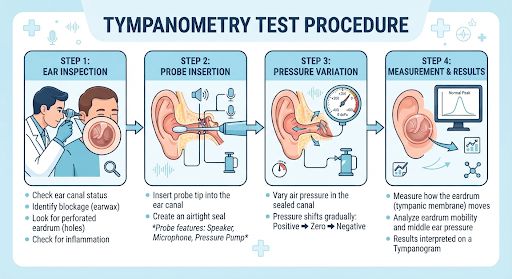
Tympanometry is typically performed in the following steps:
- The examiner checks whether earwax, inflammation, or a perforated eardrum is present.
- A small probe is inserted into the ear canal to create a seal.
- The probe contains a speaker, microphone, and air pressure pump.
- Air pressure is gradually changed from positive to neutral and then negative.
- The movement of the eardrum is measured and recorded as a tympanogram.
Does Tympanometry Hurt?
Although changing the air pressure inside the ear may sound uncomfortable, tympanometry is generally painless. Most people describe it as feeling similar to the pressure changes experienced when traveling to higher altitudes or during takeoff and landing on an airplane.
How Long Does the Test Take?
The test is very short and usually takes only a few minutes. In some cases, it may take approximately 30 seconds per ear.
Can Children Take the Test?
Yes. Tympanometry can be safely performed on young children. Since the child needs to remain relatively still during the examination, parents may be asked to hold or comfort younger children during the procedure.
Understanding Tympanometry Results
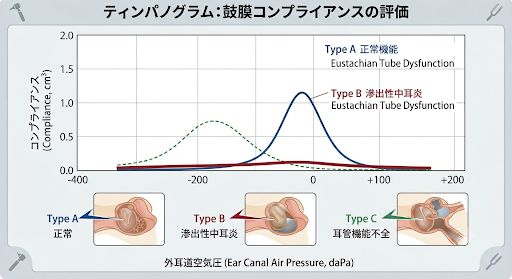
Tympanometry results are displayed as a graph called a tympanogram and are typically classified as Type A, As, Ad, B, or C.
Type A (Normal)
Type A indicates normal middle ear function.
The peak of the tympanogram appears near 0 daPa (decapascals), indicating normal eardrum mobility and middle ear pressure.
Type As
Type As has a shallower peak than Type A.
Possible causes include:
- Reduced eardrum mobility
- Stiffening of the middle ear structures
- Otosclerosis
Type Ad
Type Ad shows an abnormally high peak.
Possible causes include:
- Excessive eardrum mobility
- Ossicular chain abnormalities or discontinuity
Type B
Type B appears flat without a noticeable peak.
Possible causes include:
- Otitis media with effusion
- Perforated eardrum
- Earwax blockage
Type C
Type C shows a peak shifted toward the negative pressure side.
Possible causes include:
- Eustachian tube dysfunction
- Middle ear pressure abnormalities
- Early or resolving middle ear infections
What If Your Tympanometry Results Are Abnormal?
Abnormal tympanometry results do not automatically mean that you have hearing loss or a serious medical condition. Additional tests are usually performed to determine the underlying cause.
If You Have a Type B Result
Type B often suggests otitis media with effusion.
Additional examinations may include:
- Otoscopic examination
- Hearing tests
- Medical treatment when necessary
If You Have a Type C Result
Type C commonly suggests Eustachian tube dysfunction.
Treatment may include:
- Ear examinations
- Medication
- Instructions on pressure equalization techniques
If You Have a Type As Result
Type As may indicate otosclerosis.
Additional tests may include:
- Hearing evaluations
- CT imaging
Treatment options can include surgery or hearing aids, depending on severity.
If You Have a Type Ad Result
Type Ad may indicate ossicular chain discontinuity or excessive eardrum mobility.
Further imaging studies such as CT scans may be recommended, and surgical treatment may sometimes be required.
What If You Have Type A but Still Have Hearing Difficulties?
If your tympanometry results are normal but you experience hearing problems, the cause may be located in the inner ear or auditory nerve rather than the middle ear.
Additional tests may include:
- OAE (Otoacoustic Emissions)
- ABR (Auditory Brainstem Response)
- Comprehensive hearing evaluations
Conditions That Tympanometry Can Help Identify
Otitis Media with Effusion
Otitis media with effusion occurs when fluid accumulates behind the eardrum. It often causes hearing difficulties without obvious pain or fever, making it easy to overlook.
Eustachian Tube Dysfunction
The Eustachian tube connects the middle ear to the back of the nose and helps regulate ear pressure. Dysfunction can cause:
- Ear fullness
- Pressure sensations
- Hearing difficulties
Perforated Eardrum
A perforated eardrum is a hole or tear in the eardrum that may result in:
- Hearing loss
- Ear discharge
- Increased susceptibility to infections
Otosclerosis
Otosclerosis affects the stapes, one of the tiny bones in the middle ear, reducing its ability to transmit sound vibrations effectively.
Ossicular Chain Discontinuity
The ossicles (malleus, incus, and stapes) form a chain that transmits sound to the inner ear. When this chain becomes disconnected, sound transmission is impaired.
Tympanometry and Hearing Loss
Hearing loss can generally be classified as:
- Conductive hearing loss
- Sensorineural hearing loss
- Mixed hearing loss
Tympanometry is particularly useful for distinguishing middle ear problems from inner ear problems.
Conductive Hearing Loss
Conductive hearing loss results from problems in the outer or middle ear. Tympanometry often shows abnormal findings in these cases.
Sensorineural Hearing Loss
Sensorineural hearing loss originates in the inner ear or auditory nerve. Tympanometry results are often normal because the middle ear is functioning properly.
We prepared article of Sensorineural Hearing Loss. So, please refer it.
Regarding Sensorineural Hearing Loss↗
Auditory Neuropathy
Auditory neuropathy is a condition in which sound reaches the inner ear normally, but the transmission of sound signals to the brain is impaired.
People with auditory neuropathy may hear sounds but have difficulty understanding speech.
Tympanometry is usually normal (Type A), which is why additional tests such as OAE and ABR are essential for diagnosis.
We prepared article of Auditory Neuropathy. So, please refer it.
When Is Tympanometry Used in Newborns and Children?
Newborn hearing screening typically uses OAE or ABR testing. Tympanometry may also be performed when:
- A newborn hearing screening result is “refer”
- A child experiences recurrent middle ear infections
- Speech and language development is delayed
- Hearing concerns are present
Frequently Asked Questions
Is Tympanometry Painful?
No. It may cause a temporary feeling of ear pressure, but it is generally painless.
Can Tympanometry Diagnose Hearing Loss by Itself?
No. Tympanometry evaluates middle ear function and is usually combined with other hearing tests to determine the cause of hearing difficulties.
Can Children Have Tympanometry?
Yes. Tympanometry is commonly performed in children and may be used alongside newborn hearing assessments.
Does Type B Always Mean a Middle Ear Infection?
No. Type B results can also be caused by earwax blockage or a perforated eardrum.
How Long Does the Test Take?
The test typically takes only a few minutes.
Summary
- Tympanometry evaluates the condition of the eardrum and middle ear.
- Type A results are generally normal, while Types B and C may indicate middle ear abnormalities.
- Tympanometry can identify middle ear problems that may not be detected through standard hearing tests.
- It is also useful when evaluating hearing concerns in newborns and children.
This article is intended for general educational purposes and should not replace professional medical advice. If you have hearing concerns or abnormal test results, please consult an ear, nose, and throat (ENT) specialist.


コメント