
Have you noticed that sounds seem quieter than usual, your ear feels blocked, or you have trouble hearing in one ear?
When people think of hearing loss, they often imagine simply being unable to hear sounds clearly. However, there are several different types of hearing loss.
Conductive hearing loss occurs when a problem in the outer or middle ear makes it difficult for sound to travel properly to the inner ear. Common causes include earwax buildup, middle ear infections, and problems with the eardrum or the tiny bones in the middle ear.
Depending on the cause, hearing may improve with appropriate treatment.
In this article, we will explain the causes and symptoms of conductive hearing loss, how it differs from sensorineural hearing loss, the tests used to find the cause, treatment options, and when hearing aids may be helpful. Everything is explained in simple terms for people who are new to hearing loss.
- What Is Conductive Hearing Loss?
- Causes of Conductive Hearing Loss
- Main Symptoms of Conductive Hearing Loss
- Conductive vs. Other hearing loss
- Can Conductive Hearing Loss Be Cured?
- Tests for Conductive Hearing Loss
- Treatment for Conductive Hearing Loss
- Do You Need Hearing Aids for Conductive Hearing Loss?
- Conductive vs. Mixed Hearing Loss
- When Should You See an ENT Doctor?
- Summary
- References
What Is Conductive Hearing Loss?
Conductive hearing loss occurs when a problem in the outer or middle ear makes it difficult for sound to reach the inner ear properly.
In this section, we will explain how conductive hearing loss affects the way sound travels through the ear and what it may feel like to live with this type of hearing loss.
When Sound Has Trouble Reaching the Inner Ear
We hear sounds every day without thinking much about how the process works.
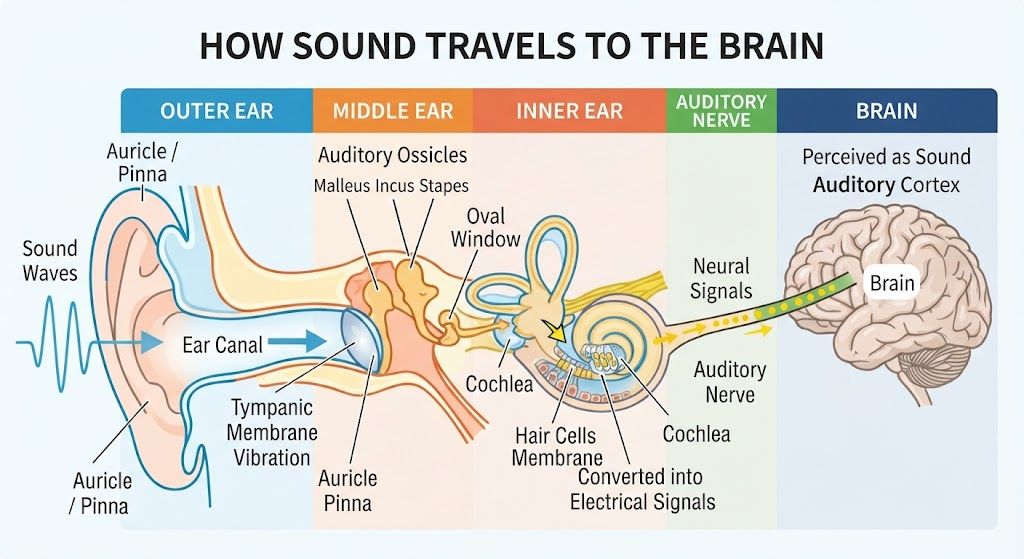
Sound enters the ear, and the ear can be divided into three main parts: the outer ear, middle ear, and inner ear.
The eardrum is located between the outer ear and middle ear. It vibrates when sound reaches it.
In conductive hearing loss, a problem in the outer or middle ear prevents sound from being transmitted properly to the inner ear.
What Does Conductive Hearing Loss Sound Like?
People with conductive hearing loss may experience symptoms such as:
- Sounds seem quieter than usual
- The ear feels blocked or full
- Voices may sound muffled
- Hearing may be worse in one ear
One of the main characteristics of conductive hearing loss is that sounds often seem quieter.
Causes of Conductive Hearing Loss
Conductive hearing loss can have many different causes, including earwax buildup, middle ear infections, and problems with the eardrum or the tiny bones in the middle ear.
Here are some of the most common causes.
Earwax Buildup
Earwax can sometimes build up inside the ear and make it harder to hear.
For example, using cotton swabs to clean your ears may push earwax deeper into the ear instead of removing it.
The ear has a natural cleaning process, and in many cases, earwax moves out of the ear on its own. However, some people are more likely to have earwax buildup.
If earwax is blocking the ear, an ear, nose, and throat (ENT) doctor can safely remove it when necessary.
Middle Ear Infection
Have you or your child ever had a middle ear infection?
A middle ear infection, also called otitis media, is an infection or inflammation in the middle ear. Acute middle ear infections can occur after a cold or other infection, when bacteria or viruses reach the middle ear.
Inflammation or fluid buildup in the middle ear can make it harder for the eardrum to vibrate normally. As a result, sound may not be transmitted properly.
In particular, otitis media with effusion can cause fluid to build up in the middle ear. This can make hearing worse even when there is little or no ear pain.
Wr prepared article of ear infections. So, please refer it.
Regarding middle ear infections↗
Eardrum Damage or a Perforated Eardrum
The eardrum is a thin and delicate membrane.
For example, putting an ear pick or cotton swab too far into the ear can damage the eardrum.
Rapid changes in air pressure, such as during air travel or scuba diving, can also put stress on the eardrum. This may cause ear pain or hearing problems.
A perforated eardrum means that there is a hole in the eardrum. This can happen as a result of an injury or other causes.
Damage to the eardrum can interfere with the transmission of sound and cause hearing loss.
Problems With the Eustachian Tube
The Eustachian tube is a narrow passage that connects the middle ear to the back of the nose.
It helps regulate air pressure in the middle ear and allows fluid to drain from the middle ear.
If the Eustachian tube does not work properly, it may become difficult to balance the pressure in the middle ear or drain fluid.
This can affect the movement of the eardrum and cause symptoms such as a blocked or full feeling in the ear and reduced hearing.
Problems With the Tiny Bones in the Middle Ear
Behind the eardrum are three tiny bones called the ossicles. They are called the malleus, incus, and stapes.
When the eardrum vibrates, these tiny bones transmit the vibrations toward the inner ear.
If the ossicles cannot move properly, or if their connection is damaged by an injury or a middle ear infection, sound may not be transmitted effectively to the inner ear.
This can cause conductive hearing loss.
Congenital Abnormalities of the Ear
Some people are born with differences or abnormalities in the shape or structure of the ear.
These abnormalities can make it difficult for sound to reach the eardrum or inner ear properly and may cause conductive hearing loss.
Examples include microtia, an abnormally small outer ear, atresia or stenosis of the ear canal, and abnormalities in the development of the ossicles.
Main Symptoms of Conductive Hearing Loss

People with conductive hearing loss may notice that sounds seem quieter than usual. They may also feel that their ear is blocked or that voices sound muffled.
The symptoms can vary depending on the underlying cause.
Sounds Seem Quieter
One of the main symptoms of conductive hearing loss is that sounds seem quieter than usual.
This is probably the symptom that many people commonly associate with hearing loss.
When sound vibrations are not transmitted properly through the outer or middle ear, less sound reaches the inner ear. As a result, sounds may seem quieter than they normally would.
A Blocked or Full Feeling in the Ear
A blocked or full feeling in the ear is another possible symptom of conductive hearing loss.
However, this feeling can also occur with problems involving the inner ear, so a blocked feeling does not necessarily mean that you have conductive hearing loss.
Earwax buildup, middle ear infections, and problems with the Eustachian tube can change the condition of the middle ear and may cause a feeling of pressure or fullness.
Voices May Sound Muffled
When earwax blocks the ear or fluid builds up in the middle ear, sounds may sometimes seem muffled or as though they are echoing inside the ear.
For example, if fluid builds up in the middle ear or the eardrum cannot move normally, sound vibrations may not be transmitted properly.
However, not everyone with conductive hearing loss experiences muffled sounds. It is better to think of this as a possible symptom rather than a symptom that always occurs.
Hearing May Be Worse in One Ear
Conductive hearing loss can sometimes affect only one ear.
For example, earwax buildup or a middle ear infection may occur in only one ear, making hearing worse on that side.
However, sudden hearing loss in one ear is not necessarily caused by conductive hearing loss. If you suddenly have difficulty hearing in one ear, it is important to see an ENT doctor as soon as possible.
Tinnitus or Ear Pain May Also Occur
Conductive hearing loss itself does not necessarily directly cause ear pain or tinnitus.
However, the condition causing the hearing loss may also cause symptoms such as ear pain or tinnitus.
For example, an ear infection may cause both hearing problems and ear pain.
Conductive vs. Other hearing loss
Conductive hearing loss mainly affects the way sound is transmitted through the outer and middle ear. Sounds often seem quieter than usual.
Sensorineural hearing loss, on the other hand, involves problems with the inner ear or the auditory nerve. In some cases, sounds may seem distorted, or a person may have difficulty understanding speech even when they can hear the sound itself.
| Comparison | Conductive Hearing Loss | Sensorineural Hearing Loss |
| Main problem | Sound does not travel properly through the ear | Problems with the parts of the ear or auditory system that detect sound |
| Main areas affected | Outer ear and middle ear | Inner ear, auditory nerve, and related structures |
| How sounds may be heard | Sounds often seem quieter | Sounds may seem distorted, or speech may be difficult to understand |
| Common causes | Earwax buildup, middle ear infections, eardrum or ossicle problems | Aging, long-term noise exposure, certain diseases and other conditions |
| Treatment | May improve when the underlying cause is treated | Depends on the underlying cause |
It is also possible to have both conductive and sensorineural hearing loss at the same time. This is called mixed hearing loss.
We prepared article of Sensorineural hearing loss. So, please refer it.
Regarding Sensorineural hearing loss↗
Mixed hearing loss is a combination of conductive hearing loss and sensorineural hearing loss. It can affect both the transmission of sound through the outer and middle ear and the inner ear or auditory nerve. Learn more about the causes, symptoms, diagnosis, and treatment of mixed hearing loss.
We prepared article of mixed hearing loss. So, please refer it.
Can Conductive Hearing Loss Be Cured?

Whether conductive hearing loss can be cured depends on its underlying cause.
In some cases, hearing can improve significantly when the cause is treated. However, not every case can be completely cured.
Hearing May Improve Depending on the Cause
Conductive hearing loss can sometimes be treated depending on what is causing it.
For example, if earwax buildup is causing the hearing loss, removing the earwax may improve hearing.
If a middle ear infection or another ear condition is causing the hearing loss, treating the underlying condition may also improve hearing.
If the problem involves the eardrum or the tiny bones in the middle ear, surgery may sometimes be considered.
It Does Not Always Go Away on Its Own
Not every case of conductive hearing loss will get better on its own.
Some causes may improve naturally over time, but it is not safe to assume that hearing loss will always disappear without treatment.
It is important to find out what is causing the hearing loss and receive appropriate treatment when necessary.
Tests for Conductive Hearing Loss

Doctors may examine the inside of the ear and perform hearing tests to find out what is causing the hearing loss.
Tests such as pure-tone audiometry, bone conduction testing, and tympanometry may be used to evaluate hearing and the condition of the middle ear.
Examining the Ear
The first step is often to examine the ear itself.
An ENT doctor may check for problems such as earwax buildup, damage to the eardrum, inflammation, or other abnormalities inside the ear.
Pure-Tone Audiometry
Pure-tone audiometry is a hearing test that checks how well you can hear different pitches of sound.
During the test, you listen to sounds such as beeps at different pitches and indicate when you can hear them.
The test measures the quietest sounds you can hear at different frequencies.
Many people have experienced a similar hearing test during a health checkup or school screening.
Bone Conduction Testing
We normally hear sounds when sound travels through the outer and middle ear. This is called air conduction.
However, sound can also reach the inner ear through vibrations in the bones of the skull. This is called bone conduction.
During a bone conduction hearing test, a small device is placed against the bone behind or near the ear. It sends vibrations through the bone directly toward the inner ear.
Because this bypasses the outer and middle ear, bone conduction testing can help doctors determine whether hearing loss is caused by a problem in the outer or middle ear or by a problem involving the inner ear.
Tympanometry
Tympanometry is a test used to check the condition of the eardrum and middle ear.
Unlike a standard hearing test, it does not measure how well you hear different sounds. Instead, it measures how the eardrum responds to changes in air pressure.
This test can help doctors identify problems such as fluid in the middle ear, problems with the Eustachian tube, or other conditions that affect the middle ear.
We prepared article of Tympanometry. So, please refer it.
Treatment for Conductive Hearing Loss

Treatment for conductive hearing loss depends on what is causing the problem.
Depending on the cause, treatment may include removing earwax, using medication, or having surgery.
Treating the Underlying Cause
There are several possible causes of conductive hearing loss.
The first step is to find out what is causing the hearing problem and then treat the underlying condition.
For example, treatment may be different if the hearing loss is caused by earwax buildup, a middle ear infection, or a problem with the eardrum or ossicles.
Removing Earwax or Other Blockages
Earwax buildup can sometimes cause conductive hearing loss.
Even if you regularly clean your ears, you may accidentally push earwax deeper into the ear without realizing it.
If earwax is blocking the ear canal, removing it properly may improve hearing.
If you think you have a large amount of earwax or a blockage, it is safer to have it checked and removed by an ENT doctor rather than trying to remove it yourself.
Treatment With Medication
Medication may be used when a condition such as a middle ear infection is causing the hearing problem.
The type of treatment depends on the underlying condition, so a doctor will decide what treatment is appropriate after examining the ear.
When Surgery May Be Needed
Surgery may sometimes be considered when the hearing loss is caused by a problem with the eardrum or the tiny bones in the middle ear.
For example, surgery may be used to repair the eardrum or improve the movement or connection of the ossicles.
Whether surgery is appropriate depends on the specific cause and condition of the ear.
When Hearing Aids May Be Used
Hearing aids can help make sounds louder and easier to hear.
If hearing loss remains after the underlying cause has been treated, or if surgery does not provide enough improvement, a hearing aid may be one option for improving hearing.
Do You Need Hearing Aids for Conductive Hearing Loss?

If treating the underlying cause does not completely restore hearing, a hearing aid may help compensate for the remaining hearing loss.
However, not everyone with conductive hearing loss needs a hearing aid. The most appropriate option depends on the cause and severity of the hearing loss.
When Hearing Loss Remains After Treatment
Conductive hearing loss can often improve when the underlying cause is treated, but this does not happen in every case.
Some people may continue to have difficulty hearing even after receiving treatment.
In these situations, a hearing aid or another type of hearing support may be considered.
Hearing Aids May Make Sounds Easier to Hear
If conductive hearing loss makes conversations difficult or interferes with everyday life, hearing aids may be an option.
Because conductive hearing loss often makes sounds seem quieter, increasing the volume with a hearing aid may make sounds easier to hear.
However, the best option depends on the cause and degree of hearing loss. An ENT doctor or hearing care professional can help determine whether a hearing aid is appropriate.
We prepared article of hearing aids. So, pkease refer it.
Other Options Besides Hearing Aids
Hearing aids are not the only way to make communication easier.
Depending on the situation, devices such as TV listening systems, speech-to-text apps, and other assistive listening devices may be helpful.
Personal sound amplifiers are another option, but if you have persistent hearing difficulties, it is important to have your ears checked by an ENT doctor first.
This is because hearing loss can have different causes, and the appropriate solution depends on what is causing the problem.
Conductive vs. Mixed Hearing Loss
Mixed hearing loss is a type of hearing loss that combines both conductive and sensorineural hearing loss.
In mixed hearing loss, there are problems in both the parts of the ear that carry sound, such as the outer and middle ear, and the parts that detect sound, such as the inner ear and auditory nerve.
As a result, a person may experience characteristics of both conductive and sensorineural hearing loss.
For example, sounds may seem quieter, while speech may also be difficult to understand.
Mixed hearing loss can have different causes, so an ENT doctor may perform hearing tests and examine the ear to determine what is causing the problem.
When Should You See an ENT Doctor?

You should consider seeing an ENT doctor if you experience symptoms such as:
- Hearing suddenly becomes worse
- You suddenly lose hearing in one ear
- You have ear pain
- Fluid or discharge comes from your ear
- Your ear feels strongly blocked or full
- Hearing difficulties continue for some time
In particular, sudden hearing loss should not be ignored. It is important to see an ENT doctor as soon as possible.
If your hearing suddenly becomes worse, the cause may not be conductive hearing loss such as earwax buildup or a middle ear infection. Other conditions, including sudden sensorineural hearing loss, can also cause sudden hearing loss.
For this reason, do not simply wait and see if your hearing improves on its own. If you suddenly have difficulty hearing, seek medical attention promptly.
Summary
Conductive hearing loss occurs when a problem in the outer or middle ear makes it difficult for sound to reach the inner ear properly.
There are many possible causes, including earwax buildup, middle ear infections, damage to the eardrum, problems with the Eustachian tube, and abnormalities of the ossicles.
Common symptoms include sounds seeming quieter than usual, a blocked or full feeling in the ear, and voices sounding muffled. Hearing may also be worse in only one ear.
However, these symptoms do not necessarily mean that you have conductive hearing loss.
Depending on the cause, conductive hearing loss may improve with treatments such as removing earwax, treating an underlying condition with medication, or having surgery. If hearing difficulties remain after treatment, hearing aids or other hearing support may help.
If your hearing suddenly becomes worse or you suddenly lose hearing in one ear, the cause may not be conductive hearing loss. It could be another condition, such as sudden sensorineural hearing loss.
For this reason, do not try to diagnose the problem yourself. If you experience sudden hearing loss, see an ENT doctor as soon as possible.
Even if you think your ear is simply blocked or that your hearing is only slightly worse than usual, different conditions can require different treatments.
If your hearing difficulties continue, it is important to have your ears examined by an ENT doctor to find out what is causing the problem.
We prepared article of hearing loss. So, please refer it.
References
https://www.jibika.or.jp/modules/disease/index.php?content_id=20%3Fn%3Dmamatena&slug=di0379&utm_source=chatgpt.com
https://ncbi.nlm.nih.gov/sites/books/NBK563267/?report=reader&utm_source=chatgpt.com
https://ncbi.nlm.nih.gov/sites/books/NBK563267/?report=classic&utm_source=chatgpt.com

コメント