
Hearing difficulties can take many different forms. You may feel that sounds are too quiet, or you may have trouble understanding what people are saying even when you can hear their voices.
One type of hearing loss is called mixed hearing loss.
Mixed hearing loss occurs when both conductive hearing loss and sensorineural hearing loss are present. In other words, there is a problem with both the parts of the ear that carry sound to the inner ear and the parts that detect sound and send auditory information to the brain.
As a result, sounds may seem quieter, while speech may also be difficult to understand clearly.
In this article, we will explain the causes, symptoms, diagnosis, and treatment of mixed hearing loss, as well as hearing aid options. The information is written in simple terms for people who are not familiar with hearing loss.
- What Is Mixed Hearing Loss?
- How Is Mixed Hearing Loss Different from Conductive and Sensorineural Hearing Loss?
- Common Causes of Mixed Hearing Loss
- What Are the Symptoms of Mixed Hearing Loss?
- How Is Mixed Hearing Loss Diagnosed?
- Treatment Options for Mixed Hearing Loss
- Things to Consider When Choosing a Hearing Aid
- Frequently Asked Questions About Mixed Hearing Loss
- Summary
- Reference
What Is Mixed Hearing Loss?
Mixed hearing loss is a type of hearing loss that has both conductive and sensorineural components.
In simple terms, it means that there is a problem with both the parts of the ear that carry sound and the parts that detect sound and send auditory information to the brain.
How Does the Ear Hear Sound?
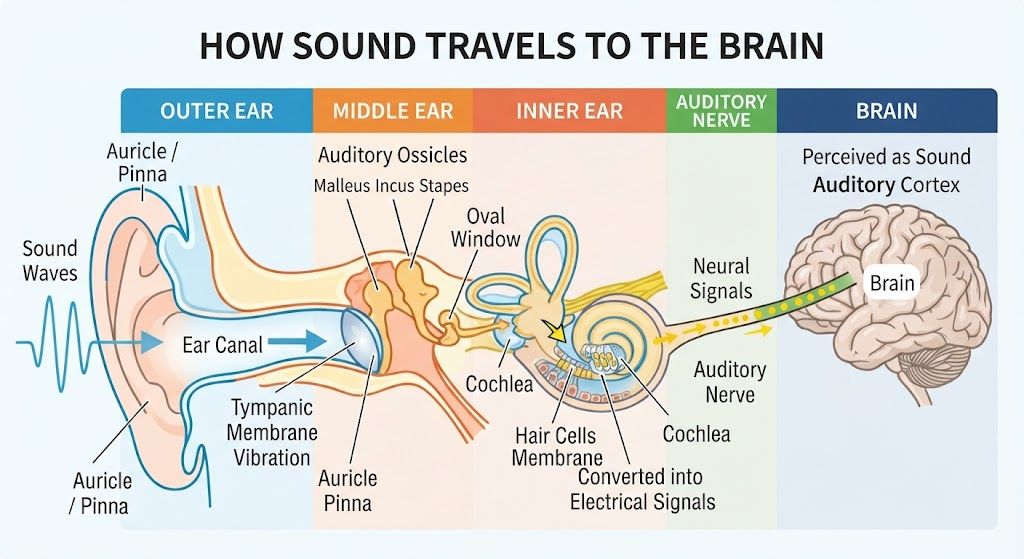
We normally hear sounds without having to think about how the process works.
The ear can be broadly divided into three main parts: the outer ear, middle ear, and inner ear.
Sound first enters the outer ear and travels toward the eardrum. When sound reaches the eardrum, it causes the eardrum to vibrate.
These vibrations are then passed to three small bones in the middle ear called the ossicles. The ossicles help amplify the vibrations and transmit them to the inner ear.
Inside the inner ear, specialized sensory cells called hair cells convert these vibrations into electrical signals. The signals then travel through the auditory nerve to the brain.
The brain processes these signals, allowing us to recognize and understand sounds.
The Three Main Types of Hearing Loss
When people hear the term “hearing loss,” they may simply imagine being unable to hear sounds. However, hearing loss can be classified into several different types depending on where the problem occurs.
Conductive hearing loss occurs when there is a problem in the outer or middle ear that prevents sound from being transmitted properly. Sounds may seem quieter as a result.
Sensorineural hearing loss mainly involves the inner ear or auditory nerve and affects how sound is detected or how auditory information is transmitted to the brain.
Mixed hearing loss is a combination of conductive and sensorineural hearing loss.
We prepared article of conductive hearing loss and sensorineural hearing loss. So, please refer it.
Regarding conductive hearing loss↗
Regarding sensorineural hearing loss↗
Mixed Hearing Loss: When Two Types of Hearing Loss Occur Together
Mixed hearing loss occurs when both conductive and sensorineural hearing loss are present.
With conductive hearing loss, sounds may seem quieter because sound is not being transmitted efficiently through the outer or middle ear.
With sensorineural hearing loss, a person may have difficulty understanding speech clearly or distinguishing between similar sounds, even when the sound itself is loud enough.
Therefore, a person with mixed hearing loss may experience both reduced loudness and difficulty understanding speech clearly.
How Is Mixed Hearing Loss Different from Conductive and Sensorineural Hearing Loss?
The main difference between these three types of hearing loss is which part of the auditory system is affected.
Conductive hearing loss mainly affects the outer or middle ear.
Sensorineural hearing loss mainly affects the inner ear or auditory nerve.
Mixed hearing loss has both conductive and sensorineural components, meaning that problems occur in both areas.
Comparison of the Three Types of Hearing Loss
| Conductive Hearing Loss | Sensorineural Hearing Loss | Mixed Hearing Loss | |
| Main problem | Sound is not transmitted properly | The ability to detect sound or transmit auditory information is affected | Both conductive and sensorineural problems are present |
| Main areas affected | Outer ear and middle ear | Inner ear and/or auditory nerve | Outer/middle ear plus inner ear and/or auditory nerve |
| Common causes | Earwax buildup, middle ear infections, eardrum problems, and abnormalities of the ossicles | Aging, long-term noise exposure, certain medications, and inner ear disorders | A middle ear disorder combined with an inner ear disorder, among other causes |
| How it may sound | Sounds often seem quieter | Sounds may seem quieter, and speech may be difficult to understand | Sounds may seem quieter, and speech may also be difficult to understand clearly |
| When sounds are made louder | Hearing may improve in some cases | Difficulty understanding speech may remain even when sounds are made louder | Difficulty understanding speech may remain even when sounds are made louder |
| Treatment and management | Treating the underlying cause may improve hearing in some cases | Hearing aids and other forms of hearing support may be used when hearing cannot be restored | Treatment of the underlying cause plus hearing aids or other hearing support may be considered |
The exact symptoms and treatment options vary from person to person. A hearing test and medical examination are important for determining what is causing the hearing loss and which treatment may be appropriate.
Common Causes of Mixed Hearing Loss
Mixed hearing loss can occur when conductive hearing loss caused by a problem in the middle ear is combined with sensorineural hearing loss caused by a problem in the inner ear or auditory system.
Common causes include chronic otitis media, cholesteatoma, and otosclerosis.
Mixed hearing loss can also occur when age-related sensorineural hearing loss develops alongside a middle ear disorder. In some cases, a head injury can affect both the middle ear and inner ear, resulting in mixed hearing loss.
Chronic Otitis Media and Cholesteatoma
Chronic otitis media and cholesteatoma can cause conductive hearing loss because they affect the middle ear.
If the inner ear is also damaged, a sensorineural component may develop, resulting in mixed hearing loss.
With chronic otitis media, several changes may occur, including:
- A hole developing in the eardrum
- Thickening or deformation of the eardrum
- Reduced movement of the ossicles
- Damage to the ossicles caused by long-term inflammation
If inflammation continues for a long time, it may also affect the cochlea in the inner ear and cause sensorineural hearing loss.
A cholesteatoma is a growth of abnormal skin cells that can develop behind the eardrum. It may damage or put pressure on the ossicles, which can lead to conductive hearing loss.
If inflammation or damage extends toward the inner ear, sensorineural hearing loss may also occur.
However, chronic otitis media and cholesteoma do not always lead to mixed hearing loss. Early evaluation and appropriate treatment are therefore important.
We prepared article of Ear infections. So, please refer it.
Otosclerosis
Otosclerosis is a condition in which abnormal bone growth affects the small bones in the middle ear, particularly the stapes.
When the stapes cannot move properly, sound vibrations cannot be transmitted efficiently to the inner ear. This can cause conductive hearing loss.
In some cases, otosclerosis can also affect the inner ear. When both conductive and sensorineural hearing loss are present, mixed hearing loss can occur.
Age-Related Hearing Loss Combined with a Middle Ear Disorder

Aging is one of the common causes of sensorineural hearing loss.
Of course, not everyone experiences significant hearing loss as they get older. Many older adults continue to enjoy conversations and everyday sounds without major difficulty.
However, hearing can gradually become less sensitive with age. This is often related to age-related sensorineural hearing loss.
If a person who already has age-related hearing loss develops a middle ear problem, such as otitis media, both the conductive and sensorineural components may be present. This can result in mixed hearing loss.
Head Injuries and Other Causes
A strong blow to the head can sometimes damage structures around the ear.
However, head injuries do not always affect hearing, and not everyone who experiences a head injury will develop hearing loss.
Depending on the injury, both the middle ear, including the eardrum and ossicles, and the inner ear may be damaged.
If both the conductive structures of the outer or middle ear and the sensory structures of the inner ear are affected, mixed hearing loss may occur.
What Are the Symptoms of Mixed Hearing Loss?
People with mixed hearing loss may experience both reduced sound volume and difficulty understanding speech clearly.
Other symptoms may also occur depending on the condition causing the hearing loss. These can include tinnitus, ear discharge, or a feeling of fullness or blockage in the ear.
Sounds May Seem Quiet and Speech May Sound Unclear
Because mixed hearing loss has both conductive and sensorineural components, it can cause a combination of symptoms.
The conductive component may make sounds seem quieter because sound is not being transmitted efficiently through the outer or middle ear.
The sensorineural component may make speech sound unclear or distorted, making it difficult to understand what someone is saying.
As a result, a person with mixed hearing loss may feel that sounds are too quiet and that speech is difficult to understand even when the volume is increased.
Tinnitus, Ear Discharge, and a Feeling of Ear Fullness
Tinnitus, such as ringing or buzzing in the ear, can occur alongside sensorineural hearing loss. It can also occur as a result of certain middle ear conditions.
Ear discharge may occur when mixed hearing loss is caused by a middle ear condition such as chronic otitis media.
Some people may also experience a feeling of fullness, pressure, or blockage in the ear.
Because these symptoms can have many different causes, it is important to have the ears examined by an ENT doctor, especially if symptoms are persistent or suddenly become worse.
How Is Mixed Hearing Loss Diagnosed?
When diagnosing mixed hearing loss, hearing tests such as pure-tone audiometry are used to determine how well a person can hear different sounds.
Other tests, such as tympanometry, may also be performed to examine the condition of the eardrum and middle ear and to help identify the underlying cause of the hearing loss.
Pure-Tone Audiometry

The test where you listen for a “beep” and press a button or raise your hand when you hear the sound is called pure-tone audiometry.
This test measures the softest sounds you can hear at different frequencies, helping determine how well you hear different pitches.
Pure-tone audiometry is commonly used to evaluate the degree and type of hearing loss.
How to Read an Audiogram
Pure-tone audiometry is performed using a device called an audiometer.
The results are shown on a graph called an audiogram.
On an audiogram, the horizontal axis shows the frequency, or pitch, of the sound, usually measured in hertz (Hz).
The vertical axis shows the hearing level, measured in decibels hearing level (dB HL).
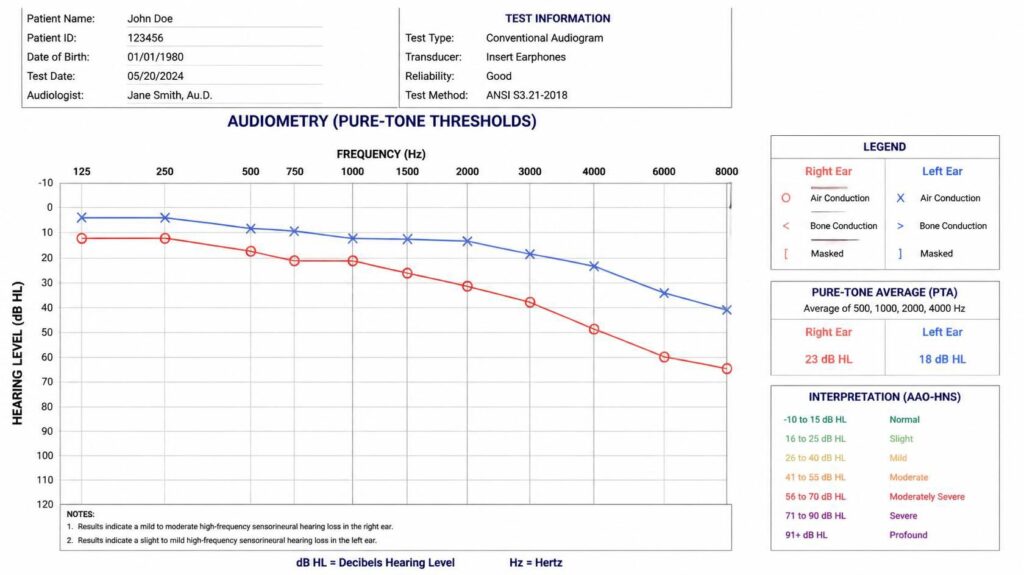
As you move downward on the graph, a louder sound is needed for the person to hear it. In other words, a lower position on the graph generally indicates greater hearing loss.
The frequency increases from left to right, meaning that sounds become higher in pitch as you move toward the right side of the graph.
Measuring Air-Conduction and Bone-Conduction Hearing
During pure-tone audiometry, both air-conduction and bone-conduction hearing may be measured.
Air conduction refers to hearing sound as vibrations travel through the outer and middle ear before reaching the inner ear.
Bone conduction refers to transmitting vibrations through the bones of the skull directly to the inner ear, bypassing much of the outer and middle ear.
In mixed hearing loss, both conductive and sensorineural components are present. Therefore, hearing thresholds may be elevated for both air conduction and bone conduction.
Comparing the air- and bone-conduction results can help doctors determine whether a conductive component is present in addition to sensorineural hearing loss.
Other Tests

Tympanometry is a test used to evaluate the eardrum and middle ear.
Unlike a standard hearing test, which measures how soft a sound a person can hear, tympanometry measures how the eardrum responds to changes in air pressure and provides information about the condition of the middle ear.
It can help identify problems such as middle ear fluid, otitis media, or Eustachian tube dysfunction.
Depending on the suspected cause of hearing loss, an ENT doctor may also perform other examinations or imaging tests.
We prepared article of Tympanometry. So, please refer it.
Treatment Options for Mixed Hearing Loss
Treatment for mixed hearing loss depends on which conductive and sensorineural components are present and what is causing them.
Problems affecting the outer or middle ear may sometimes be improved with medication or surgery.
When sensorineural hearing loss cannot be reversed, hearing aids or other hearing devices may be used to improve access to sound.
The most appropriate treatment depends on the underlying cause, the degree of hearing loss, and the condition of the middle and inner ear.
The Conductive Component May Sometimes Improve with Surgery

When hearing loss is caused by a problem in the outer or middle ear, treatment may sometimes improve hearing.
Depending on the cause, medication or surgery may be used.
For example, treatment may be aimed at the underlying middle ear disease or at repairing or improving the function of structures involved in sound transmission.
For this reason, identifying the cause of the conductive component is an important part of treatment.
The Sensorineural Component Can Be Difficult to Reverse
Some types of sensorineural hearing loss may improve with appropriate treatment, depending on the cause and when the hearing loss developed.
However, when sensorineural hearing loss is caused by factors such as aging or long-term exposure to loud noise, restoring the hearing that has already been lost can be difficult.
In these situations, hearing aids and other hearing support devices can help compensate for reduced hearing and make speech and everyday sounds easier to hear.
Hearing Aids, Bone-Conduction Devices, and Other Options
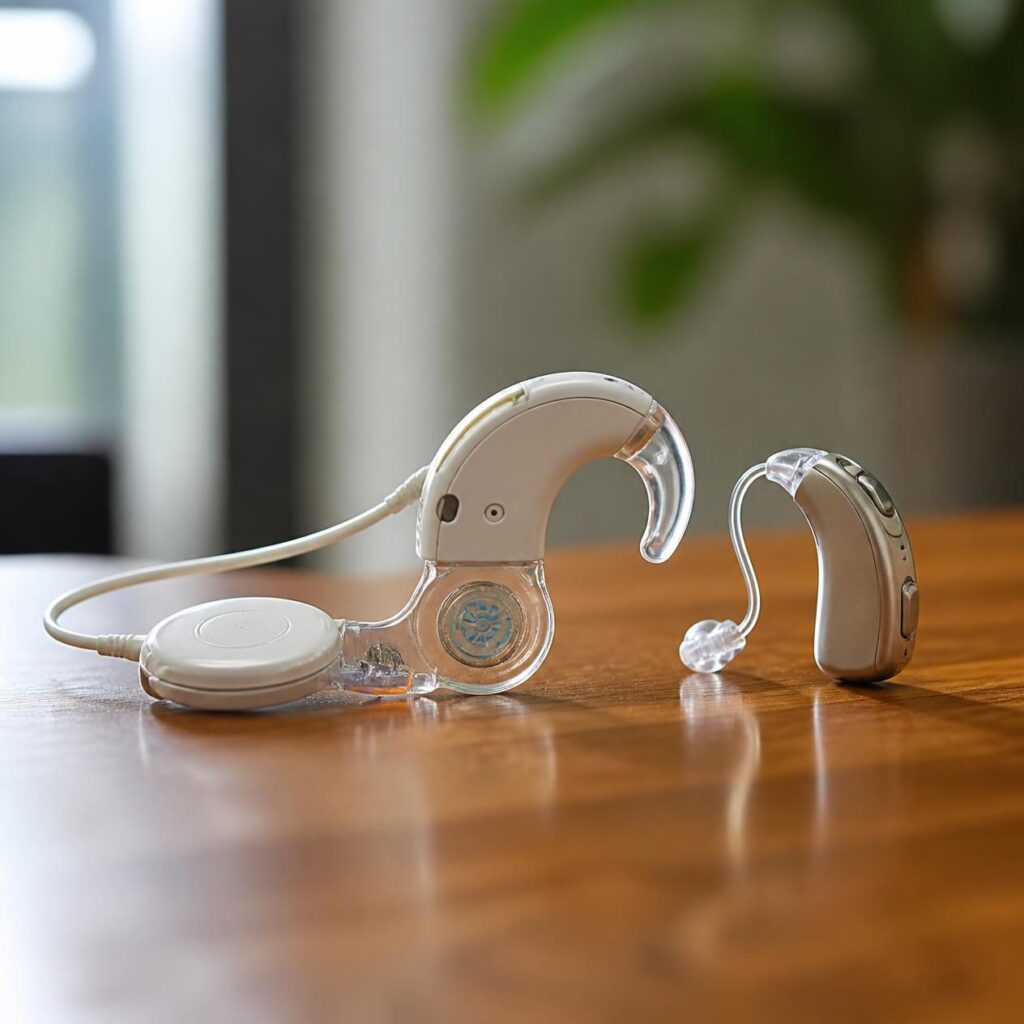
When people think of hearing loss, they often think of conventional hearing aids. However, there are several types of hearing devices and treatment options.
For example, bone-conduction hearing devices can be useful for some people with conductive hearing loss because they transmit sound vibrations through the skull to the inner ear.
However, they may be less effective when the main problem is sensorineural hearing loss, because they do not repair damage to the inner ear or auditory nerve.
Depending on the person’s hearing level and the condition of the inner ear, other options may also be considered. In some cases of severe or profound hearing loss, a cochlear implant may be an option.
The appropriate choice depends on the type and severity of hearing loss and should be discussed with an ENT doctor or hearing care professional.
We prepared article of hearing aid and article of cochlear. So, please refer it.
Things to Consider When Choosing a Hearing Aid
There is no single hearing aid that is right for everyone.
The best choice depends on your hearing level, the cause of your hearing loss, how you experience sounds in everyday life, and your personal needs.
There are many types of hearing aids available, and different manufacturers offer different features and technologies.
For this reason, it is important to try a hearing aid before making a decision and find one that works well for you.
A hearing care professional can also help you choose and adjust a hearing aid based on your hearing test results and daily listening needs.
We prepared article of how to select hearing aids. So, please refer it.
Regarding how to select about hearing aids↗
Frequently Asked Questions About Mixed Hearing Loss
Can Mixed Hearing Loss Be Cured?
The conductive component of mixed hearing loss may improve with medication or surgery, depending on its cause.
However, sensorineural hearing loss can be difficult to reverse, particularly when it is related to aging or long-term damage to the inner ear.
As a result, it is not always possible to completely restore hearing in people with mixed hearing loss.
Treatment focuses on addressing any underlying condition that can be treated and improving hearing with hearing aids or other appropriate hearing devices when necessary.
Will Mixed Hearing Loss Get Worse If It Is Left Untreated?
Mixed hearing loss does not necessarily get worse in every case.
However, if the condition causing the hearing loss, such as chronic middle ear disease, is left untreated, hearing may deteriorate further.
Some underlying ear conditions can also cause other complications if they are not properly treated.
For this reason, it is important to see an ENT doctor to identify the cause of the hearing loss and determine whether treatment is necessary.
Can Mixed Hearing Loss Affect Only One Ear?
Yes. Mixed hearing loss can affect only one ear.
Both conductive and sensorineural hearing loss can occur in just one ear. Therefore, it is possible for mixed hearing loss to occur on only one side.
The cause and severity may also be different between the two ears.
Do Hearing Aids Help with Mixed Hearing Loss?
Hearing aids can be helpful for some people with mixed hearing loss, depending on their hearing level and the underlying cause.
Before choosing a hearing aid, it is important to have your hearing tested and understand what is causing the hearing loss.
A hearing care professional can then recommend and adjust a hearing aid based on your hearing needs.
The most suitable hearing aid can vary from person to person, so trying different devices and finding one that works well in everyday situations can be helpful.
Summary
Mixed hearing loss is a type of hearing loss that has both conductive and sensorineural components.
It can occur when a middle ear condition, such as otitis media, chronic otitis media, cholesteatoma, or otosclerosis, is combined with a problem affecting the inner ear or auditory system.
Mixed hearing loss can also develop when multiple factors occur at the same time. For example, a person may have age-related sensorineural hearing loss and later develop a middle ear disorder.
People with mixed hearing loss may experience both reduced sound volume and difficulty understanding speech clearly.
The first step in treatment is to identify the underlying cause of the hearing loss.
If the problem is related to the outer or middle ear, hearing may sometimes be improved with medication or surgery. When the sensorineural component cannot be reversed, hearing aids or other hearing devices may be used to improve hearing.
Because the causes and symptoms of mixed hearing loss vary from person to person, it is important to work with an ENT doctor and hearing care professional to find the treatment and hearing support that best match your hearing condition and daily needs.
We prepared article of general hearing loss. So, please refer it also.
Reference
American Speech-Language-Hearing Association (ASHA). Hearing Loss in Adults.


コメント