Someone sits down across from you and starts chewing. A coworker clicks a pen. The person next to you on the train sniffs, again and again. Your chest tightens, your jaw clenches, and all you want is for the sound to stop, or to get away from it.
If that sounds familiar, you may have wondered whether you are just being petty. You are not alone, and it is not a character flaw. A strong reaction to specific sounds, even quiet ones, has a name: misophonia.
This guide explains what misophonia is, how it feels, how it differs from hyperacusis and other sound sensitivities, who to see, and what can help.
In this article
- What misophonia is, and what sounds usually set it off
- How it differs from just being annoyed (with a quick self-check)
- How it differs from hyperacusis, tinnitus, and other sound sensitivities
- Who to see and what treatment looks like
- Everyday ways to cope, and how family and coworkers can help
- What Is Misophonia?
- Common Triggers
- What a Reaction Feels Like
- Is It More Than Annoyance? A Quick Self-Check
- Misophonia vs. Hyperacusis and Similar Conditions
- Who Gets Misophonia, and When Does It Start?
- What Causes It?
- Who Should You See?
- What Can Help?
- If Someone You Love Has Misophonia
- Frequently Asked Questions
- Key Takeaways
- References
What Is Misophonia?
Misophonia literally means “hatred of sound,” but that name is a little misleading. People with misophonia do not react to every sound. They react to specific sounds, and the reaction is mostly about what the sound triggers in them, not how loud it is.
In 2022, a panel of experts from several fields agreed on a shared definition: misophonia is a disorder of decreased tolerance to specific sounds or their associated stimuli, with strong emotional and bodily reactions. Having a shared definition matters because researchers can now compare studies more fairly.
It is still a young field. As of November 2026, misophonia is not listed as its own condition in the main diagnostic manuals (DSM-5-TR and ICD-11). That does not make it imaginary. People are clearly affected, and research is moving forward.
Common Triggers
Triggers are personal, but a few groups come up again and again:
- Eating and drinking sounds: chewing, lip smacking, crunching, slurping, loud swallowing
- Breathing and nose sounds: sniffing, nose blowing, heavy breathing, snoring
- Repetitive movement sounds: pen clicking, finger or foot tapping, loud typing, utensils on plates
- Throat and mouth sounds: throat clearing, coughing
Some people also react to the sight of the movement that goes with the sound, such as watching someone chew. Triggers can also change over time, and one trigger can grow into several.
If your problem is that everyday sounds in general are too loud, or even painful, that points more toward hyperacusis. The comparison table below shows the difference.
What a Reaction Feels Like
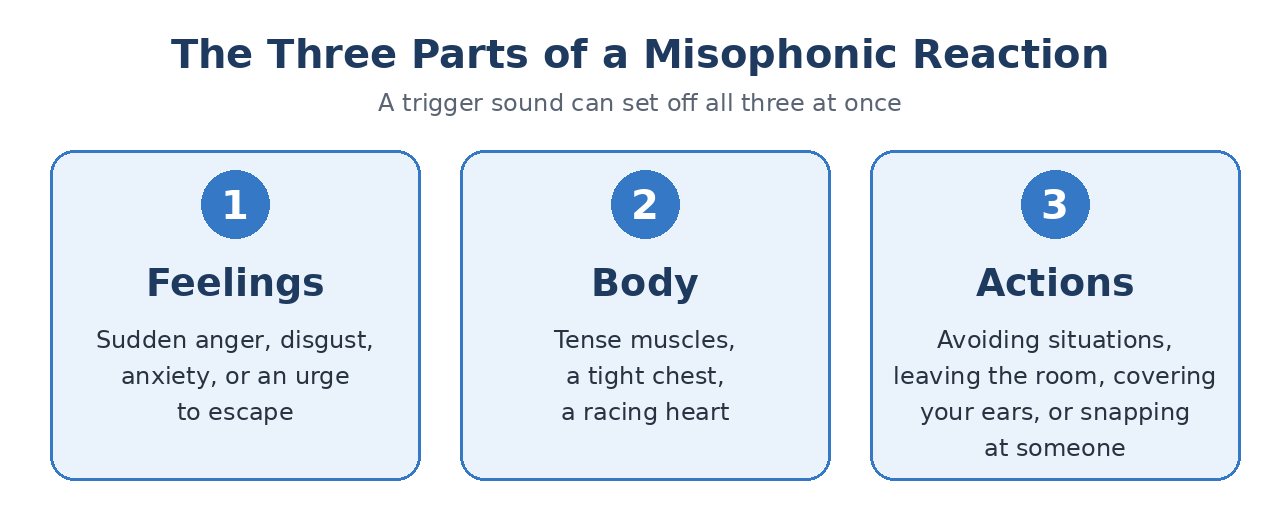
A misophonic reaction usually has three parts:
- Feelings: sudden anger, disgust, anxiety, or an urge to escape
- Body: tense muscles, a tight chest, a racing heart
- Actions: avoiding situations, leaving the room, covering your ears, or snapping at the person making the sound
Most people try to hold the reaction in. Some snap verbally, and a smaller number react physically, often toward objects rather than people. Many feel guilty or embarrassed afterward, because they know the reaction is out of proportion. Even thinking about a situation where a trigger might happen can raise stress.
Is It More Than Annoyance? A Quick Self-Check
Everyone has sounds they dislike. What stands out in misophonia is the strength of the reaction and how much it affects daily life. Read through these and see how many sound like you. This is not a diagnosis. It is a way to put words to what you experience.
- Certain sounds (chewing, sniffing, pen clicking) make me feel sudden anger or disgust.
- Other people do not seem bothered by the same sounds.
- The sound does not have to be loud, and a quiet or distant one still bothers me.
- I plan around the sounds, for example by avoiding shared meals, quiet rooms, or public transport.
- I feel a strong urge to stop the sound or leave.
- It affects my work, school, meals, or relationships.
- I remember being bothered by similar sounds since childhood or my early teens.
If several of these fit and your daily life is affected, misophonia is worth looking into. If only one or two fit but you are still struggling, you can ask for help anyway.
There is no single official test. Clinicians and researchers use questionnaires, such as the Amsterdam Misophonia Scale, together with an interview.
Misophonia vs. Hyperacusis and Similar Conditions
“Sound sensitivity” covers several different problems, and they can overlap. This table is a rough guide.
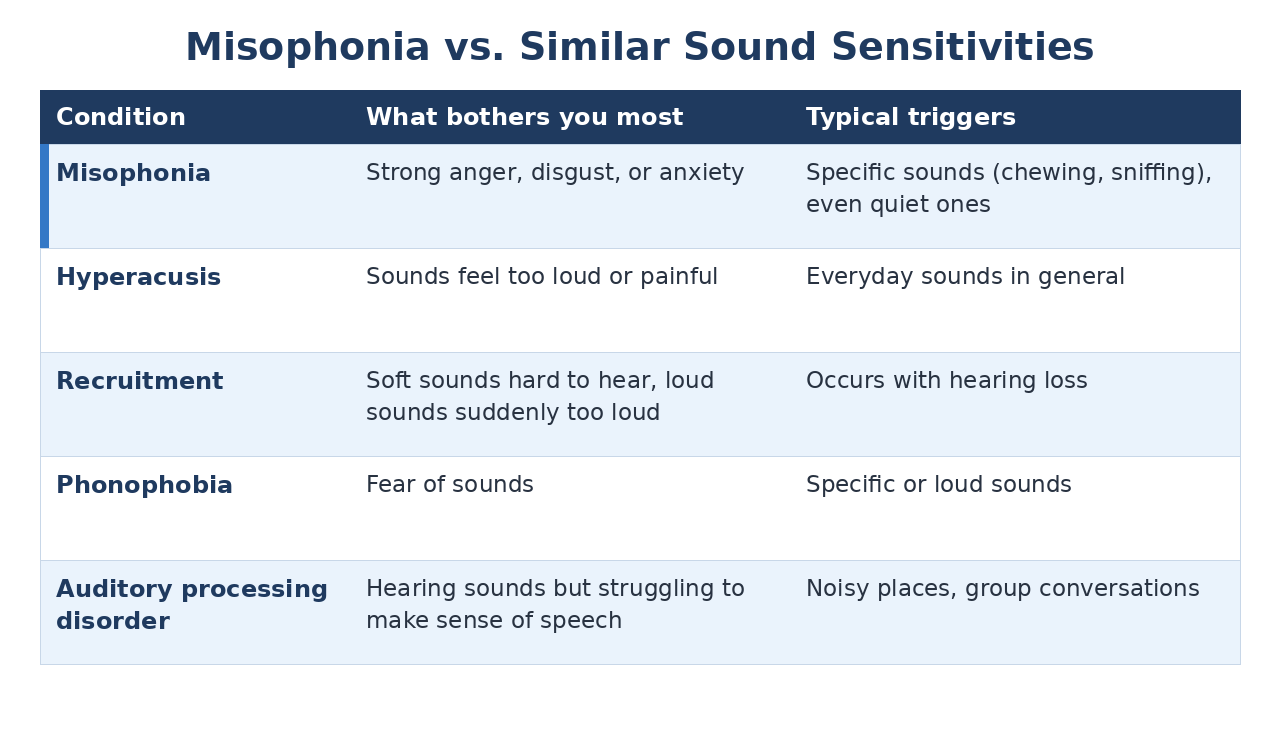
| Condition | What bothers you most | Typical triggers |
|---|---|---|
| Misophonia | Strong emotions such as anger, disgust, or anxiety | Specific sounds, such as chewing or sniffing, even when quiet |
| Hyperacusis | Sounds feel too loud or painful | Everyday sounds in general, such as dishes, traffic, or sirens |
| Recruitment | Soft sounds are hard to hear, but loud sounds suddenly feel too loud | Happens with hearing loss |
| Phonophobia | Fear of sounds | Specific or loud sounds |
| Auditory processing disorder (APD) | Hearing sounds but struggling to make sense of speech | Noisy places and group conversations |
For more detail, see our guides to hyperacusis, recruitment, and auditory processing disorder. If you also hear ringing or buzzing, our tinnitus guide explains more.
These conditions can occur together. In one study comparing adults with misophonia and healthy controls, hyperacusis was more common in the misophonia group, while an objective hearing test did not differ between the two groups. Misophonia is not a hearing loss problem, and in studies that tested hearing, most people with it had typical results. Still, a hearing check is a sensible first step, because it can show whether something else is going on. Our guide to what a decibel is and how to read a hearing test may help you read your results.
Who Gets Misophonia, and When Does It Start?
Misophonia often begins in childhood or the early teens, though not always. In studies of people who sought help, the average starting age was about 13, and some people report that it began even earlier. These numbers come from adults looking back, so the exact age is hard to pin down. Many adults say they have felt this way for as long as they can remember.
How common is it? In a national U.S. survey of 4,005 adults chosen to match the population, about 4.6% met the criteria for misophonia, and many more said sounds sometimes bothered them. Numbers differ between countries and studies, depending on how misophonia is measured, so treat any single figure as a rough guide.
What Causes It?
No one knows yet. Research is looking at how the brain’s sound-processing areas interact with the systems that control emotion and the body’s alarm response. It is not a sign of a bad temper or weak willpower.
Misophonia is reported more often in people with anxiety, depression, ADHD, or obsessive-compulsive traits. It is not clear which comes first or how they are connected, and having misophonia does not mean you have any of these.
Who Should You See?
A step-by-step approach works well:
- Start with a hearing professional (an audiologist or ENT doctor). They can check your hearing and look for hyperacusis, tinnitus, or other ear problems.
- If the distress is strong, add a mental health professional. A psychologist or therapist who knows misophonia can help you work on the emotional side.
See a doctor promptly if you notice a sudden change in hearing, hearing problems in one ear only, strong dizziness, or ear pain or discharge. Our guide to sudden hearing loss explains why timing matters.
If the irritation or low mood is making it hard to work, leave the house, or enjoy life, please reach out to a doctor or a mental health service in your area. If you ever feel hopeless or unsafe, contact your local emergency number or crisis line.
What Can Help?
There is no medicine that cures misophonia, and for many people the goal is less distress and more control, not silence.
Therapy
Cognitive behavioral therapy (CBT) and related talking therapies have the most research so far. In the first randomized trial, group CBT helped more than waiting for treatment. More recent trials of acceptance and commitment therapy and of relaxation training found that both lowered misophonia severity. Audiologist-led CBT by video call has also shown promise in an early study without a control group. Still, trials are small, not everyone improves, and researchers are still working out which approach suits which person. Sound-based treatment on its own has not yet been backed by controlled studies, and other methods, such as counterconditioning, have only limited evidence. A therapist experienced with misophonia can help you choose.
Everyday strategies
- Change your seat or distance at meals, meetings, or on public transport.
- Add other sound, such as music, nature sounds, or a fan, to soften a trigger.
- Use earplugs or noise-canceling headphones for specific moments, like a commute or a long meeting, rather than all day, so you can still hear people and traffic.
- Tell people ahead of time, in a short and calm way: “It is not about you. Certain sounds are really hard for me.”
- Calm your body with slow breathing, a short walk, or a glass of water.
If Someone You Love Has Misophonia
Telling someone to “just ignore it” rarely works. A few things help more:
- Believe them. Say “That sounds really hard” instead of “You are overreacting.”
- Do not take it personally. The person making the sound has done nothing wrong, and the person reacting is not trying to be rude.
- Work on solutions together. Sit a little further away, play background music, or take breaks during meals.
- Talk when things are calm, not in the middle of a reaction.
If a child cries, gets angry, or runs away from certain sounds, try not to label it as bad behavior. Ask what they find hard, and consider sharing it with their teacher or doctor.
Frequently Asked Questions
Is misophonia a real condition?
Yes. Experts agreed on a definition in 2022 and research is growing. As of November 2026, it is not yet a separate diagnosis in DSM-5-TR or ICD-11, but that does not mean it is not real or does not deserve help.
Can misophonia be cured?
There is no known cure. Many people find their distress becomes easier to manage with therapy and daily strategies, but results vary and research is still early.
Is misophonia the same as hearing loss?
No. Misophonia is about how the brain and body react to certain sounds, not how well you hear. Some people with misophonia also have hearing loss, tinnitus, or hyperacusis, which is why a hearing check is useful.
Is misophonia linked to ADHD or anxiety?
Studies have reported higher rates of ADHD, anxiety, and some other conditions in people with misophonia. The link is not well understood, and having misophonia does not mean you have any of them.
How do I know if I have misophonia?
No single test confirms it. The self-check above can help you describe your experience. If the reactions are strong and affect your life, talk with a hearing professional or a therapist.
Key Takeaways
- Misophonia is a strong emotional reaction to specific sounds, such as chewing or sniffing, and it is not just about loudness.
- It usually starts in childhood or the early teens, and it is not a sign of bad character.
- It is different from hyperacusis (sounds feel too loud or painful), though the two can overlap.
- Start with a hearing check, and add a therapist if the distress is strong. CBT has the most research, though the evidence is still early.
- Small changes, such as seating, background sound, and telling people, can make daily life easier.
References
- Swedo SE, et al. Consensus Definition of Misophonia: A Delphi Study. Frontiers in Neuroscience, 2022;16:841816. https://doi.org/10.3389/fnins.2022.841816
- Dixon LJ, Schadegg MJ, Clark HL, Sevier CJ, Witcraft SM. Prevalence, Phenomenology, and Impact of Misophonia in a Nationally Representative Sample of U.S. Adults. Journal of Psychopathology and Clinical Science, 2024;133(5):403-412. https://doi.org/10.1037/abn0000904
- Schröder A, Vulink N, Denys D. Misophonia: Diagnostic Criteria for a New Psychiatric Disorder. PLOS ONE, 2013. https://pmc.ncbi.nlm.nih.gov/articles/PMC3553052
- Jager I, de Koning P, Bost T, Denys D, Vulink N. Misophonia: Phenomenology, Comorbidity and Demographics in a Large Sample. PLOS ONE, 2020. https://pmc.ncbi.nlm.nih.gov/articles/PMC7159231
- Jager I, Vulink N, Bergfeld IO, van Loon A, Denys D. Cognitive Behavioral Therapy for Misophonia: A Randomized Clinical Trial. Depression and Anxiety, 2021. https://pmc.ncbi.nlm.nih.gov/articles/PMC8359510
- Bowers E, et al. Acceptance and Commitment Therapy Versus Progressive Relaxation Training for Misophonia: A Randomized Controlled Trial. Journal of Affective Disorders, 2025;393.
- Woolley MG, et al. Psychosocial and Audiological Characteristics in Misophonia: An Interdisciplinary Comparison Study of Adults with Misophonia to Healthy Controls. Journal of Otology, 2025;20(2):82-92. https://pmc.ncbi.nlm.nih.gov/articles/PMC12510352
- Aazh H, Najjari A, Moore BCJ. Audiologist-Delivered CBT via Video Calls for Misophonia, Hyperacusis, and Tinnitus: A Preliminary Analysis. American Journal of Audiology, 2024. https://pubs.asha.org/doi/10.1044/2024_AJA-23-00254
- Aazh H. Cognitive Behavioural Therapy (CBT) for Managing Tinnitus, Hyperacusis, and Misophonia: The 2025 Tonndorf Lecture. Brain Sciences, 2025. https://doi.org/10.3390/brainsci15050526
- Cleveland Clinic. Misophonia. https://my.clevelandclinic.org/health/diseases/24460-misophonia
コメント