When your baby arrives, alongside all the joy there’s often a quiet question in the back of your mind: “Can they hear okay?”
And if the newborn hearing screening comes back with a “refer” result, it’s completely normal for your mind to go blank for a moment.
Congenital hearing loss — hearing loss that’s present from birth — affects about 1 to 2 in every 1,000 babies. That makes it more common than many people think. The good news is that testing and treatment have improved a lot in recent years, and the earlier it’s found, the more options your family has.
My wife has hearing loss, and I’ve spent years learning about hearing. In this article, I’ll walk new parents through the latest information as of 2026, in plain language and without the medical jargon.
The screening steps and support systems described here are based on Japan. If you’re raising your baby in Japan as an English speaker, I’ve added notes on the Japanese terms you’ll hear at the hospital and city office. If you live elsewhere, the medical basics are the same, and I’ve noted where things may work differently.
What you’ll learn in this article
- • What causes congenital hearing loss — and why it’s no one’s fault
- • What to do after a “refer” result (including why a CMV test within 3 weeks of birth matters)
- • Treatment and support in 2026: hearing aids, cochlear implants, gene therapy and more
- What is congenital hearing loss?
- Main causes of congenital hearing loss
- How newborn hearing screening works
- Can congenital hearing loss be treated? Treatment and support in 2026
- Signs of hearing you can notice at home (by age)
- Raising your child and supporting language after diagnosis
- Frequently asked questions
- Summary
- References
What is congenital hearing loss?
Congenital hearing loss means a baby is born with difficulty hearing.
How common is it?
It occurs in about 1 to 2 out of every 1,000 births. In a typical school year group across a city, that could be dozens of children — so it’s not a rare condition.
What matters most is this: finding it early and starting support early can greatly reduce its effect on language development. That’s why babies in Japan (and in many other countries) have their hearing checked shortly after birth through newborn hearing screening.
Every child hears differently
“Congenital hearing loss” covers a wide range of experiences:
- Degree: mild, moderate, severe or profound. (People who cannot hear at all may describe themselves as Deaf.)
- One ear or both: it can affect both ears, or just one (called unilateral hearing loss).
- Changes over time: some types are mild at birth and progress as the child grows.
Types of hearing loss
There are three main types seen in congenital hearing loss. Here’s a quick overview:
- Conductive hearing loss: caused by a problem in the outer or middle ear, so sounds seem quieter. → Learn more about conductive hearing loss
- Sensorineural hearing loss: caused by the inner ear or the hearing nerve. Sound reaches the ear but isn’t passed on to the brain clearly — a bit like hearing through a blurry filter. Most congenital hearing loss is this type. → Learn more about sensorineural hearing loss
- Auditory neuropathy: where the inner ear works, but the signal doesn’t travel to the brain properly. It’s sometimes linked to the OTOF gene, which we’ll come back to later. → Learn more about auditory neuropathy
I’ve also written a more detailed article on the types of hearing loss, so feel free to take a look.
Main causes of congenital hearing loss
The causes fall into three broad groups: genes, infections during pregnancy, and the baby’s condition around birth. That said, in many cases the exact cause is never found.
Genetic causes (more than half)

About 60% of congenital hearing loss is thought to involve genes.
When you hear “genetic,” you might think, “So it came from us — it’s our fault?” Please hold that thought.
Most hearing-related genes are recessive. That means both parents can hear perfectly well, have no idea they carry a hearing loss gene, and still have a baby with hearing loss.
In other words, nobody did anything to cause it. This is one of the most important things I want you to take away from this article.
More than 100 genes linked to hearing have been found. In Japan, three of the most common are:
- GJB2: the blueprint for a protein called connexin 26. This is the most common cause of genetic hearing loss in Japan (and in many other countries too). → Learn more about GJB2
- SLC26A4: the blueprint for a protein called pendrin, which helps the inner ear develop. → Learn more about SLC26A4
- OTOF: the blueprint for a protein called otoferlin, which passes sound signals on to the nerve. Gene therapy is furthest along for this type. → Learn more about OTOF
Those names are a mouthful — but you don’t need to memorize them! Just remember this: the type of gene involved affects how hearing changes over time and which treatments work best.
Infections during pregnancy (especially CMV)
If the mother catches certain infections during pregnancy, they can affect the baby. These include:
- Cytomegalovirus (CMV)
- Rubella (German measles)
- Toxoplasmosis, and others
The one I especially want you to know about is cytomegalovirus (CMV). It’s considered the most common non-genetic cause of congenital hearing loss.
CMV is a very common virus, and most adults who catch it have few or no symptoms. But if a mother is infected during pregnancy, the virus can pass through the placenta to the baby (this is called congenital CMV infection).
Not every baby with CMV develops hearing loss. Only some infected babies show symptoms at birth — and even babies without symptoms can develop hearing loss later, so ongoing check-ups are important.
The encouraging news: when CMV is the cause and it’s found early, it can now be treated. I’ll explain more in the screening section below.
Rubella caught in early pregnancy can cause hearing loss, cataracts and heart problems (congenital rubella syndrome). It’s preventable with vaccination, so it’s worth checking the vaccination records of both parents — dads included.
The baby’s condition around birth
The chance of hearing loss is slightly higher when a baby:
- was born with a very low birth weight
- stayed in the NICU (neonatal intensive care unit) for a long time
- had severe newborn jaundice
Babies in these situations usually receive closer hearing check-ups at the hospital.
How newborn hearing screening works

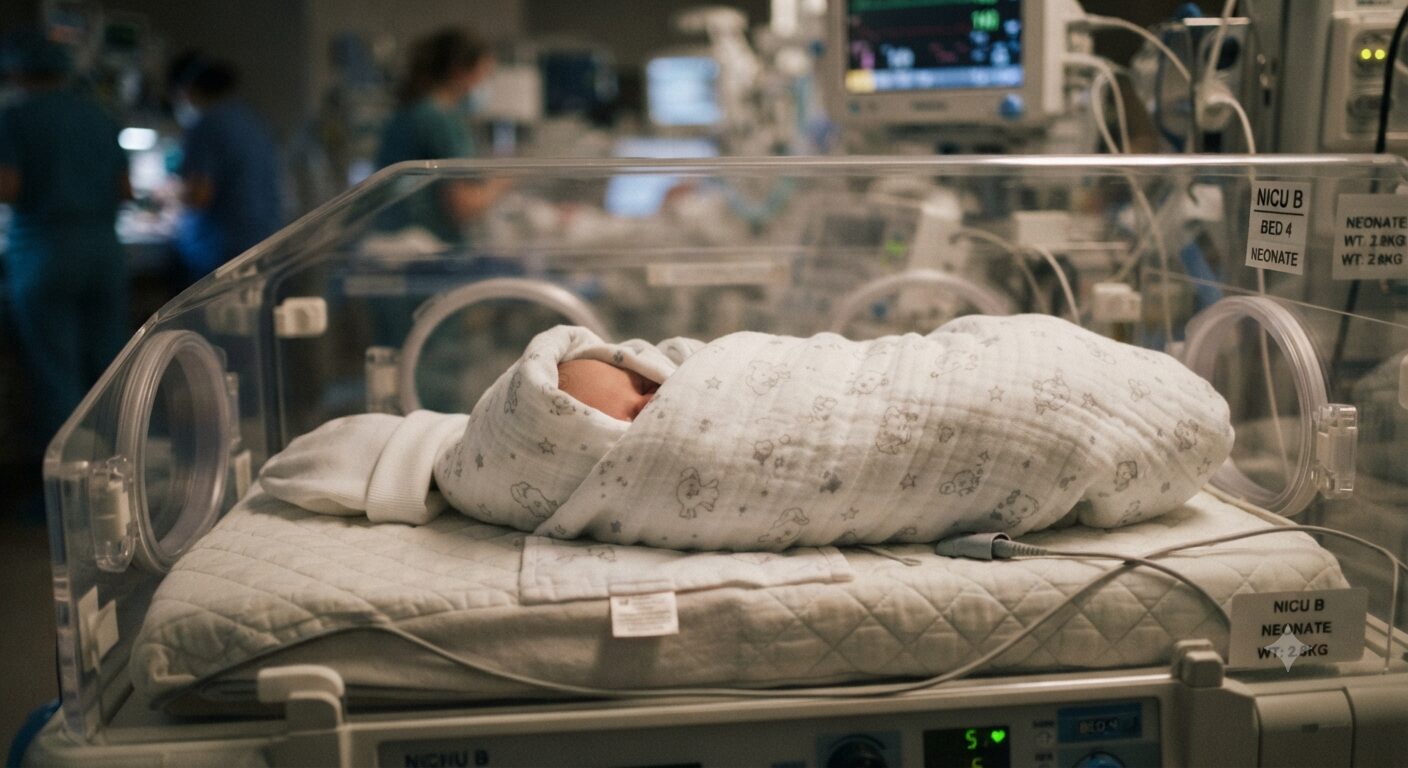
After birth, while you’re still in the hospital, your baby will have a newborn hearing screening (called shinseiji chōkaku kensa in Japanese). It’s painless, takes just a few minutes and is usually done while your baby sleeps.
According to a national survey for fiscal 2023, about 96% of babies born in Japan had this screening, and more than 90% of cities and towns helped cover the cost.
The screening steps
- 1. First screening (usually within 3 days of birth): A machine called an automated ABR (automated auditory brainstem response) checks how your baby’s brain responds to sound.
- 2. Second screening (usually within about 1 week): If the first result was “refer,” the test is repeated.
- 3. CMV test (within 3 weeks of birth): If the second result is also “refer,” your baby’s urine is tested for cytomegalovirus.
- 4. Diagnostic hearing test (by 2–3 months of age): An ENT (ear, nose and throat) specialist center checks in detail whether there is hearing loss and how much.
Another screening method called OAE (otoacoustic emissions) also exists. However, a revised national guideline in August 2026 states that the first and second screenings should use automated ABR. Hospitals that use OAE are working on ways to offer automated ABR too.
A “refer” result does NOT mean your baby has hearing loss
This is the point I most want you to take away.
“Refer” simply means “let’s take a closer look.” It is not a diagnosis. Right after birth, there may still be fluid in the ears, or the baby may move during the test, making it hard to get a clear reading.
At the same time, it’s best not to just “wait and see” for too long. The CMV test and the diagnostic test have set time windows, so please follow the schedule.
After a “refer”: get the CMV test within 3 weeks
This is the most important update for 2026.
Congenital CMV infection can be diagnosed from a urine sample taken within 21 days of birth. After 21 days, doctors can no longer tell whether the infection happened before or after birth — which is why this deadline matters so much.
Why the rush? Because if CMV turns out to be the cause, babies who meet certain conditions can be treated with an oral medicine (more on this in the next section).
The August 2026 guideline revision recommends doing the second screening and the CMV test while you’re still in the maternity hospital, if possible. If it has to happen after discharge, ask the hospital or your local public health nurse (hokenshi, based at your city or ward office): “When and where can my baby have the CMV urine test?”
When should the diagnostic test happen?
National guidelines give these target timelines:
| CMV Test Result | Recommended Timing for Further Testing |
| Positive | Within 2 months of birth |
| Negative | No later than 3 months of age |
Japan’s national goal is to identify hearing loss by 3 months and start support (early intervention) by 6 months. The earlier you know, the more time you have to calmly choose the right approach for your baby.
How much does it cost?
The cost of newborn hearing screening varies by hospital and by city. Some cities cover the full cost; others cover part of it. Check the screening voucher (jushinken) you receive with your Maternal and Child Health Handbook (Boshi Techo), or your city’s website.
I’ve also written a detailed article on newborn hearing screening, so feel free to take a look.
Tip for English speakers in Japan: Many cities offer a multilingual version of the Boshi Techo, including English. If you’re unsure about a test or a deadline, it’s perfectly fine to ask the hospital staff or your hokenshi to write down the date and place for you.
Living outside Japan? Many countries follow a similar “1-3-6” goal: screening by 1 month, diagnosis by 3 months and support by 6 months. Whether CMV testing is routine after a “refer” result differs by country and hospital, so ask your pediatrician or midwife — and remember the 21-day window.
Can congenital hearing loss be treated? Treatment and support in 2026

For a long time, people were told that congenital hearing loss itself couldn’t be cured. In 2026, that picture is slowly changing. Depending on the cause, there are several options.
When CMV is the cause: antiviral medicine
In 2023, Japan’s national health insurance began covering an antiviral medicine called valganciclovir for babies with symptomatic congenital CMV infection.
It’s a syrup given by mouth twice a day, and it can help improve hearing or slow hearing loss from getting worse.
There are a few conditions:
- It’s for babies who have symptoms of CMV at birth (symptomatic infection)
- Treatment needs to start within 2 months of birth
That’s exactly why the CMV test within 3 weeks of birth matters so much. Talk with your pediatrician about whether this treatment is right for your baby.
Hearing aids and cochlear implants

Devices are used to support hearing, depending on its degree.
Hearing aids: make sounds louder and deliver them to the ear. Babies can start using them from a few months old. → Learn more about hearing aids
Cochlear implants: for severe to profound hearing loss where hearing aids don’t help enough. During surgery, an electrode is placed in the inner ear to stimulate the hearing nerve directly. Since Japan’s criteria were updated in 2022, babies under 1 year old can have the surgery if they meet the conditions. → Learn more about cochlear implants
A cochlear implant doesn’t make speech understandable straight away. Listening skills develop over time with ongoing rehabilitation (auditory therapy). Research also shows that cochlear implants tend to work well for the gene types most common in congenital hearing loss, such as GJB2 and OTOF.
The latest on gene therapy (OTOF)
2026 has been a milestone year for gene therapy for hearing loss.
- April 2026: Results from a clinical trial of 42 people with OTOF-related hearing loss were published in the journal Nature. Hearing improved in about 90% of participants, with the effect lasting up to 2.5 years. Children showed especially large improvements.
- April 2026: The first OTOF gene therapy was approved in the United States.
- In Japan: A company-led clinical trial for infants and young children has been registered, but the treatment is not yet available as standard care.
This is genuinely hopeful news. Still, OTOF-related hearing loss accounts for only a few percent of congenital hearing loss, so gene therapy isn’t an option for every child — at least not yet.
I’ve also written a detailed article on gene therapy, so feel free to take a look.
Why consider genetic testing?
You might wonder, “What’s the point of knowing the cause?” Knowing which gene is involved can help in several ways:
- It’s easier to predict whether the hearing loss is likely to progress
- It helps you choose the right treatment, such as whether a cochlear implant is likely to work well
- It shows whether your child may be eligible for gene therapy, such as for OTOF
In Japan, genetic testing for congenital hearing loss is covered by national health insurance. You can decide whether to have it after talking with a genetic counselor, so if you’re curious, ask your doctor.
Living outside Japan? Insurance coverage, age criteria for cochlear implants and access to CMV treatment and gene therapy vary by country. Your pediatrician or audiologist can tell you what’s available where you live.
Signs of hearing you can notice at home (by age)

Even if your baby passes the newborn screening, hearing loss can sometimes appear or progress later. As with CMV, some babies have no symptoms at birth but develop hearing changes as they grow.
That said, there’s no need to test your baby nervously every day. Think of these as a rough guide for those moments when you think, “Hmm, I wonder…”
| Approximate Age | Examples of Responses to Sound |
| 0–1 month | Startles at loud sounds; may calm down when spoken to while crying |
| 3–4 months | Turns toward the sound of a voice; laughs aloud when played with |
| 6–7 months | Turns when their name is called; looks toward the TV or other sounds |
| 9–10 months | Frequently babbles, making sounds such as “dadada” or “mamama” |
| Around 1 year | Understands simple words such as “give it to me”; begins to say meaningful words |
Every baby develops at their own pace, so missing one item doesn’t mean your baby has hearing loss. If something worries you, feel free to bring it up at a routine baby check-up, or with a pediatrician or ENT doctor. In Japan, the parents’ record pages of your Boshi Techo also include hearing checkpoints for each age.
Raising your child and supporting language after diagnosis
After a diagnosis, one of the biggest worries for many parents is, “Will my child’s language develop properly?”
The short answer: by supporting hearing early, or bringing in other ways to communicate such as sign language, you can strongly support your child’s language and emotional development.
There’s more than one way to communicate
- Spoken language: using hearing aids or cochlear implants to support hearing, your child learns language through sound.
- Sign language: a visual language your child takes in through their eyes. In Japan this is Japanese Sign Language (JSL); other countries have their own, such as ASL or BSL.
- A mix of both: many families use both spoken and sign language, depending on the child and the family.
There’s no single right answer. It’s fine to choose what suits your child and your family, together with the professionals supporting you.
Where to get help and what support is available (Japan)
- Early support programs: support centers for children with hearing loss, and infant education counseling at schools for the deaf (many accept families from age 0)
- “Kotoba no kyoshitsu” (speech and hearing classes): while attending a regular elementary school, children can practice listening and speaking skills
- Physical Disability Certificate (shintai shōgaisha techō): available depending on the degree of hearing loss; it can help cover the cost of hearing aids and more → Learn more about the certificate
- Hearing aid subsidies for mild to moderate hearing loss: even if your child doesn’t qualify for the certificate, your city may still offer support
For school, there are many options: schools for the deaf (special needs schools for hearing), regular classes at a local elementary school, special classes for children with hearing loss, and more.
For English-speaking families in Japan: Most of these services are handled through your city or ward office. If you’re not confident in Japanese, ask whether an interpreter or a multilingual support desk is available. Some areas also offer interpreting services for medical visits. And if your family uses English at home, it’s worth telling your support team early, so they can plan around a bilingual environment.
Living outside Japan? Ask your audiologist or pediatrician about your country’s early intervention program. Deaf community organizations and parent groups are also a great source of support.
Our family’s story
My wife’s hearing loss wasn’t congenital — she lost her hearing as a child. She attended speech and hearing classes and practiced her pronunciation. Today she chats with people just like anyone else, and when something is tricky, she finds her own ways to handle it.
Having hearing loss doesn’t stop a child from growing up to be fully themselves. There are many paths forward.
Frequently asked questions
Is congenital hearing loss hereditary?
Genes are often involved, but a parent with hearing loss won’t necessarily have a child with hearing loss. On the other hand, two hearing parents can have a baby with congenital hearing loss. If you’re concerned, you can talk it through with a genetic counselor.
If my baby passed the newborn hearing screening, can I stop worrying?
A “pass” means your baby was very likely hearing at the time of the test. But some hearing loss appears later or progresses over time, so keep an eye on the age-by-age signs and ask if anything concerns you.
Can congenital hearing loss affect just one ear?
Yes — this is called unilateral hearing loss. Because the other ear can hear, it’s easy to miss in daily life. But your child may find it harder to follow speech in noisy places or to tell where sounds are coming from.
Can it get worse in adulthood?
Not all hearing loss progresses, but depending on the gene type, hearing can decline as a child grows. Regular hearing tests help you keep track of any changes.
What can I do to reduce the risk of CMV during pregnancy?
CMV is often found in the saliva and urine of young children. Recommended steps include washing your hands well after changing an older child’s diaper or helping them eat, and not sharing food, cups or spoons with them. That said, it’s hard to prevent CMV completely, so if you do get infected, please don’t blame yourself.
How much do testing and treatment cost?
In Japan, most cities help pay for newborn hearing screening. The CMV urine test, diagnostic hearing tests and cochlear implant surgery are covered by national health insurance. Medical expense subsidies for children and the Physical Disability Certificate can also help, so check with your city or ward office. (Outside Japan, coverage depends on your country and insurance.)
Summary
We’ve looked at congenital hearing loss using the latest information from 2026. Here’s a quick recap:
- Congenital hearing loss affects 1–2 in 1,000 babies. It’s not rare, and it’s no one’s fault.
- More than half of cases involve genes. The most common non-genetic cause is cytomegalovirus (CMV).
- A “refer” result on the newborn hearing screening is not a diagnosis. But do follow the schedule: a CMV urine test within 3 weeks of birth, and a diagnostic hearing test by 2–3 months.
- Options are growing: CMV medicine, cochlear implants from under 1 year old, and OTOF gene therapy.
I truly understand how worrying it can be to wonder about your baby’s hearing. But we now live in a time when finding out early means there’s so much you can do.
You don’t have to carry this alone. Lean on your hospital, your public health nurse and early-support specialists. And most of all, keep talking to your baby, keep holding them close, and enjoy every day together.

コメント