
“Mom keeps turning the TV up louder.”
“Dad asks me to repeat myself all the time, but I guess that is just getting older.”
Does this sound familiar?
Researchers around the world are paying close attention to the link between hearing loss and dementia.
According to a major report in The Lancet, a leading medical journal in the UK, hearing loss is one of the largest risk factors for dementia that we can actually do something about.
That does not mean hearing loss leads to dementia.
But noticing it early and taking simple steps can help protect the conversations and everyday moments that matter to your family.
This guide is written for anyone who lives with or cares for an older parent or relative, even if you know nothing about hearing loss yet. We will cover:
- What hearing loss actually is
- Why hearing loss may raise the risk of dementia
- Whether hearing aids can help, based on the latest research
- Signs your family can watch for, plus what you can do starting today

- What Is Hearing Loss?
- Hearing Loss Is One of the Biggest Risk Factors We Can Change
- Why Might Hearing Loss Raise the Risk of Dementia?
- Can Hearing Aids Help Prevent Dementia? What the Latest Research Says
- Hearing Loss Can Be Mistaken for Memory Problems
- Checklist: Signs of Hearing Loss Families Can Notice
- What Your Family Can Do Starting Today
- When Your Parent Does Not Want Hearing Aids
- Frequently Asked Questions
- Summary
- References
What Is Hearing Loss?
Hearing loss simply means that sounds and voices have become harder to hear.
It is not only about hearing nothing at all. It also includes milder problems, like struggling to catch quiet voices or losing track of conversations in noisy places.
Hearing that fades gradually with age is called age-related hearing loss (doctors call it presbycusis).
Just as our eyes change with age, our ears do too.
It is very common. The World Health Organization (WHO) estimates that more than 25% of people over 60 have hearing loss serious enough to affect daily life.
In Japan, for example, a 2025 national survey (JapanTrak 2025) found that about 1 in 6 people aged 65 to 74, and about 1 in 3 people aged 75 or older, notice that they have trouble hearing.
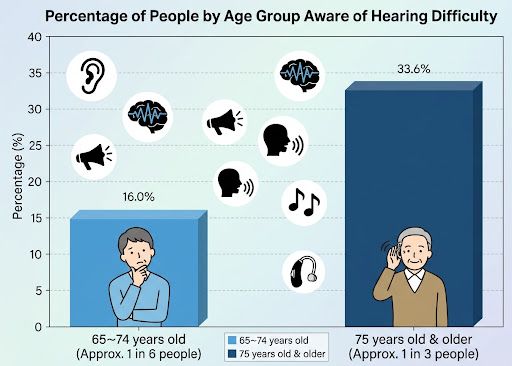
And those numbers only count people who have noticed it themselves.
Age-related hearing loss creeps in slowly, so many people do not realize it is happening. Often, it is the family who notices first.
One more thing worth knowing: age-related hearing loss is not just about sounds getting quieter.
High-pitched sounds usually fade first, which makes similar sounds like “s,” “f,” and “th” hard to tell apart.
So your parent may hear that you are talking, but still not understand what you said.
For a closer look at how hearing works and the different types of hearing loss, see What Is Hearing Loss? and Why Older Adults Lose Their Hearing.
Hearing Loss Is One of the Biggest Risk Factors We Can Change
First, a quick look at dementia itself.
According to the WHO, more than 55 million people around the world are living with dementia, and that number keeps growing as populations age.
It is something that can touch almost any family.
In 2024, an international team of experts published an updated report in The Lancet.
It lists 14 risk factors that may make dementia more likely. All of them are things that can potentially be changed through lifestyle, treatment, or public health measures.
- Less education in early life
- Hearing loss
- High LDL (“bad”) cholesterol
- Depression
- Head injury
- Physical inactivity
- Smoking
- Diabetes
- High blood pressure
- Obesity
- Drinking too much alcohol
- Social isolation
- Air pollution
- Untreated vision loss
The report estimates that if all 14 could be eliminated, about 45% of dementia cases might be prevented or delayed.
Nearly half. That is a hopeful number.
Here are the factors with the largest estimated impact.
| Risk factor | Estimated share of dementia cases |
|---|---|
| Hearing loss | 7% |
| High LDL cholesterol | 7% |
| Less education in early life | 5% |
| Social isolation | 5% |
| Depression | 3% |
| Untreated vision loss | 2% |
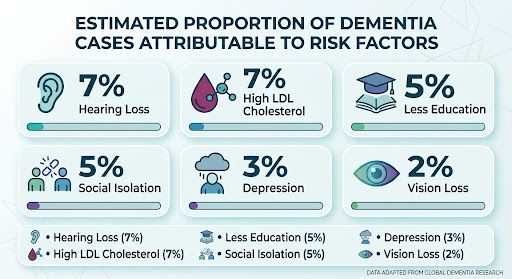
Hearing loss is tied with high cholesterol as the single largest factor.
One important note: 7% does not mean that 7% of people with hearing loss will develop dementia.
It means that if hearing loss could be removed from the whole population, dementia cases might drop by roughly that share.
Having hearing loss does not mean someone will get dementia.
Why Might Hearing Loss Raise the Risk of Dementia?
Scientists do not yet know the exact cause.
But there are three main explanations that researchers are looking at.
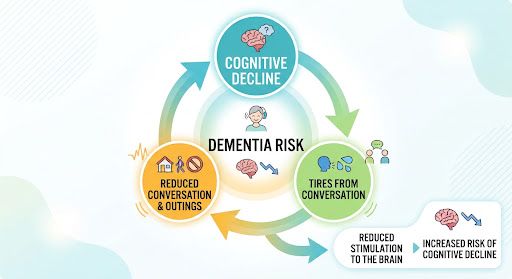
Reason 1: Listening wears the brain out
Conversation feels effortless, but in a split second your brain is doing all of this:
- Hearing what the other person is saying
- Holding their words in short-term memory
- Comparing them with past memories to understand the meaning
- Deciding how to respond
- Putting a sentence together
- Saying it out loud
When hearing gets harder, just the very first step takes a lot of effort.
If the brain spends most of its energy trying to catch the words, there is less left over for remembering and thinking.
This may be why many people with hearing loss say that talking with others leaves them exhausted.
Reason 2: The brain gets less stimulation
Our bodies weaken when we do not use them. A leg in a cast loses muscle, and the brain works in a similar way.
When less sound reaches the brain, the parts that process sound get less exercise.
Over time, it can become harder to connect sounds to words.
Some studies have found that people with hearing loss tend to have smaller volumes in certain areas of the brain.
Reason 3: People talk and go out less
This one may be the easiest to picture.
After asking people to repeat themselves again and again, many of us start to feel embarrassed.
We nod along without really following, and slowly drift out of the conversation.
Family dinners and social events start to feel like too much trouble.
Fewer conversations mean fewer chances to keep the mind active.
That is also why social isolation and depression appear on the Lancet list of risk factors.
These three reasons probably work together rather than alone.
Put the other way around, helping someone hear well enough to enjoy conversation is also good for their brain.
Can Hearing Aids Help Prevent Dementia? What the Latest Research Says
This is probably the question you care about most.
The honest answer: we cannot say that hearing aids will prevent dementia.
But more and more research suggests that caring for hearing may also help protect brain health.
Here is a simple summary of the key studies.
| Study | What they did | What they found |
|---|---|---|
| ACHIEVE study (USA, 2023) | About 980 adults aged 70 to 84 were split into two groups: hearing aids with expert support, or a healthy aging education program. They were followed for 3 years. | No clear difference overall. But among people already at higher risk of cognitive decline, the rate of decline was about 48% slower with hearing care. |
| Framingham Heart Study (USA, 2025) | About 3,000 adults aged 60+ were followed for up to 20 years. | Among people under 70, those who used hearing aids had about a 61% lower risk of dementia than those who did not. No clear difference in people 70 and older. |
| Shanghai study (China, 2026) | About 700 people with hearing loss and mild cognitive impairment (MCI) were compared for 2 years. | No clear difference in progression to dementia. But about 15% of the hearing aid group returned to a normal cognitive score, compared with about 2% of the other group. |
Put side by side, a few patterns start to appear.
- Starting earlier may be better. In the Framingham study, the difference showed up in people who began before age 70.
- People with other risk factors may benefit more. This was the finding of the ACHIEVE study.
- Actually hearing better is what matters. Owning hearing aids is not enough. Getting them adjusted and wearing them regularly is the key.
The ACHIEVE study also found that people who received hearing care communicated more easily, socialized more, and felt less lonely, in every group.
Even before thinking about dementia, simply enjoying conversations with family and friends again is a good reason to give hearing aids a try.
The ACHIEVE researchers are following participants for six years, and longer-term results are expected.
We will update this article when new findings come out.
Hearing Loss Can Be Mistaken for Memory Problems
Most memory and thinking tests are done by talking.
A doctor asks questions out loud, like “What is today’s date?” or “Please remember these words.”
You can probably see the problem already.
If someone cannot hear the question clearly, they cannot answer it correctly.
Mishearing a question, or staying quiet instead of asking again, can lower the score.
Researchers have pointed out that people with hearing loss may be judged as having weaker memory or thinking than they really do, and some are developing written versions of these tests.
If conversations with your parent no longer seem to connect, you may worry that it is dementia.
Before jumping to that conclusion, it helps to ask a simpler question: are they actually hearing what is being said?
Sometimes the real reason is hearing, not memory.
If your parent has a memory test coming up, these tips can help.
- If they have hearing aids, make sure they wear them
- Tell the doctor at the start that they have trouble hearing
- Let them know it is fine to ask for questions to be repeated
- If possible, have their hearing checked first
Checklist: Signs of Hearing Loss Families Can Notice
Because age-related hearing loss develops slowly, family members often notice it before the person does.
Think about your parent or relative and see if any of these sound familiar.
- □ The TV or radio volume is louder than it used to be
- □ They say “Sorry?” or “What?” much more often
- □ They do not respond when you speak from behind them
- □ They miss the doorbell or phone
- □ They stop joining in at busy family dinners or gatherings
- □ They misunderstand things or give answers that do not match the question
- □ They say that everyone mumbles these days
- □ They seem less interested in seeing people
If even one of these applies, it is worth getting a hearing test.
Instead of brushing it off as part of getting older, think of it as simply finding out where their hearing is today.
By the way, have you ever raised your voice because your parent could not hear you, only to be told you are too loud?
This is called recruitment, and it is common with age-related hearing loss. They are not being difficult.
Learn more in Why Shouting at Someone with Hearing Loss Can Backfire.
What Your Family Can Do Starting Today
1. Get a hearing test
- Start by finding out how well they hear now. Sometimes the problem is just earwax.
- A family doctor, an ear, nose, and throat (ENT) doctor, or an audiologist can check hearing. In many places, a family doctor is a good first stop.
2. Try hearing aids
- An audiologist or licensed hearing aid specialist can fit and adjust hearing aids to match their hearing. Many clinics offer a trial period.
- Hearing aids are tuned to the frequencies a person has trouble hearing. Simple sound amplifiers just make everything louder.
- Learn more in What Are Hearing Aids? and How to Choose the Right Hearing Aid.
3. Look into financial support
- Hearing aids can be expensive, but support is available in many countries through public health systems, health insurance, or programs for older adults.
- Rules differ a lot from country to country and even by region. Ask your doctor, insurer, or local senior services before buying, because some programs require you to apply first.
4. Change how you speak
- Face them and speak from the front
- Speak slowly and clearly instead of shouting
- Turn off the TV or reduce background noise
- If something does not get through, rephrase it or write it down
5. Keep conversation and outings part of daily life
- Talking with people is itself good stimulation for the brain.
- Small things count, like going shopping together or chatting on the phone.
The most important point, as the research suggests, is to act early.
The longer hearing loss goes untreated, the longer it may take to get used to hearing aids.
When Your Parent Does Not Want Hearing Aids
“I suggested hearing aids, but Dad will not even consider it.”
This is one of the most common struggles families face.
In the United States, fewer than 30% of adults aged 70 and older with hearing loss have ever used hearing aids.
Common reasons for saying no include:
- Not wanting to look old, or not wanting others to notice
- Feeling that their hearing is not that bad
- A bad past experience where everything just sounded loud
- Cost
Rather than pushing, try these approaches.
- Focus on joy, not dementia prevention. Talk about the moments they would love to hear better, like chatting with grandchildren, a hobby group, or a favorite TV show.
- Start with just a hearing test. Suggesting a test together feels much less pressured than shopping for hearing aids.
- Explain that it is normal for sounds to feel loud at first. The brain may need a few months to adjust to sounds it has not heard in a while. With a few follow-up adjustments, things usually start to sound more natural.
- Show them how small modern hearing aids are. Many sit almost hidden behind the ear or inside the ear canal.
Hearing aids will not make hearing exactly like it was when they were younger.
Some people give up because it is not perfect, but stopping often means fewer conversations, which is a real loss.
A good goal is not perfect hearing, but conversations that feel much easier.
If your parent already has signs of dementia, getting used to something new and handling small tasks like changing batteries may be harder. Their doctor or audiologist can suggest options that are easier to manage, such as rechargeable models.
Frequently Asked Questions
Q. Does hearing loss always lead to dementia?
No. Hearing loss is one factor that can raise the risk, but many people with hearing loss never develop dementia.
Q. Will hearing aids prevent dementia?
We cannot say that for certain yet.
However, a growing number of studies have found slower cognitive decline or lower dementia risk in people who use hearing aids.
Hearing aids have also been shown to make communication easier and reduce loneliness.
Q. At what age should we start paying attention?
The best time is whenever someone starts noticing trouble hearing, whatever their age.
The Lancet report places hearing loss among the midlife risk factors (up to about age 65), so earlier action is better.
A baseline hearing test in your 50s or 60s makes it easier to spot changes later.
Q. Is a sound amplifier good enough?
Sound amplifiers make all sounds louder.
Hearing aids can be adjusted to boost the specific pitches a person struggles with.
An amplifier can be fine for occasional use, but for everyday conversation it is worth talking to a hearing professional first.
Q. Is one hearing aid enough?
If both ears have hearing loss, wearing two hearing aids usually makes it easier to tell where sounds come from and to follow conversations in noisy places.
A hearing professional can help decide what is right.
Summary
- Hearing loss is one of the largest dementia risk factors we can change (7% in the 2024 Lancet report)
- Listening fatigue, less brain stimulation, and fewer conversations may all play a role
- Hearing aids are not proven to prevent dementia, but people who start early or have other risk factors have seen promising results
- Hearing loss can be mistaken for memory problems, so check hearing first
- If you notice signs, start with a hearing test together, and look into financial support
Dementia does not appear overnight.
Like hearing loss, there are many small things families can do in daily life.
If you have been thinking, “Mom has been asking me to repeat myself a lot lately,” that may be a signal worth listening to. Taking action now can help protect the time your family spends talking and laughing together.
Living in Japan?
If your family lives in Japan, public support may help with the cost of hearing aids. Many cities also offer their own subsidies for people aged 65 and older, so check with your local city office before buying.
References
- Livingston G, et al. Dementia prevention, intervention, and care: 2024 report of the Lancet standing Commission. The Lancet, 2024
- Hearing Aids Slow Cognitive Decline in Older Adults with Hearing Loss and at Risk for Cognitive Decline (Alzheimer’s Association International Conference, 2023)
- Francis L, et al. Self-Reported Hearing Aid Use and Risk of Incident Dementia. JAMA Neurology, 2025 (summary article)
- Do Hearing Aids Slow Dementia in MCI? Results Are Mixed (Medscape, 2026)
- WHO: Deafness and hearing loss (fact sheet)
- WHO: Dementia (fact sheet)
- JapanTrak 2025 (Japan Hearing Instruments Manufacturers Association)

コメント