
Have you ever wondered what hearing loss actually means?
Many people think that someone with hearing loss cannot hear at all. Others may think of hearing loss simply as something that happens to older people. However, hearing loss does not necessarily mean complete deafness.
Hearing loss is a condition in which sounds are more difficult to hear or understand. It can range from mild difficulty hearing certain sounds or conversations to severe hearing loss where little or no sound can be heard.
Hearing loss can affect people of all ages and can have many different causes, including aging, exposure to loud noise, illness, genetic factors, and conditions present from birth. Some people may also have difficulty understanding speech even when they can hear sounds normally.
In this guide, we explain what hearing loss is, the different types and causes of hearing loss, common symptoms, how it is diagnosed, available treatments and hearing support devices, and how hearing loss can affect everyday communication.
- What Is Hearing Loss?
- Types of Hearing Loss
- Causes of Hearing Loss
- Symptoms of Hearing Loss
- How Hearing Loss Can Affect Daily Life
- Communication for People With Hearing Loss
- How Is Hearing Loss Diagnosed?
- Treatment for Hearing Loss
- Devices and Services That Can Help With Hearing Loss
- Other Symptoms Associated With Hearing Loss
- Is Hearing Loss Genetic?
What Is Hearing Loss?

Hearing loss is not a disease itself. It is a condition or symptom that makes it difficult to hear or understand sounds.
Hearing loss can affect one or both ears, and the degree of hearing loss can range from mild to profound. Some people may have difficulty hearing soft sounds, while others may struggle to understand speech even when they can hear that someone is talking.
Hearing loss is generally classified by its severity as follows:
| Degree of hearing loss | Hearing level |
| Mild | 25–45 dB |
| Moderate | 46–70 dB |
| Severe | 71–95 dB |
| Profound | 96–115 dB |
| Deafness | Little or no hearing |
The exact ranges used to classify hearing loss may vary depending on the guideline or organization.
In Japan, people with severe or profound hearing loss may qualify for a disability certificate depending on their hearing levels and other criteria. However, people with mild or moderate hearing loss may have significant difficulty in everyday life even if they do not meet the criteria for a disability certificate.
It is important to remember that hearing loss is not simply a matter of being able to hear or not hear. Even people with relatively mild hearing loss may have difficulty understanding conversations, especially in noisy environments.
Types of Hearing Loss

There are several types of hearing loss. They can be classified based on where in the auditory system the problem occurs or what caused the hearing loss.
The three main types based on the location of the problem are:
- Conductive hearing loss
- Sensorineural hearing loss
- Mixed hearing loss
There is also a condition known as auditory processing disorder (APD), in which a person may have difficulty understanding or processing sounds even though their standard hearing test results are normal.
Conductive Hearing Loss
Conductive hearing loss occurs when a problem in the outer or middle ear prevents sound from reaching the inner ear properly.
Common causes include problems with the ear canal, eardrum, or middle ear.
People with conductive hearing loss often experience sounds as quieter or muffled, rather than distorted. In many cases, the inner ear and auditory nerve are functioning normally.
Examples of conditions that can cause conductive hearing loss include earwax blockage, middle ear infections, fluid in the middle ear, and problems affecting the eardrum or middle-ear bones.
Because the problem is related to the transmission of sound, some forms of conductive hearing loss can be treated medically or surgically.
Sensorineural Hearing Loss
Sensorineural hearing loss occurs when there is a problem with the inner ear, particularly the cochlea, or the auditory nerve and related neural pathways.
It is the most common type of permanent hearing loss.
People with sensorineural hearing loss may not simply hear sounds as quieter. They may also have difficulty understanding speech, particularly when there is background noise.
For example, a person may be able to hear that someone is speaking but have difficulty understanding exactly what they are saying. Sounds may also seem unclear or distorted.
Age-related hearing loss and noise-induced hearing loss are common examples of sensorineural hearing loss.
We prepared article of Sensorineural hearing loss. So, please refer it.
Regarding Sensorineural hearing loss↗
Mixed Hearing Loss
Mixed hearing loss is a combination of conductive and sensorineural hearing loss.
This means that a person has a problem affecting the transmission of sound through the outer or middle ear as well as a problem involving the inner ear or auditory nerve.
As a result, a person may experience both reduced volume and difficulty understanding speech.
Mixed hearing loss can occur for a variety of reasons. It is also relatively common in older adults, who may have age-related sensorineural hearing loss in addition to a problem affecting the middle or outer ear.
Auditory Processing Disorder (APD)
Auditory processing disorder (APD) is a condition in which a person has difficulty processing and understanding sounds, even though their hearing sensitivity may be normal on a standard hearing test.
For example, a person with APD may be able to hear someone speaking but have difficulty understanding what they are saying, especially in noisy or busy environments.
Because standard hearing tests may show normal results, APD can be difficult to identify.
If you often find it difficult to understand what people are saying despite having a normal hearing test, auditory processing difficulties may be one possible explanation.
Hearing Loss in One or Both Ears
Hearing loss can affect one ear or both ears.
When hearing loss affects both ears, it is called bilateral hearing loss. When it affects only one ear, it is called unilateral hearing loss.
Hearing loss does not always develop equally in both ears. Some people may have normal or near-normal hearing in one ear but significant hearing loss in the other.
Unilateral hearing loss can make it difficult to determine where sounds are coming from and can make it harder to understand speech when there is background noise.
For this reason, even hearing loss in only one ear can have a significant impact on everyday communication.
Causes of Hearing Loss

Hearing loss can have many different causes, so it is not always possible to identify a single cause for every person.
Some of the most common causes and risk factors include:
- Exposure to loud noise
- Aging
- Stress
- Genetic factors
- Conditions present at birth
- Earwax buildup or improper ear cleaning
- Ear diseases and other medical conditions
The cause of hearing loss can vary greatly from person to person. For example, some people develop hearing loss gradually as they get older, while others may develop it suddenly because of an illness or another medical condition.
Some people are born with hearing loss, while others develop it later in life.
Understanding the cause of hearing loss is important because the appropriate treatment and management can depend on what is causing the hearing loss.
Symptoms of Hearing Loss

The most common symptom of hearing loss is difficulty hearing or understanding speech and other sounds.
For some people, sounds simply seem quieter than they used to. For others, sounds may seem unclear or distorted, making it difficult to understand what someone is saying even when they can hear that person speaking.
Hearing loss can also occur together with other symptoms, such as tinnitus, which causes sounds such as ringing or buzzing to be heard without an external source.
Hearing loss can affect many aspects of everyday life. Common signs and difficulties include:
- Having little difficulty in one-on-one conversations but struggling to follow conversations involving several people
- Frequently turning up the volume on the television
- Having difficulty understanding conversations on the phone
- Not noticing electronic sounds from household appliances
- Frequently asking people to repeat themselves
- Having difficulty understanding speech when there is background noise
Some people do not realize that they have hearing loss because it can develop gradually.
For example, you may become accustomed to turning up the volume on the TV or asking people to repeat themselves without realizing that these changes could be signs of hearing loss.
If you regularly experience these difficulties, it may be worth having your hearing checked by a hearing professional or healthcare provider.
How Hearing Loss Can Affect Daily Life

What kinds of difficulties can hearing loss cause in everyday life?
Hearing loss can affect many situations that people encounter every day. Even relatively mild hearing loss can make communication more difficult, particularly in noisy environments or when several people are talking at the same time.
Common difficulties include:
- Following conversations with several people
- Understanding speech on television
- Communicating with staff when paying for something at a store or restaurant
- Understanding what someone is saying in a noisy environment
- Hearing announcements in public places
- Communicating over the phone
The specific difficulties vary from person to person depending on the severity and type of hearing loss.
For example, someone with mild hearing loss may have little difficulty having a one-on-one conversation in a quiet room but struggle to follow a conversation in a busy restaurant.
Hearing loss can therefore affect much more than simply the ability to hear sounds. It can also make social interactions and everyday communication more challenging.
Communication for People With Hearing Loss

The best way to communicate with someone who has hearing loss depends on their degree of hearing loss, communication preferences, and the support they use.
People with mild or moderate hearing loss can generally communicate using spoken language. Many people with severe hearing loss can also communicate through speech, particularly when they use hearing aids or a cochlear implant.
However, some people with profound hearing loss or deafness may have difficulty communicating through spoken language.
For people who use sign language, sign language can be an important way to communicate.
Sign language is not simply a collection of gestures. It is a complete language with its own grammar and linguistic structure. Learning a sign language is therefore similar to learning another spoken language.
Not everyone with hearing loss uses sign language, and many people communicate primarily through spoken language.
When sign language is not an option, written communication can be useful. For example, writing down important information or using a smartphone or speech-to-text app can make communication easier.
When communicating with someone who has hearing loss, it is also helpful to:
- Face the person while speaking
- Speak clearly at a natural pace
- Avoid shouting
- Reduce background noise when possible
- Use written information when necessary
- Ask the person what communication method works best for them
The most important thing is not to assume that everyone with hearing loss communicates in the same way.
How Is Hearing Loss Diagnosed?
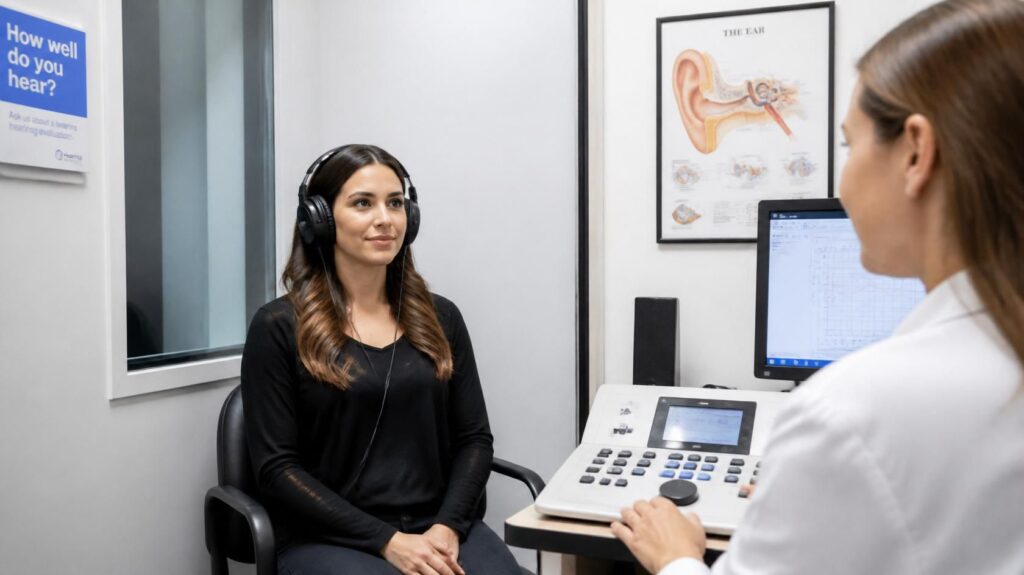
Have you ever had your hearing tested?
Hearing loss is usually identified through a hearing evaluation. A healthcare professional or hearing specialist can use several different tests to determine how well a person can hear and whether there may be a problem in the outer, middle, or inner ear.
Two common hearing tests are:
- Pure-tone audiometry
- Speech audiometry
Pure-Tone Audiometry
Pure-tone audiometry is one of the most common hearing tests.
During the test, you listen to sounds at different pitches and volumes through headphones or earphones. You indicate when you can hear each sound, allowing the examiner to determine the softest sounds you can hear at different frequencies.
The results are recorded on an audiogram, which shows the level of hearing in each ear.
This is the type of hearing test that is commonly used during health checkups and medical examinations.
Speech Audiometry
Speech audiometry evaluates how well you can hear and understand speech.
Instead of listening only to tones, you listen to spoken words or sentences and are asked to repeat what you hear.
This test can provide information that a pure-tone hearing test alone cannot provide, particularly for people who can hear sounds but have difficulty understanding speech.
Signs You May Have Hearing Loss
A hearing test is not the only way to notice possible hearing loss. Changes in everyday life can also be clues.
For example:
- You cannot tell when a thermometer or other electronic device has finished making a sound.
- You no longer notice birds singing.
- You frequently ask people to repeat themselves.
- You often increase the volume of the television.
- You have difficulty following conversations in noisy places.
These signs do not necessarily mean that you have hearing loss, but if you notice several of them, it may be a good idea to have your hearing checked.
Hearing Screening for Newborns
Hearing loss can also be present from birth.
Newborn hearing screening is performed soon after birth in many countries to check whether a baby may have hearing loss.
Early identification is important because hearing plays an important role in the development of speech, language, and communication.
If a newborn does not pass the initial screening, additional tests are usually performed to determine whether hearing loss is actually present and, if so, what may be causing it.
Tympanometry
Tympanometry is a test used to check how well the eardrum and middle ear are working.
During the test, a small device is gently placed in the ear canal. The device changes the air pressure in the ear and measures how the eardrum responds.
Tympanometry can help identify problems in the middle ear, such as:
- Fluid behind the eardrum
- Middle ear infections
- Eardrum problems
- Problems with the small bones in the middle ear
- Eustachian tube dysfunction
Unlike a pure-tone hearing test, which measures how well you can hear different sounds, tympanometry evaluates the condition and function of the middle ear.
For this reason, tympanometry is often used together with other hearing tests when evaluating possible hearing loss.
We prepared article of tympanometry. So, please refer it.
Treatment for Hearing Loss

Many products and books claim that they can “cure” or improve hearing loss. However, whether hearing loss can be treated depends largely on its cause.
In many cases, permanent hearing loss cannot be completely reversed.
For example, some types of age-related or genetic hearing loss are caused by permanent damage to structures in the inner ear or auditory system. In these cases, treatments that claim to restore normal hearing should be approached with caution.
However, some types of hearing loss can be treated.
For example, conductive hearing loss caused by earwax buildup, an ear infection, or certain middle-ear conditions may improve with appropriate medical treatment.
Sudden sensorineural hearing loss is another important example. Prompt medical treatment may help restore hearing in some cases. Because treatment may be more effective when started early, sudden hearing loss should be treated as a medical emergency and evaluated by a healthcare professional as soon as possible.
The most appropriate treatment depends on the type, severity, and cause of the hearing loss.
Even when hearing loss cannot be cured, there are many ways to improve communication and make everyday life easier.
Research into gene therapy for hearing loss is also advancing, with some experimental treatments showing promising results and improvements in hearing reported in clinical studies.
We prepared article of gene therapy. So, please refer it.
Devices and Services That Can Help With Hearing Loss
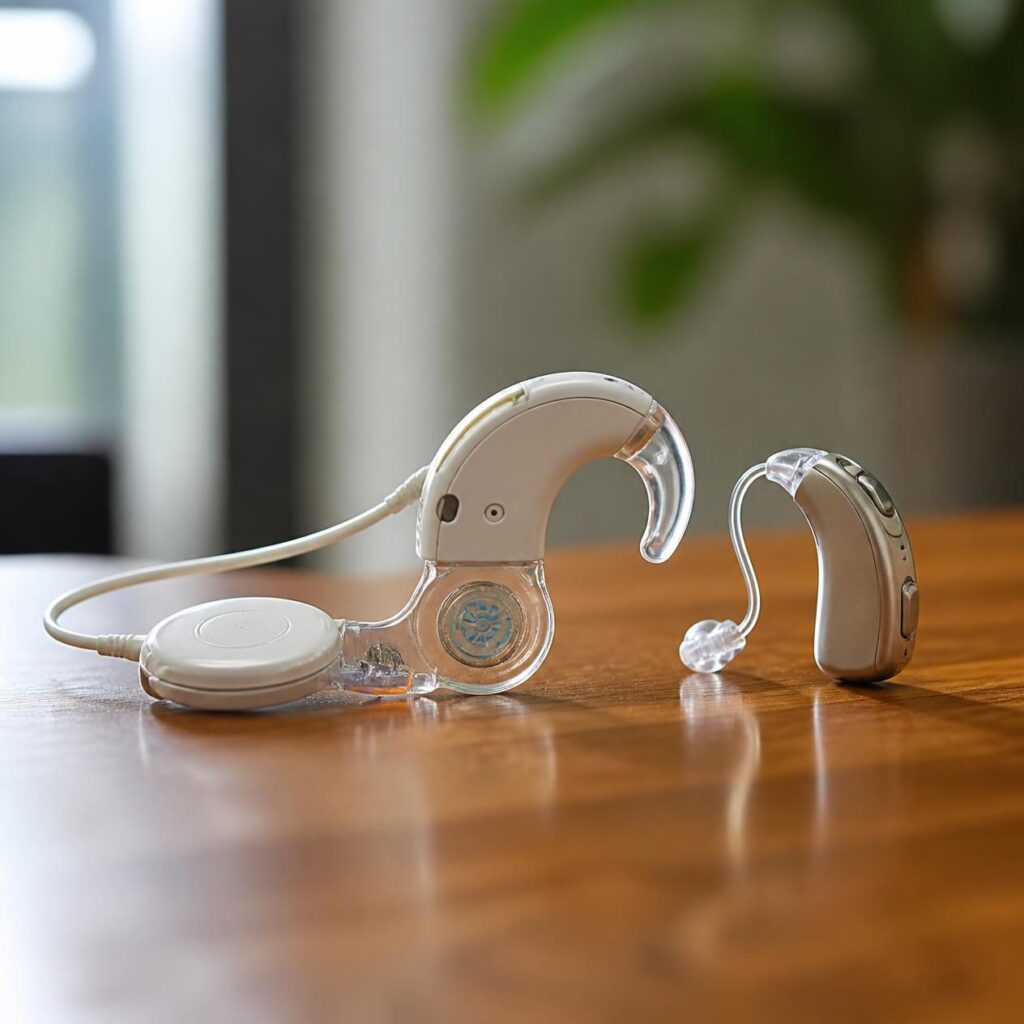
When hearing loss cannot be completely reversed, various devices and services can help people hear and communicate more easily.
They work somewhat like glasses or contact lenses for people with vision problems: they do not necessarily restore the underlying condition, but they can help compensate for the difficulty.
Common hearing support options include:
- Hearing aids
- Cochlear implants
- Personal sound amplification products
- Remote microphone systems, such as Roger
- Assistive listening devices and speakers
Hearing Aids
Hearing aids are electronic devices that amplify and process sounds to make them easier to hear.
They are commonly used by people with mild to severe hearing loss, although the appropriate type and level of amplification depend on the individual’s hearing.
Modern hearing aids can also include features such as Bluetooth connectivity, rechargeable batteries, noise reduction, and automatic sound processing.
We prepared article of hearing aids. So, please refer it.
Cochlear Implants
A cochlear implant is a medical device that can provide a sense of sound to people with severe to profound sensorineural hearing loss who receive limited benefit from hearing aids.
Unlike a hearing aid, which primarily amplifies and processes sound, a cochlear implant bypasses damaged parts of the inner ear and electrically stimulates the auditory nerve.
Cochlear implants are not suitable for everyone, and whether they are an appropriate option depends on factors such as the person’s hearing level, medical condition, and ability to benefit from the device.
We prepared article of cochlear implant. So, please refer it.
Personal Sound Amplification Products
Personal sound amplification products, sometimes called PSAPs, are designed to make environmental sounds louder.
They are different from hearing aids and are not intended to diagnose or treat hearing loss.
People who suspect they have hearing loss should have their hearing evaluated rather than relying solely on a sound amplification product.
Remote Microphone Systems
Remote microphone systems can make it easier to understand speech, especially in noisy environments or when the speaker is some distance away.
A microphone worn or held by the speaker sends their voice directly to a compatible hearing aid or other listening device.
This can be particularly helpful in situations such as classrooms, meetings, lectures, and conversations in restaurants.
Other Hearing Support
There are also technologies that can convert speech into text in real time.
For example, smartphone apps and speech-to-text services can display spoken words as text, which can be useful during conversations, meetings, medical appointments, and other situations where hearing is difficult.
Some people also use hearing assistance dogs, which can alert them to important sounds such as doorbells, alarms, and other environmental sounds.
The best form of support depends on the person’s hearing, lifestyle, communication needs, and personal preferences.
Other Symptoms Associated With Hearing Loss
Hearing loss does not always occur on its own. Some people with hearing loss also experience other symptoms, such as tinnitus or hyperacusis.
Tinnitus and Hearing Loss
Tinnitus is the perception of a sound that does not come from an external source.
People with tinnitus may hear sounds such as ringing, buzzing, humming, or hissing even when there is no actual sound in the environment.
Tinnitus and hearing loss often occur together. In some cases, treating the underlying cause of hearing loss may also improve tinnitus. However, because many types of permanent hearing loss cannot be completely reversed, tinnitus may also persist.
Living with persistent tinnitus can be stressful, particularly when a person does not understand what is causing the sound.
Worry and stress can make tinnitus feel more noticeable, which can create a cycle in which tinnitus causes anxiety and anxiety makes the tinnitus more difficult to ignore.
Although completely eliminating tinnitus can be difficult, there are treatments and strategies that may help reduce its impact on everyday life.
Learning more about tinnitus can also help reduce unnecessary anxiety and make it easier to manage.
Hyperacusis: Increased Sensitivity to Sound
Another condition that can occur alongside hearing problems is hyperacusis, a condition in which certain sounds seem unusually loud, intense, or uncomfortable.
For example, everyday sounds such as a vacuum cleaner, dishes, traffic, or other people’s voices may feel excessively loud or even painful.
Hyperacusis does not mean that a person simply has exceptionally good hearing or can hear quieter sounds than other people.
Instead, it involves an increased sensitivity or reduced tolerance to certain sounds.
Like tinnitus, hyperacusis can cause significant stress and anxiety, particularly when people are frequently exposed to sounds they find uncomfortable.
If sound sensitivity is interfering with everyday life, it is important to discuss the symptoms with a healthcare professional.
Is Hearing Loss Genetic?
Some types of hearing loss are caused by genetic factors.
However, having a parent with hearing loss does not necessarily mean that their child will also have hearing loss.
Genetic hearing loss can occur in different ways depending on the specific gene and inheritance pattern involved.
Some genetic forms of hearing loss are inherited from parents, while others can result from a new genetic change that was not previously present in the family.
For example, some forms of inherited hearing loss are autosomal recessive. In these cases, a child may develop hearing loss when they inherit a disease-causing variant from both parents, even if neither parent has significant hearing loss themselves.
This means that hearing loss can occur in a child even when there is no obvious history of hearing loss in the family.
Genetic factors are only one possible cause of hearing loss. Other causes include aging, noise exposure, infections, medications, injuries, and other medical conditions.
If a child is born with hearing loss or hearing loss occurs at a young age, genetic testing may sometimes help identify the underlying cause.
Understanding the genetic cause can be useful for determining the appropriate medical care, assessing whether other family members may be affected, and considering potential treatments or therapies in the future.
Most importantly, having a family history of hearing loss does not mean that a child will definitely develop hearing loss. The likelihood depends on the specific genetic cause and how that condition is inherited.


コメント