

“I have hearing loss. Will my child have it too?”
If you’re starting to think about having a baby, you’ve probably asked yourself this question.
My wife has had moderate sensorineural hearing loss since childhood. Before we had children, she worried a lot about passing it on.
Let me start with the answer: having a parent with hearing loss does not mean a child will definitely have it too. Whether it’s passed on depends a lot on what caused the hearing loss and how it’s inherited.
In this article, I’ll walk you through:
- How common hearing loss at birth actually is
- How hearing loss can be passed down
- The typical odds for each inheritance pattern
- Where to turn if you’re worried
I’ll also share what happened when my wife and I went through genetic counseling. I hope it helps.
- The Short Answer: A Parent’s Hearing Loss Isn’t Always Passed On
- Is Your Hearing Loss the Kind That Can Be Inherited?
- How Inheritance Works, Explained with a “Blueprint”
- The Odds of Passing Hearing Loss to Your Child, by Pattern
- Our Family’s Story: What “It Might, or It Might Not” Really Meant
- What You Can Do If You’re Worried
- Frequently Asked Questions
- Summary: Don’t Blame Yourself — Start by Understanding
- References
The Short Answer: A Parent’s Hearing Loss Isn’t Always Passed On
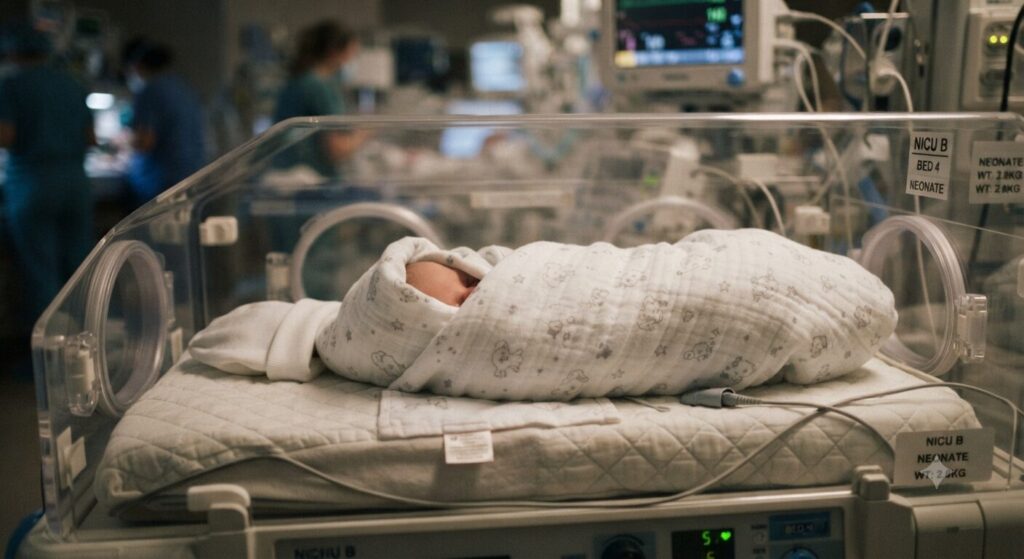
About 1 to 2 in 1,000 babies are born with hearing loss
Worldwide, about 1 to 2 in every 1,000 babies are born with hearing loss (congenital hearing loss). Genes play a role in more than half of these cases.
In Japan, a Shinshu University study of more than 150,000 newborns in Nagano Prefecture found the same thing: about 1 to 2 in 1,000 babies had hearing loss at birth, and more than half of those cases were genetic.
The rest are caused by things other than genes, such as infections during pregnancy (for example, cytomegalovirus or rubella).
Most babies with genetic hearing loss are born to hearing parents
This may surprise you, but most children with genetic hearing loss are born to parents who both hear normally.
When hearing loss is the only symptom and it’s caused by genes, about 80% of cases follow a pattern called “recessive inheritance.” With this pattern, it’s common for no one else in the family to have hearing loss.
So it’s not as simple as “the parent has hearing loss, so the child will too.” What really matters is what caused your hearing loss, and how it’s inherited.
Is Your Hearing Loss the Kind That Can Be Inherited?

Hearing loss from birth vs. hearing loss that comes later
Hearing loss falls into two broad groups:
- Congenital hearing loss: present from birth
- Acquired (later-onset) hearing loss: starts during childhood or adulthood
When people hear “genetic,” they usually think of hearing loss from birth. But some hearing loss that shows up in childhood or adulthood is also linked to genes. For example, some genetic types start in young adulthood and slowly get worse over time. In Japan, doctors call one such type “juvenile-onset bilateral sensorineural hearing loss.”
My wife’s hearing loss was also found when she was a child. Since “it wasn’t there at birth, so it can’t be genetic” isn’t a safe assumption, this is something to talk through with a specialist rather than decide on your own.
Hearing loss with a clear cause usually isn’t inherited

On the other hand, hearing loss with a clear cause like the ones below is considered separately from genetic hearing loss:
- Age-related hearing loss
- Noise-induced hearing loss
- Hearing loss caused by an illness, such as an ear infection
- Hearing loss caused by an infection during pregnancy
When the cause isn’t clear, doctors consider that genes may be involved.
How Inheritance Works, Explained with a “Blueprint”

Genes are your body’s blueprint, and a child gets one copy from each parent
In simple terms, genes are the blueprint for building your body. Even the tiny parts inside your ears are built from this blueprint.
Each part of the blueprint comes as a pair: one copy from your father and one from your mother. Each parent passes on one of their two copies, and which one gets passed on is a 50/50 chance.
If part of the blueprint has been changed, the inner ear may not form or work properly, which can lead to hearing loss. More than 100 genes linked to hearing loss have been found so far. Which gene is involved can affect how severe the hearing loss is and whether it gets worse over time.
“Dominant” and “recessive” don’t mean “strong” and “weak”
You’ll often hear the words “dominant” and “recessive” when people talk about inheritance. These words only describe how easily a trait shows up. They don’t mean one gene is better or stronger than another.
| Term | Meaning |
| Dominant inheritance | Hearing loss can occur when just one copy of the gene contains a genetic change. |
| Recessive inheritance | Hearing loss occurs only when both copies of the gene contain genetic changes. |
With recessive inheritance, if only one copy is changed and the other works normally, your hearing isn’t affected. A person like this is called a “carrier.” When a baby with hearing loss is born to two hearing parents, it’s usually because both parents happen to be carriers of a change in the same gene.
In Japan, the Genetics Society of Japan proposed new Japanese terms for “dominant” and “recessive” in 2017, because the old ones sounded like “superior” and “inferior.” Japanese doctors now often use both the old and new terms.
The Odds of Passing Hearing Loss to Your Child, by Pattern
If your hearing loss is genetic, the chance of passing it on depends on the inheritance pattern. Here’s a quick overview:
| Scenario | Estimated likelihood of the child having hearing loss |
| You have hearing loss caused by dominant inheritance | Approximately 50% |
| You have hearing loss caused by recessive inheritance, and your partner does not carry a genetic change in the same gene | The child will not develop hearing loss but will be a carrier. |
| You have hearing loss caused by recessive inheritance, and your partner is a carrier of a genetic change in the same gene | Approximately 50% |
| (Reference) Both parents have normal hearing but are carriers of a genetic change in the same gene | Approximately 25% |
Dominant inheritance: about 50%
With dominant inheritance, whether the changed copy is passed to your child is a 50/50 chance. That’s why the chance of passing it to the next generation is about 50%.
This type is often mild to moderate and tends to get worse slowly over time. If other family members have similar hearing loss, it may be this type.
Recessive inheritance: it depends on your partner
If you have recessive hearing loss, both copies of the same gene are changed. So your child will always receive one changed copy from you.
Whether your child has hearing loss then depends on the copy they get from your partner:
- If your partner doesn’t carry a change in the same gene, your child won’t have hearing loss
- If your partner is a carrier for the same gene, the chance is about 50%
In other words, with recessive inheritance, your partner’s genes matter too, not just yours.
Other types are rare
There are also less common types, such as “X-linked inheritance,” which can affect boys and girls differently, and “mitochondrial inheritance,” which is passed down from the mother. The odds work differently for these, so if one applies to you, ask a specialist to explain your situation.
The odds above are only general guides. You can’t tell which pattern applies to you until you know which gene is causing your hearing loss.
Our Family’s Story: What “It Might, or It Might Not” Really Meant

My wife had genetic counseling and testing at a hospital
Because she was worried about passing on her hearing loss, my wife had genetic counseling and a genetic test at a hospital in Japan.
The test found a few changes in genes linked to hearing loss, but all of them were the recessive type.
And when we asked what we most wanted to know — “Will our child inherit it?” — the doctor said:
“It might be passed on, or it might not.”
Honestly, my first thought was, “That’s not much of an answer!”
What the doctor really meant
Once you understand how inheritance works, though, you can see why that was the only honest answer.
With recessive inheritance, whether a child has hearing loss depends on whether the partner — me — carries a change in the same gene. I hadn’t been tested, so the doctor couldn’t say “It won’t be passed on.”
Also, research into the genes behind hearing loss is still going on, and current tests can’t check everything. Looking back, I understand that the doctor was explaining what the chances were under different conditions.
Our son was born, and then our second child
Our son was born healthy, without hearing loss.
By the time we had our second child, we understood how inheritance works, so we didn’t worry about it. I’ve found that the anxiety that comes from “not knowing” gets much lighter once you understand the facts.
What You Can Do If You’re Worried
Start with genetic counseling
It’s hard to figure out on your own whether your hearing loss is the inherited kind. A good first step is to talk to your ENT doctor or audiologist and ask for a referral to genetic counseling.
In genetic counseling, a specialist asks about your family history and helps you think through the chances of passing on hearing loss and whether testing makes sense for you. Genetic testing for hearing loss is recommended to be done together with genetic counseling.
For us, going through counseling turned “vague worry” into “Oh, so that’s how it works.” That made a big difference.
Get genetic testing for hearing loss
Genetic testing for hearing loss usually needs only a small blood sample. In Japan, genetic testing for congenital hearing loss has been covered by national health insurance since 2012 and is done at university hospitals and other centers across the country. Availability and cost differ from country to country, so check with your doctor.
If the gene behind your hearing loss is found, you may be able to learn:
- The chance of passing it on to your child
- How your hearing loss might change (for example, whether it’s likely to get worse)
- Other health issues to watch for besides hearing loss
Keep in mind that testing doesn’t always find the cause.
Please refer “Genetic Testing for Hearing Loss: What It Tells You, Things to Know, and How to Get Tested in Japan [2026 Update]“.
After birth, newborn hearing screening helps you find out early
After your baby is born, a newborn hearing screening can check their hearing. Thanks to this screening, hearing loss can now be found very early.
Even if your baby does have hearing loss, finding out early means you can start support sooner.
Frequently Asked Questions
If only one parent has hearing loss, will the child have it too?
Not necessarily. If the parent’s hearing loss isn’t caused by genes, it’s generally not passed on. If it is genetic, the chance is about 50% for dominant inheritance. For recessive inheritance, there’s a chance only if the other parent is a carrier for the same gene.
What if both parents have hearing loss?
It depends a lot on whether both parents’ hearing loss is caused by the same gene. For example, even if both parents have recessive hearing loss, if different genes are involved, the child receives a working copy of each gene and may not have hearing loss. Every family is different, so it’s worth talking it through in genetic counseling.
Our first child can hear. Does that mean our second child will too?
The odds are the same for every pregnancy. Your first child’s result doesn’t raise or lower the chances for your second. If the gene behind the hearing loss is known, a genetic counselor can explain the chances for your family in detail.
Can hearing loss skip a generation?
Yes. Recessive hearing loss doesn’t affect a carrier’s hearing, so it can skip one or more generations. That’s why genetic hearing loss can appear even when no relatives have hearing loss.
Is hearing loss that starts in adulthood inherited?
Hearing loss with a clear cause, such as aging, loud noise, or illness, is generally not inherited. However, some genetic types of hearing loss do start in adulthood. If the cause isn’t clear, talk to an ENT doctor or audiologist.
Summary: Don’t Blame Yourself — Start by Understanding
Having a parent with hearing loss doesn’t mean a child will definitely have it too.
- About 1 to 2 in 1,000 babies are born with hearing loss, and genes are involved in more than half of these cases
- Most genetic hearing loss is recessive, and most of these babies are born to hearing parents
- Dominant hearing loss has about a 50% chance of being passed on; for recessive hearing loss, it depends on your partner’s genes
- Genetic counseling and testing can sometimes tell you which pattern applies to you
Inheritance comes down to chance. It’s not something you can control. Even if your child has hearing loss, there’s absolutely no reason to blame yourself.
I’ve had many chances to talk with mothers of children with hearing loss, and many of them are actively gathering information with a positive attitude. Of course, not everyone can feel positive right away. That’s exactly why, when you’re feeling anxious, I hope you’ll reach out to a specialist instead of carrying it alone.
For our family, understanding how it all works made us feel much lighter. I hope this article helps other parents who are facing the same worries.


コメント