

Have you ever thought, “I can hear the person speaking, but I can’t understand what they are saying”?
Or perhaps you have been told that your hearing is normal, yet you still find it difficult to follow conversations.
This can be especially noticeable in noisy places, when several people are talking, or when you are speaking on the phone.
These difficulties are sometimes associated with conditions or listening difficulties known as APD (Auditory Processing Disorder) and LiD (Listening Difficulties).
APD and LiD can cause difficulties that are not fully explained by simply saying that someone has “bad hearing.” A person may be able to hear sounds normally but still struggle to make sense of spoken language, especially in challenging listening situations.
In this article, we will explain what APD and LiD are, what symptoms people may experience, how they differ from hearing loss and developmental conditions, how they are assessed, possible contributing factors, and practical ways to make everyday communication easier.
If you have ever thought, “Maybe this is happening to me,” understanding your own listening difficulties can be a good first step toward finding the right support.
- Have You Ever Had Trouble Understanding Speech Even Though You Can Hear the Sounds?
- What Are APD and LiD?
- What Symptoms Can Occur With APD and LiD?
- How Are APD and LiD Different From Other Causes of Listening Difficulties?
- How Are APD and LiD Different From Hearing Loss?
- What Is the Relationship Between APD, LiD, and Developmental Conditions?
- What Is the Relationship Between APD, LiD, and ADHD?
- How Are APD and LiD Different From Language Development or Language Comprehension Difficulties?
- Can Concentration, Fatigue, or Stress Make Listening More Difficult?
- Can You Have APD or LiD Even If Your Hearing Is Normal?
- How Are APD and LiD Assessed?
- What Causes APD and LiD?
- Can APD and LiD Be Treated or Improved?
- What Should You Do If You Think You May Have APD or LiD?
- Frequently Asked Questions About APD and LiD
- Conclusion: If You Can Hear but Can’t Understand Speech, You Don’t Have to Struggle Alone
Have You Ever Had Trouble Understanding Speech Even Though You Can Hear the Sounds?

With APD and LiD, you may be able to hear sounds clearly but still have difficulty understanding what someone is saying, especially when listening to speech in everyday situations.
First, let’s take a look at the situations in which you may have the most difficulty following conversations.
Do Any of These Situations Sound Familiar?
For example:
- You have trouble following conversations in noisy places.
- You can hear someone’s voice, but you cannot make out what they are saying.
- You frequently ask people to repeat themselves.
- You have difficulty keeping up when several people are talking.
- You find phone conversations particularly difficult.
- You have trouble understanding people who speak quickly.
- Turning up the volume on the TV does not necessarily make the words easier to understand.
- You can hear the words, but it takes time to understand what they mean.
- You have been told that your hearing is normal, but you still have difficulty understanding speech.
If you frequently experience situations like these, your listening difficulties may be related to APD or LiD.
However, these symptoms can also have other causes. Experiencing some of these difficulties does not necessarily mean that you have APD or LiD.
Why Can You Have Trouble Understanding Speech Even When Your Hearing Is Normal?
Being able to hear a sound and being able to understand spoken language are not exactly the same thing.
In everyday life, we hear many sounds at the same time, including someone’s voice, other people’s conversations, traffic, music, and background noise.
Our brains normally help us focus on the sounds that are important while filtering out sounds that are less relevant. This allows us to focus on what someone is saying even when there are other sounds around us.
However, if it is difficult to separate different sounds or focus on the speech you need to hear, you may experience a situation where you can hear someone’s voice but cannot understand what they are saying.
In other words, hearing a sound does not automatically mean that you can recognize and understand it as spoken language.
What Are APD and LiD?
APD focuses on difficulties with processing auditory information after sounds enter the ears. LiD, on the other hand, focuses more broadly on the difficulty a person experiences when trying to understand spoken information.
Today, the two terms are sometimes discussed together as LiD/APD, because there is considerable overlap between them and it can be difficult to clearly separate them in every case.
What Is APD?
APD stands for Auditory Processing Disorder.
A simplified way to think about how we understand speech is:
Sound enters the ears → the brain processes and organizes the sound → we understand the words
With APD, difficulties can occur during the processing of auditory information. As a result, a person may be able to hear someone’s voice but have difficulty understanding the words being spoken.
For example, you may clearly hear that someone is talking to you, but still find it difficult to work out exactly what they are saying.
These difficulties can become more noticeable in challenging listening environments, such as noisy places or conversations involving several people. In these situations, the brain has to separate the speech you want to hear from other sounds around you.
What Is LiD?
LiD stands for Listening Difficulties.
LiD is a broader term that focuses on the difficulties a person experiences when listening and understanding spoken information.
These difficulties can be related to a variety of factors, including auditory processing, language processing, attention, and other cognitive processes.
This means that LiD does not necessarily point to one specific underlying cause. Instead, it describes the real-world difficulty a person experiences when trying to listen and understand.
What Is the Difference Between APD and LiD?
APD and LiD are both related to difficulties understanding spoken language even when a person can hear sounds.
LiD focuses more on the listening difficulty itself—the problems a person experiences in everyday situations.
APD focuses more specifically on difficulties with processing auditory information.
Because these concepts overlap, they are sometimes discussed together as LiD/APD. It is not always possible to completely separate the two.
| APD | LID | |
| Meaning | Difficulty with auditory processing | Difficulty with listening and understanding |
| Main focus | How auditory information is processed | The difficulty experienced when listening |
| Simple explanation for people unfamiliar with the terms | Difficulty processing sounds effectively | Difficulty understanding speech even though sounds can be heard |
It is important to remember that APD and LiD are not simply another way of saying that someone has hearing loss. A person may have normal hearing sensitivity but still experience significant difficulty understanding speech, particularly in challenging listening situations.
What Symptoms Can Occur With APD and LiD?

The listening difficulties associated with APD and LiD can affect not only everyday conversations but also school, work, and social situations.
People may have particular difficulty in situations where they need to separate speech from other sounds, such as in noisy places, phone calls, or conversations involving several people.
Common Listening Difficulties in Everyday Life
People with APD or LiD may experience difficulties such as:
- Having trouble following conversations in noisy places
- Finding it difficult to separate someone’s voice from background noise in restaurants, stations, or other busy places
- Having trouble keeping up with conversations involving several people
- Losing track of who is speaking or what the conversation is about
- Frequently asking people to repeat themselves
- Saying “Could you say that again?” more often than other people
- Having difficulty understanding TV programs or online videos
- Finding that turning up the volume does not necessarily make speech easier to understand
- Finding phone conversations particularly difficult
- Having more difficulty when they cannot see the other person’s face or mouth
- Struggling to understand people who speak quickly or quietly
- Mishearing words that sound similar
These are some of the listening difficulties that may occur in everyday life.
Take a moment to think about how many of these situations you regularly experience. This can help you understand what kinds of listening situations are particularly difficult for you.
Difficulties at School or Work
APD and LiD can also make school and work more challenging.
For example, you may:
- Have trouble understanding what people say during meetings
- Lose track of who is speaking when several people participate in a meeting
- Mishear verbal instructions
- Find it difficult to handle phone calls
- Have trouble following online meetings
- Struggle to concentrate on speech in a noisy workplace
- Become extremely tired from having to concentrate so hard to understand what people are saying
- Frequently ask people to repeat themselves and be misunderstood as someone who is “not paying attention”
- These difficulties can affect communication and may sometimes lead to misunderstandings with teachers, coworkers, or other people.
Why Is Speech Particularly Difficult in Noisy Places?
One of the most common difficulties is suddenly finding it much harder to understand speech when there is a lot of background noise.
In everyday situations, our brains normally help us focus on sounds that are important to us while filtering out many of the sounds we do not need to pay attention to.
This ability is often discussed in terms of the cocktail party effect. For example, at a busy party, you may be able to focus on one person’s voice even though many other people are talking around you.
With APD or LiD, separating the speech you want to hear from background sounds can be more difficult in some situations.
As a result, it may sometimes feel as though all the sounds around you are coming in at once, making it difficult to focus on the person you are trying to listen to.
Why Are Phone Calls and Online Meetings Difficult?
When we communicate face-to-face, we use more than just sound to understand what someone is saying.
We also get information from their facial expressions, mouth movements, gestures, and the context of the conversation.
A phone call provides much less visual information. If you miss part of what the other person says, there may be fewer clues available to help you work out what was said.
Online meetings can also be challenging. Audio quality, connection problems, microphone quality, and background noise can make speech more difficult to understand.
Why Can Conversations With Several People Be Difficult?
When only one person is speaking, following the conversation may be relatively manageable.
However, when several people start talking at the same time, it can become much harder to know which voice to focus on.
You may lose track of who is speaking or have difficulty following the conversation.
This can be particularly challenging during meetings, group discussions, and social gatherings.
How Are APD and LiD Different From Other Causes of Listening Difficulties?
Difficulty understanding speech is not necessarily caused by APD or LiD.
Hearing loss, developmental differences, language difficulties, attention, and other factors can also make it harder to understand what people are saying.
For this reason, experiencing listening difficulties does not automatically mean that you have APD or LiD.
How Are APD and LiD Different From Hearing Loss?
APD and LiD can look similar to hearing loss because both can make it difficult to understand what someone is saying.
However, there can be an important difference.
With hearing loss, sounds may be quieter or more difficult to hear because the person’s hearing sensitivity is reduced.
With APD or LiD, a person may have hearing within the normal range but still have difficulty understanding speech, particularly in challenging listening situations.
In other words, the final problem may look similar—“I can’t understand what people are saying”—but the factors behind the difficulty can be different.
When APD or LiD is suspected, hearing is generally checked first to determine whether hearing loss or another problem affecting the ears could be contributing to the difficulty.
What Is the Relationship Between APD, LiD, and Developmental Conditions?
APD and LiD can be associated with developmental conditions, but having APD or LiD does not necessarily mean that a person has a developmental condition.
Likewise, a person can experience listening difficulties associated with APD or LiD without having a developmental condition.
Because listening and understanding speech involve several different abilities, including attention, language processing, and auditory processing, difficulties in one area can sometimes affect another.
What Is the Relationship Between APD, LiD, and ADHD?
People with ADHD or autism spectrum disorder (ASD), for example, may have difficulties with attention or with selecting relevant information from a complex environment.
These characteristics can sometimes affect how easily they can follow spoken information.
However, APD and LiD are not the same thing as ADHD or ASD.
A person does not need to have a developmental condition to experience APD or LiD-related listening difficulties.
How Are APD and LiD Different From Language Development or Language Comprehension Difficulties?
Listening difficulties associated with APD or LiD are not the same as problems with language development or language comprehension.
However, understanding spoken language requires several different abilities to work together.
These include hearing, auditory processing, language processing, attention, and understanding the meaning of words and sentences.
Because these abilities are closely connected, difficulties in one area can sometimes be related to difficulties in another.
Can Concentration, Fatigue, or Stress Make Listening More Difficult?
Yes. Listening is affected by more than hearing ability alone.
When you are trying to understand a conversation, you need to concentrate on the speaker while filtering out background noise and other distractions.
This can require a great deal of mental effort.
As a result, the same person may find listening much more difficult when they are tired, stressed, or having trouble concentrating.
In some situations, speech that is relatively easy to understand when you are well rested may become much harder to follow when you are mentally or physically exhausted.
This is one reason why listening difficulties can vary depending on the situation and the person’s condition at the time.
Can You Have APD or LiD Even If Your Hearing Is Normal?
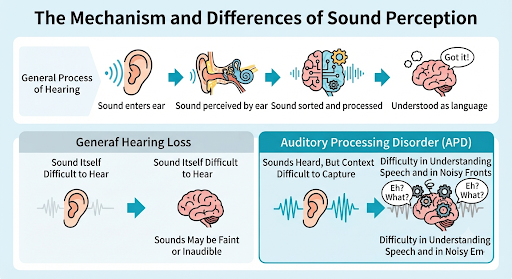
A standard pure-tone hearing test measures how quietly you can hear sounds, but it does not directly measure how well you understand speech in everyday listening situations.
For this reason, some people may have hearing within the normal range but still experience difficulty understanding speech, particularly in certain situations.
What Does a Standard Hearing Test Tell You?
A standard hearing test often uses a pure-tone audiometry test.
During the test, you listen to tones at different pitches and indicate when you can hear them.
The test is mainly used to determine your hearing sensitivity—how loud a sound needs to be for you to hear it.
However, simply being able to hear these tones does not tell us everything about how well you can understand spoken language.
Why Can Speech Still Be Difficult to Understand With Normal Hearing?
Being able to hear a tone does not necessarily mean that you can easily recognize and understand spoken words.
For example, you may be able to hear the sounds clearly but still have difficulty working out what someone is saying, especially when there is background noise or several people are talking.
This is why a person can have hearing within the normal range and still experience significant difficulty understanding speech.
Can a Standard Hearing Test Alone Identify APD or LiD?
Not necessarily.
Routine hearing screenings generally focus on whether you can hear sounds at different pitches and volumes.
Other tests, such as speech audiometry, may be used to assess how well you can recognize or understand spoken words.
When APD or LiD is suspected, however, clinicians may need to consider multiple types of information, including hearing tests, speech-related tests, questionnaires, interviews, and the specific listening difficulties a person experiences in everyday life.
In other words, a normal hearing test does not automatically mean that there is no problem with listening or understanding speech.
How Are APD and LiD Assessed?
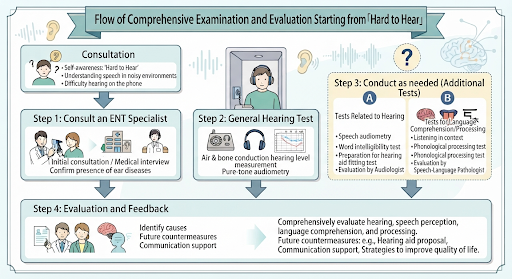
If APD or LiD is suspected, the first step is usually to check the person’s hearing and the condition of their ears.
After that, depending on the person’s symptoms and needs, additional tests and assessments may be used to understand what types of listening difficulties they are experiencing.
Rather than relying on a single test, clinicians may consider several different types of information together.
Who Should You Talk to if You Think You Have APD or LiD?
If you think you may have APD or LiD, a good starting point is to speak with an ear, nose and throat (ENT) specialist or another healthcare professional who can assess your hearing.
It is particularly helpful to explain your specific difficulties.
For example, you might say:
- “My hearing test was normal, but I have trouble understanding conversations.”
- “I can understand people in quiet places, but not in restaurants.”
- “I have much more difficulty when several people are talking.”
- “Phone calls are particularly difficult for me.”
Not every medical facility offers specialized assessment for APD or LiD, so it may be worth checking in advance whether the clinic provides these services.
What Kind of Tests Might You Have?
When APD or LiD is suspected, a hearing test is usually performed first to check whether hearing loss or another problem affecting the ears could be contributing to the difficulty.
Depending on the situation, additional tests may then be used to examine different aspects of listening and auditory processing.
These may include assessments of:
- Understanding speech in background noise
- Separating speech from competing sounds
- Processing sounds presented to both ears
- Distinguishing between similar sounds
- Recognizing the order or sequence of sounds
Because listening and understanding speech also involve language and attention, these areas may be assessed when appropriate.
The exact assessment process can vary depending on the person, their age, symptoms, and the healthcare provider.
What Is an Auditory Processing Test?
A standard hearing test mainly asks:
“How softly can you hear a sound?”
Auditory processing assessments, on the other hand, look at aspects of what happens after a sound is heard.
For example, they may examine whether you can:
- Understand speech in background noise
- Process sounds coming into both ears
- Distinguish between similar sounds
- Recognize the correct order of sounds
A simple way to think about the difference is:
| Test | What it mainly examines |
| Standard hearing test | Whether you can hear quiet sounds |
| Auditory processing assessment | How well you process and understand sounds after hearing them |
These assessments can provide useful information about a person’s listening difficulties, but there is not necessarily one single test that can explain every listening problem.
What Should You Know Before Getting Tested?
Specialized assessment for APD or LiD is not available at every healthcare facility.
If you are interested in being assessed, it is a good idea to contact the clinic beforehand and ask whether they evaluate APD or LiD and what types of tests are available.
You may also want to explain the situations that are most difficult for you when making the appointment.
Is the Assessment Different for Children and Adults?
The assessment process can differ depending on the person’s age.
For children, an ENT specialist may work together with professionals such as a speech-language pathologist when appropriate.
This is because children’s listening difficulties can be affected by not only hearing and auditory processing but also language development and communication skills.
For example:
- ENT specialist → checks hearing and the health of the ears
- Speech-language pathologist → evaluates language, communication, and related abilities
In some cases, other professionals may also be involved depending on the child’s needs.
If a child is having difficulties at school, it can also be helpful to talk with teachers, school support staff, or a school counselor.
Adjustments to the learning environment—such as providing written information, reducing background noise, or making sure instructions are given clearly—may make it easier for the child to participate and learn.
What Causes APD and LiD?
Listening difficulties associated with APD and LiD can have many possible contributing factors.
Developmental differences, language processing, attention, a history of hearing loss or middle ear infections, and problems affecting the brain or nervous system may all play a role in some cases.
However, there is not always one clear cause that can explain a person’s listening difficulties.
Can APD or LiD Be Present From Birth?
Some listening difficulties associated with APD or LiD may be related to differences in auditory processing or development that have been present from an early age.
However, there is no single cause of APD or LiD.
A combination of factors involving auditory processing, language, attention, and development may contribute to listening difficulties.
In some cases, it may not be possible to identify a specific cause.
How Is APD or LiD Related to Development?
In children, the development of hearing, language, attention, and other skills can affect how easily they understand spoken information.
As these abilities develop, some children may have difficulty processing or understanding speech, particularly in challenging listening environments.
This does not necessarily mean that there is a problem with their hearing itself.
Can Hearing Loss or Middle Ear Infections Affect Listening?
A history of hearing loss or middle ear infections may sometimes affect listening and speech understanding.
Current hearing loss can also make it difficult to understand speech, so checking hearing is an important part of evaluating listening difficulties.
For this reason, it is important to consider whether hearing loss or other problems affecting the ears may be contributing to the difficulty before focusing specifically on APD or LiD.
Can Problems With the Brain or Nervous System Cause Listening Difficulties?
In some cases, problems affecting the brain or nervous system may affect how auditory information is processed.
For example, a head injury or certain neurological conditions may affect the way the brain processes sounds or spoken language.
These situations are different from the developmental listening difficulties that some people experience, so a healthcare professional may need to consider the person’s medical history and symptoms when evaluating the problem.
What If the Cause Is Not Clear?
Unfortunately, the exact cause of APD or LiD is not always clear.
There are many different factors that can contribute to listening difficulties, and several factors may be involved at the same time.
This means that it is not always possible to say, “This is the one thing causing the problem.”
Even when the exact cause cannot be identified, it can still be useful to understand when and why listening becomes difficult.
Identifying the situations that cause the most difficulty can help you find practical ways to make communication easier.
Can APD and LiD Be Treated or Improved?

There is no single approach that works for everyone with APD or LiD.
Because the causes and contributing factors can vary from person to person, support often focuses not only on treating an underlying cause but also on reducing the difficulties a person experiences in everyday life.
This may include making the listening environment easier, using written information, or using assistive listening technologies.
Create an Environment That Makes Listening Easier
Listening can become particularly difficult when there is a lot of background noise or when several people are talking at the same time.
Whenever possible, reducing background noise can make conversations easier to follow.
It can also help to have people speak one at a time rather than having several people talk over each other.
For example, during a meeting, choosing a quieter room and making sure only one person speaks at a time may make it easier to follow the discussion.
Ask People to Change the Way They Speak
The way someone speaks can also affect how easy they are to understand.
Very fast speech, very quiet speech, or unclear pronunciation can make conversations difficult to follow—even for people without APD or LiD.
If possible, asking the other person to speak a little more slowly or clearly may help.
Of course, asking someone to change the way they speak is not always easy. Your relationship with the person and the situation may determine whether this feels comfortable.
Use Written Information Alongside Speech
Because some people with APD or LiD have difficulty processing spoken information, combining speech with written information can make communication easier.
For example, speech-to-text and live transcription services can convert spoken conversations into text in real time.
Tools such as Notta may be useful for this purpose, depending on the language and situation.
Written information can be especially helpful for important instructions, meetings, lectures, and other situations where missing part of a conversation could cause problems.
Consider Assistive Listening Systems
Assistive listening systems can also help some people hear speech more clearly.
Examples include FM systems and Roger systems, which can transmit a speaker’s voice more directly to a listener.
Depending on the person’s hearing and listening difficulties, these technologies may make speech easier to understand, particularly in noisy environments or when the speaker is some distance away.
If you are considering using an assistive listening system at school or work, you may need to discuss it with the school, employer, or relevant support staff.
What Can You Do at School or Work?
There are several ways to make communication easier at school or work.
For example, you might use:
- Live transcription or speech-to-text tools
- Assistive listening systems
- Written instructions instead of relying only on verbal instructions
- Email or workplace messaging for important information
- Meeting notes or written summaries
- A quieter place for important conversations
- One person speaking at a time during meetings
At school, it may be helpful to discuss these options with teachers or other school support staff.
At work, you may be able to ask for important information to be provided in writing through email or an internal messaging system.
The most useful support will depend on the situations that are difficult for you, so it can be helpful to identify your specific listening challenges first.
What Should You Do If You Think You May Have APD or LiD?
If you think you may have APD or LiD, start by identifying when and where you have difficulty understanding speech.
It can be helpful to write down the situations that are difficult for you and then discuss them with an ENT specialist or another appropriate healthcare professional.
Start by Identifying Your Listening Difficulties
Think about what situations make it difficult for you to understand speech.
For example:
- Is it difficult to understand people in noisy places?
- Is it easier to understand someone when you are in a quiet room?
- Are phone calls particularly difficult?
- Do you have trouble following conversations with several people?
- Do you struggle with fast speech?
- Do you find it difficult to follow online meetings?
- Do you become very tired from concentrating on conversations?
Making a list of these situations can help you understand your own listening difficulties.
It can also give your healthcare provider useful information when discussing your symptoms.
Talk to an ENT Specialist or Other Healthcare Professional
If you think you may have APD or LiD, consider talking to an ear, nose and throat (ENT) specialist or another healthcare professional who can evaluate your hearing and listening difficulties.
APD and LiD may not be familiar terms to everyone, and specialized assessment is not available at every medical facility.
If you are concerned about your hearing or have persistent difficulty understanding speech, it is worth discussing your symptoms with a professional rather than trying to diagnose yourself.
Don’t Rely on a Hearing Test Alone
A standard hearing test mainly measures how well you can hear sounds at different pitches and volumes.
It does not necessarily explain all of the difficulties a person may experience when trying to understand speech in everyday situations.
Therefore, even if your hearing test is within the normal range, that does not automatically mean that your listening difficulties are not real.
If you continue to have difficulty understanding speech, tell your healthcare provider about the specific situations in which you struggle.
Explain the Situations That Are Difficult for You
When talking with a healthcare professional, try to describe what happens in real-life situations rather than simply saying, “I can’t hear well.”
For example:
“I can hear people talking, but I can’t understand what they are saying when there is background noise.”
or
“My hearing test was normal, but I have a lot of trouble following conversations with several people.”
Specific examples can help your healthcare provider understand the type of difficulty you are experiencing and decide what kind of assessment may be appropriate.
Frequently Asked Questions About APD and LiD
People who are learning about APD and LiD often have questions such as, “Is APD a disease?”, “Can adults have APD?”, and “Can I have APD even if my hearing is normal?”
Here are some common questions and answers to help you better understand APD and LiD.
Is APD a Disease?
APD refers to difficulties processing auditory information and understanding spoken information.
However, it is not always appropriate to think of APD as a single disease with one clearly defined cause.
Listening difficulties can be associated with a variety of factors, including auditory processing, language, attention, development, and other cognitive processes.
For this reason, understanding the person’s individual symptoms and background is important.
Are APD and LiD the Same Thing?
Not exactly.
LiD (Listening Difficulties) focuses on the difficulties a person experiences when listening and understanding spoken information.
APD (Auditory Processing Disorder) focuses more specifically on difficulties involving the processing of auditory information.
There is considerable overlap between the two concepts, and they are sometimes discussed together as LiD/APD.
Can Adults Have APD?
Yes.
APD and LiD-related listening difficulties can also occur in adults.
Some people have experienced these difficulties since childhood, while others may not become aware of them until later in life.
For example, a person may manage relatively well in quiet environments but begin to notice significant difficulties after starting a job that involves meetings, phone calls, or noisy workplaces.
Is APD Only Found in Children?
No.
APD and LiD are not limited to children.
Both children and adults can experience difficulties understanding speech even when their hearing sensitivity is within the normal range.
The way these difficulties are assessed and supported may differ depending on a person’s age and individual circumstances.
Can You Have APD Even If Your Hearing Is Normal?
Yes.
A person can have hearing within the normal range on a standard hearing test and still have difficulty understanding speech in certain situations.
For example, listening may become particularly difficult when:
- There is a lot of background noise
- Several people are talking
- Someone speaks quickly
- The speaker is far away
- You are talking on the phone
- You are participating in an online meeting
This is because hearing sounds and processing spoken information are not exactly the same thing.
Do People With APD Need Hearing Aids?
Not necessarily.
Having APD or LiD does not automatically mean that you need hearing aids.
However, depending on a person’s hearing and listening difficulties, hearing aids or assistive listening systems may sometimes help make speech easier to understand, particularly in challenging listening environments.
The most appropriate support depends on the individual’s hearing, listening profile, and specific difficulties.
If you are considering hearing aids or assistive listening technology, discuss your options with an appropriate healthcare or hearing professional.
Can APD Be Cured?
There is no simple answer to whether APD or LiD can be “cured.”
The underlying factors and listening difficulties can vary considerably from person to person.
Rather than focusing only on whether the condition can be cured, it may be more useful to identify what makes listening difficult and find ways to reduce those difficulties.
Depending on the individual, this may include:
- Reducing background noise
- Changing the way people communicate
- Using written information alongside speech
- Using speech-to-text or live transcription
- Using assistive listening systems
- Making adjustments at school or work
The goal is to find approaches that make communication easier and help reduce the impact of listening difficulties on everyday life.
Conclusion: If You Can Hear but Can’t Understand Speech, You Don’t Have to Struggle Alone
Difficulty understanding speech even though you can hear sounds clearly is not necessarily something you should simply ignore or dismiss as “being distracted” or “not paying attention.”
With APD (Auditory Processing Disorder) and LiD (Listening Difficulties), a person may have hearing within the normal range but still struggle to understand speech in situations such as noisy places, conversations with several people, or phone calls.
Listening difficulties can also be influenced by many different factors, including auditory processing, language, attention, and development.
For this reason, it is important not to assume that you have APD based only on your symptoms.
Instead, try to identify your own listening difficulties, such as:
- What types of environments make it difficult to understand speech?
- What kinds of conversations are particularly difficult?
- Are phone calls or online meetings difficult?
- What did your hearing test show?
Keeping track of these difficulties can help you explain your experiences to a healthcare professional.
If your listening difficulties are affecting your everyday life, consider talking to an ENT specialist or another appropriate healthcare professional.
Listening difficulties are not always obvious to the people around you.
Someone may appear to have normal hearing because they can hear sounds, while still struggling significantly to understand spoken language.
You do not have to simply put up with these difficulties on your own.
Depending on your needs, using written information, making adjustments to the listening environment, using speech-to-text tools, or considering assistive listening systems may make communication easier.
The most important thing is to understand what situations are difficult for you and what kinds of support actually help.
If you feel that you can hear sounds but still cannot understand what people are saying, recognizing that difficulty is an important first step toward finding ways to communicate more comfortably.

コメント