You walk into a silent room, and the ringing suddenly seems louder. You get into bed at night, and it is all you can hear.
Tinnitus is easiest to notice when everything around you is quiet. Sound therapy works with that fact. By adding a gentle, steady sound to your surroundings, it helps your attention move away from the ringing. It is not a cure, and it will not switch tinnitus off. The goal is to make it less bothersome.
My wife has tinnitus too: a high ringing and a lower hum. I cannot hear either one, so I will never fully understand what it is like.
In this article
- What sound therapy is, and what it can and cannot do
- Which sounds to choose, and how loud to play them
- When to use sound, and phone apps you can try
- Hearing aids and sound generators
- Signs that mean you should see a doctor first
What Is Sound Therapy for Tinnitus?
Sound therapy, sometimes called sound enrichment, means using outside sound to make tinnitus less noticeable and less upsetting. The sound can be as simple as a fan, a radio, rain played from a speaker, or a phone app.
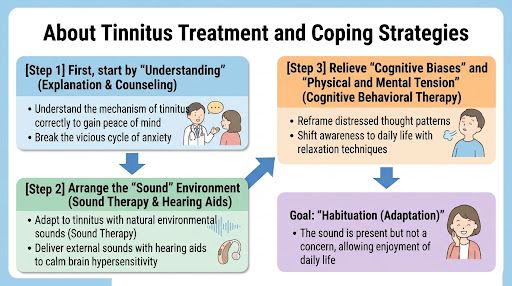
It helps to be clear about what it does. There is no treatment that reliably removes tinnitus, so care focuses on reducing how much it bothers you. In the American guideline for adults with persistent, bothersome tinnitus, sound therapy is an option a clinician may offer, alongside counseling, cognitive behavioral therapy (CBT), and hearing aids when there is hearing loss. No single approach works for everyone.
Why Quiet Sound Helps
Tinnitus is more noticeable in a quiet place, so adding gentle sound whenever it is quiet can help distract your brain from focusing on it. Worrying about tinnitus can also make it seem louder and more intrusive, which adds to the distress. With regular use, the aim is a point where the brain filters the tinnitus out most of the time, even though it may still be there. This is called habituation.

Getting Used to It vs. Covering It Up
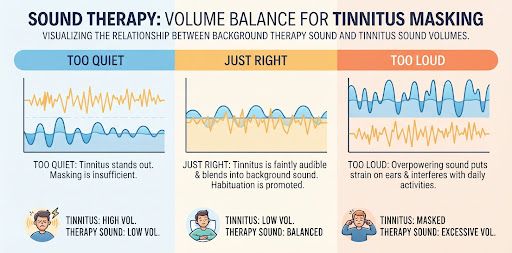
- Getting used to it (the main goal here): play a sound a little quieter than your tinnitus, so the two blend. This supports habituation.
- Masking: play a louder sound that drowns the tinnitus out. This gives short-term relief, but it does not build long-term habituation, and the tinnitus can seem louder when the sound stops.
Choosing a Sound
- Natural sounds: rain, waves, wind, or birdsong.
- White noise and other steady noise.
- Gentle music at a low volume.
- Everyday background sound: a fan, distant traffic, or a ticking clock.
Sounds that are pleasant and do not demand your attention usually work best, so it is worth trying several and choosing one you like.
How Loud Should It Be?
Aim for a level where the sound blends with your tinnitus and you can still just hear it. You are not trying to bury the tinnitus completely.
Keep the volume low, especially with earbuds or headphones. Our guide to safe volume and listening time explains what is safe. If everyday sounds already feel too loud, see hyperacusis.
When and How to Play It
- Avoid complete silence. Add sound whenever it is quiet and the tinnitus stands out.
- At night, play a sound at a low volume. It can help you fall asleep, and it also helps if you wake early and notice the tinnitus.
- A bedside unit with a sleep timer switches off once you are asleep. A pillow speaker is quieter for a partner.
How Long Should You Keep Going?
Habituation is gradual, so do not judge it after a few days. Sound is most useful while the tinnitus is intrusive, and many people find they need it less as they get used to the tinnitus. The effect differs from person to person.
Using Your Phone and Apps
- iPhone: Background Sounds plays sounds such as rain and ocean. You can find it under Settings > Accessibility > Audio & Visual > Background Sounds.
- Tinnitus apps: ReSound Relief, from the hearing aid maker GN, offers sound therapy, relaxation exercises, and information about tinnitus. You do not need a hearing aid to use it. Its tinnitus tools are free in the basic version, with an optional paid premium version.
Hearing Aids and Sound Generators
Tinnitus often goes together with hearing loss, so a hearing test is a standard part of a tinnitus check-up. When hearing loss is present, correcting it with hearing aids can make tinnitus less noticeable. For more, see our beginner’s guide to hearing aids.
A sound generator is a small device, worn in or behind the ear, that produces a steady noise. Some hearing aids combine amplification with a built-in sound generator. Wearable generators are usually fitted by a specialist as part of a management plan, so it is best to have your hearing checked first.
When to See a Doctor First
Most tinnitus is not dangerous, but see a doctor before relying on sound therapy if:
- It began suddenly, especially with hearing loss. Read about sudden hearing loss.
- It is mainly in one ear.
- It beats in time with your pulse.
- It began after a head injury.
- It is getting worse, or you have it regularly or constantly and it bothers you.
For causes, types, and what to expect at a check-up, see our tinnitus guide.
Living in Japan?
In Japan, tinnitus is usually handled by an ENT clinic (耳鼻咽喉科). The Japan Audiological Society publishes a Tinnitus Practice Guideline (2019, in Japanese).
FAQ
Can sound therapy cure tinnitus?
No. It aims to make tinnitus less noticeable and less bothersome, and results vary.
Can I use my own music?
Yes. Gentle music at a low volume is a common choice.
Do I need hearing loss to try it?
No. Everyday sound and white noise are easy to try. If tinnitus is persistent, it is still a good idea to have your hearing checked.
Summary
- Sound therapy uses gentle sound to help you get used to tinnitus. It is not a cure.
- Choose a pleasant, steady sound and keep the volume low, so it blends with the tinnitus.
- Habituation is gradual, so give it time.
- Check your hearing, and ask a professional before buying a sound generator.
- Sudden, one-sided, or pulsing tinnitus, or tinnitus after a head injury, means seeing a doctor first.
References
- Tinnitus UK (British Tinnitus Association), Sound Therapy leaflet
- Tunkel DE, et al. Clinical Practice Guideline: Tinnitus Executive Summary. Otolaryngology–Head and Neck Surgery. 2014;151(4):533–541.
- AAO-HNSF, Clinical Practice Guideline: Tinnitus Update (2026)
- NHS, Tinnitus: causes and when to see a GP
- ReSound, Support for the ReSound Relief app
- Japan Audiological Society, Tinnitus Practice Guideline 2019 (in Japanese)
コメント