Can you get a Physical Disability Certificate if you have hearing loss in Japan? How severe does your hearing loss need to be to qualify?
Not everyone with hearing loss is eligible for a Physical Disability Certificate (身体障害者手帳, Shintai Shōgaisha Techō). Eligibility is determined based on specific criteria, including hearing levels and, for some disability grades, speech discrimination scores.
In this article, we explain in simple terms who may qualify for a Physical Disability Certificate for hearing loss in Japan, including the eligibility criteria for Grades 2, 3, 4, and 6. We also explain what “dB” means when looking at hearing test results and walk you through the application process step by step.
We also cover the support that may be available to people with a Physical Disability Certificate, such as assistance with the cost of hearing aids, tax deductions, and discounts on public transportation and other services. In addition, we explain hearing aid subsidy programs that may be available from local governments even if you do not have a Physical Disability Certificate.
We prepared article of hearing loss. So, please refer it.
- Can You Get a Physical Disability Certificate for Hearing Loss in Japan?
- Eligibility Requirements for a Physical Disability Certificate for Hearing Loss
- Hearing Disability Grades for a Physical Disability Certificate
- What Does “dB” Mean in a Hearing Test?
- How to Apply for a Physical Disability Certificate
- What Support Can You Receive with a Physical Disability Certificate?
- Support for Hearing Loss Without a Physical Disability Certificate
- The Relationship Between a Physical Disability Certificate and Hearing Aids
- Frequently Asked Questions About Physical Disability Certificates for Hearing Loss
- Can I Get a Physical Disability Certificate If I Have Hearing Loss in Only One Ear?
- Can I Get a Physical Disability Certificate If I Use Hearing Aids in Both Ears?
- Can Children Get a Physical Disability Certificate?
- Can I Get a Physical Disability Certificate for Acquired Hearing Loss?
- If I Wear Hearing Aids, Does That Mean My Hearing Has Improved for the Purpose of Certification?
- Does Getting a Physical Disability Certificate Automatically Mean I Will Receive a Hearing Aid?
- What Should I Do If I Do Not Qualify for a Physical Disability Certificate?
- What Happens to My Physical Disability Certificate If My Hearing Improves?
- Does a Physical Disability Certificate Need to Be Renewed?
- Summary: You May Qualify for a Physical Disability Certificate If You Meet the Criteria
Can You Get a Physical Disability Certificate for Hearing Loss in Japan?
Yes. People with hearing loss may be eligible for a Physical Disability Certificate (身体障害者手帳, Shintai Shōgaisha Techō) in Japan.
However, not everyone with hearing loss can get a Physical Disability Certificate.
The severity of hearing loss varies from person to person. For hearing disabilities, eligibility is determined based on specific criteria, including hearing levels in both ears and, for certain disability grades, speech discrimination scores.
What Is a Physical Disability Certificate?
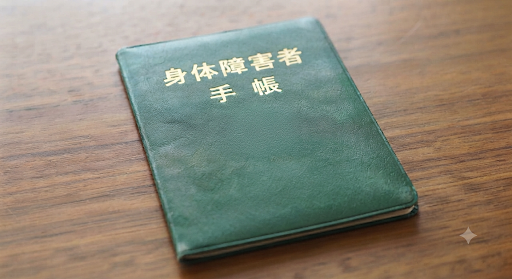
A Physical Disability Certificate (身体障害者手帳) is an official certificate issued by a prefectural government or other local authority to certify that a person has a physical disability that meets certain legal criteria in Japan.
It covers several types of disabilities, including hearing impairment, visual impairment, physical disabilities affecting movement, and certain internal disabilities.
Having a Physical Disability Certificate may allow you to receive various forms of support depending on your type and grade of disability. These may include tax deductions, discounts on public transportation and public facilities, and access to certain welfare services.
Not Everyone with Hearing Loss Is Eligible
People with hearing loss can receive a Physical Disability Certificate, but eligibility depends on the severity and characteristics of their hearing loss.
Simply having a diagnosis of hearing loss does not automatically qualify you for a certificate.
My wife also uses hearing aids, but she does not have a Physical Disability Certificate.
What Changes If You Get a Physical Disability Certificate?
Some people may feel that they do not want or need a Physical Disability Certificate.
However, having one can provide access to various forms of support.
For example, depending on your disability grade and the program involved, you may be eligible for tax deductions, discounts on public transportation and public facilities, and various welfare services.
For people with hearing loss, meeting the relevant requirements may also allow you to receive financial assistance toward the cost of hearing aids through the Assistive Device Cost Subsidy System (補装具費支給制度, Hōsōgu-hi Shikyū Seido).
However, having a Physical Disability Certificate does not automatically mean that all hearing aid costs will be covered. There are specific requirements and procedures for using this system.
Eligibility Requirements for a Physical Disability Certificate for Hearing Loss
Whether you qualify for a Physical Disability Certificate for hearing loss is not determined simply by how many decibels (dB) you cannot hear.
Your hearing levels in both ears and, depending on the disability grade, your ability to understand spoken words are important factors.
In this section, we explain which hearing test results are relevant when determining eligibility for a Physical Disability Certificate.
Eligibility Is Not Determined by Hearing Level Alone
There are different types of hearing tests used to assess hearing ability.
Some tests measure how well you can hear sounds at different volumes, while others measure how accurately you can understand spoken words.
Therefore, eligibility is not determined solely by how loud a sound needs to be before you can hear it. For some disability grades, how well you can understand speech is also an important factor.
Hearing in Both Ears Is Important
When applying for a Physical Disability Certificate because of hearing loss, hearing levels in both ears are important.
If you have hearing loss in only one ear and your other ear has normal hearing, you generally do not qualify for a Physical Disability Certificate based on hearing impairment alone.
However, there is an exception. If the hearing level is 90 dB or more in one ear and 50 dB or more in the other ear, you may meet the criteria for Grade 6 hearing impairment.
Eligibility Is Determined Based on Hearing Test Results
Two of the main hearing tests used to evaluate hearing are pure-tone audiometry and speech discrimination testing.
In a pure-tone hearing test, you listen to sounds such as beeps at different pitches and indicate when you can hear them. The test measures the quietest sounds you can detect at different frequencies.
A speech discrimination test measures how accurately you can recognize and understand spoken words.
For a Physical Disability Certificate, the results of pure-tone audiometry are particularly important. Hearing levels are expressed in decibels (dB), a unit used to describe sound level and hearing sensitivity.
The results of these tests, together with other information about your hearing condition, are used to determine whether you meet the legal criteria for a Physical Disability Certificate and, if so, which disability grade applies.
Hearing Disability Grades for a Physical Disability Certificate
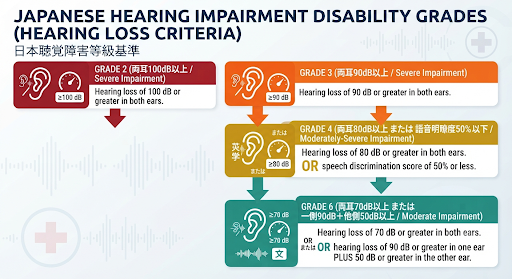
There are four disability grades for hearing impairment under Japan’s Physical Disability Certificate system: Grade 2, Grade 3, Grade 4, and Grade 6.
If you are wondering, “How severe does my hearing loss need to be to qualify for a Physical Disability Certificate?”, the first step is to check these criteria.
The following table summarizes the eligibility criteria for each grade.
| Grade | GradeHearing Disability Criteria |
| Grade 2 | Hearing level of 100 dB or more in both ears |
| Grade 3 | Hearing level of 90 dB or more in both ears |
| Grade 4 | Hearing level of 80 dB or more in both ears, or the best speech discrimination score using both ears is 50% or less |
| Grade 6 | Hearing level of 70 dB or more in both ears, or hearing level of 90 dB or more in one ear and 50 dB or more in the other ear |
Grade 2 Eligibility Criteria
There is no Grade 1 for hearing impairment. Therefore, Grade 2 is the highest disability grade for hearing impairment under the Physical Disability Certificate system.
You may qualify for Grade 2 if your hearing level is 100 dB or more in both ears.
This represents a very severe level of hearing impairment. The official criteria describe this condition as “total deafness in both ears” (両耳全ろう).
Grade 3 Eligibility Criteria
You may qualify for Grade 3 if your hearing level is 90 dB or more in both ears.
At this level of hearing loss, it can be difficult to hear speech unless it is presented at a very loud volume.
Grade 4 Eligibility Criteria
There are two ways to meet the criteria for Grade 4 hearing impairment:
- A hearing level of 80 dB or more in both ears
- A best speech discrimination score of 50% or less using both ears
In other words, you may qualify if your pure-tone hearing test shows a hearing level of 80 dB or more in both ears, or if you can correctly understand only half or fewer of the words presented during a speech discrimination test.
Grade 6 Eligibility Criteria
There is no Grade 5 for hearing impairment.
There are two ways to meet the criteria for Grade 6:
- A hearing level of 70 dB or more in both ears
- A hearing level of 90 dB or more in one ear and 50 dB or more in the other ear
Why Is There No Grade 5?
The Physical Disability Certificate system itself includes Grade 5.
However, Grade 5 is not included in the classification for hearing impairment.
This means that while Grades 1 through 6 exist in the overall Physical Disability Certificate system, hearing impairment is classified only as Grade 2, Grade 3, Grade 4, or Grade 6.
What Does “dB” Mean in a Hearing Test?
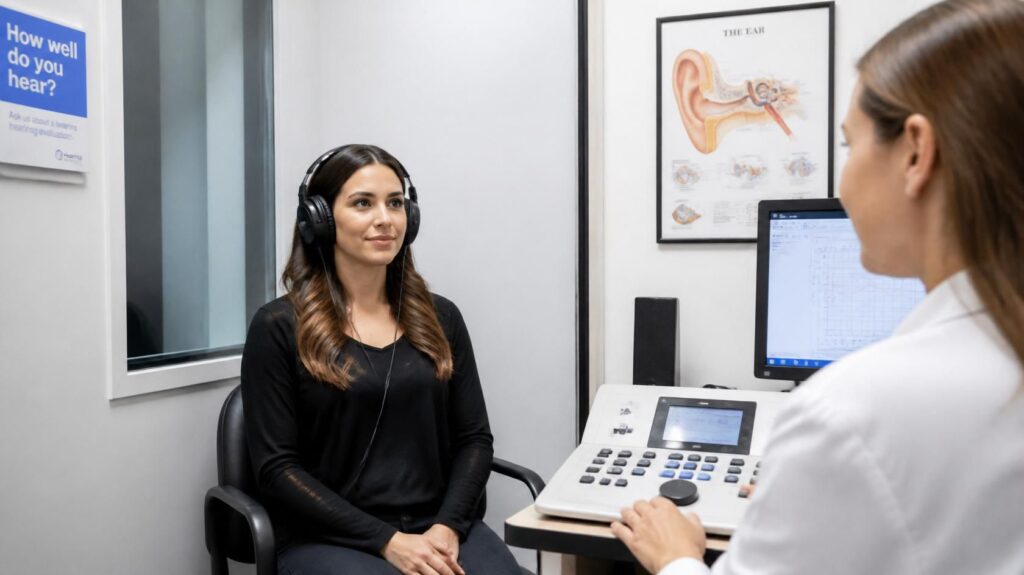
dB (decibel) is a unit used to describe sound level and, in hearing tests, the level of hearing sensitivity.
During a hearing test, dB indicates how loud a sound needs to be before you can hear it. In general, the higher the number, the louder the sound needs to be for you to hear it, which indicates a greater degree of hearing loss.
For example, if your hearing level is measured at 70 dB, it means that you need a sound presented at around 70 dB hearing level before you can detect it at that particular frequency.
Hearing Loss Severity
Hearing loss is often described using categories such as mild, moderate, severe, and profound. The ranges used can vary depending on the classification system.
For example, one commonly used classification is:
| Degree of Hearing Loss | Hearing Level |
| Mild hearing loss | 25–45 dB |
| Moderate hearing loss | 46–70 dB |
| Severe hearing loss | 71–95 dB |
| Profound hearing loss | 96–115 dB |
For example, 60 dB falls within the moderate hearing loss range in this classification. A hearing level of 60 dB means that relatively loud sounds may be needed before they can be detected. A hearing level of 70 dB is around the upper end of this range.
However, there is an important point to understand when looking at hearing test results.
A Hearing Test Result of 70 dB Is Not the Same as a 70 dB Sound
The 70 dB shown on a hearing test and an actual 70 dB sound in everyday life are not the same thing.
A hearing test is not simply checking whether you can hear everyday sounds such as a vacuum cleaner at 70 dB.
The dB value shown on an audiogram represents your hearing level—in other words, how loud a pure tone needs to be for you to detect it compared with a standard reference level.
For example, a hearing level of 95 dB means that very loud sounds are generally needed for you to detect sounds at the tested frequency.
Hearing Loss Categories and Disability Grades Are Different
It is also important not to confuse the categories of hearing loss—such as mild, moderate, severe, and profound hearing loss—with the Grade 2, 3, 4, and 6 classifications used for Japan’s Physical Disability Certificate.
These are different classification systems.
A person may be described as having a particular degree of hearing loss based on their hearing test results, but whether they qualify for a Physical Disability Certificate is determined separately according to Japan’s legal criteria for hearing impairment.
How to Apply for a Physical Disability Certificate
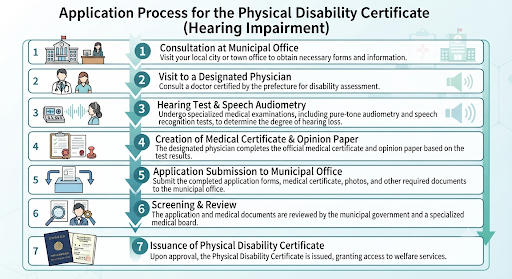
To obtain a Physical Disability Certificate (身体障害者手帳, Shintai Shōgaisha Techō), you generally need to consult your local government, see a designated physician, have the required medical certificate and opinion form prepared, submit an application, and go through an official review process.
Simply visiting a regular ear, nose and throat (ENT) clinic does not necessarily mean that you can apply for a Physical Disability Certificate.
For this reason, it is important to contact your local government first and check which physicians are authorized to assess hearing disabilities for the certificate.
Here is an overview of the application process.
First, Contact Your Local Municipal Office
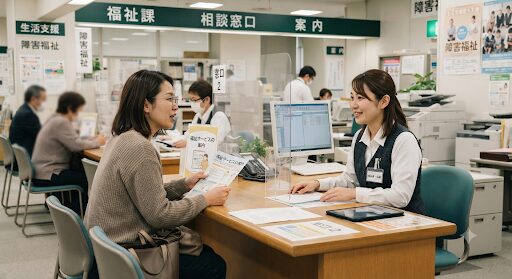
The first step is to contact the disability welfare department or another appropriate office at the municipal government where you live.
Ask about:
- How to apply for a Physical Disability Certificate
- What documents you need
- Which physicians are designated to assess hearing disabilities
- How long the application and review process usually takes
The name of the responsible office and the documents required may vary depending on the municipality. Contacting your local government before visiting a doctor can help make the process smoother.
Visit an ENT Doctor
Next, you will need to see a physician who is designated under Article 15 of Japan’s Act on Welfare of Physically Disabled Persons.
This is important because not every ENT doctor is authorized to prepare the medical certificate required for a Physical Disability Certificate.
It is therefore recommended that you first check with your municipal office or another local government authority to find an appropriate designated physician or medical facility.
Have the Designated Physician Prepare the Medical Certificate and Opinion Form
The designated physician will examine your hearing and perform the tests required to assess your eligibility for a Physical Disability Certificate.
For hearing impairment, these may include:
- Pure-tone audiometry
- Speech discrimination testing
The exact tests required may depend on your hearing condition and other circumstances.
Your hearing test results and other medical information are then used to determine whether your hearing impairment meets the criteria for a Physical Disability Certificate.
The physician will prepare a Physical Disability Certificate Medical Certificate and Opinion Form (身体障害者診断書・意見書) based on the examination and test results.
This document includes information such as:
- The type of disability
- Hearing test results
- Speech discrimination test results
- The person’s hearing condition
- The degree of disability
You do not decide your disability grade yourself. The designated physician prepares the medical certificate and opinion form based on your examination results and other relevant information.
Submit Your Application to Your Municipal Office
Once the medical certificate and opinion form has been prepared, you will need to gather the documents required for your application.
These commonly include:
- Physical Disability Certificate application form
- Physical Disability Certificate Medical Certificate and Opinion Form
- A photograph of the applicant
- Identification documents
- Documents related to the applicant’s My Number (Individual Number)
The exact documents required, as well as the required photograph size and other details, may vary depending on the municipality.
Once you have prepared the necessary documents, submit them to the appropriate municipal office where you live.
This officially starts the application process.
Some municipalities may allow applications to be submitted by mail, while others may primarily handle applications at the municipal office. Check with your local government in advance.
Your Application Is Reviewed Before the Certificate Is Issued
After you submit your application, the relevant authorities review your medical certificate, opinion form, and other documents to determine whether you meet the legal criteria for a Physical Disability Certificate.
For hearing impairment, your hearing test results, speech discrimination test results, and other relevant information may be considered when determining the appropriate disability grade.
Additional information or confirmation may be requested if necessary.
If you are determined to meet the criteria, your Physical Disability Certificate will be issued.
You can then collect the certificate from the appropriate municipal office or other designated location.
How Long Does the Application Take?
You will not receive a Physical Disability Certificate immediately after submitting your application.
The process may involve an examination by a designated physician, hearing tests, preparation of the medical certificate and opinion form, and an official review by the relevant authorities.
The time required varies depending on the municipality and the details of the application.
As a general guide, the process may take around one to two months, although it can take two to three months in some cases if the review takes longer.
Because processing times vary, it is a good idea to ask your local disability welfare office how long the process is expected to take before you apply.
What Support Can You Receive with a Physical Disability Certificate?
Having a Physical Disability Certificate may give you access to various forms of support, depending on your type and grade of disability and the specific program involved.
For people with hearing impairment, common examples include financial assistance toward hearing aids through the Assistive Device Cost Subsidy System (補装具費支給制度, Hōsōgu-hi Shikyū Seido), disability tax deductions, and discounts or exemptions for public transportation and other public services.
However, the available support and eligibility requirements are not the same for everyone. Some programs are provided by the national government, while others are operated by prefectural or municipal governments or individual service providers.
Financial Assistance for Hearing Aids
If you obtain a Physical Disability Certificate, you may be able to use the Assistive Device Cost Subsidy System (補装具費支給制度) to receive financial assistance toward the cost of a hearing aid.
This system provides assistance for certain assistive devices, including hearing aids.
However, this does not mean that you can receive financial assistance for any hearing aid you choose.
The system has specific eligibility requirements, approved device standards, and application procedures. The amount of assistance and the type of hearing aid that can be covered are also subject to the rules of the system.
We prepared article of Financial Assistance. So, please refer it.
Regarding Financial Assistance↗
Tax Deductions and Reductions
Having a Physical Disability Certificate may make you eligible for a disability tax deduction (障害者控除).
This is a tax system that allows a certain amount to be deducted from your taxable income when calculating income tax and resident tax.
For the Japanese income tax system, people who qualify as a person with a disability can generally receive a deduction of ¥270,000. People classified as special disabilities, including those with a Physical Disability Certificate of Grade 1 or Grade 2, can generally receive a deduction of ¥400,000.
A larger deduction of ¥750,000 may apply when a special disability is a person living with and supported by certain family members in the same household.
| Category | Income Tax Deduction |
| Person with a disability | ¥270,000 |
| Special disability (Physical Disability Certificate Grade 1 or 2) | ¥400,000 |
| Special disability living with and supported by certain family members | ¥750,000 |
Keep in mind that these amounts are deductions from taxable income, not direct reductions in the amount of tax you pay. The actual reduction in your tax burden depends on factors such as your income and tax situation.
Discounts on Public Transportation and Public Facilities
Depending on your disability grade and the specific service, a Physical Disability Certificate may also provide access to discounts or exemptions on transportation and other services.
Examples may include:
- Train and bus fares
- Expressway tolls
- Admission fees for public facilities
- Other public services
Under certain conditions, you may also be eligible for a reduction or exemption from NHK reception fees.
However, the exact discount or exemption depends on the relevant system, transportation company, facility, or service provider.
Eligibility can also vary depending on your disability grade and other conditions, so check the rules before using a service.
Available Services Vary by Municipality
The Physical Disability Certificate is part of a nationwide system in Japan, but the services available to certificate holders are not necessarily the same everywhere.
In addition to national programs, prefectural and municipal governments may provide their own services and financial assistance.
These local programs can differ depending on the local government’s regulations, budget, and policies.
As a result, two people with the same type and grade of hearing impairment may have access to different services depending on where they live.
After receiving a Physical Disability Certificate, it is a good idea to contact the disability welfare office of your local municipality and ask what programs and benefits are available in your area.
Support for Hearing Loss Without a Physical Disability Certificate
Not having a Physical Disability Certificate does not necessarily mean that you cannot receive any support for hearing loss.
Some local governments in Japan offer their own hearing aid subsidy programs for people who do not have a Physical Disability Certificate.
In particular, some municipalities have programs for children with hearing loss. Because these programs are operated by local governments, the eligibility requirements and amount of financial assistance can vary considerably from one area to another.
If you do not qualify for a Physical Disability Certificate, it is worth checking with your local municipal government to see whether any other support programs are available.
Hearing Aid Subsidies Provided by Local Governments
Some municipalities provide their own subsidies to help cover the cost of hearing aids.
These programs may be available even if you do not have a Physical Disability Certificate.
However, these subsidies are not available in every municipality.
Eligibility requirements can also differ. For example, a program may have requirements concerning age, hearing level, household income, or the type of hearing aid.
If you are considering purchasing a hearing aid, check with your local municipal office before buying one. In some cases, you may need to apply for approval before purchasing the hearing aid in order to receive the subsidy.
Hearing Aid Subsidies for Children Under 18
Some municipalities provide hearing aid subsidies specifically for children, including children under 18.
These programs are designed to support children with hearing loss who may not meet the criteria for a Physical Disability Certificate but could benefit from hearing aids.
However, these are local government programs and are not available throughout Japan.
The age requirements, hearing level requirements, household income limits, eligible devices, and amount of financial assistance can vary depending on the municipality.
If you are looking for hearing aid support for a child, contact your local municipal government and ask whether a subsidy program is available in your area.
Programs and Eligibility Requirements Vary by Municipality
Local governments in Japan may offer different support programs for people with hearing loss.
This means that the program itself, eligibility requirements, amount of financial assistance, and application procedures can differ depending on where you live.
For this reason, do not assume that a program is available—or unavailable—based only on information from another city or prefecture.
Always check with your local municipal office before applying or purchasing a hearing aid.
The Relationship Between a Physical Disability Certificate and Hearing Aids
A Physical Disability Certificate and hearing aids are closely related in Japan, but having a certificate does not mean that you automatically receive a hearing aid for free.
If you meet the relevant requirements, you may be able to receive financial assistance toward the cost of a hearing aid through the Assistive Device Cost Subsidy System (補装具費支給制度, Hōsōgu-hi Shikyū Seido).
However, there are specific eligibility requirements and procedures that must be followed.
This section explains how a Physical Disability Certificate affects hearing aid costs and what kind of support may be available.
We prepared article of hearing aids. So, please refer it.
Can You Get a Hearing Aid at a Lower Cost with a Physical Disability Certificate?
Having a Physical Disability Certificate does not automatically make hearing aids cheaper.
If you have a Physical Disability Certificate and meet the requirements for the Assistive Device Cost Subsidy System, you may be able to receive financial assistance toward the cost of a hearing aid.
However, this is not a discount on the retail price of the hearing aid.
The system provides financial assistance according to specific rules and approved standards. Not every hearing aid is eligible, and you cannot necessarily choose any hearing aid you want and have its entire cost covered.
Therefore, it is important to understand that:
- A Physical Disability Certificate does not mean that hearing aids are free.
- You cannot necessarily choose any hearing aid and receive full financial assistance for it.
- You need to complete the required application procedures.
- The hearing aid must meet the requirements of the subsidy system.
What Do You Need to Use the Assistive Device Cost Subsidy System?
As a general rule, you need to have a Physical Disability Certificate for hearing impairment to use the Assistive Device Cost Subsidy System for hearing aids.
However, having a certificate alone does not automatically mean that your hearing aid will be covered.
You must also meet the other requirements of the system and complete the necessary application procedures.
Because the process involves specific rules regarding eligibility, approved devices, and costs, contact your local municipal government before purchasing a hearing aid.
Can You Buy a Hearing Aid Without a Physical Disability Certificate?
Yes. You can purchase a hearing aid even if you do not have a Physical Disability Certificate.
Many people need hearing aids even though they do not meet the eligibility criteria for a Physical Disability Certificate.
My wife is one example. She uses hearing aids even though she does not have a Physical Disability Certificate.
If you have a Physical Disability Certificate, you may be eligible for financial assistance depending on your circumstances. However, the hearing aid is not necessarily free, and not every hearing aid is covered by the system.
If you do not have a Physical Disability Certificate, you can still purchase a hearing aid at your own expense. You may also be eligible for a separate hearing aid subsidy provided by your local municipality.
Because local programs vary, it is worth checking with your municipal government before purchasing a hearing aid.
Frequently Asked Questions About Physical Disability Certificates for Hearing Loss
People considering a Physical Disability Certificate for hearing loss often have questions such as, “Can I get a certificate if only one ear is affected?”, “Can I get one if I already use hearing aids?”, or “Can children get a Physical Disability Certificate?”
Here are answers to some of the most common questions about Physical Disability Certificates and hearing impairment in Japan.
Can I Get a Physical Disability Certificate If I Have Hearing Loss in Only One Ear?
Under the current eligibility criteria, hearing loss in only one ear generally does not qualify for a Physical Disability Certificate based on hearing impairment alone.
However, if your hearing level is 90 dB or more in one ear and 50 dB or more in the other ear, you may meet the criteria for Grade 6 hearing impairment.
Therefore, the hearing level in both ears is important when determining eligibility.
Can I Get a Physical Disability Certificate If I Use Hearing Aids in Both Ears?
Yes.
Using hearing aids does not automatically prevent you from obtaining a Physical Disability Certificate.
If your hearing condition meets the eligibility criteria, you may qualify for a certificate even if you use hearing aids in both ears.
The hearing assessment used to determine eligibility is generally based on your hearing without hearing aids.
Can Children Get a Physical Disability Certificate?
Yes. Children can also receive a Physical Disability Certificate if they meet the relevant criteria.
There are eligibility criteria for hearing impairment, but the testing methods used to assess hearing may differ depending on the child’s age and stage of development.
If you are considering a Physical Disability Certificate for a child, contact your local municipal government or a designated physician for information about the appropriate testing and application process.
Can I Get a Physical Disability Certificate for Acquired Hearing Loss?
Yes.
You can qualify for a Physical Disability Certificate even if your hearing loss developed later in life.
In other words, hearing loss does not have to be present from birth.
Older adults can also qualify if their hearing impairment meets the relevant eligibility criteria. There is no general age limit that prevents someone from receiving a Physical Disability Certificate for hearing impairment.
If I Wear Hearing Aids, Does That Mean My Hearing Has Improved for the Purpose of Certification?
For the purpose of determining eligibility for a Physical Disability Certificate, hearing impairment is generally assessed based on hearing without hearing aids or other hearing devices.
This is often referred to as unaided hearing or hearing in the unaided condition (裸耳).
In other words, the fact that you can hear better while wearing hearing aids does not necessarily mean that you no longer meet the criteria for a Physical Disability Certificate.
Does Getting a Physical Disability Certificate Automatically Mean I Will Receive a Hearing Aid?
No.
Simply obtaining a Physical Disability Certificate does not mean that a hearing aid will automatically be provided.
If you need a hearing aid, you must separately apply for assistance through the Assistive Device Cost Subsidy System (補装具費支給制度) and meet its requirements.
The system also has rules regarding which hearing aids and costs are eligible for assistance.
What Should I Do If I Do Not Qualify for a Physical Disability Certificate?
If you do not meet the criteria for a Physical Disability Certificate, you may still be able to receive other forms of support.
Some municipalities in Japan provide their own hearing aid subsidy programs that do not require a Physical Disability Certificate.
The eligibility requirements and amount of assistance vary by municipality, so check with your local government to see what support is available where you live.
What Happens to My Physical Disability Certificate If My Hearing Improves?
If your hearing improves, your Physical Disability Certificate does not necessarily become invalid immediately.
However, if your hearing improves significantly and your current condition no longer meets the eligibility criteria for your disability grade, you may need to have your disability grade changed or, in some cases, return the certificate.
If there is a significant change in your hearing, consult your local disability welfare office before taking any action.
Does a Physical Disability Certificate Need to Be Renewed?
A Physical Disability Certificate generally does not require regular renewal in the same way that a driver’s license does.
If your disability condition remains unchanged, you generally do not need to renew the certificate every few years.
However, if your hearing improves or worsens significantly, you may need to apply for a change in your disability grade or undergo another assessment.
In some cases, the local government may also require you to undergo a reassessment at a specified time.
You may also need to complete separate procedures if you move to a different address or lose your certificate.
Summary: You May Qualify for a Physical Disability Certificate If You Meet the Criteria
People with hearing loss may be eligible for a Physical Disability Certificate (身体障害者手帳) in Japan if their hearing impairment meets the legally defined criteria.
For hearing impairment, the available disability grades are Grade 2, Grade 3, Grade 4, and Grade 6.
Eligibility is primarily determined by the hearing levels in both ears. For some grades, speech discrimination scores are also taken into consideration.
Having a Physical Disability Certificate may provide access to various forms of support, depending on your disability grade and circumstances. These may include financial assistance toward the cost of hearing aids through the Assistive Device Cost Subsidy System (補装具費支給制度), disability tax deductions, and discounts on public transportation and public facilities.
However, a Physical Disability Certificate does not mean that hearing aids are automatically provided for free. Separate eligibility requirements and application procedures apply to hearing aid assistance.
Even if you do not meet the criteria for a Physical Disability Certificate, you may still be able to receive support for hearing loss. Some local governments offer their own hearing aid subsidy programs for people who do not have a Physical Disability Certificate.
If you are unsure whether your hearing level qualifies you for a Physical Disability Certificate, the best place to start is your local municipal government’s disability welfare office.
They can provide information about the eligibility criteria, designated physicians, required documents, application procedures, and other support programs available in your area.


コメント