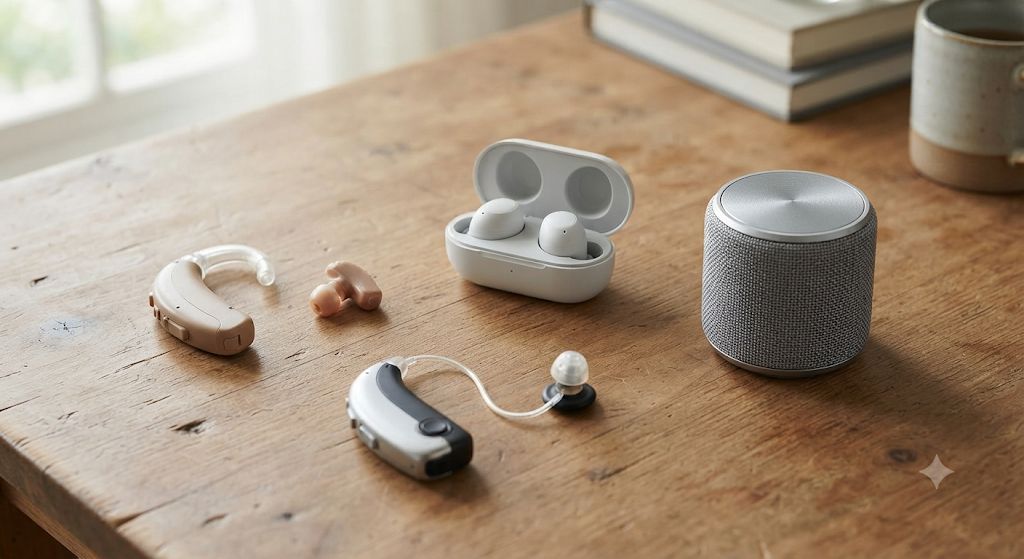
When you think of a hearing aid, you may picture a small device worn behind the ear or a hearing aid that fits inside the ear canal.
However, there is another type of hearing aid called a pocket-type hearing aid. Instead of being worn directly on or inside the ear, the main device is carried in a pocket or attached to clothing, and sound is delivered to the ear through a wired earpiece.
Pocket-type hearing aids look and work quite differently from behind-the-ear and in-the-ear hearing aids. Their larger size can make them easier to operate, and some models are designed to provide high levels of amplification. On the other hand, you need to carry the main unit with you, and the device and cable can be more noticeable.
In this article, we explain what pocket-type hearing aids are, how they work, how to use them, how much they cost, and their advantages and disadvantages. We also compare them with other types of hearing aids and explain who may benefit from using one and what to look for when choosing a device.
We prepared article of general hearing aids. So, please refer it.
- What Is a Pocket-Type Hearing Aid?
- Advantages of Pocket-Type Hearing Aids
- Disadvantages of Pocket-Type Hearing Aids
- How to Use a Pocket-Type Hearing Aid
- How Much Does a Pocket-Type Hearing Aid Cost?
- How Does a Pocket-Type Hearing Aid Compare With Other Hearing Aids?
- Who Are Pocket-Type Hearing Aids Suitable For?
- Who May Not Be Suited to a Pocket-Type Hearing Aid?
- How to Choose a Pocket-Type Hearing Aid
- Frequently Asked Questions About Pocket-Type Hearing Aids
- Are Pocket-Type Hearing Aids Still Available?
- Are Pocket-Type Hearing Aids Designed for Older Adults?
- Can I Use a Pocket-Type Hearing Aid in Only One Ear?
- What Is the Difference Between a Pocket-Type Hearing Aid and a Personal Sound Amplifier?
- Can I Use a Pocket-Type Hearing Aid to Listen to the TV?
- Can I Buy a Pocket-Type Hearing Aid From a Hearing Care Provider?
- Conclusion: Pocket-Type Hearing Aids Are a Good Option for People Who Prefer Simple Controls
What Is a Pocket-Type Hearing Aid?
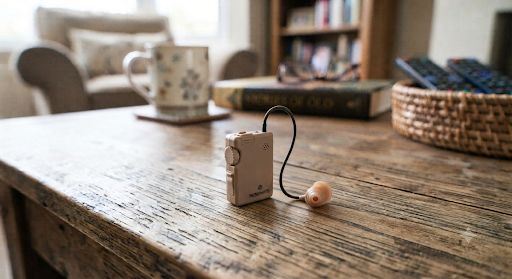
A pocket-type hearing aid is a hearing aid in which the main device is carried in a pocket or attached to clothing, while sound is delivered to the ear through a wired earpiece.
Unlike behind-the-ear and in-the-ear hearing aids, pocket-type hearing aids have a larger main unit that is separate from the earpiece. This design makes them relatively easy to operate, and some models can provide high levels of amplification.
A Hearing Aid That You Carry in Your Pocket
Have you ever heard of a pocket-type hearing aid?
As the name suggests, a pocket-type hearing aid is designed to be carried in a pocket or somewhere on your clothing while you use it.
When most people think of hearing aids, they probably imagine a device worn behind the ear or a small device that fits inside the ear. A pocket-type hearing aid looks quite different.
The main unit is connected to an earpiece by a cable, and you hear amplified sound through the earpiece while carrying the main unit in your pocket or on your clothing.
The design may look somewhat unusual if you are used to modern hearing aids. In fact, it may look more like a small portable radio or audio device than a conventional hearing aid.
How Does a Pocket-Type Hearing Aid Work?
A pocket-type hearing aid works in much the same basic way as other hearing aids.
A microphone picks up sounds from the surrounding environment. The hearing aid processes and amplifies those sounds according to the user’s hearing needs, and the amplified sound is then delivered to the ear through the earpiece.
Because the main unit and cable are often in contact with clothing, you may hear unwanted rustling or handling noise when the device moves against your clothes.
Some models use design features such as placing the microphone closer to the ear to reduce this type of noise. Many hearing aids also include noise-reduction features, but it is difficult to completely eliminate clothing and cable noise.
What Does a Pocket-Type Hearing Aid Look Like?
A typical pocket-type hearing aid has a relatively large, box-shaped main unit with an earpiece connected by a cable.
The main unit may look somewhat like a small portable radio or other compact audio device.
Because the main unit is worn on the body rather than directly on or behind the ear, pocket-type hearing aids are also commonly described as body-worn hearing aids in English-speaking countries.
The exact design varies from one product to another, but the basic concept is the same: the main unit is carried on the body and connected to the ear by a cable.
Advantages of Pocket-Type Hearing Aids
One of the biggest advantages of a pocket-type hearing aid is its ease of operation.
Because the main unit is larger than the controls found on many modern hearing aids, buttons, switches, and volume controls can be easier to see and operate. Battery replacement can also be easier, and some models are capable of providing high levels of amplification.
Easy-to-Understand Controls
One of the biggest strengths of a pocket-type hearing aid is its simple operation.
The main unit is relatively large, so buttons and controls can be easier to identify and operate than those on very small hearing aids. Functions such as power and volume control may be clearly marked and positioned where they are easy to reach.
For people who find small hearing aid controls difficult to use, this can be a significant advantage.
A Larger Main Unit Can Be Easier to Operate
Many behind-the-ear and in-the-ear hearing aids are designed to be as small as possible. As a result, their buttons and battery compartments can also be very small.
A pocket-type hearing aid has a larger main unit, which allows manufacturers to provide larger and easier-to-use controls.
This can be particularly helpful for older adults and people who have difficulty handling small buttons, switches, or battery compartments.
Some Models Are Relatively Affordable
Some pocket-type hearing aids are available at a relatively lower price than other types of hearing aids.
For people who need hearing assistance but are concerned about the cost of a hearing aid, a pocket-type model may be worth considering if an appropriate model is available within their budget.
However, price alone should not determine which hearing aid you choose. The device should also be appropriate for your hearing loss and provide the features and level of amplification you need.
Batteries and Charging Can Be Easier to Handle
Small hearing aids can sometimes be difficult to handle, especially when changing batteries or operating a small battery compartment.
A pocket-type hearing aid has a larger main unit, so battery replacement and other controls may be easier to access.
Some models also use standard-sized batteries, such as AA or AAA batteries, although the battery type varies by product.
For people who find small hearing aid batteries difficult to handle, this can be one of the practical advantages of a pocket-type design.
Some Models Provide High Levels of Amplification
Some pocket-type hearing aids are designed to provide high levels of amplification and may be suitable for people with moderate to severe hearing loss.
However, the level of hearing loss a particular device can accommodate varies by model. A hearing aid should be selected and adjusted based on the individual’s hearing test results and hearing needs.
A high-output hearing aid is not automatically the best choice simply because it provides more amplification. Proper fitting and adjustment are important for both hearing performance and comfort.
Disadvantages of Pocket-Type Hearing Aids
Pocket-type hearing aids are easy to operate, but they also have some disadvantages.
Because the main unit is separate from the earpiece, you need to carry the device with you. The cable can also get in the way, and the device may be more noticeable than a behind-the-ear or in-the-ear hearing aid.
Depending on the model, connectivity with smartphones and other devices may also be more limited than with newer hearing aids.
You Need to Carry the Main Unit
One of the biggest disadvantages of a pocket-type hearing aid is that you need to carry the main unit with you.
Unlike an in-the-ear hearing aid or a behind-the-ear hearing aid, the main unit is not worn directly on or behind your ear. You need to put it in a pocket or attach it somewhere on your clothing.
Some people may find this inconvenient, especially if they prefer to keep their pockets free or carry as little as possible.
The Cable Can Get in the Way
A pocket-type hearing aid uses a wired earpiece connected to the main unit.
The cable can sometimes get caught on clothing or other objects, which can be inconvenient during everyday activities.
You may also hear a tapping or rustling sound when the cable or main unit rubs against your clothing. This can be particularly noticeable when the device moves around in your pocket.
More Noticeable Than Behind-the-Ear or In-the-Ear Hearing Aids
In-the-ear hearing aids are designed to fit inside the ear, while behind-the-ear hearing aids sit behind the ear. Both can be relatively discreet, especially compared with older, larger hearing aid designs.
A pocket-type hearing aid, on the other hand, has a larger main unit that is carried outside the ear and connected to the earpiece by a cable.
Because of this, it is generally more noticeable than other types of hearing aids.
Someone seeing a pocket-type hearing aid for the first time might even mistake it for a small radio or other portable audio device.
If keeping your hearing aid as discreet as possible is important to you, a behind-the-ear or in-the-ear hearing aid may be a better option.
Smartphone Connectivity May Be Limited
Compared with many modern behind-the-ear and receiver-in-the-canal (RIC) hearing aids, fewer pocket-type hearing aids offer features such as Bluetooth connectivity, smartphone control, or direct audio streaming.
However, this varies by product, so always check the specifications of the specific model you are considering.
If you want to stream music, phone calls, or other audio directly from your smartphone to your hearing aids, connectivity should be one of the features you check before buying.
Fewer Models Are Available Today
Pocket-type hearing aids are still available from some manufacturers, but there are generally fewer models to choose from than there are for behind-the-ear or in-the-ear hearing aids.
This is especially true in markets where smaller, more discreet hearing aids have become the mainstream choice.
In Japan: Some manufacturers, including Rion, Panasonic Hearing, and Sanwa Seisakusho, still offer or have offered pocket-type hearing aids. Availability varies by manufacturer and product, so check the manufacturer’s current product lineup before purchasing.
How to Use a Pocket-Type Hearing Aid
Using a pocket-type hearing aid generally involves preparing the battery or charging the device, putting the earpiece in your ear, adjusting the volume, and carrying the main unit in a suitable location.
Because the main unit and cable can come into contact with your clothing, it is also important to use and position the device in a way that minimizes unwanted noise and prevents the cable from getting caught.
1. Insert the Battery or Turn the Device On
For battery-powered models, open the battery compartment and insert the battery according to the instructions.
Make sure the positive (+) and negative (−) sides are facing the correct direction.
For rechargeable models, make sure the device is sufficiently charged before use.
Some pocket-type hearing aids use commonly available batteries such as AA or AAA batteries, although the battery type varies by model.
The location and operation of the power switch also vary between products. Check the user manual to find out how to turn your hearing aid on and off.
2. Put the Earpiece in Your Ear
Put the earpiece connected to the main unit into or onto your ear.
The design of the earpiece varies depending on the product. For example, it may use:
- An ear tip that fits into the ear
- An ear hook that rests around the ear
- A custom earmold designed to fit your ear
A proper fit is important. If the earpiece does not fit securely, sound leakage or feedback may occur.
Some models are designed for one ear, while others can be used with earpieces for both ears.
3. Adjust the Volume
Once the earpiece is in place, adjust the volume using the dial or buttons on the main unit while listening to the sounds around you.
On some models, the volume control may also function as the power switch.
Avoid turning the volume up unnecessarily high simply because louder sound seems easier to hear.
Excessive volume can make sounds uncomfortable and may contribute to listening fatigue. If you have difficulty hearing even after increasing the volume, the hearing aid may need to be adjusted rather than simply turned up louder.
If you consistently need to use a very high volume setting, consult a hearing care professional or audiologist.
4. Put the Main Unit in Your Pocket or Attach It to Your Clothing
Once you have adjusted the volume, carry the main unit according to the manufacturer’s instructions.
If the microphone is located on the main unit, make sure it is not covered by clothing.
Try to keep the main unit from moving around excessively inside your pocket. Movement can cause clothing noise, handling noise, or accidental changes to the controls.
It is also a good idea to position the cable so that it does not easily get caught on clothing or other objects.
5. Turn the Hearing Aid Off After Use
Turn the hearing aid off when you are finished using it.
For battery-powered models, switching the device off when not in use can help conserve battery power.
Store the hearing aid according to the manufacturer’s instructions and take appropriate care of the earpiece, cable, and main unit.
How Much Does a Pocket-Type Hearing Aid Cost?

The price of a pocket-type hearing aid varies depending on the model. Some are relatively affordable, while others offer features such as high-power amplification and advanced digital sound processing.
Rather than choosing a hearing aid based solely on price, it is important to consider whether the device is suitable for your hearing loss and provides the features you need.
What Is the Typical Price of a Pocket-Type Hearing Aid?
Prices vary significantly between countries, manufacturers, and models.
In Japan: Representative pocket-type hearing aids currently available in Japan generally cost around ¥40,000 to ¥90,000, although prices vary depending on the product and retailer.
Pocket-type hearing aids can be relatively affordable compared with some other types of hearing aids, but the price does not necessarily indicate how well a particular hearing aid will work for you.
If you are buying a hearing aid outside Japan, check prices from local hearing care providers and manufacturers, as pricing and available models differ by country.
What Is the Difference Between More Expensive and Less Expensive Models?
Price differences between hearing aids can be related to factors such as sound-processing technology, maximum output, adjustment options, battery or charging systems, and additional features such as Bluetooth connectivity.
However, a more expensive hearing aid is not necessarily easier for everyone to hear with.
The most appropriate hearing aid depends on factors such as your hearing loss, listening environments, personal preferences, and how well the device is fitted and adjusted.
Don’t Choose a Hearing Aid Based on Price Alone
A higher price does not automatically mean better hearing.
Hearing aids are designed to compensate for hearing loss, but everyone’s hearing is different. A hearing aid that works well for one person may not provide the same benefit for someone else.
While more expensive models may offer additional features or more sophisticated sound processing, these features do not necessarily translate directly into better hearing for every user.
Whenever possible, try different hearing aids and have them properly fitted and adjusted before making your decision.
We prepared article of how to select hearing aids. So, please refer it.
Regarding how to choose hearing aids↗
How Does a Pocket-Type Hearing Aid Compare With Other Hearing Aids?
A pocket-type hearing aid differs from other hearing aids mainly because the main unit is carried in a pocket or attached to clothing rather than being worn directly on or behind the ear.
Each type has its own advantages and disadvantages in terms of portability, visibility, ease of operation, and whether a cable is used.
| Type | Where the Main Unit Is Worn | Visibility | Ease of Operation | Cable | Main Characteristic |
| Pocket-type | Pocket or on clothing | More noticeable | ◎ Easy | Yes | Large, easy-to-operate controls |
| Behind-the-ear (BTE) | Behind the ear | Relatively discreet | ○ Generally easy | No | One of the most common designs |
| In-the-ear (ITE) | In or at the entrance of the ear | Relatively discreet | △ Can be more difficult | No | Fits in the ear |
| Receiver-in-the-canal (RIC) | Behind the ear + receiver in the ear canal | Relatively discreet | ○ Generally easy | Thin wire | Small and widely used |
The actual size, features, visibility, controls, and connectivity vary by product.
A pocket-type hearing aid prioritizes ease of handling and operation, while many modern hearing aids place greater emphasis on compact size, discreetness, wireless connectivity, and portability.
For this reason, neither design is universally better. The right choice depends on your hearing loss, lifestyle, dexterity, and personal preferences.
We prepared article of type of hearing aids. So, please refer it.
Regarding type of hearing aids↗
Who Are Pocket-Type Hearing Aids Suitable For?
Pocket-type hearing aids may be a good option for people who find small controls difficult to operate or who prefer a simple and straightforward hearing aid.
On the other hand, people who prioritize discreetness, portability, or a cable-free design may prefer a behind-the-ear or in-the-ear hearing aid.
People Who Want Simple Controls
One of the main strengths of a pocket-type hearing aid is its simple operation.
Functions such as turning the device on and off and adjusting the volume can often be controlled using relatively large buttons, switches, or dials on the main unit.
If you prefer a hearing aid that is straightforward and easy to operate, a pocket-type hearing aid may be worth considering.
People Who Have Difficulty Using Small Buttons
Small buttons and controls can be difficult to operate, especially for people who have trouble handling small objects.
The larger main unit of a pocket-type hearing aid allows for larger controls that may be easier to see and operate.
If you find the buttons or battery compartments on small hearing aids difficult to handle, a pocket-type model may be a suitable option.
People Who Prefer a Simple Hearing Aid
Many modern behind-the-ear and in-the-ear hearing aids offer a wide range of features, including wireless connectivity, smartphone controls, rechargeable batteries, and automatic sound processing.
Some pocket-type hearing aids, by comparison, are designed with a simpler approach to operation.
If you would rather avoid complicated controls and simply want a hearing aid that is easy to use, a pocket-type hearing aid may be a good fit.
People Looking for a High-Power Hearing Aid
Some pocket-type hearing aids can provide high levels of amplification and may be suitable for people with severe or profound hearing loss.
However, the appropriate level of amplification depends on the individual’s hearing loss and the specific hearing aid.
If you need a high-output hearing aid, a pocket-type model may be one option to discuss with a hearing care professional.
People Who Don’t Mind Carrying the Main Unit
A pocket-type hearing aid requires you to carry the main unit in a pocket or attach it to your clothing.
If you don’t mind carrying the device and are comfortable using a wired earpiece, this may not be a major disadvantage.
On the other hand, if you prefer to keep your pockets free or minimize the number of things you carry, another type of hearing aid may be more convenient.
Who May Not Be Suited to a Pocket-Type Hearing Aid?
Pocket-type hearing aids may not be the best choice for people who want a discreet hearing aid or prefer not to deal with a cable.
Because the main unit is relatively large and connected to the earpiece by a cable, other hearing aid styles may be more suitable for people who prioritize a small, discreet, or cable-free design.
People Who Want a Cable-Free Hearing Aid
A pocket-type hearing aid uses a wired earpiece connected to the main unit.
Unlike truly wireless earbuds, the earpiece cannot be used without a cable connecting it to the main device.
If you find cables inconvenient or frequently catch them on clothing or other objects, a pocket-type hearing aid may not be the best choice for you.
People Who Want Their Hearing Aid to Be as Discreet as Possible
Pocket-type hearing aids have a relatively large main unit that is carried outside the ear.
This makes them more noticeable than many modern in-the-ear, behind-the-ear, and receiver-in-the-canal hearing aids.
If keeping your hearing aid as discreet as possible is one of your top priorities, you may want to consider other types of hearing aids.
How to Choose a Pocket-Type Hearing Aid
When choosing a pocket-type hearing aid, don’t focus only on the price. You should also consider whether it provides enough amplification for your hearing loss, how easy it is to operate, the type of battery or charging system, the fit of the earpiece, and the support available after purchase.
Make Sure It Is Suitable for Your Hearing Loss
The most important thing when choosing any hearing aid is whether it can provide useful hearing support for your individual hearing loss.
The same is true when choosing a pocket-type hearing aid.
Check whether the device can provide an appropriate level of amplification for your hearing loss and whether it can be properly adjusted to your hearing needs.
If possible, have your hearing tested and consult a hearing care professional before purchasing a hearing aid.
Consider Whether You Need One or Two Earpieces
If you have hearing loss in both ears, you may wonder whether you should use a hearing aid in one ear or both ears.
The appropriate choice depends on factors such as your hearing loss, listening environments, daily activities, and budget.
For some people, using hearing aids in both ears can provide advantages such as better awareness of sounds from different directions and improved speech understanding in certain situations.
However, not everyone necessarily needs two hearing aids. Discuss your options with an audiologist or other qualified hearing care professional.
Check Whether the Volume and Controls Are Easy to Use
Ease of operation is one of the main advantages of a pocket-type hearing aid.
Therefore, it is important to make sure that you can comfortably operate the controls.
Check whether the volume control is easy to find and adjust and whether the other buttons and switches are easy for you to use.
If the controls are difficult to operate, one of the main advantages of choosing a pocket-type hearing aid may be lost.
Choose Between Battery-Powered and Rechargeable Models
Pocket-type hearing aids may use replaceable batteries or rechargeable batteries, depending on the model.
Neither option is necessarily better for everyone. The best choice depends on your habits and what is easiest for you to manage.
For example, some people may prefer replaceable batteries because they don’t have to remember to charge the device.
Others may prefer a rechargeable model because they don’t want to handle or replace small batteries.
Think about which option you are more likely to use consistently.
A hearing aid is only useful if you actually wear and use it regularly.
Check Whether the Earpiece and Cable Feel Comfortable
Because pocket-type hearing aids use a wired earpiece, the cable and earpiece should be comfortable for you.
Make sure the earpiece fits securely and does not cause discomfort.
You should also consider whether the cable gets in the way during your normal activities.
If you find the cable annoying or uncomfortable, it may be difficult to use the hearing aid consistently.
Check the Support Available After Purchase
A hearing aid is not simply a device that makes every sound louder.
Depending on your type and degree of hearing loss, simply increasing the volume may not provide enough improvement in speech understanding.
Proper fitting and adjustment can make a significant difference in how useful a hearing aid is.
Before purchasing, check whether the seller or hearing care provider offers follow-up adjustments, maintenance, and other support after purchase.
Frequently Asked Questions About Pocket-Type Hearing Aids
Pocket-type hearing aids are still available in some markets, and different models may offer features such as one- or two-ear use, television connectivity, and different types of earpieces.
Here are some common questions people may have before buying a pocket-type hearing aid.
Are Pocket-Type Hearing Aids Still Available?
Yes. Although they are much less common than behind-the-ear and in-the-ear hearing aids in many markets, some manufacturers still produce pocket-type or body-worn hearing aids.
Availability varies considerably by country and manufacturer.
If you are interested in a pocket-type hearing aid, check current products from manufacturers and local hearing care providers.
Are Pocket-Type Hearing Aids Designed for Older Adults?
Not necessarily.
Pocket-type hearing aids are not exclusively designed for older adults. Their relatively large controls can make them useful for anyone who finds small buttons, switches, or battery compartments difficult to handle.
They may also be a good option for people who simply prefer a simple and straightforward design.
However, the larger main unit and cable may be less suitable for people who prioritize discreetness or portability.
Can I Use a Pocket-Type Hearing Aid in Only One Ear?
It depends on the model.
Some pocket-type hearing aids are designed for use with one earpiece, while others can connect to earpieces for both the left and right ears.
If you have hearing loss in both ears, ask a hearing care professional whether one or two hearing aids would be appropriate for your hearing needs.
What Is the Difference Between a Pocket-Type Hearing Aid and a Personal Sound Amplifier?
A pocket-type hearing aid is a hearing aid designed to compensate for hearing loss. Hearing aids are generally intended to be fitted and adjusted according to the user’s hearing needs.
A personal sound amplifier, on the other hand, is primarily designed to make surrounding sounds louder.
The two types of products may look similar, but they serve different purposes.
If you think you have hearing loss, it is a good idea to have your hearing evaluated rather than simply choosing a sound amplifier based on how loud it sounds.
Can I Use a Pocket-Type Hearing Aid to Listen to the TV?
Yes. You can use a pocket-type hearing aid while watching television.
Some models may also offer a way to send the TV audio directly to the hearing aid, although the available features vary by product.
If television listening is important to you, check whether the model supports a TV connection or other audio input before purchasing.
Can I Buy a Pocket-Type Hearing Aid From a Hearing Care Provider?
In some countries, pocket-type hearing aids may be available through hearing care professionals, audiologists, hearing aid retailers, or directly from manufacturers.
However, not every provider carries pocket-type models because they are less common than other hearing aid styles.
In Japan: Pocket-type hearing aids may be available from hearing aid retailers, manufacturer-affiliated stores, and other authorized sellers. Some products may also be available through online retailers. Availability varies by product, so it is a good idea to check with the seller before visiting or purchasing.
Conclusion: Pocket-Type Hearing Aids Are a Good Option for People Who Prefer Simple Controls
A pocket-type hearing aid is a type of hearing aid in which the main unit is carried in a pocket or attached to clothing, with sound delivered to the ear through a wired earpiece.
Compared with behind-the-ear and in-the-ear hearing aids, pocket-type hearing aids have a larger main unit and use a cable. However, this design also has advantages, such as easier volume adjustment, battery replacement, and overall operation.
Some models can also provide high levels of amplification and may be suitable for people with moderate to severe hearing loss. However, the appropriate hearing aid depends on each person’s hearing loss and should be properly fitted and adjusted.
On the other hand, pocket-type hearing aids may not be the best choice for people who want a discreet hearing aid or prefer a cable-free design.
When choosing a pocket-type hearing aid, don’t make your decision based on price alone. Check whether it is suitable for your hearing loss, whether the controls are easy for you to operate, whether the earpiece and cable are comfortable, and whether follow-up fitting and support are available after purchase.
Behind-the-ear and in-the-ear hearing aids may be more common today, but a pocket-type hearing aid can still be a useful option for people who value simple operation, easy-to-handle controls, and high amplification.
The best hearing aid is not necessarily the smallest or most expensive one. What matters is finding a device that fits your hearing needs, lifestyle, and preferences.
We prepared article of hearing loss. If you don’t know hearing loss clearly, please refer it.
コメント